
PPAR-gamma: how CBD acts on the nuclear receptor and glucose metabolism
CBD activates the nuclear receptor PPAR-gamma in cell tests and in rats. However, in a study involving 62 people with type 2 diabetes, it did not improve glycemia.
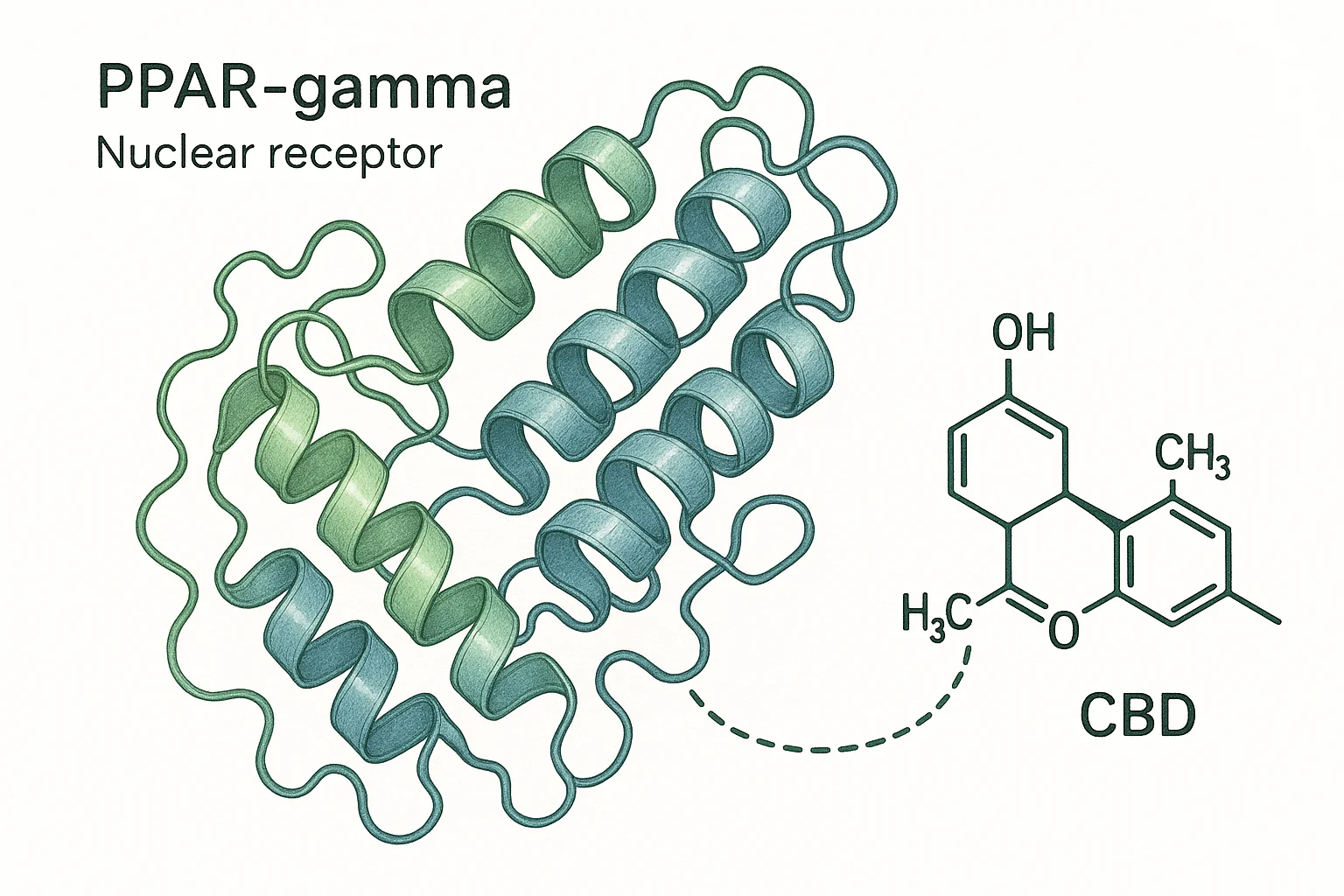
When you hear about CBD receptors, you probably think of CB1 and CB2. However, cannabinoids have also been described as activators of nuclear receptors from the PPAR family, which are transcription factors that control the genes of fat and glucose metabolism (O’Sullivan, British Journal of Pharmacology, 2016). This article explains what PPAR-gamma is, what has been specifically demonstrated for CBD, and where the boundary lies between the described pathway and the confirmed effect. It keeps in mind one thing that texts about mechanisms usually overlook: with each finding, it states what it was measured on, whether it was a laboratory slide, an experimental animal, or a patient. Because between the receptor response in cell culture and the outcome in a patient with diabetes lies a distance that no signaling pathway diagram alone can overcome.
KEY INFORMATION
• Activation of PPAR-gamma by cannabinoids has been demonstrated in reporter tests, binding studies, and experiments on receptor-knockout animals (O’Sullivan, British Journal of Pharmacology, 2016).
• In the only published randomized study of 62 people with type 2 diabetes, CBD did not improve glycemic parameters compared to placebo (Jadoon et al., Diabetes Care, 2016).
• The experiment that most strongly links CBD to PPAR-gamma was conducted on rats, not humans or transgenic mice.
• GLUT4 and adiponectin are known PPAR-gamma targets in the pharmacology of thiazolidinediones, not measured endpoints for CBD.
What is PPAR-gamma and how does it work in the cell?
PPAR-gamma (peroxisome proliferator-activated receptor gamma) belongs to the superfamily of nuclear receptors. Unlike membrane receptors such as CB1 or 5-HT1A, it acts inside the cell nucleus as a transcription factor. Upon binding a ligand, it attaches directly to DNA and alters the expression of hundreds of genes. It does not transmit signals through secondary messengers but rewrites the cell’s genetic program.
In metabolism, PPAR-gamma serves as a fat tissue disposer. It controls the formation of adipocytes, the uptake of fatty acids, and the storage of lipids. This is why it has become a target for antidiabetic drugs from the thiazolidinedione group. Pioglitazone and rosiglitazone are synthetic agonists of this receptor, with a potency unmatched by any cannabis component.
Natural ligands of PPAR-gamma are fatty acids, especially polyunsaturated ones, and prostaglandins. Compounds produced by the body itself, such as anandamide and 2-arachidonoylglycerol, have been described as PPAR-gamma activators with anti-inflammatory effects. Their role is discussed in more detail in our introduction to the endocannabinoid system. The mechanism itself is therefore not exotic. The question is whether the phytocannabinoid administered orally reaches concentrations in tissues that this receptor can even notice.
On what was it measured that CBD activates PPAR-gamma?
The answer is shorter than popular literature suggests. O’Sullivan prepared a summary of the evidence in a review from 2016. She lists four methods on which this entire field stands: reporter gene tests, ligand binding studies, experiments with selective receptor antagonists, and animals with the gene knocked out. All are laboratory tools. The review states directly that activation of PPAR receptors mediates some, but not all, of the described effects of cannabinoids (O’Sullivan, British Journal of Pharmacology, 2016).
This distinction has practical significance because it changes the rank of the statement. The review does not conduct its own measurements: it collects and evaluates others’. A statement like “studies using recombinant receptor have shown that CBD binds to the ligand-binding domain” thus describes primary experiments described elsewhere, not the result of the review itself. Citing the review as a source suggests a measurement that is not present in this work.
We do not provide a number describing the potency of CBD compared to rosiglitazone, although it circulates in texts about cannabis. It could not be confirmed in any source we reached while writing this article, and a number without verified origin is worse than its absence: it looks like a measurement, but is a quote from a quote.
Which mechanisms have been tested for CBD, and which only for drugs?
This question determines the value of the entire article. The table below separates two things that blend into one in texts about CBD: the known pharmacology of the PPAR-gamma receptor, developed on thiazolidinediones, and what has actually been measured for cannabidiol. The middle column provides the research material, as it determines how far one can go with the conclusion.
| Claim | On what it was measured | What does not follow from this |
|---|---|---|
| Cannabinoids activate PPAR-gamma | Reporter tests, binding studies, gene knockout animals | That this occurs at concentrations achieved after oral administration |
| CBD limits neuroinflammation through PPAR-gamma | Rats, injected beta-amyloid, antagonist GW9662 | That the same effect occurs in the human brain |
| PPAR-gamma increases GLUT4 expression | Pharmacology of thiazolidinediones, antidiabetic drugs | That CBD does the same, as it has not been measured for it |
| PPAR-gamma raises adiponectin levels | Pharmacology of thiazolidinediones | That this translates to insulin sensitivity after CBD |
| CBD improves glycemia | Humans, 62 people with type 2 diabetes, 13 weeks | Nothing. This endpoint was tested and came out against CBD |
The last row is the most important because it is the only one describing a measurement in humans. The three rows above describe a pathway that exists but has been described on different material or a different substance.
What did the study of CBD in people with type 2 diabetes show?
Jadoon and colleagues conducted a randomized, double-blind study of 62 people with type 2 diabetes not treated with insulin. Participants were assigned to five arms for 13 weeks: CBD at a dose of 100 mg twice daily, THCV, two combinations of both substances, and placebo. The primary endpoint was HDL cholesterol levels (Jadoon et al., Diabetes Care, 2016).
The result for CBD was negative. Compared to placebo, cannabidiol did not significantly change any of the assessed parameters. The changes recorded pertained to comparisons with baseline values of the same arm, not with placebo: a decrease in resistin and an increase in glucose-dependent insulinotropic peptide. Comparison within one group does not tell whether the preparation worked or whether it was just the passage of time and participation in the study.
The substance that performed well in this study was THCV, not CBD: it lowered fasting glucose levels and improved the function of pancreatic beta cells. This cannabinoid was indicated by the authors in the conclusion as a candidate for further work, and its mechanism is described separately in our post about THCV and insulin sensitivity. None of the combined arms had a significant effect on the endpoints.
Does PPAR-gamma explain the anti-inflammatory action of CBD?
Partially, and only in an animal model. Esposito and colleagues published a paper in 2011 that most strongly links these two things. They studied the effect of CBD in a rat model of Alzheimer’s disease, where neurotoxicity is induced by the administration of beta-amyloid. Blocking the PPAR-gamma receptor abolished the effect of CBD on reactive gliosis and subsequently on neuronal damage (Esposito et al., PLoS One, 2011).
It is important to know the limits of this experiment, as it is often described more broadly than allowed. The full text of the paper does not contain a single occurrence of the words “transgenic” and “plaque.” Therefore, there were no transgenic mice, amyloid plaques were not counted, and the preparation was not administered for seven weeks. There were rats, injected beta-amyloid, antagonist GW9662, and two endpoints: gliosis and neuronal damage. The paper also noted stimulation of neurogenesis in the hippocampus dependent on the same receptor.
The dependence on the antagonist is a strong argument here because it shows causation, not just correlation. However, it does not change the species or the method of administering beta-amyloid. Other pathways through which cannabidiol affects the course of inflammation are discussed in our text about the mechanism of action of CBD in inflammatory states.
What concentrations need to be achieved for the receptor to respond?
Here lies the most serious objection to the entire story about PPAR-gamma. The transcriptional response in cell tests occurs at concentrations in the tens of micromolar range. The concentrations achieved in plasma after oral administration of cannabidiol are orders of magnitude lower. If there is such a distance between these two numbers, the mechanism described in a test tube does not explain the clinical effect, even if the pathway itself is described flawlessly.
We have noticed that popular texts about CBD rarely juxtapose these two quantities next to each other, although it determines the value of the entire argument. Instead, they describe the signaling pathway in increasingly finer steps, which creates the impression of growing certainty. However, only the detail of the description increases, not the number of measurements in humans.
For the record: the aforementioned study in people with diabetes used 100 mg of CBD twice daily for 13 weeks, which is a dose significantly higher than that found in supplements. Even at this dose, glycemia did not change compared to placebo. This is the best available test of the metabolic hypothesis, and it came out negative. We do not provide any dosing recommendations because there is no basis on which to base them.
What is the status of CBD in food in the European Union?
cannabidiol remains an unauthorized novel food in the European Union. A health notification submitted by the manufacturer is not an authorization and does not change the status of the ingredient. A mechanistic article like this describes research on the receptor, not the medicinal properties of the product, and this boundary must not be blurred.
The EFSA panel on nutrition and novel foods updated its position on the safety of CBD in 2026. It derived a temporary safe dose of 0.0275 mg per kilogram of body weight per day, using an uncertainty factor of 400, and stated that it applies only to preparations with a purity of at least 98 percent. For three groups, safety cannot be established: individuals under 25 years of age, pregnant and breastfeeding women, and those taking medications simultaneously (EFSA NDA Panel, EFSA Journal, 2026).
The panel also noted consistent liver toxicity in animal studies and a hepatotoxic signal in humans, more pronounced when medications are taken simultaneously. Data gaps indicated in 2022 have not been closed. This is important background for any text on the metabolic action of cannabidiol.
Frequently Asked Questions
What is PPAR-gamma and why is it important for metabolism?
PPAR-gamma is a nuclear receptor that acts as a transcription factor. It regulates genes responsible for the formation of adipocytes, the uptake of fatty acids, and the storage of lipids. It is a target for antidiabetic drugs from the thiazolidinedione group, such as pioglitazone. Most of its known metabolic pharmacology has been described for these drugs.
Has it been proven that CBD activates PPAR-gamma?
This has been demonstrated using laboratory methods: in reporter gene tests, ligand binding studies, using selective antagonists, and in animals with the gene knocked out (O’Sullivan, British Journal of Pharmacology, 2016). None of these methods measure the state in humans after oral administration of the preparation.
Does CBD improve insulin sensitivity in humans?
In a randomized study of 62 people with type 2 diabetes, CBD at a dose of 100 mg twice daily for 13 weeks did not significantly change glycemic parameters compared to placebo. Fasting glucose levels were lowered by THCV, another cannabinoid from the same study (Jadoon et al., Diabetes Care, 2016).
On what animals was CBD and PPAR-gamma studied in the brain?
On rats that were injected with beta-amyloid. Blocking PPAR-gamma with the antagonist GW9662 abolished the effect of CBD on reactive gliosis and neuronal damage (Esposito et al., PLoS One, 2011). The full text of this work does not mention transgenic mice or counting amyloid plaques.
Why is the concentration of the substance more important here than the pathway itself?
Because the receptor response in cell culture occurs at concentrations in the tens of micromolar range, while the values achieved in plasma after oral administration are orders of magnitude lower. When there is such a distance between these two numbers, a correctly described mechanism does not yet explain any effect in humans.
What is the legal status of CBD as a food ingredient in the EU?
CBD remains an unauthorized novel food, and a health notification does not replace authorization. The EFSA panel derived a temporary safe dose in 2026 and stated that safety cannot be established for individuals under 25 years of age, pregnant and breastfeeding women, and those taking medications (EFSA NDA Panel, EFSA Journal, 2026).
This article is for informational and educational purposes only and does not constitute medical advice. Before starting to use cannabis or CBD for therapeutic purposes, consult a doctor, especially if you are taking other medications, are pregnant, or breastfeeding.
Author: Michał Waluk · Published: 2026-08-09 · Updated: 2026-08-16