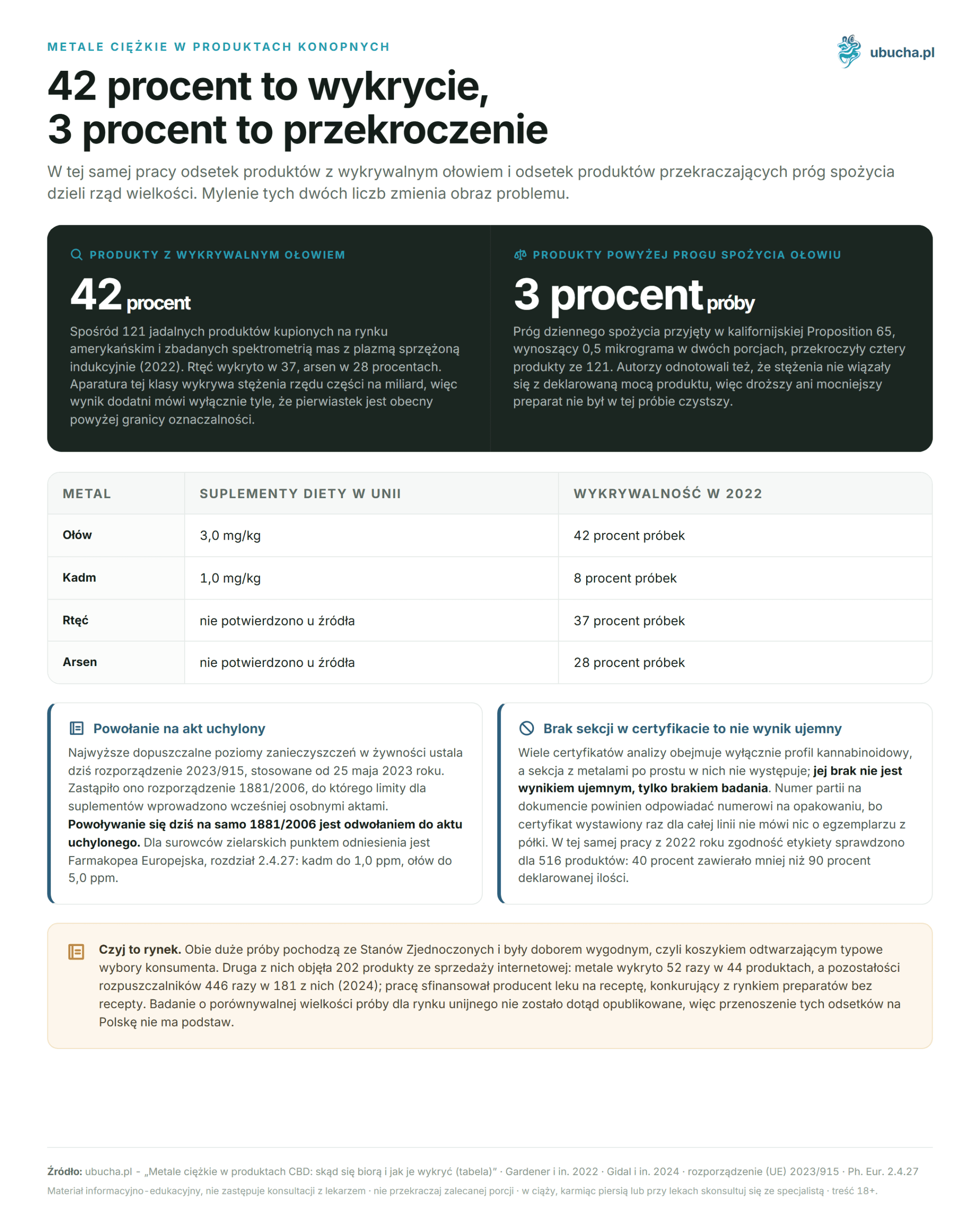

Heavy Metals in CBD Products: Where They Come From and How to Detect Them (Table)
How many CBD products contain lead, cadmium, or arsenic, what limits apply in the EU, and what a certificate of analysis will not tell you. Numbers from studies, with the provided sample.
Hemp is one of the plants that absorbs metals from the soil along with nutrients, so the question of raw material purity is not theoretical in this industry. A 2022 study of the American market found lead in 42 percent, mercury in 37 percent, arsenic in 28 percent, and cadmium in 8 percent of 121 tested edible CBD products (Gardener et al., Science of the Total Environment, 2022). However, detection is not the same as exceeding the norm, and these two numbers are often confused. Below, we separate one from the other: how many products actually contained metals, how many exceeded the threshold, what limits apply in the EU, and what a certificate of analysis will not clarify.
KEY INFORMATION
• Lead was detected in 42 percent, and arsenic in 28 percent of 121 edible CBD products in the American study from 2022.
• In the same study, the daily intake threshold for lead from California’s Proposition 65 was exceeded by four products, or about 3 percent of the sample.
• Detectability is not the same as exceeding the limit, and the difference between these numbers can be significant.
• Limits for dietary supplements in the EU are set by Regulation 2023/915, effective from May 25, 2023; it replaced Regulation 1881/2006.
• The European Pharmacopoeia in section 2.4.27 states for dried plant raw materials and their extracts cadmium up to 1.0 ppm and lead up to 5.0 ppm.
Where do heavy metals come from in hemp products?
The source is almost always the soil, not the production process. Hemp has a developed root system and large biomass, allowing it to thrive in substrates with relatively high metal content, which is why it is studied as a plant for phytoremediation, or cleaning contaminated soils. This same characteristic means that cultivation on contaminated land transfers some of the contamination to the raw material.
The mechanism can be described at the genetic level. In a hydroponic study of a flowering hemp variety, it was shown that all seven genes from the HMA transporter family are expressed in the plant, significantly more in the roots than in the leaves, and exposure to cadmium increases their activity (Marabesi et al., Frontiers in Plant Science, 2023). It is worth noting what this study found about the distribution of metal in the plant: the most cadmium accumulated in the roots, which the authors explain by the preferential binding of this metal there. The popular claim that flowers accumulate metals more than roots is not supported by this study.
It should be remembered, however, the limitations of such evidence. This was a greenhouse experiment on a water medium, on one variety, and at cadmium concentrations from 0 to 25 mg per liter, not an observation of a field crop. A systematic review of the literature on hemp contamination concludes that there is clearly insufficient data on the prevalence of these contaminants and their impact on humans (Dryburgh et al., British Journal of Clinical Pharmacology, 2018). Hemp is not an exception in this regard: the same question about raw material purity arises with other plants considered metal accumulators, including edible algae such as spirulina and chlorella.
How many CBD products really contain heavy metals?
The answer depends on what counts, and therefore the sample must be provided along with the number. In the study by Gardener and colleagues, 121 edible CBD products purchased on the American market were tested using inductively coupled plasma mass spectrometry. Lead was detected in 42 percent of them, mercury in 37, arsenic in 28, and cadmium in 8 percent. The authors also checked for phthalates, and the percentage of products with detectable concentrations ranged from 13 to 80 percent, depending on the compound.
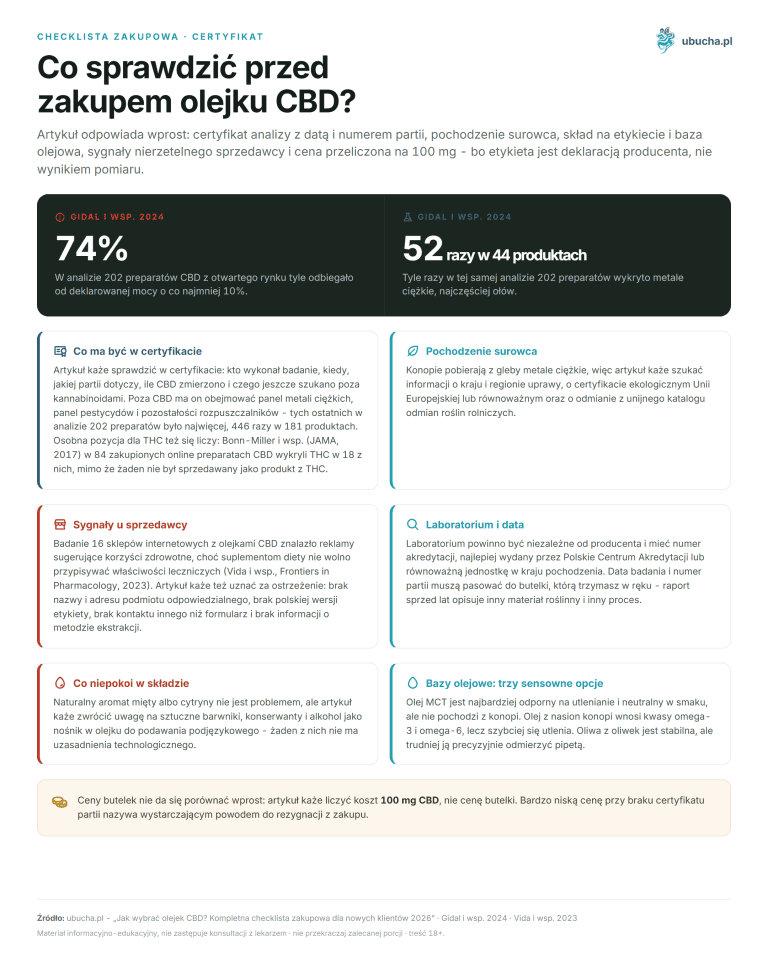
The second point of reference comes from an analysis of 202 CBD products purchased in American online sales between October and December 2021. Heavy metals were detected 52 times in 44 of 202 products, or about 22 percent, with lead being the most frequently detected metal. Residual solvents were found much more often, 446 times in 181 of 202 products (Gidal et al., Frontiers in Pharmacology, 2024). The reader has the right to know who funded this work: Jazz Pharmaceuticals, a manufacturer of a prescription drug containing cannabidiol, thus a competitor in the over-the-counter product market. The funder participated in the study design, data analysis, and text editing, which the authors disclose directly.
Both samples were convenience samples, meaning a shopping basket replicating typical consumer choices in the United States. Therefore, these are not percentages of the European or Polish market, and there is no basis to present them as such. No study of comparable sample size has yet been published for the EU market.
Does the detection of a metal mean exceeding the norm?
No, and this is the most commonly confused pair of numbers in this topic. ICP-MS class equipment detects concentrations on the order of parts per billion, so a positive result only indicates that the element is present above the detection limit. Only comparison with the limit determines whether the product meets requirements.
In the study by Gardener and colleagues, the daily intake threshold for lead set in California’s Proposition 65, which is 0.5 micrograms in two servings, was exceeded by four products out of 121. This is about 3 percent of the sample, with 42 percent having detectable lead. The difference between these two values is an order of magnitude and completely changes the picture of the problem. The authors also noted that the concentrations of metals and phthalates were not related to the declared potency of the product, so a more expensive or stronger preparation was not cleaner in this sample.
It is worth remembering the difference in units, as they are mixed freely in certificates. The notation mg/kg means the same as ppm, micrograms per kilogram is ppb, and micrograms per serving is a completely different measure, depending on the serving size adopted by the producer. Regulatory limits for food are given in mg/kg of product, while Proposition 65 thresholds refer to daily intake. Comparing them directly leads to false conclusions in both directions.
What limits apply in the European Union?
This depends on the category under which the product is marketed, as dietary supplements, food, and medicines are subject to different regimes. The highest permissible levels of contaminants in food are currently set by Commission Regulation (EU) 2023/915 of April 25, 2023, effective from May 25, 2023. It replaced Regulation 1881/2006, to which limits for supplements were previously introduced by Regulations 2021/1317 for lead and 2021/1323 for cadmium. Referring to 1881/2006 alone is a reference to a repealed act.
For medicinal products and herbal raw materials, the reference point is the European Pharmacopoeia. Section 2.4.27, dedicated to heavy metals in plant raw materials and fatty oils, states for dried plant raw materials and their extracts cadmium up to 1.0 ppm and lead up to 5.0 ppm, unless the detailed monograph states otherwise. The following table includes only those values that have been confirmed at the source.
| Metal | Dietary Supplements in the EU | Ph. Eur. 2.4.27 (Plant Raw Materials and Extracts) | Detectability in the 2022 Study (121 Edible Products) |
|---|---|---|---|
| Lead (Pb) | 3.0 mg/kg | 5.0 ppm | 42 percent of samples |
| Cadmium (Cd) | 1.0 mg/kg | 1.0 ppm | 8 percent of samples |
| Mercury (Hg) | no confirmed limit for this category | the chapter includes the determination of this element; confirmed limits apply to cadmium and lead | 37 percent of samples |
| Arsenic (As) | no confirmed limit for this category | the chapter includes the determination of this element; confirmed limits apply to cadmium and lead | 28 percent of samples |
Source: Regulation (EU) 2023/915, European Pharmacopoeia 2.4.27, Gardener et al. 2022. Status as of August 16, 2026.
What will a certificate of analysis not tell you?
A certificate of analysis is the only document that refers to a specific batch, but it is not a guarantee in itself, and you need to know what to look for in it. The first thing is the scope of testing. Many certificates only cover the cannabinoid profile, and the metals section simply does not appear in them; its absence is not a negative result, but rather a lack of testing. The same applies to other groups of contaminants, which is discussed further in the text about what independent laboratories test for pesticides and microbiology.
The second thing is the assignment to the batch. A certificate issued once for the entire product line does not say anything about the specific item on the shelf, as the raw material changes between harvests. The batch number on the document should match the number on the packaging. The third thing is the laboratory’s accreditation according to ISO 17025 standards, which confirms the technical competence of the testing unit; in Poland, the list of accredited laboratories is maintained by the Polish Centre for Accreditation.
The fourth thing is the consistency of the declaration with the measurement, and here the documentation can be the weakest. In the same 2022 study, the compliance of labels for 516 topical and edible products was checked: 40 percent contained less than 90 percent of the declared amount of cannabidiol, 18 percent more than 110 percent, and only 42 percent fell within the plus-minus 10 percent range. The scale of this phenomenon is the subject of a separate text about how often CBD products are mislabeled.
Does the origin of the raw material determine purity?
The origin itself does not determine purity, although it is often presented that way. There is a claim in circulation that Directive 86/278/EEC regulates the metal content in European agricultural soils and thus makes EU crops safer. This narrowing goes too far. The directive concerns environmental protection in the use of sewage sludge in agriculture, and the limit values in Annex I A refer to soils where sludge is applied, with a range for cadmium from 1 to 3 mg/kg dry mass for a pH of 6 to 7. This is not a universal soil quality regime covering every field in the EU.
The practical conclusion is different and follows directly from the data. Since in the studied sample, the concentrations of contaminants were not related to the declared potency of the product, they are also not automatically related to the declaration of origin, which no one verifies at the time of purchase. The measurement of the finished product from a specific batch is what matters, as it encompasses everything at once: the raw material, the carrier oil, and the process itself.
It must be added honestly how uncertain this whole picture is. A systematic review from 2018 states that the direct toxicity of hemp contaminants is poorly measured, and there is a lack of literature describing their prevalence and impact on humans. Both major studies on which this text is based concern the American market and a convenience sample. For the Polish market, comparable data simply does not exist.
Frequently Asked Questions
Why do hemp plants absorb heavy metals from the soil?
They have a developed root system, large biomass, and tolerance to relatively high concentrations of metals, which is why they are studied as a plant for cleaning contaminated soils. Transporters from the HMA family are responsible for absorption, and their activity increases after exposure to cadmium, especially in the roots.
How many CBD products contain heavy metals?
In a study of 121 edible CBD products from the American market in 2022, lead was detected in 42 percent, mercury in 37, arsenic in 28, and cadmium in 8 percent. In another sample of 202 products purchased in 2021, metals were detected in 44 of them, or about 22 percent. Both results pertain to a convenience sample, not the European market.
Does the detection of a metal mean the product is unsafe?
No. Detection only indicates that the element is present above the detection limit of the device. In the 2022 study, lead was detected in 42 percent of samples, but the California daily intake threshold for lead was exceeded by four products out of 121, or about 3 percent. The comparison with the limit is what determines safety, not just a positive result.
What are the metal limits in the European Union?
For food and dietary supplements, the highest permissible levels are set by Regulation (EU) 2023/915, effective from May 25, 2023, replacing Regulation 1881/2006. For supplements, the lead limit is 3.0 mg/kg, and cadmium is 1.0 mg/kg. Herbal raw materials and their extracts are assessed according to the European Pharmacopoeia.
What should a certificate of analysis include regarding metals?
A separate section for metals, not just the cannabinoid profile, the specified method of determination, a batch number matching the packaging, and units stated directly. The value of the document increases if the laboratory is accredited according to ISO 17025 standards. The absence of a metals section is not a negative result, but rather an indication that testing was not performed.
Does European origin of the raw material guarantee purity?
No, it does not guarantee. Directive 86/278/EEC, which such assurances refer to, concerns the use of sewage sludge in agriculture, not the general quality control of soils across the EU. In available studies, the concentrations of contaminants were not related to the declared potency of the product, so the measurement of a specific batch of the finished product is what matters.
What do the units in test results differ?
The notation mg/kg means the same as ppm, and micrograms per kilogram is ppb. Micrograms per serving is a different measure, as it depends on the serving size adopted by the producer. Limits for food are given in mg/kg of product, while daily intake thresholds refer to the amount consumed, so they cannot be directly compared.
If you are looking for products in this category, the question to the seller is always the same: is there a certificate for this batch covering metals, not just cannabinoids. You can find the current offer in the oils category.
This article is for informational and educational purposes only and does not constitute medical advice. Before starting to use hemp or CBD for therapeutic purposes, consult your doctor, especially if you are taking other medications, are pregnant, or breastfeeding.
Author: Michał Waluk · Published: 2026-08-09 · Updated: 2026-08-16