
How to Moisturize Dried Cannabis - and What Not to Do
Dried cannabis: what you really lose, why moisturizing does not restore aroma, and why mold is more dangerous than dryness. Data from storage studies.
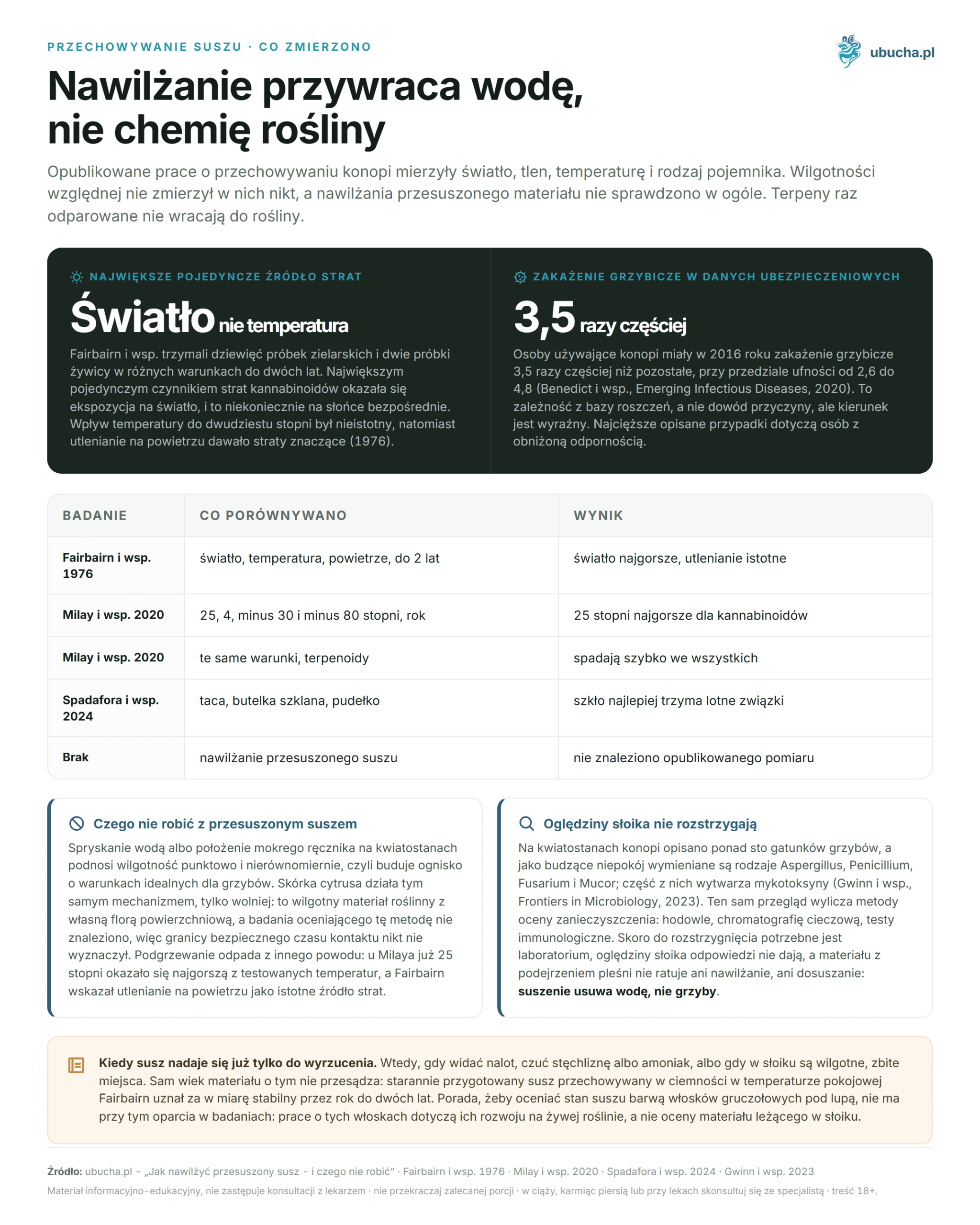
You open a jar, and instead of elastic flowers, you have something that crumbles in your fingers and smells like hay. Guides respond with a set of numbers: this percentage of humidity, this many hours in the jar, lemon peel for two hours. When you start looking for studies from which these numbers come, it turns out that none of them stand behind them. Published works on cannabis storage measured something else: light, oxygen, temperature, and type of container. No one measured relative humidity during storage, and the moisturizing of dried material was not checked at all. Below we show what these works indicate, what moisturizing will not restore, and why with dried cannabis, the real threat is mold, not just dryness.
KEY INFORMATION
• The largest single factor in cannabinoid loss was found to be light, not temperature (Fairbairn et al., 1976).
• Terpene concentrations drop quickly under all tested storage conditions (Milay et al., Frontiers in Plant Science, 2020).
• Over a hundred species of fungi have been described on cannabis flowers, some of which produce mycotoxins (Gwinn et al., 2023).
• Moisturizing restores water, not the plant’s chemistry.
What does dried cannabis really lose?
It loses water and volatile terpenes, and along the way, some cannabinoids. However, the latter are affected by factors that have nothing to do with humidity: light and air exposure. This is indicated by a study that stored cannabis samples under controlled conditions for two years and compared which factor was most harmful.
Fairbairn et al. (The Journal of Pharmacy and Pharmacology, 1976) kept nine herbal samples and two resin samples under various conditions for up to two years. The largest single factor in cannabinoid loss was found to be exposure to light, and not necessarily direct sunlight. The effect of temperatures up to twenty degrees was insignificant, while oxidation in the air caused significant losses. The authors also noted that losses decrease when glandular hairs are not damaged, as they act like well-filled and well-sealed containers. The conclusion of the study: carefully prepared herbal material is relatively stable for one to two years if kept in darkness at room temperature.
A newer measurement adds temperature to this. Milay et al. (Frontiers in Plant Science, 2020) stored flowers in darkness for a year at four temperatures: 25, 4, minus 30, and minus 80 degrees. The worst result was at 25 degrees, where cannabinoid concentrations changed the most. Grinding the flowers also harmed them. The study was funded by the Israeli Ministry of Agriculture and a charitable foundation, and the samples were provided by two cannabis companies, which the authors note in their acknowledgments.
Does moisturizing restore anything?
It restores moisture and elasticity, but not aroma or chemical composition. Terpenes are volatile compounds: once evaporated, they do not return to the plant. In Milay’s study, terpenoid concentrations dropped quickly under all tested conditions, including in the freezer, so there is no condition that would keep them intact.
The type of container has more influence here than any rescue treatment. Spadafora et al. (Analytical and Bioanalytical Chemistry, 2024) compared three storage methods: an open tray, a glass bottle, and a closed polyethylene box. Glass best preserved the original profile of volatile compounds. However, the same work shows that storage in glass promotes the conversion of acidic cannabinoids to neutral forms, so even the best container is a compromise, not a solution.
We did not find any studies specifically on moisturizing. Neither with a humidity regulator, nor with citrus peel, nor with a wet towel. All circulating numbers on forums, from relative humidity ranges to hours of equalization and grams of cannabis per regulator, come from product descriptions and user experience, not from published measurements. Therefore, we do not provide them here.
| Study | What was compared | Result |
|---|---|---|
| Fairbairn et al. 1976 | Light, temperature, air exposure, up to 2 years | Light is the worst, oxidation is significant, temperature up to 20 degrees is insignificant |
| Milay et al. 2020 | 25, 4, minus 30, and minus 80 degrees, one year, in darkness | 25 degrees is the worst for cannabinoids, terpenoids drop everywhere |
| Spadafora et al. 2024 | Open tray, glass bottle, polyethylene box | Glass best retains volatile compounds, but promotes loss of acidic forms |
| None | Moisturizing dried cannabis | We did not find any published measurement |
Why is mold more dangerous than dryness?
Because dried cannabis is unpalatable, while moldy can be dangerous. Moisturizing raises humidity in a closed container, creating exactly the condition that fungi need to grow. With cannabis, this is not a theoretical threat, as the composition of fungi on flowers is documented.
Gwinn et al. (Frontiers in Microbiology, 2023) collected a review of fungi associated with cannabis. Over a hundred species have been described, and concerning ones include Aspergillus, Penicillium, Fusarium, and Mucor. Some of them produce mycotoxins that can affect the health of humans and animals and cause opportunistic infections in immunocompromised individuals. The authors note that this aspect has been overlooked in assessing the safety of cannabis products for years. The work was funded by the American agricultural agency, with no commercial ties.
The same review lists methods for assessing contamination: cultures, liquid chromatography, immunological tests. Since a laboratory is needed for resolution, inspecting a jar does not provide answers. The scale of the problem is evident in insurance data: Benedict et al. (Emerging Infectious Diseases, 2020) found that cannabis users had fungal infections 3.5 times more often in 2016 than others, with a confidence interval from 2.6 to 4.8. This is a correlation from claims data, not proof of causation, but the direction is clear. The most severe described cases involve individuals with reduced immunity, such as fatal aspergillosis in a bone marrow transplant recipient after smoking contaminated material (Hamadeh et al., Chest, 1988).
What not to do with dried cannabis?
Do not moisten it directly and do not heat it. Spraying with water or placing a wet towel on the flowers raises humidity locally and unevenly, creating a hotspot with ideal conditions for the fungi mentioned above. There is no way to reverse such a mistake by simply drying it out.
Citrus peel works on the same mechanism, just slower. It is a moist plant material with its own surface flora, placed in a sealed container with the material to be moisturized. We did not find studies evaluating this method, so it cannot be said where the safe contact time lies. The circulating numbers on forums of two to four hours do not come from measurements.
Heating is ruled out for another reason. In Milay’s study, even 25 degrees was the worst of the tested temperatures for cannabinoid stability, and Fairbairn pointed out that oxidation in the air is a significant source of loss. Accelerating anything with heat and airflow works exactly against what was meant to be saved.
There is also the packaging to consider. The polyethylene box performed worse than glass in Spadafora’s study in retaining volatile compounds. Fairbairn noted that losses decrease when glandular hairs are not damaged, and rubbing the cannabis in hands damages them. We explain the differences in the aroma of strains in the text Why do some strains stimulate while others calm?.
When is cannabis only fit for disposal?
When there is a film, a musty or ammonia smell, or when there are moist, compact areas in the jar. The age of the material does not determine this: Fairbairn considered carefully prepared cannabis stored in darkness at room temperature to be relatively stable for one to two years.
There is also advice to assess the state of cannabis by the color of glandular hairs under a magnifying glass. However, studies on these hairs concern their development and maturation on a living plant, not the assessment of material lying in a jar, and we did not find a study that would check their color as a measure of degradation during storage. Methods for assessing fungal contamination are laboratory methods described in Gwinn’s review, not visual inspections.
Material suspected of mold cannot be saved by either moisturizing or drying: drying removes water, not fungi. We analyze the recognition of bad smells and films separately in the text How cannabis should not smell. This entire text concerns legal cannabis from industrial hemp, meaning material with THC content up to 0.3 percent, calculated in Polish law as the sum of delta-9-THC and THCA.
Frequently Asked Questions
Can dried cannabis be saved?
It can regain moisture and elasticity. However, what has evaporated cannot be restored: terpenes are volatile compounds, and in the study by Milay et al. (2020), their concentrations dropped quickly under all tested storage conditions, including freezing. Moisturizing changes the structure, not the composition.
What is the optimal humidity for cannabis?
We did not find any published measurement that would determine it. Studies on cannabis storage compared temperature, light exposure, and type of container, not relative humidity. The ranges provided online come from product descriptions, so we do not repeat them as scientific findings.
Is lemon peel suitable for moisturizing cannabis?
It is a moist plant material with its own surface flora, placed in a sealed container. We did not find studies evaluating this method, so no one has established a safe contact time. Fungi described on cannabis flowers include Aspergillus and Penicillium (Gwinn et al., 2023), and moisture is a condition for their growth.
How to store cannabis to prevent it from drying out?
Research indicates three factors. Fairbairn et al. (1976) identified light as the largest single source of loss, and oxidation in the air as significant. Milay et al. (2020) achieved the best results for whole flowers at 4 degrees. Spadafora et al. (2024) rated glass the highest.
How to tell if cannabis is moldy?
By the presence of a film, musty or ammonia-like smell, and moist, compact areas. However, this does not provide certainty: the review by Gwinn et al. (2023) lists methods of assessment including cultures, liquid chromatography, and immunological tests, which are laboratory tools. Material suspected of mold cannot be saved.
Is smoking moldy cannabis dangerous?
Fungal infections have been described after using contaminated material, including fatal aspergillosis in a bone marrow transplant recipient (Hamadeh et al., Chest, 1988). Insurance data indicated that cannabis users had fungal infections 3.5 times more often (Benedict et al., 2020). Those with reduced immunity are most at risk.
Glass containers with hygrometers and humidity regulators are available in the Bucha store collected in the storage category (as of August 16, 2026).
This article is for informational and educational purposes and does not replace consultation with a doctor. If you are pregnant, breastfeeding, taking medications, or have chronic conditions, consult the use of supplements or herbs with a specialist.
Author: Michał Waluk · Published: 2026-08-09 · Updated: 2026-08-16