
How to Read a Dietary Supplement Label: What to Pay Attention To
Dietary supplements do not undergo clinical trials. Check what must be on the label, how to read the NRV percentage and ingredient forms, and what the GIS notification means.
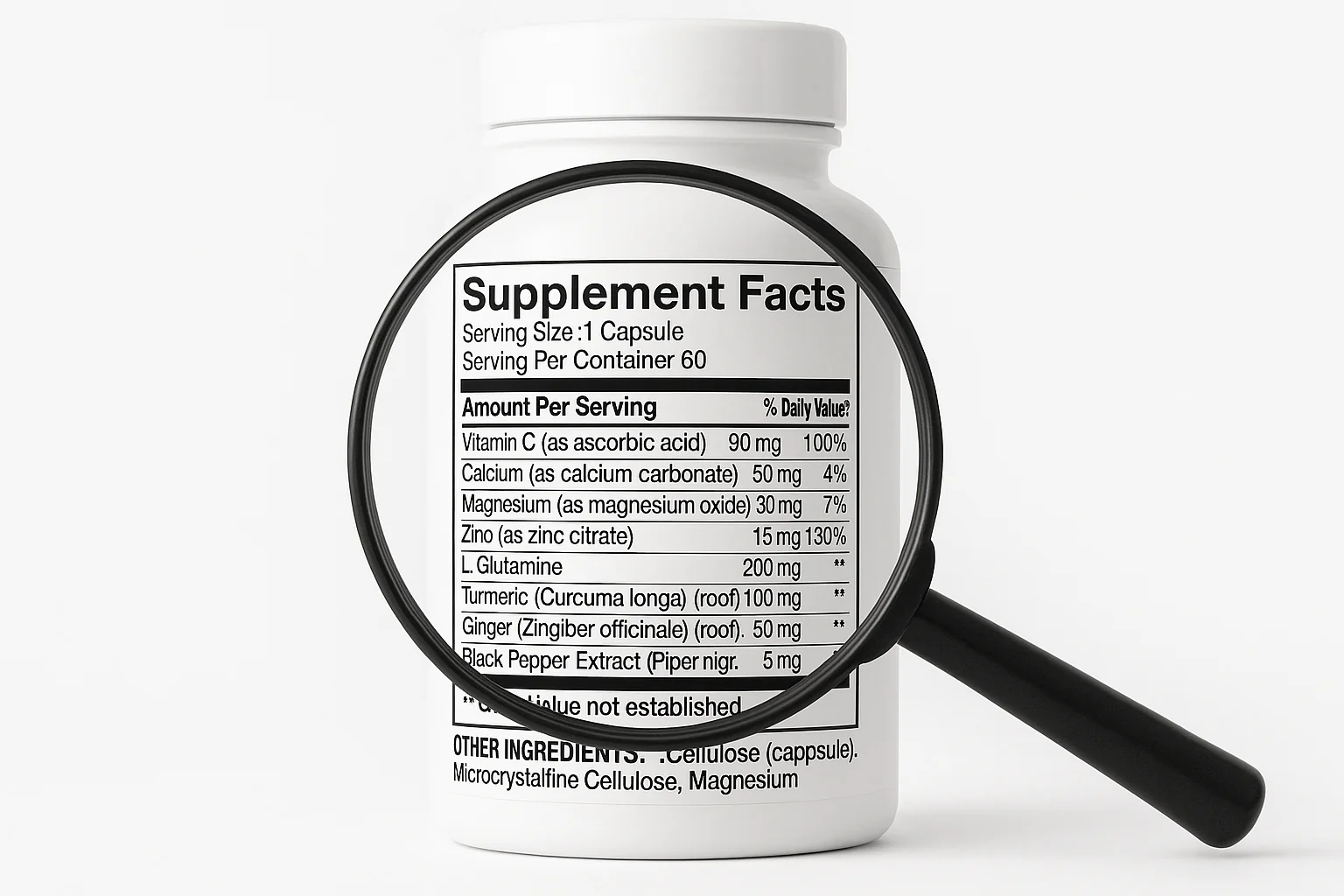
The Chief Sanitary Inspectorate states about this group of products directly: “Dietary supplements do not undergo clinical trials, they are introduced to the market and produced under food law, not pharmaceutical law” (GIS). One sentence explains why two packages standing next to each other on the shelf may cost similarly and differ in everything: the form of the ingredient, its actual absorption, and whether anyone independent has checked the content. The manufacturer does not prove efficacy before introducing the product to the market, and sanitary supervision acts after the fact. The label thus becomes the only document you have in hand while standing by the shelf. This text shows which elements are required by law, which actually say something about quality, and which are purely marketing layers.
KEY INFORMATION
• The form of the salt determines absorption: magnesium oxide was absorbed in 4 percent by healthy volunteers (Firoz and Graber, Magnesium Research, 2001).
• Dietary supplements do not undergo clinical trials and are subject to food law, not pharmaceutical law (GIS).
• The set of mandatory data on the packaging results from Directive 2002/46/EC and Regulation 1169/2011.
• Health claims are only allowed by Regulation 1924/2006, and the promise of curing a disease is illegal.
• Titanium dioxide (E171) cannot be an ingredient in supplements in the European Union since August 7, 2022.
What must be on a dietary supplement label?
The scope of mandatory information is defined by two EU acts: Directive 2002/46/EC on dietary supplements and Regulation 1169/2011 on the provision of information to consumers about food. The absence of any required element is not a graphic oversight, but a signal that the manufacturer does not control the basics.
- product name along with the designation “dietary supplement”,
- list of ingredients with the amount in the recommended serving,
- recommended daily serving and a warning not to exceed it,
- information that the supplement does not replace a varied diet,
- warning about storing out of reach of small children,
- minimum durability date and batch number,
- name and address of the entity responsible for placing the product on the market,
- allergen labeling in accordance with Annex II to Regulation 1169/2011.
A separate layer is claims. A supplement’s packaging cannot contain a claim that the product cures, prevents a disease, or eliminates it, as this is reserved for medicinal products. Only nutritional and health claims from the list maintained under Regulation (EC) No 1924/2006 are allowed, for example, a statement about vitamin C contributing to the normal function of the immune system. A sentence like “effectively treats inflammatory conditions” is a violation of regulations, not bold marketing. If a manufacturer breaks a rule that can be checked in five minutes, it is hard to assume that they are keeping track of those that are more difficult to verify. More about the boundary between one and the other legal regime can be found in the text dietary supplement vs drug.
Which label elements to check before purchase?
It is worth reversing the order of viewing the packaging. The front carries a promise, the back carries data. The table below collects seven places where the difference between a thoughtful product and a random one is visible to the naked eye, and what in each of them should raise a red flag.
| Label Element | What to Look For | Warning Signal |
|---|---|---|
| Ingredient Form | The stated name of the salt or compound, for example, citrate instead of just the word “calcium” | The name of the element without the form in which it was used |
| Content and NRV Percentage | Amount in milligrams or micrograms and reference to the value from Annex XIII to Regulation 1169/2011 | The percentage alone without mass or a multiple of NRV without mention of the upper limit of intake |
| Auxiliary Ingredients | Fillers, carriers, and anti-caking agents listed by name | Titanium dioxide (E171), prohibited in food in the EU since August 7, 2022 |
| External Verification | NSF International, USP Verified, Informed Sport, GMP certification of the manufacturer | General “laboratory tested” without the name of the laboratory and date |
| Claims | Wording in accordance with the list from Regulation 1924/2006 | Verbs “cures”, “regenerates”, “removes disease” |
| Allergens | Highlighted in the ingredient list, even in trace amounts | Complex plant composition without a single mention of allergens |
| Responsible Entity | Full company name and postal address | Only an email address or a PO box |
The NRV percentage is often read as a measure of the product’s potency, but it is a measure of reference. The reference values from Annex XIII are used to compare products with each other, not to determine servings. For fat-soluble vitamins, excess is not washed out in urine, so it is worth checking whether the manufacturer even refers to the upper tolerable intake level established by EFSA. How much you should take is determined by a doctor or pharmacist who knows your results, not a table on the packaging.
Why does the form of the ingredient matter more than the dose?
The number on the front of the package describes the mass of the chemical compound, not the amount that will enter the bloodstream. The difference can be several times, and it is best seen with magnesium, as this element has undergone direct comparisons between salts.
Firoz and Graber measured the absorption of four commercially available preparations, giving healthy volunteers about 21 mEq of magnesium daily and tracking the increase in urinary excretion. Magnesium oxide performed the worst, with fractional absorption at 4 percent, while magnesium chloride, lactate, and aspartate absorbed significantly better and similarly (Firoz and Graber, Magnesium Research, 2001). Earlier, Lindberg and colleagues compared oxide with citrate: oxide was practically insoluble in water and dissolved in 43 percent only under conditions corresponding to peak gastric acid secretion, while citrate was soluble even in plain water. After oral loading, the increase of magnesium in urine was 0.22 versus 0.006 mg per mg of creatinine (Lindberg et al., Journal of the American College of Nutrition, 1990). None of these studies provide the percentage absorption of citrate, so numbers circulating on the internet like “absorbs at 40 percent” have no basis in them.
The same mechanism applies to other elements. Calcium carbonate requires an acidic environment in the stomach, so in people taking proton pump inhibitors, it performs worse than citrate. Iron can be administered as sulfate, fumarate, or gluconate, and these forms differ in gastric tolerance. For vitamin B12, the label may indicate cyanocobalamin or coenzyme forms, and for vitamin B6, pyridoxine or pyridoxal-5-phosphate. The name of the form is information; its absence is too.
The practical conclusion concerns arithmetic. Magnesium oxide consists of about 60 percent by weight of magnesium itself, while organic salts contain much less, as the acid molecule weighs its own. The declaration “500 mg of magnesium citrate” and the declaration “500 mg of magnesium” describe two different things. Manufacturers who provide both the mass of the salt and the content of the element save you the trouble of calculating and signal that they know why that number is on the package.
What does “complex” and “extract” really mean on the packaging?
The word “complex” is not a legal term, and the manufacturer can use it freely. Sometimes it means a mixture of several salts of the same element, which can be justified, and sometimes a single compound supplemented with fillers. The ingredient list determines this, not the trade name.
With plant raw materials, the question is different and comes down to standardization. The notation “extract from ashwagandha root standardized to 5 percent withanolides” indicates how much of the substance the manufacturer guarantees in each batch. The term “extract from root” says nothing, as two batches of the same plant can differ in content many times, depending on the variety, soil, and harvest time. The extraction ratio, recorded as 10:1 or 20:1, is also useful, indicating how much raw material was used per unit of product. These numbers alone do not speak to efficacy but allow for comparison between two packages. How much two standardizations of the same raw material can diverge is shown in the comparison in the text about differences between KSM-66 and Sensoril extracts.
The third layer is independent verification. Programs such as NSF International, USP Verified, or Informed Sport rely on external laboratories testing market samples and checking the composition against the declaration and microbiological purity. The absence of such a mark does not determine anything, as the share of certified products is small. However, its presence is one of the few signals that someone has confirmed it outside the company selling the product. A similar role is played by a batch testing report if the manufacturer publishes it; how to read it is described in the guide to analytical certificates.
How does the GIS notification differ from drug approval?
The notification from the Chief Sanitary Inspectorate is a declaration, not a permission. The entity introducing the supplement to the market is obliged to notify the inspection of the first introduction of the product to the market and provide a sample label. An investigation can take place even after the product has been sold.
An over-the-counter drug goes through the reverse process. Before it reaches the pharmacy, the responsible entity must present documentation of quality, safety, and efficacy, and permission is granted by the Office for Registration of Medicinal Products, Medical Devices, and Biocidal Products. Efficacy is a condition for entering the market, not a matter of trust in the manufacturer.
This difference leads to two practical things. First, the notification number or mention of its submission is not a sign of quality and says nothing about the action of the preparation. Second, the burden of assessment shifts to the buyer, as no one has checked for you whether the declared amount of the ingredient has any justification, apart from the list of health claims. The register of products subject to notification is public and maintained by the sanitary inspection, so the product can be found by name. This check is an identity verification of the product, not a confirmation that it works. We have gathered a wide selection of vitamin and mineral preparations in the supplements category, where we provide the composition of each item according to the manufacturer’s label.
Frequently Asked Questions
What does the NRV percentage on the label mean?
NRV is the reference intake value from Annex XIII to Regulation 1169/2011, provided for vitamins and minerals. The NRV percentage indicates what portion of this value is covered by a serving of the product. It is used to compare products with each other, not to determine how much you should take; that is decided by a doctor or pharmacist.
How does a dietary supplement differ from an over-the-counter drug?
A supplement is a food product and is subject to food law, and its introduction to the market is preceded by notification to the sanitary inspection. An over-the-counter drug requires permission from the Registration Office, preceded by documentation of quality, safety, and efficacy. The GIS states directly that supplements do not undergo clinical trials.
What health claims are allowed on the packaging?
Only those included in the EU list maintained under Regulation (EC) No 1924/2006, in the wording from that list or equivalent for the consumer. Claiming that a product cures a disease, prevents it, or removes it is illegal and applies only to medicinal products.
Does the GIS notification number confirm the quality of the product?
No. The notification is a declaration of the fact of introducing the product to the market, not a permission or an assessment of efficacy. An inspection investigation can take place even when the product is on the shelf. The register allows you to find the product by name, but it says nothing about its action.
How to check if the composition matches the declaration?
The strongest available signal is a certificate from an independent research program, such as NSF International, USP Verified, or Informed Sport, where an external laboratory tests market samples. A batch testing report published by the manufacturer is also helpful, provided it includes the date, batch number, and laboratory name.
Why does the form of the salt affect the absorption of the ingredient?
Because it determines solubility and the method of transport in the intestine. In the study by Firoz and Graber from 2001, magnesium oxide was absorbed in 4 percent by healthy volunteers, while chloride, lactate, and aspartate performed significantly better. Lindberg previously demonstrated the superiority of citrate over oxide in solubility and urinary excretion.
Does the minimum durability date affect the action of the supplement?
Yes, because the manufacturer guarantees the declared content of ingredients until that date, not just the absence of harm. Vitamin C oxidizes under the influence of light and heat, omega-3 fatty acids become rancid after opening, and bacterial cultures lose viability in heat. Storage conditions from the label are practically significant here.
This article is for informational and educational purposes and does not replace consultation with a doctor. If you are pregnant, breastfeeding, taking medications, or have chronic conditions, consult a specialist about the use of supplements or herbs.
Author: Michał Waluk · Published: 2026-08-09 · Updated: 2026-08-16