
H4CBD, hydrogenated cannabidiol: what is it and is it legal (FAQ)
H4CBD is tetrahydrocannabidiol, a hydrogenated analog of CBD known since 1940. Check how it is produced, whether it is psychoactive, and what Polish law says about it.
H4CBD is sold as “stronger CBD”, and the name itself is often incorrectly stated in Polish descriptions. The abbreviation expands to tetrahydrocannabidiol, not hexahydrocannabidiol: four hydrogen atoms, four, not six. This mistake is not cosmetic, as it leads the reader to believe they are dealing with an equivalent of HHC on the side of cannabidiol. The compound itself is not a novelty; it has been known since 1940, and it only reached the market when cheap hemp-derived cannabidiol made its production profitable. However, eighty years in the laboratory has not translated into knowledge about its effects on humans: there are still no clinical studies. Below, we gather what is known about H4CBD from the literature and the Polish list of controlled substances, without assurances that cannot be supported by sources.
KEY INFORMATION
• H4CBD is tetrahydrocannabidiol, a hydrogenated analog of CBD known since 1940 and obtained by hydrogenating cannabidiol (Schirmer et al., Drug Testing and Analysis, 2025).
• Unlike CBD, it binds to the CB1 receptor, but the literature does not agree on the strength of this binding.
• There are no clinical studies on humans, and user reports of psychoactive effects are divided.
• H4CBD does not appear in the Polish list of controlled substances under its own name; control has been introduced by several countries, including France and Switzerland.
What is H4CBD and how is it produced?
H4CBD, or tetrahydrocannabidiol, is a semi-synthetic cannabinoid obtained by hydrogenating cannabidiol. The number 4 in the abbreviation indicates the number of attached hydrogen atoms, which gives the full name: tetra, not hexa. The compound was first described in 1940, and its production process is analogous to that of HHC, with the only difference being that the raw material is cannabidiol, not tetrahydrocannabinol (Schirmer et al., Drug Testing and Analysis, 2025).
The reaction itself is catalytic hydrogenation: the molecule is subjected to hydrogen in the presence of a metallic catalyst, most often palladium or nickel. Hydrogen attaches to double bonds, causing part of the molecule to lose its unsaturation, making the whole compound more resistant to oxidation and degradation due to light and temperature. For the producer, this means a longer shelf life for the finished product, which is a real technological advantage over cannabidiol itself.
The rest of the promises require caution. Hydrogenation is not a simple process: it requires pressure, controlled temperature, and product purification, and working outside the pharmaceutical regime leaves impurities and a mixture of diastereoisomers in varying proportions. The material for one of the few studies on H4CBD metabolism was simply purchased from an online store, and before use, it had to be chromatographically analyzed to know what it actually contained.
How does H4CBD differ from CBD and HHC?
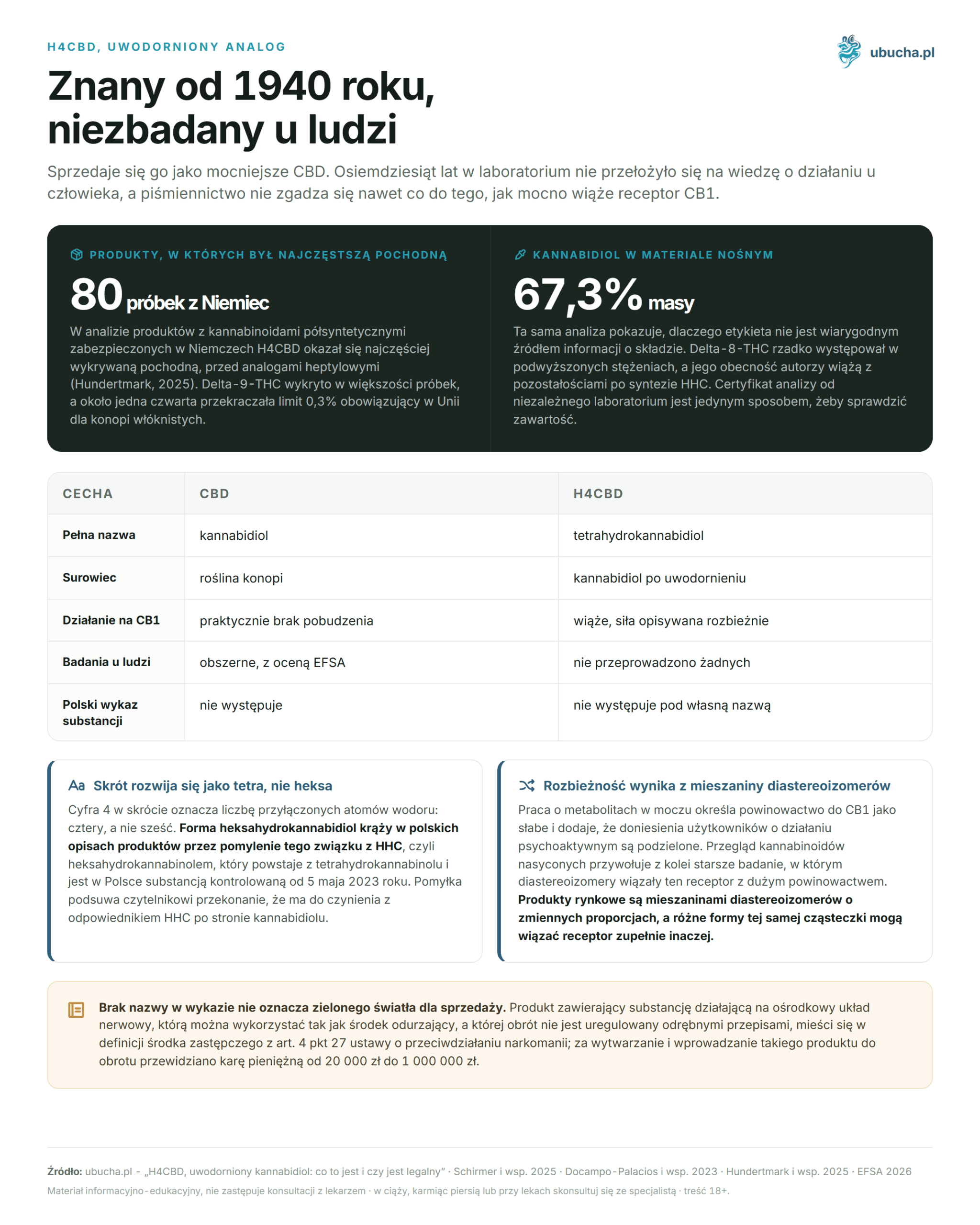
Three compounds, one family tree, and three completely different profiles. CBD comes directly from the plant and practically does not stimulate the CB1 receptor. H4CBD is derived from CBD and already binds to the CB1 receptor. HHC is derived from tetrahydrocannabinol and stimulates CB1 as a partial agonist. The table below compares what can be said about them based on sources.
| Feature | CBD | H4CBD | HHC |
|---|---|---|---|
| Full name | Cannabidiol | Tetrahydrocannabidiol | Hexahydrocannabinol |
| Raw material | Hemp plant | Cannabidiol | Tetrahydrocannabinol from cannabidiol |
| Action on CB1 | Practically no stimulation | Binds to the receptor, strength described inconsistently | Partial agonist, 9R epimer stronger |
| Human studies | Extensive, with EFSA safety assessment | No clinical studies | No studies, profile not established |
| Status in the Polish list | Does not appear | Does not appear under its own name | Controlled substance since May 5, 2023 |
The biggest difference lies not in chemistry, but in how much is known about each of them. Cannabidiol has undergone clinical studies and formal safety assessment, while H4CBD has a few analytical works. If you want to compare the entire family of hydrogenated derivatives, we have gathered it in a post about HHCH and related abbreviations.
Is H4CBD psychoactive?
It is unknown, and that is a fair answer. The literature agrees that H4CBD binds to the CB1 receptor, which cannabidiol practically does not do, but does not agree on the strength of this binding. A study dedicated to H4CBD metabolites in urine describes its affinity for CB1 as weak and adds that user reports of psychoactive effects are divided (Schirmer et al., 2025).
A review of saturated cannabinoids recalls an older study in which diastereoisomers of H4CBD bound to the CB1 receptor with high affinity (Docampo-Palacios et al., Molecules, 2023). This discrepancy is not accidental: market products are mixtures of diastereoisomers in varying proportions, and different forms of the same molecule can bind to the receptor quite differently.
What is needed to resolve this? Human studies with a control group, in which participants receive a characterized preparation, and the effects are measured with a research tool, not a forum survey. Such a study does not exist. Until it does, every statement like “H4CBD provides light relaxation but does not intoxicate” is a report, not a result. If you care about a compound without effects on consciousness and with a real research background, cannabidiol remains the better-documented choice.
Is H4CBD legal in Poland in 2026?
H4CBD does not appear under its own name in the Polish list of psychotropic substances, narcotic drugs, or new psychoactive substances. This list is an annex to the regulation of the Minister of Health, not to the law itself, and it is in this list that individual compounds are mentioned by name and chemical formula. We checked the text of the regulation at the source: the name “cannabidiol” does not appear in it even once, in any form.
However, the absence of a name in the list does not mean a green light for sale. A product containing a substance that acts on the central nervous system, which can be used like a narcotic, and whose circulation is not regulated by separate provisions, falls within the definition of a substitute under Article 4 point 27 of the Act on Counteracting Drug Addiction (t.j. Dz.U. 2023 poz. 1939). The production and introduction of such a product into circulation is prohibited, and Article 52a paragraph 1 provides for a fine from 20,000 PLN to 1,000,000 PLN.
Outside of Poland, the situation is varied. Control over H4CBD has been introduced by several countries, including France and Switzerland (Schirmer et al., 2025). Transporting such products across borders is therefore risky regardless of what the law says in the country of purchase. For comparison, HHC itself has been a controlled substance in Poland since May 5, 2023, which we discuss in more detail in the text about hexahydrocannabinol.
What is known about the safety of H4CBD?
There is practically no data on the safety of H4CBD in humans. No clinical studies assessing toxicity or drug interactions have been conducted, and what is known boils down to the identification of metabolites. A 2025 study described carboxylated, hydroxylated, and doubly hydroxylated metabolites along with their glucuronides in urine (Schirmer et al., 2025), which are traces that can detect use, not data on risk.
From the metabolism of cannabidiol comes one practical warning. CBD interacts with cytochrome P450 enzymes and can change the concentrations of drugs metabolized this way, including some antiepileptic drugs (StatPearls, Cannabidiol (CBD) in Clinical Care). No analogous studies have been conducted for H4CBD, so the possibility of such interactions remains open and unstudied.
It is also worth remembering how cautiously the safety of cannabidiol itself is assessed today. The EFSA panel in its 2026 update states that the safety of CBD cannot be established in individuals under 25 years of age, in pregnant and breastfeeding women, and in individuals taking medications simultaneously (EFSA NDA Panel, 2026). If such a conclusion cannot be circumvented for a well-studied compound, caution is even more justified for its hydrogenated derivative.
How often does H4CBD appear in products on the market?
More often than its low recognition would suggest. In an analysis of 80 products with semi-synthetic cannabinoids secured in Germany, H4CBD turned out to be the most frequently detected derivative, ahead of heptyl analogs. Acetates were rarely detected and usually in trace amounts (Hundertmark et al., Drug Testing and Analysis, 2025).
This same analysis shows why the label is not a reliable source of information about composition. Delta-9-THC was detected in most secured samples, and about one quarter exceeded the 0.3% delta-9-THC limit applicable in the EU for industrial hemp. In the carrier material, concentrations of cannabidiol reaching 67.3% by weight were found. Delta-8-THC rarely occurred in elevated concentrations, and its presence is linked by the authors to residues from HHC synthesis.
For the buyer, this means a simple thing: a product described as “H4CBD” may be a mixture in which, alongside the declared ingredient, there is a controlled substance. An analysis certificate from an independent laboratory is the only way to verify this, and its absence is information in itself. We described the mechanism of this market’s emergence in more detail in the text about synthetic cannabinoids and their dangers.
Frequently Asked Questions
What is H4CBD and how does it differ from CBD?
H4CBD is tetrahydrocannabidiol, a hydrogenated analog of CBD obtained by adding four hydrogen atoms to the cannabidiol molecule. It is more resistant to oxidation and temperature than CBD. The pharmacological difference is that H4CBD binds to the CB1 receptor, which cannabidiol practically does not do.
Is H4CBD hexahydrocannabidiol?
No. The number 4 in the abbreviation indicates four attached hydrogen atoms, so the correct name is tetrahydrocannabidiol. The term “hexahydrocannabidiol” circulates in Polish product descriptions due to confusing H4CBD with HHC, which is hexahydrocannabinol, derived from tetrahydrocannabinol and is a controlled substance.
Is H4CBD psychoactive?
This cannot be determined today. The literature agrees that H4CBD binds to the CB1 receptor, but describes the strength of this binding inconsistently, and user reports are divided. No clinical studies on humans with a control group have been conducted, so forum reports cannot be confirmed or refuted.
Is H4CBD legal in Poland?
H4CBD does not appear under its own name in the Polish list of controlled substances. However, a product containing it may be considered a substitute in the sense of Article 4 point 27 of the Act on Counteracting Drug Addiction, and the production and introduction of such a product into circulation is punishable by a fine from 20,000 PLN to 1,000,000 PLN.
How is H4CBD produced?
Through catalytic hydrogenation of cannabidiol: the molecule is subjected to hydrogen in the presence of a catalyst, most often palladium or nickel. Hydrogen attaches to double bonds, which increases the stability of the compound. The process requires pressure, controlled temperature, and product purification, so the purity of market preparations can vary.
How does H4CBD differ from HHC?
H4CBD is derived from cannabidiol, while HHC is derived from tetrahydrocannabinol obtained earlier from cannabidiol. HHC stimulates the CB1 receptor as a partial agonist and has been a controlled substance in Poland since May 5, 2023. H4CBD does not appear in the list, and its effects on humans remain unstudied.
Does H4CBD often appear in products on the market?
Yes. In an analysis of 80 products with semi-synthetic cannabinoids secured in Germany, H4CBD was the most frequently detected derivative, ahead of heptyl analogs. In the same sample, delta-9-THC was found in most products, and about one quarter exceeded the EU limit of 0.3% for industrial hemp.
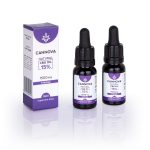
If you are looking for products based on well-studied cannabidiol, not its derivatives, start with hemp oils available in the store at Bucha.
This article is for informational and educational purposes only and does not constitute legal advice. The legal status described in the article is valid as of the date of publication: regulations regarding cannabis may change. Before making a decision, consult a lawyer or current legal acts.
Author: Michał Waluk · Published: 2026-08-09 · Updated: 2026-08-11