
Ways to Smoke Herbs: Bong, Joint, Pipe, Chillum or Vaporizer
Bong, joint, pipe, chillum, and vaporizer in one comparison based on research: carbon monoxide, water filtration, respiratory symptoms, and recovery.
There are several ways to smoke herbs and cannabis, and comparing them falls within the realm of harm reduction: instead of moralizing, we provide what has been measured and state clearly what has not been measured. The reference point remains a clinical study in which 18 healthy volunteers consumed cannabis in a hospital setting in six variants: three strengths of the raw material were compared with two methods of administration. Peak THC concentrations in plasma after vaporization were similar to those after smoking a cannabis cigarette, while the level of carbon monoxide in exhaled air was lower after vaporization (Abrams et al., Clinical pharmacology and therapeutics, 2007). Below, we break down five methods: joint, bong, pipe, chillum, and vaporizer, into comparable factors and show where the evidence is strong and where it ends with physics and common sense.
KEY INFORMATION
• In a study with 18 people, vaporization resulted in similar THC concentrations in plasma with lower carbon monoxide levels than smoking (Abrams et al., 2007).
• Water in a bong does not retain carbon monoxide because this gas is practically insoluble in it.
• In an online survey, using a vaporizer was associated with fewer respiratory symptoms, also compared to water pipes.
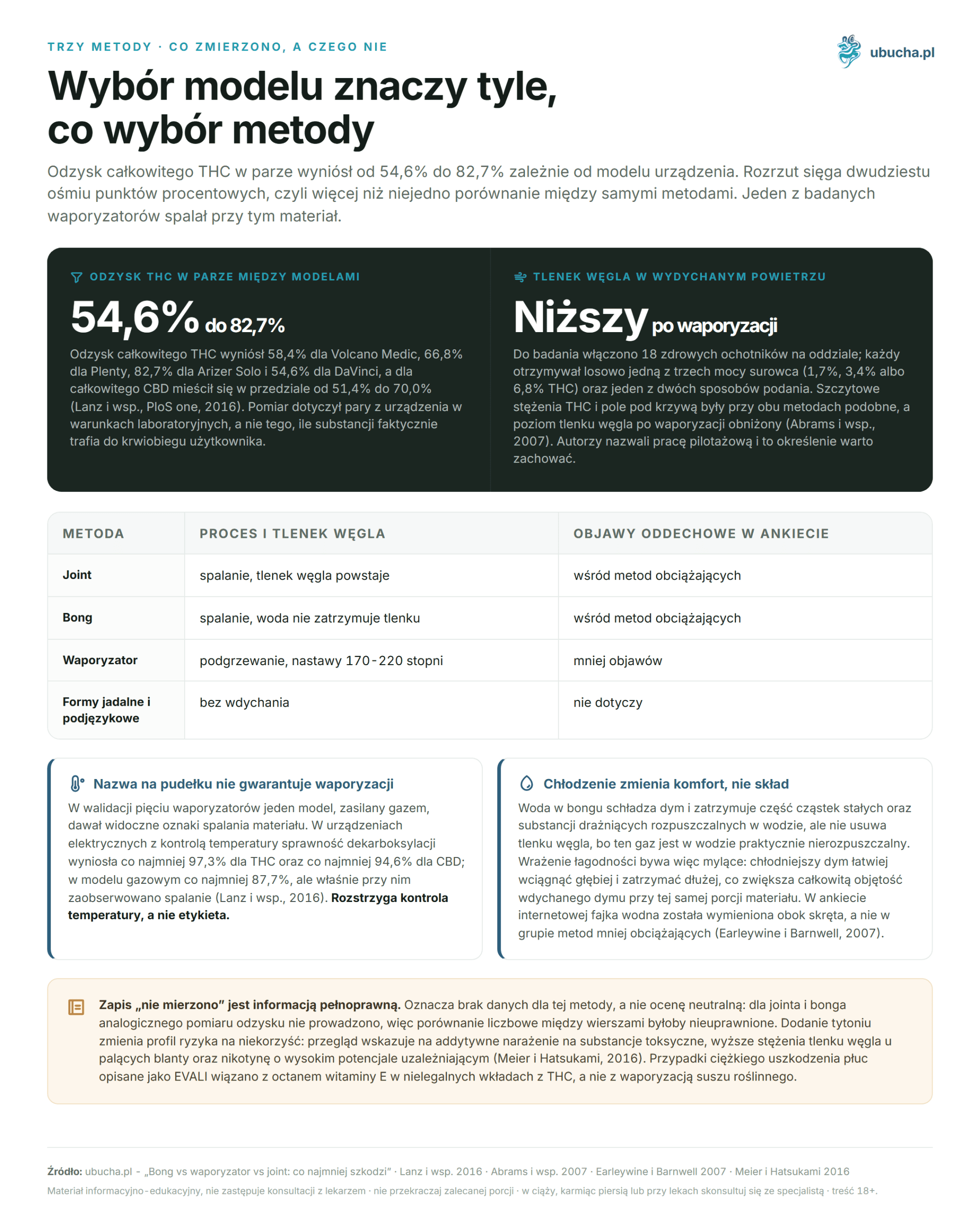
• THC recovery in vapor ranged from 54.6% to 82.7% depending on the device, and one of the tested vaporizers burned the material.
• Adding tobacco increases exposure to toxic substances and adds nicotine addiction.
What is the difference between combustion and vaporization?
The difference is chemical, not marketing. In a joint and in a bong, the material smolders, meaning combustion occurs: some compounds oxidize completely, some incompletely, and the resulting smoke carries, alongside active substances, products of this process, including carbon monoxide and particulate matter. A vaporizer heats the raw material to a temperature below the ignition threshold, usually in the range of 170-220 degrees Celsius, and releases volatile components in the form of vapor.
The separation of these two phenomena determines the rest of the comparison. Where there is no combustion, there is no carbon monoxide or soot, because there is no reaction that would produce them. However, this does not mean that vapor is neutral for the respiratory tract: you still inhale an aerosol from the plant material, and at high temperature settings, thermal degradation products appear.
It is also worth distinguishing the device from the category. In the validation of five vaporizers, one model, powered by gas, showed visible signs of burning the material (Lanz et al., PloS one, 2016). The name “vaporizer” on the box does not guarantee that the device actually vaporizes. Temperature control, not the label, determines this.
How to choose equipment based on this condition is detailed separately in our guide on how a vaporizer works.
Does a vaporizer really reduce carbon monoxide?
Yes, and this comes from a study on humans, although one must know its scale. The study included 18 healthy volunteers in the ward. Each received a randomly assigned combination of one of three strengths of raw material (1.7%, 3.4%, or 6.8% THC) and one of two methods of administration: the Volcano vaporizer or a cannabis cigarette for six days.
Delta-9-THC concentrations in plasma, carbon monoxide in exhaled air, and physiological and neuropsychological effects were measured. Peak THC concentrations and the area under the curve of concentration over six hours were similar for both methods, the level of carbon monoxide after vaporization was reduced, and no adverse events were recorded (Abrams et al., Clinical pharmacology and therapeutics, 2007).
The authors called their work a pilot study, and this designation is worth keeping. Their conclusion was that vaporization is a safe and effective method of administering THC, and further studies on the clinical efficacy of cannabis could benefit from it as a non-combustion method. However, eighteen people observed over six days is sufficient to demonstrate a difference in exposure to carbon monoxide, but not to determine health effects over the years.
There is still a lack of long-term observations in large groups comparing morbidity among vaporizing and smoking individuals. Until they exist, a fair formulation is: vaporization reduces documented exposure to combustion products, not that its safety in the long term has been proven.
Does a bong filter smoke more effectively than a joint?
Water in a bong does less than it is credited with. It cools the smoke, which reduces thermal irritation of the throat, and retains some particulate matter and water-soluble irritants. However, it does not remove carbon monoxide, as this gas is practically insoluble in water and passes through the tank without significant change in concentration.
The impression of smoothness can therefore be misleading. Cooler smoke is easier to inhale deeper and hold longer, which increases the total volume of smoke inhaled with the same amount of material. Cooling changes comfort, not composition.
This is reflected in symptom data. In a large online survey, the authors summarized that regular users of joints, blunts, pipes, and water pipes could reduce respiratory symptoms by switching to a vaporizer (Earleywine and Barnwell, Harm reduction journal, 2007). The water pipe was mentioned alongside the joint, not in the group of less burdensome methods.
A bong has another risk that comparisons usually ignore. Standing water in the tank promotes the growth of bacteria and mold if the device is not regularly cleaned, and when used in a group, it becomes a means of transmitting microorganisms.
What changes when tobacco is added to a joint?
It clearly changes the risk profile and not in a favorable way. A review dedicated to the combined use of cannabis and tobacco indicates that such a combination may lead to additive exposure to toxic substances. People smoking blunts tend to have higher carbon monoxide concentrations in exhaled air, and cannabis smoke can be richer in certain carcinogens than tobacco smoke (Meier and Hatsukami, Drug and alcohol dependence, 2016).
Chemical exposure brings a second problem, independent of the toxicology of the smoke. Tobacco introduces nicotine, a substance with a high potential for addiction, so the mixture combines two separate patterns of use into one habit. The composition of the smoke and the potential for addiction are two different axes of risk, and it is worth separating them.
The authors of the review also point out the weaknesses of this literature, and it is worth repeating them. Definitions of combined use differ between studies, sample sizes can be small, and control of confounding variables, such as the time since the last cigarette, can be incomplete. The direction of the conclusion is consistent, but these studies do not establish the precise size of the effect.
We have elaborated on this topic in our post about why combining cannabis and tobacco is a bad idea.
What is the difference between a pipe and a chillum, and what does it change?
A pipe and a chillum burn the material just like a joint, so carbon monoxide and particulate matter are produced in them unchanged. The difference from a joint is one: the paper does not burn, as the material lies in a bowl made of wood, glass, or metal. A chillum is simply a small pipe for one puff.
For the pipe, there is a measurement, and it is the same one we refer to above regarding the bong. In the survey by Earleywine and Barnwell, pipes were mentioned alongside joints and water pipes as methods where switching to a vaporizer could reduce respiratory symptoms (Harm reduction journal, 2007). Thus, the pipe ended up in the same group as the joint and bong, not in the less burdensome methods.
No measurements cover chillums separately, which is why the entry next to it in the table below states no measurement instead of a number. The process is the same as with the pipe, so the lower harm of the chillum is based on the size of the portion, not on the study result. One puff instead of a whole joint limits the amount of smoke in a session but does not change its composition.
Which method to choose therefore depends on what you want to limit. Regarding combustion products, none of the smoking methods performs better than a vaporizer, as they all rely on the same process. In terms of convenience or discretion, the equipment, not the chemistry, determines this; we have detailed the types and materials in a separate text about pipes and chillums.
How do these five methods compare?
The table below compares parameters that can be compared between methods. The entries “not measured” and “no measurement” are legitimate information: they indicate a lack of data for that method, not a neutral assessment.
| Parameter | Joint | Bong | Vaporizer | Pipe | Chillum |
|---|---|---|---|---|---|
| Process | combustion | combustion | heating, usually set at 170-220°C | combustion | combustion |
| Carbon monoxide | produced | produced, water does not retain it | level reduced compared to smoking (Abrams 2007) | produced | produced |
| Particulate matter and soot | present | partially retained by water | no combustion, so no soot | present | present |
| Respiratory symptoms in survey | listed among burdening methods | listed among burdening methods | fewer symptoms (Earleywine and Barnwell 2007) | listed among burdening methods | no measurement, survey mentions pipes, not chillums |
| THC recovery in in vitro study | not measured | not measured | 54.6-82.7% depending on model (Lanz 2016) | not measured | not measured |
| Tobacco mixture | possible | possible | not applicable | possible | possible |
| Handling | very simple | simple, requires cleaning | requires temperature setting | simple, requires cleaning the bowl | very simple, one portion at a time |
| Smell | strong, lingers | strong | weaker than smoke | strong | strong, but portion is small |
The row about recovery requires a disclaimer, as it can be easily misinterpreted. The measurement concerned vapor from the device under laboratory conditions, not how much substance actually enters the user’s bloodstream. For the joint, bong, pipe, and chillum, no analogous measurement was conducted in this work, so a numerical comparison between the rows would be unjustified.
How much active substance does a vaporizer recover?
This question is answered by the validation of five devices available on the market, conducted on THC and CBD type raw material. The recovery of total THC in vapor was 58.4% for the Volcano Medic model, 66.8% for Plenty, 82.7% for Arizer Solo, and 54.6% for DaVinci. For total CBD, values ranged from 51.4% to 70.0% (Lanz et al., PloS one, 2016).
The variation between models reaches twenty-eight percentage points, which is a difference greater than many comparisons between the methods themselves. Therefore, the choice of a specific device is comparable in significance to the choice between vaporization and smoking.
The second measured quantity concerns decarboxylation, which is the conversion of inactive acidic forms of cannabinoids into active forms. In electric devices with temperature control, the efficiency of this process was at least 97.3% for THC and at least 94.6% for CBD. In the gas-powered model, it was at least 87.7%, but burning of the material was observed with it.
The incomplete recovery leads to a practical consequence: the material after the session is not sterilized and still contains some active substances. What to do with it is described in our post on how to use ABV material.
Are there methods without inhalation?
Yes, and from the perspective of the respiratory system, they are a solution, not a compromise. Edible forms, capsules, and sublingual preparations do not require inhaling anything, so the problem of lung exposure disappears entirely, rather than being limited.
The price of this solution is pharmacokinetic. Inhalation provides an effect within minutes, while oral forms go through liver metabolism, so the effect appears after several minutes and lasts much longer. This is where the typical mistake with edible forms comes from: adding another portion before the previous one has taken effect.
A separate category is preparations from industrial hemp, including sublingual oils. Here, it is necessary to correct a widespread inaccuracy regarding the threshold. Polish law defines industrial hemp as plants in which the sum of delta-9-THC and tetrahydrocannabinolic acid in flowering or fruiting tops, from which the resin has not been removed, does not exceed 0.3% in relation to dry mass, rounded to one decimal place. The basis is art. 4 point 5 of the Act on Counteracting Drug Addiction as amended by the Act of March 24, 2022 (Journal of Laws 2022 item 763).
Two things in this sentence are often misrepresented. The threshold is 0.3%, not 0.2%, and it is calculated as the sum of delta-9-THC and THCA, not just delta-9-THC, which realistically changes the result of laboratory testing. The threshold applies to the plant, not to the finished product on the shelf.
Finally, a note about vaporization cartridges, as this is where the loudest incident in this field lies. Cases of severe lung damage described as EVALI were linked to vitamin E acetate in illegal THC cartridges, not to vaporizing plant material. We described the history of this crisis in our post about why vitamin E acetate should never be in a cartridge.
Frequently Asked Questions
Is a vaporizer safer than a joint?
In a study with 18 volunteers, vaporization resulted in plasma THC concentrations similar to smoking, with lower carbon monoxide levels in exhaled air (Abrams et al., Clinical pharmacology and therapeutics, 2007). This is evidence of reduced exposure to combustion products, not evidence of no risk in the long term.
Does a bong filter smoke more effectively than a joint?
Water cools the smoke and retains some particulate matter, but does not remove carbon monoxide, which is practically insoluble in it. In the survey by Earleywine and Barnwell, water pipes were mentioned alongside joints as methods where switching to a vaporizer could reduce respiratory symptoms.
What changes when tobacco is added to cannabis?
A review by Meier and Hatsukami indicates additive exposure to toxic substances with combined use, higher carbon monoxide concentrations in joint smokers, and the presence of certain carcinogens in cannabis smoke. Tobacco adds nicotine, which has a high potential for addiction.
How much active substance does a vaporizer recover?
In in vitro validation, the recovery of total THC in vapor ranged from 54.6% to 82.7% depending on the device model, and for CBD from 51.4% to 70.0% (Lanz et al., PloS one, 2016). The variation between devices is greater than usually assumed.
How much THC can industrial hemp contain in Poland?
The law allows a total of delta-9-THC and THCA not exceeding 0.3% of dry mass in the flowering or fruiting tops of the plant, rounded to one decimal place (art. 4 point 5 of the Act on Counteracting Drug Addiction, Journal of Laws 2022 item 763). The threshold applies to the plant, not the finished product.
Vaporization devices for herbs and flowers can be found in the vaporizers category in the u Bucha store.
This article is for informational and educational purposes and does not constitute medical advice. Before starting to use cannabis or CBD for therapeutic purposes, consult a doctor, especially if you are taking other medications, are pregnant, or breastfeeding.
Author: Michał Waluk · Published: 2026-08-09 · Updated: 2026-08-24