
Veterans and PTSD and Psychedelic Therapy: What the Research Shows
Phase 3 studies on MDMA, the FDA refusal from 2024, and pilot studies with psilocybin in veterans. How many people, what numbers, and how many veterans were actually in these trials.
MDMA-assisted therapy is today the most frequently described hope for post-traumatic stress disorder, and military veterans are the group most often discussed in this context. These two statements can easily be combined into a third, which the data does not support: that phase 3 studies were conducted on veterans. They were conducted on individuals with severe PTSD, among whom veterans constituted a minority. Below, we check what exactly was measured in both phase 3 studies, who participated in them, why the American regulator refused registration in 2024, and what is known about psilocybin in this population. We compare this with data on the effectiveness of standard treatment, because without this point of reference, no number from the MDMA studies means anything. We also provide the legal status in Poland.
KEY INFORMATION
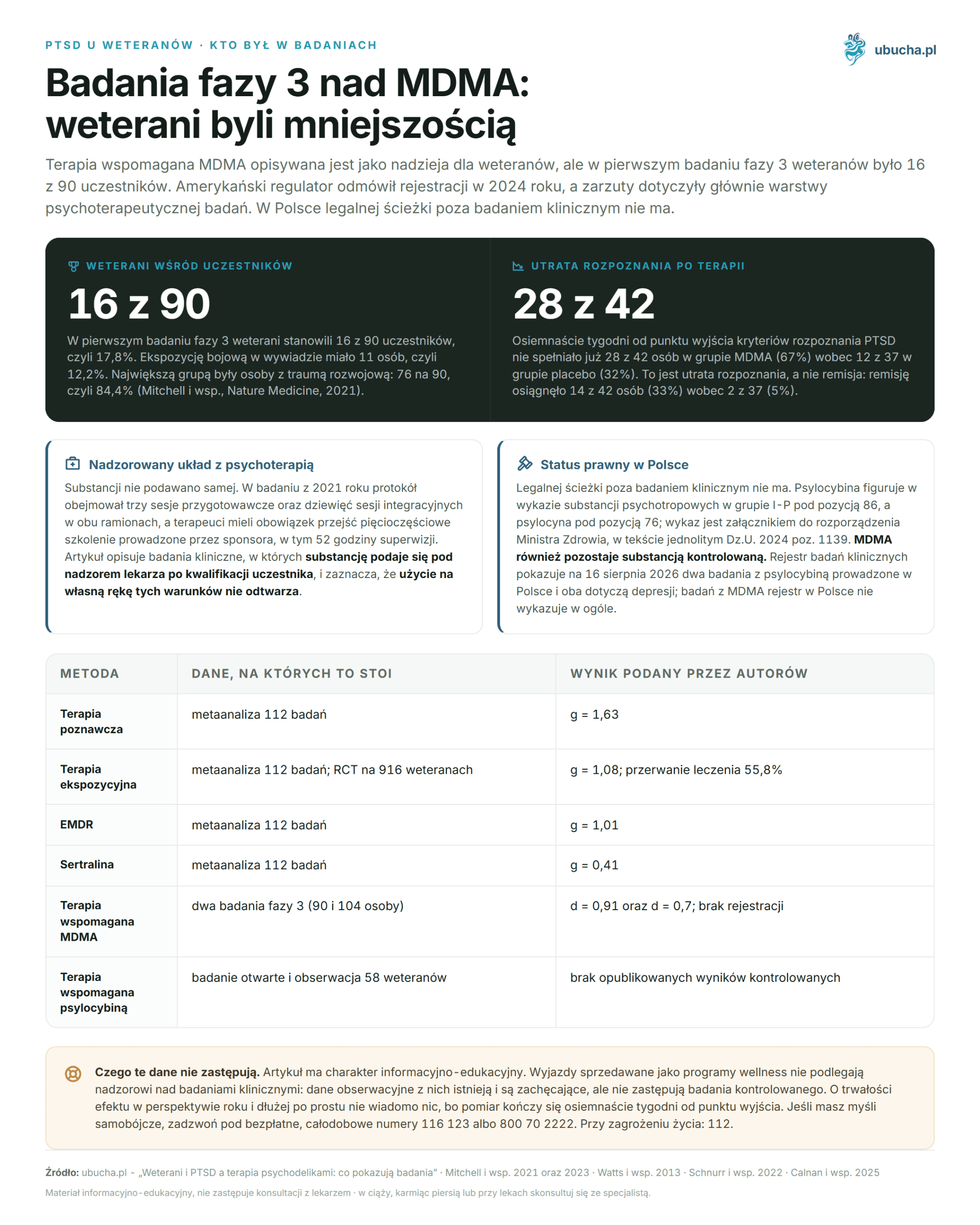
• In the phase 3 study after MDMA-assisted therapy, 28 out of 42 individuals (67%) no longer met PTSD criteria compared to 12 out of 37 (32%) after psychotherapy alone (Mitchell et al., Nature Medicine, 2021).
• Veterans constituted 16 out of 90 participants in this study, or 17.8%.
• The American regulator refused registration in 2024; allegations mainly concerned the psychotherapeutic layer of the studies.
• In a randomized VA study of 916 veterans, 55.8% of individuals in the prolonged exposure arm discontinued treatment.
Why is PTSD in veterans so difficult to treat?
Because the methods with the best evidence base work less effectively in this group than in others, and every second person drops out. Both of these things have been calculated. A meta-analysis covering 137 therapeutic comparisons from 112 studies showed that trials with a higher proportion of veterans yielded smaller effects, both for psychotherapy and for medications.
This same meta-analysis provides effect sizes for individual methods. Cognitive therapy achieved g = 1.63, exposure therapy 1.08, and EMDR 1.01. Among medications, topiramate (1.20) and paroxetine (0.74) performed the best, while sertraline stopped at 0.41 (Watts et al., Journal of Clinical Psychiatry, 2013). The authors conclude that no single best method can be identified.
The second problem is even more practical. In a randomized study conducted in 17 centers of the American veterans’ health service with 916 participants, prolonged exposure was compared with cognitive processing therapy. Both worked, and the difference between them was not clinically significant. The percentage of individuals who discontinued treatment was 55.8% for prolonged exposure and 46.6% for cognitive processing therapy (Schnurr et al., JAMA Network Open, 2022). A method that a patient does not complete is not an effective method in practice.
What did the phase 3 studies on MDMA really show?
They showed a greater reduction in symptoms than psychotherapy alone with placebo, in two independent trials of about one hundred participants each. The first of these, published in 2021, included 90 individuals with severe PTSD randomly assigned to MDMA-assisted therapy or identical psychotherapy with placebo. The protocol included three preparatory sessions and nine integration sessions in both arms.
The primary endpoint was the change in the CAPS-5 scale. It averaged -24.4 points after MDMA compared to -13.9 points after placebo, with an effect size of 0.91. Eighteen weeks from baseline, 28 out of 42 participants in the MDMA group (67%) no longer met PTSD criteria compared to 12 out of 37 in the placebo group (32%). This is a loss of diagnosis, not remission, and these two things are often conflated in discussions. Remission, defined as loss of diagnosis with a CAPS-5 score not exceeding 11 points, was achieved by 14 out of 42 individuals (33%) compared to 2 out of 37 (5%).
The second phase 3 study, published in 2023, included 104 individuals with PTSD of moderate to severe intensity. The change in the CAPS-5 scale was -23.7 compared to -14.8 points, with an effect size of 0.7. By the end of the study, 37 out of 52 individuals (71.2%) no longer met the diagnosis compared to 20 out of 42 (47.6%), and remission criteria were met by 24 out of 52 (46.2%) compared to 9 out of 42 (21.4%) (Mitchell et al., Nature Medicine, 2023). Serious adverse events occurred in five individuals in the MDMA group (9.4%) and two in the placebo group (3.9%), and no deaths were reported.
Who funded the phase 3 studies and how long was the observation?
Both trials were fully funded by private donations from the MAPS organization, which also provided the substance itself. Its subsidiary designed the study and monitored the data, and some authors received salary from it. Therapists were required to undergo a five-part training conducted by the sponsor: an online course, several days of in-person training, experiential learning, and 52 hours of supervision.
This does not invalidate the result and is not unusual in drug studies. However, the reader has the right to know that both phase 3 trials in this indication were conducted by an entity interested in their outcome, the same one that later submitted the registration application.
The second issue is the time horizon, and it is equally important. Neither phase 3 trial reports twelve-month follow-up; measurement ends eighteen weeks from baseline. A paper that described such a distant follow-up after MDMA-assisted therapy was retracted by the journal, so citing it is now unacceptable. Nothing is known about the durability of the effect in the perspective of a year or longer.
| Method | Data it stands on | Result reported by authors |
|---|---|---|
| Cognitive therapy | meta-analysis of 112 studies | g = 1.63 |
| Exposure therapy | meta-analysis of 112 studies; RCT on 916 veterans | g = 1.08; treatment discontinuation 55.8% |
| EMDR | meta-analysis of 112 studies | g = 1.01 |
| Sertraline | meta-analysis of 112 studies | g = 0.41 |
| MDMA-assisted therapy | two phase 3 studies (90 and 104 individuals) | d = 0.91 and d = 0.7; no registration |
| Psilocybin-assisted therapy | open study and observation of 58 veterans | no published controlled results |
How many veterans were actually in the phase 3 studies?
In the first phase 3 study, there were 16 veterans out of 90 participants, or 17.8%. Eleven individuals had combat exposure in their history, or 12.2%. The largest group consisted of individuals with developmental trauma: 76 out of 90, or 84.4%. This is the number that most often falls out of discussions, and it changes the meaning of the entire result.
The difference is not formal. The aforementioned meta-analysis shows directly that trials with a higher proportion of veterans yield smaller effects, regardless of the type of treatment. Therefore, transferring the percentage of 67% to the veteran population is a conclusion that the authors of this work do not draw, and evidence from another study speaks rather against it.
A fair summary sounds different: phase 3 studies included individuals with severe PTSD lasting an average of 14 years, with over 90% having comorbid depression, and veterans were among them. The result is promising for them but is not confirmed for them. In the general population of veterans, the prevalence of PTSD was measured in a representative sample of 3157 individuals: 8.0% lifetime and 4.8% currently, with a strong association with suicidal thoughts (odds ratio 9.7) and suicide attempts (odds ratio 11.8) (Wisco et al., Journal of Clinical Psychiatry, 2014).
Why did the American regulator refuse registration in 2024?
The advisory committee concluded that the evidence of efficacy was insufficient and that the benefits did not outweigh the risks. The refusal for registration came a few months later. However, the allegations mainly concerned not the substance itself but the psychotherapeutic layer, which the regulator, as it claims, does not regulate.
Three of them frequently return in analyses. The first is functional unblinding: a participant in an intensive session with MDMA knows what they received, so the double-blind trial remains blind only on paper. The second is the reporting of adverse events, including euphoria, which the regulator treats as a signal of potential abuse and which was lacking in reports. The third is the lack of subgroup analysis dividing participants into those with prior MDMA experience and those without.
Separately stands the heaviest allegation: violations of boundaries in the therapeutic relationship, which occurred in the studies, and the sponsor did not present what corrective measures were implemented afterward (Roseman, Journal of Psychopharmacology, 2025). The author of this analysis does not defend the sponsor but points out the paradox: some of the allegations concern elements that the regulator has no tools to assess. What this decision means in practice is described more broadly in the text about the FDA decision regarding MDMA.
What is known about psilocybin in veterans?
Less than about MDMA and exclusively from studies without a control group. The best-documented is the observation of 58 veterans who participated in trips with psilocybin or ayahuasca in countries where it is legal. Participants filled out eight questionnaires up to four weeks before the trip and up to four weeks after it.
Improvement occurred in all eight outcomes, the largest in the depression scale PHQ-9 (29.1%) and in the PTSD symptom scale PCL-5 (26.1%). Psilocybin sessions performed better in seven out of eight measurements, while ayahuasca performed better in the PCL-5 scale (26.4% vs 24.8%). The authors also report a difference by gender: men achieved greater improvement in all outcomes except PCL-5, where it was the opposite (24.1% in men vs 32.1% in women) (Calnan et al., Brain and Behavior, 2025).
Limitations are fundamental. There was no control group, the measurement covered only a few weeks after the session, and participants chose to go on the trip, which selects individuals inclined towards improvement. Additionally, there is funding: the work was supported by Heroic Hearts Project, Heroic Hearts UK, and Beckley Retreats, which are entities that organize the same trips. The authors declare that sponsors had no influence on the study design or data analysis, and this declaration should be read together with the result. The clinical trial registry shows on August 16, 2026, eight studies combining psilocybin, PTSD, and veterans, but one of them (NCT05554094, Ohio State University) is an open trial, has closed recruitment status, and has not published results.
What about access to such therapy in Poland?
There is no legal pathway outside of clinical trials, and no studies in this indication are being conducted in Poland. Psilocybin is listed in the schedule of psychotropic substances in group I-P under item 86, and psilocin under item 76; the list is an annex to the regulation of the Minister of Health, in the consolidated text Dz.U. 2024 poz. 1139. MDMA also remains a controlled substance.
The public clinical trial registry shows on August 16, 2026, two studies with psilocybin being conducted in Poland, and both concern depression, not post-traumatic stress disorder. The registry shows no studies with MDMA in Poland at all. Therefore, a veteran seeking to participate in a study would have to look for it abroad and meet the inclusion criteria of a foreign center.
Caution remains regarding commercial offers. Trips to countries where psilocybin is legal are sold as wellness programs and are not subject to oversight of clinical trials. Observational data from such trips exist and are encouraging, but they do not replace controlled studies. The context of the entire field has been gathered in a review of therapies using psychedelics.
Frequently Asked Questions
Does MDMA-assisted therapy work for PTSD in veterans?
The evidence comes from trials where veterans were a minority. In the first phase 3 study, 28 out of 42 people in the MDMA group no longer met PTSD criteria after treatment compared to 12 out of 37 in the placebo group, but there were only 16 veterans among the 90 participants. There is no separate phase 3 study for veterans.
How many veterans were in the 2021 phase 3 study?
Sixteen out of ninety participants, or 17.8%. Eleven individuals (12.2%) had combat exposure, and 76 individuals (84.4%) had developmental trauma. The average duration of PTSD in this sample was 14 years, and over 90% of participants had comorbid depression.
Does psilocybin help veterans with PTSD?
Published data is observational. In a study of 58 veterans participating in legal trips with psilocybin or ayahuasca, PTSD symptoms on the PCL-5 scale decreased by 26.1%, and depression symptoms by 29.1%. There was no control group, and the measurement covered only a few weeks after the session.
Why did the FDA refuse to register MDMA therapy in 2024?
The advisory committee deemed the evidence of efficacy insufficient, and the risks unjustified by the benefits. Allegations included functional unblinding of trials, deficiencies in reporting adverse events, and violations of boundaries in the therapeutic relationship, for which the sponsor did not demonstrate corrective measures taken.
What percentage of people with PTSD are military veterans?
In a representative sample of 3157 American veterans, the lifetime prevalence of probable PTSD was 8.0% and 4.8% currently. The authors emphasize that conditional risk was also high after non-combat injuries, so the image of a veteran with PTSD solely from combat is too narrow.
Can a veteran from Poland participate in such a study?
As of August 16, 2026, the clinical trial registry shows no studies with MDMA in Poland, and two studies with psilocybin concern depression. Participation would therefore require traveling and meeting the inclusion criteria of a foreign center. Recruitment often changes, so the status should be checked directly in the registry.
What is the difference between therapy in a study and a commercial trip?
Oversight and the way harm is reported. A clinical trial has an approved protocol, an ethics committee, and an obligation to report adverse events. A trip sold as a wellness program lacks any of these elements, and the data comes from individuals who chose to participate themselves.
This article is for informational and educational purposes. It describes clinical trials in which the substance is administered under medical supervision after participant qualification; using these conditions on one’s own does not replicate them. These substances are controlled in Poland under the Act on Counteracting Drug Addiction. If you have suicidal thoughts, call the free, 24-hour numbers 116 123 or 800 70 2222. In case of life-threatening situations: 112.
Author: Michał Waluk · Published: 2026-08-09 · Updated: 2026-08-16