
Women and Psychedelics: Differences in Experience and Outcomes
Pharmacokinetics, the 5-HT2A receptor, and the cycle: what studies on psychedelics say about women, and what no one has published yet despite common belief.
A number circulating on the internet suggests that women respond to MDMA-assisted therapy significantly better than men. We checked the full text of the study to which this is attributed, and such an analysis is not present: sex was used solely as a control variable, and the authors did not publish results divided by women and men. At the same time, the differences between sexes in the pharmacology of psychedelics are real, measured, and have practical implications. This text separates one from the other: what has been counted and by whom, what comes from animal studies, and what is a gap that no one has yet closed. We provide each number along with what makes it verifiable: how many people were included in the study, in what setup it was conducted, and what exactly was measured. Where data is lacking, we state this directly instead of filling the gap with a hypothesis.
KEY INFORMATION
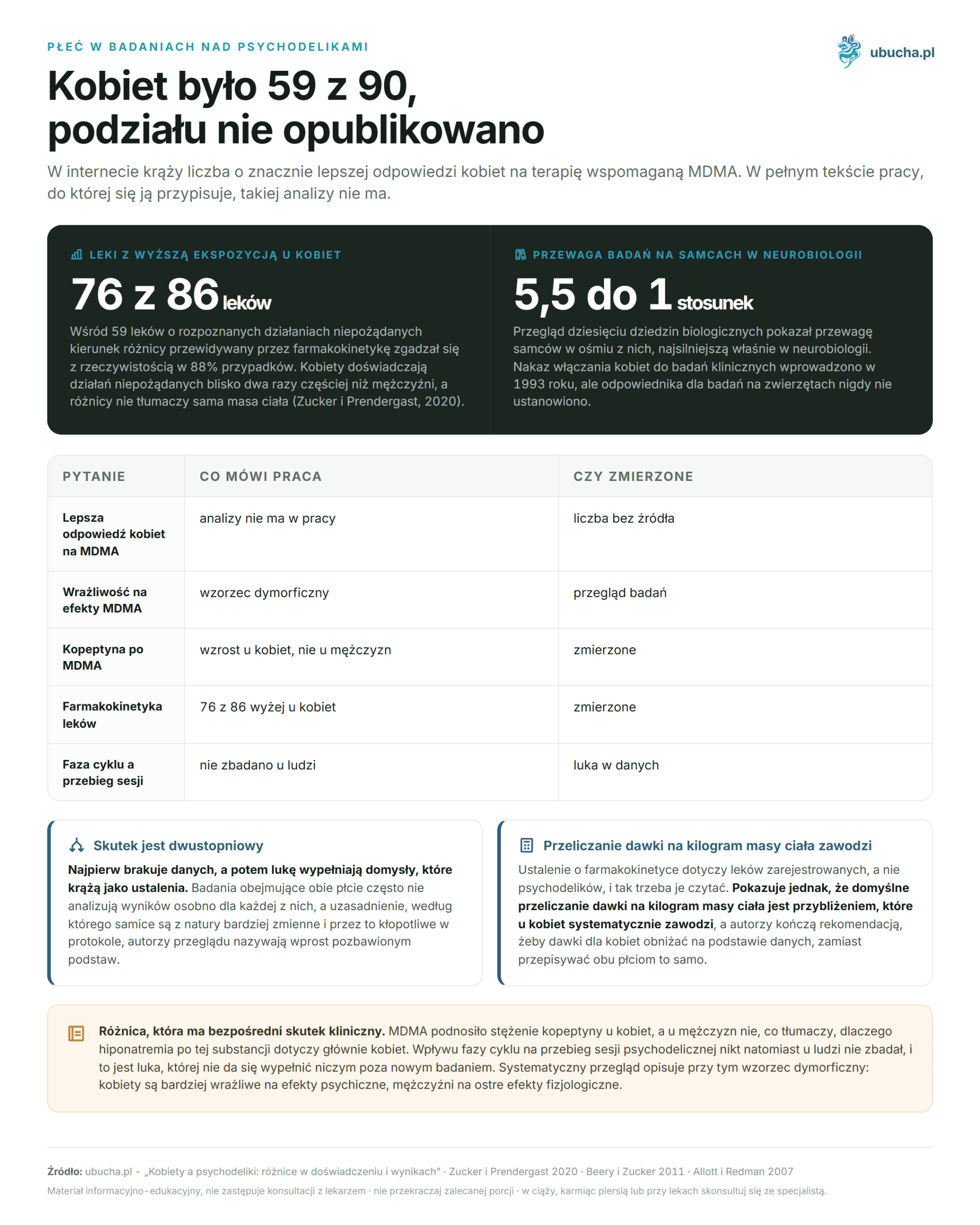
• Of the 86 drugs studied, 76 had higher pharmacokinetic values in women, and the difference was not explained by body weight (Zucker and Prendergast, Biology of Sex Differences, 2020).
• In the first phase 3 study on MDMA, women constituted 59 out of 90 participants, yet results divided by sex were not published.
• MDMA increased copeptin levels in women, but not in men; this explains why hyponatremia after ecstasy mainly affects women.
• The influence of the cycle phase on the course of a psychedelic session has not been studied in humans.
Why have women been excluded from psychedelic research?
Because they have been excluded from the entire field of neurobiology, and psychedelics inherited this habit along with the methodology. A review of ten biological fields showed a male predominance in eight of them, the strongest being in neurobiology, where studies conducted exclusively on males outnumbered studies on females by a ratio of 5.5 to 1.
American authorities mandated the inclusion of women in clinical studies in 1993, but no equivalent mandate for animal studies was ever introduced. The authors of the review add an observation that also pertains to psychedelic works: studies involving both sexes often do not analyze results separately for each. They also dismantle the justification with which this habit was explained. The belief that females are inherently more variable and therefore troublesome in the protocol is directly called unfounded (Beery and Zucker, Neuroscience and Biobehavioral Reviews, 2011).
The consequence is twofold. First, there is a lack of data, and then the gap is filled with assumptions that circulate as findings. We describe several such assumptions below along with what has actually been measured.
Do women react to MDMA differently than men?
Yes, and this is one of the better-documented differences in this group of substances. A systematic review of preclinical and clinical studies finds a dimorphic pattern: adult women are more sensitive to acute and subacute physical and psychological effects of MDMA, as well as to long-term changes in the serotonin system. Men, on the other hand, are more sensitive to acute physiological effects (Allott and Redman, Neuroscience and Biobehavioral Reviews, 2007).
Part of this difference has a more general source than MDMA itself. A review of the pharmacokinetics of 86 drugs showed that women had higher exposure values for 76 of them, and among 59 drugs with recognized adverse effects, the direction of the difference predicted by pharmacokinetics matched reality in 88% of cases. Women experience adverse effects nearly twice as often as men, and the difference is not explained by body weight alone. The authors conclude with a recommendation to lower doses for women based on data, rather than prescribing the same to both sexes.
This finding pertains to registered drugs, not psychedelics, and should be read as such. However, it shows that defaulting to dose calculation per kilogram of body weight is an approximation that systematically fails for women. In psychedelic studies, the dose is calculated either per kilogram or based on a body weight of 70 kilograms.
What does estrogen do to the 5-HT2A receptor?
It increases its expression, but this is known from studies in rats, not in humans. Estradiol in the phase of acute positive feedback stimulates the expression of the 5-HT2A receptor and serotonin transporter genes in the dorsal raphe nucleus, accompanied by an increase in the density of both in forebrain areas responsible for mood and emotions in humans.
The team that described this subsequently showed that raloxifene completely blocks this effect in female rats after ovariectomy, indicating the mediation of nuclear estrogen receptors (Sumner et al., Neuroscience Letters, 2007). The 5-HT2A receptor is the main target of classical serotonergic psychedelics, and we describe the mechanism of its stimulation separately in the text about the 5-HT2A receptor and brain plasticity.
The transition from rat to human is a leap, not a conclusion. The hypothesis that a session in the follicular phase is more intense than in the luteal phase is reasonable from this data and remains untested: we do not know of any published clinical study that planned to measure the cycle phase as a variable and provided a result. Hormonal variability in the cycle has, moreover, a broader physiological range, as seen, for example, in the endocannabinoid system in the menstrual cycle.
Do women respond better to MDMA-assisted therapy?
No one has published this, even though data exists. In the first phase 3 study on MDMA-assisted therapy, women constituted 59 out of 90 participants, or 65.6%, and two individuals from this group identified their gender as non-binary. Sex entered the model solely as one of the control variables in exploratory analyses. The remission rates separately for women and men are not provided in this work.
We checked this in the full text, as circulating discussions attribute specific values to this work. The numbers that would compare remission in women and men do not appear in it even once, just as the subgroup analysis with trauma from sexual assault is absent. The result provided by the authors pertains to the entire sample and is a loss of diagnosis, not remission: 28 out of 42 individuals in the MDMA group did not meet PTSD criteria after treatment compared to 12 out of 37 in the placebo group. Remission, meaning loss of diagnosis with a CAPS-5 score not exceeding 11 points, was achieved by 14 out of 42 individuals compared to 2 out of 37. These two values were also not broken down by sex.
The only published analysis with a breakdown by sex in this area that we found comes from an observation of 58 veterans after retreat sessions with psilocybin or ayahuasca. Men achieved greater improvement in all outcomes except for PTSD symptoms, where the direction reversed: 32.1% improvement in women compared to 24.1% in men (Calnan et al., Brain and Behavior, 2025). The study had no control group, the difference was not planned as a main hypothesis, and the work was funded by organizations conducting these retreats. A broader picture of this population is described in the text about veterans and psychedelic therapy.
Do women develop PTSD more often after trauma?
The answer is less straightforward than the circulating version suggests. A meta-analysis of fourteen risk factors for PTSD in adults after trauma exposure included sex in the group of factors that predict illness in some populations but not in others. Age at the time of injury and ethnic background also fell into this group.
Two other groups proved to be significantly more consistent. The first included education, previous injuries, and childhood difficulties, while the second included psychiatric history and reported childhood violence. However, the strongest effects came from factors acting during or after the trauma: the severity of the trauma, lack of social support, and additional life stressors (Brewin et al., Journal of Consulting and Clinical Psychology, 2000).
The practical conclusion is different from what the shorter version of this thesis suggests. If the decision to develop the illness is more influenced by what happens around the person after the trauma than by their sex, then the question of differences between women and men in therapy should be posed more cautiously. The effect sizes for individual factors are described by the authors as moderate.
What risks particularly concern women?
The best-documented risk is hyponatremia after MDMA. In a randomized placebo-controlled crossover study, sixteen healthy volunteers, eight women and eight men, received 125 mg of MDMA. The level of copeptin, a marker of vasopressin secretion, significantly increased at 60 and 120 minutes in women, but not in men.
The authors directly link this to clinical observation: hyponatremia after ecstasy is mainly reported in women. The copeptin response disappeared after the administration of duloxetine, indicating the mediation of serotonin and norepinephrine release (Simmler et al., Journal of Clinical Endocrinology and Metabolism, 2011). The authors also noted that after MDMA, participants drank more water, while the kidneys retained more than after placebo. These two phenomena together explain why the popular recommendation in club environments to “drink plenty of water” works against the person who listens to it in this context.
The second issue has no data, and that is precisely the answer. Pregnant women are excluded from all clinical protocols involving psychedelics, so no one has studied safety for the fetus, and it cannot be inferred from anything. The third is hormonal medications: contraception and hormone replacement therapy enter hepatic metabolism, and we have not found direct studies on interactions with psychedelics. The lack of data is not evidence of safety here.
Frequently Asked Questions
Do women experience psychedelics differently than men?
In the case of MDMA, yes. A systematic review of preclinical and clinical studies describes a dimorphic pattern: women are more sensitive to acute and subacute physical and psychological effects, while men are more sensitive to acute physiological effects. For psilocybin and LSD, there are no comparable reviews with the same level of evidence.
How does the menstrual cycle phase affect a psychedelic session?
It is unknown, as no one has measured this in humans. The hypothesis of a more intense experience in the follicular phase is based on studies in rats, where estradiol increased the density of the 5-HT2A receptor in the forebrain. We did not find any published clinical study with the cycle phase as a planned variable.
Did women achieve higher PTSD remission after MDMA than men?
Such an analysis has not been published. In the phase 3 study attributed to these numbers, women constituted 59 out of 90 participants, and sex was included in the model only as a control variable in exploratory analyses. The result provided by the authors pertains to the entire sample, not separately for women and men.
Is MDMA more dangerous for women?
In one specific mechanism, yes. After 125 mg of MDMA, the level of copeptin increased in women, but not in men, which corresponds to the known prevalence of hyponatremia in women after ecstasy. After MDMA, participants drank more water, and the kidneys retained more than after placebo, so the issue here is water retention, not dehydration.
Are psychedelics safe for pregnant women?
There is no data to say so. Pregnant women are excluded from all clinical protocols, so the safety for the fetus remains unknown. The lack of studies is not evidence of safety and should be read in that direction. The same applies to breastfeeding.
Why are women underrepresented in psychedelic research?
The habit came from the entire field of neurobiology, where studies exclusively on males outnumbered studies on females by a ratio of 5.5 to 1. The mandate to include women in clinical studies was introduced in 1993, but this mandate did not cover animal studies, and works involving both sexes often do not analyze results separately.
This article is for informational and educational purposes. It describes clinical studies in which the substance is administered under medical supervision after participant qualification; using these substances on one’s own does not replicate those conditions. These substances are controlled in Poland under the Act on Counteracting Drug Addiction. If you have suicidal thoughts, call the free, 24-hour numbers 116 123 or 800 70 2222. In case of life-threatening situations: 112.
Author: Michał Waluk · Published: 2026-08-09 · Updated: 2026-08-16