
Default Mode Network (DMN) and Afterglow: What Happens in the Brain After an Experience
The Default Mode Network (DMN) and afterglow: what was really measured in studies on psilocybin, how long the effects lasted, and what was not shown.
When you sit idly and let your thoughts wander, your brain does not rest. The network called DMN, or Default Mode Network, is active, responsible for memories, planning, and constructing a narrative about oneself. Imaging studies have shown that psychedelics significantly reduce its activity, and participants in clinical trials later describe a several-week period of mood improvement known as afterglow. This article clarifies what has been measured in this story and what has been added along the way. Two numbers circulating in the Polish internet, namely the alleged decrease in blood flow of 10-20% and the exact length of the neuroplasticity window, have no basis in the works to which they are attributed. The text describes scientific research and does not encourage the use of controlled substances.
KEY INFORMATION
• Psilocybin decreased cerebral blood flow and BOLD signal most strongly in network hubs; the magnitude of the decrease in the prefrontal cortex predicted the intensity of subjective effects (Carhart-Harris, PNAS, 2012).
• The popular number indicating a decrease of 10-20% does not appear in this work or its summary.
• In a study with psilocybin in depression, a treatment response was found in 71% of participants after four weeks, and in a one-year follow-up of the same group in 75%.
• The neuroplasticity window has so far been described in mice: the duration of its opening was proportional to the length of acute effects described in humans (Nardou, Nature, 2023).
• Psilocybin and psilocin are controlled substances in Poland from group I-P.
What is the Default Mode Network (DMN)?
It is a system of brain areas that activates when attention is not directed to the external world. It includes the medial prefrontal cortex, posterior cingulate gyrus, and structures of the medial temporal lobe. The network is responsible for recalling memories, imagining the future, and taking the perspective of others.
A synthesis of thirty years of imaging research on this network was published in the Annals of the New York Academy of Sciences (Buckner et al., 2008). The authors describe it as a system composed of subsystems, with the posterior cingulate gyrus as the convergence point. It is worth clarifying this, as this work is often attributed to the journal Nature Reviews Neuroscience, which it does not pertain to.
The relationship between excessive activity of this network and mental disorders has been described in separate works. Resting state analysis in individuals with depression showed abnormally heightened self-referential processing within the network (Sheline et al., PNAS, 2009), and in post-traumatic stress disorder, connectivity within this network predicted the severity of symptoms (Lanius et al., Acta Psychiatrica Scandinavica, 2010).
How do psychedelics change DMN activity?
They decrease it, and this was a surprising result for the researchers themselves. In a study published in PNAS, psilocybin was administered intravenously to two groups of fifteen healthy volunteers, and cerebral blood flow and BOLD signal were measured. Stimulation was expected, but only decreases were observed.
The decreases were greatest in hub regions, including the thalamus and anterior and posterior cingulate gyrus. Consistently, a decrease in activity in the anterior cingulate gyrus and medial prefrontal cortex was repeated, and the magnitude of this decrease predicted the intensity of subjective effects. Psilocybin also weakened positive coupling between the prefrontal cortex and posterior cingulate gyrus (Carhart-Harris et al., PNAS, 2012).
In Polish discussions of this work, a number indicating a decrease in flow of 10-20% appears. It is neither in the summary nor in the conclusions of this study, so treat it as an addition. The mechanism itself later received theoretical frameworks collected in a model called REBUS, described as an attempt to unify knowledge about the effects of psychedelics on the brain (Carhart-Harris et al., Pharmacological Reviews, 2019), but this is an interpretative model, not a measurement.
What is afterglow and what is known about it?
Afterglow is a period described by study participants as lightness, openness, and clarity of thought lasting from a few days to several weeks after a session. It is not a result of the substance lingering in the body, as it is eliminated earlier. However, there is less hard data about its biology than popular discussions suggest.
The closest measurement of a lasting change in the network comes from a study in which 38 participants received psilocybin during a five-day meditation retreat. The decoupling of the medial prefrontal cortex and posterior cingulate gyrus was associated with the strength of the ego dissolution experience, and the extent of this decoupling predicted improvement in psychosocial functioning four months later (Smigielski et al., NeuroImage, 2019).
On the clinical side, afterglow has a counterpart in the form of rapid mood improvement. In a randomized study with a waiting group, two sessions with psilocybin reduced the severity of depression as early as the day after the first session, and the effect lasted for four weeks of observation (Davis et al., JAMA Psychiatry, 2021). The practical side of this period is described in a separate text about afterglow and the neuroplasticity window.
What did studies on the neuroplasticity window really show?
They showed that the window exists in mice, and did not show how long it lasts in humans. This distinction is often lost in texts about afterglow, where the number of days is sometimes given with an accuracy suggesting measurement in humans.
A study published in Nature showed that different psychedelics reopen the critical period for social reward learning in mice. The duration of this window opening was proportional to the length of acute subjective effects described in humans, and a common cellular mechanism turned out to be the remodeling of the extracellular matrix (Nardou et al., Nature, 2023). The authors do not transfer these time frames to humans.
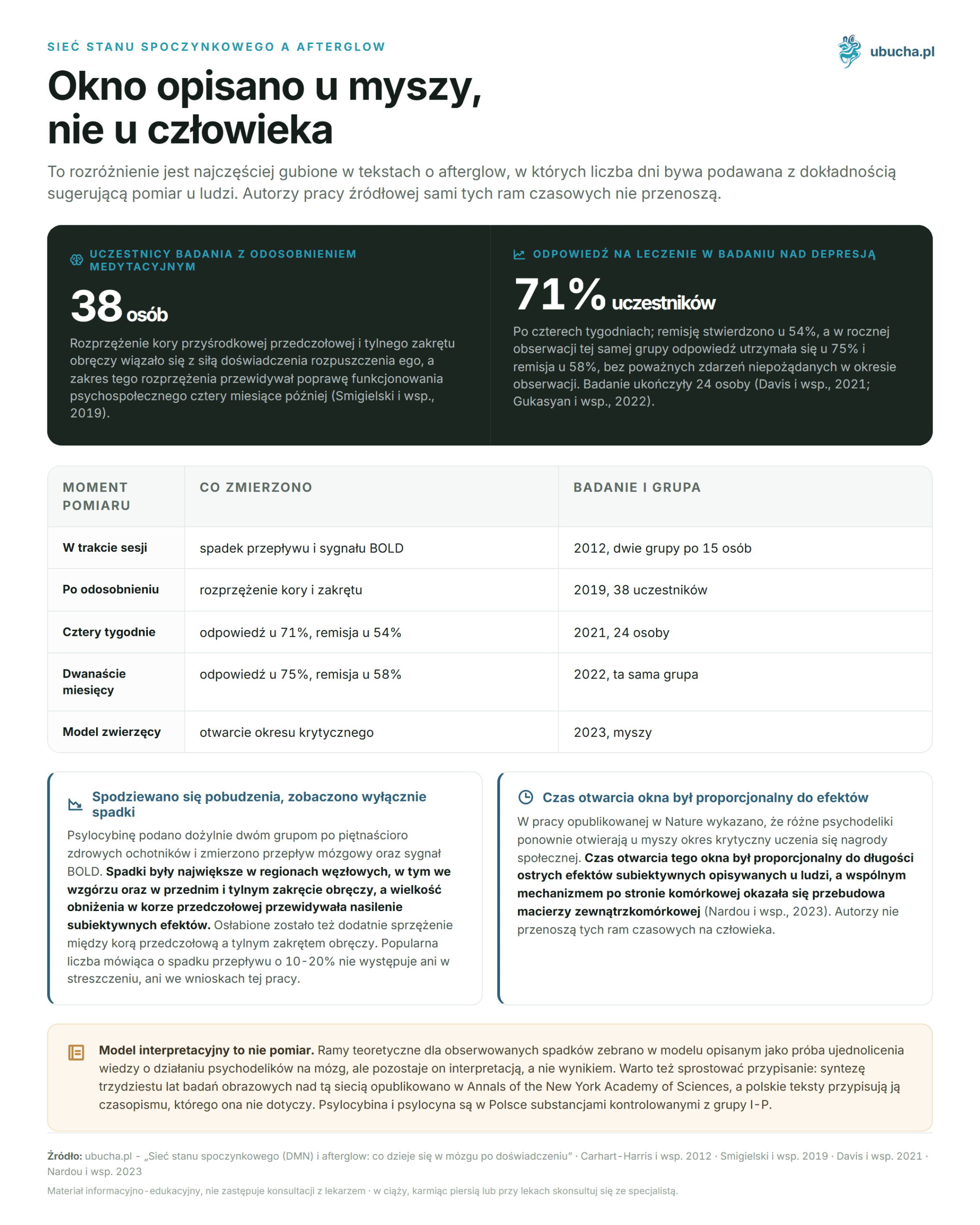
| Measurement Moment | What was measured | Study and group |
|---|---|---|
| During the session | Decrease in cerebral blood flow and BOLD signal in hub regions; the magnitude of the decrease predicted the intensity of effects | Carhart-Harris, 2012; two groups of 15 healthy volunteers |
| After five days of retreat | Decoupling of the prefrontal cortex and posterior cingulate gyrus associated with ego dissolution | Smigielski, 2019; 38 participants |
| Four weeks | Response to treatment in 71% and remission in 54% of participants | Davis, 2021; 24 people who completed the study |
| Twelve months | Response in 75% and remission in 58%, with no serious adverse events during the observation period | Gukasyan, 2022; the same group |
| Animal model | Reopening of the critical period for social reward learning | Nardou, 2023; mice |
On the cellular side, the most frequently cited work showed that psychedelics increased neurite growth and the number of dendritic spines in cell cultures and in animals, acting through the TrkB receptor pathways, mTOR kinase, and 5-HT2A receptor (Ly et al., Cell Reports, 2018). The TrkB receptor is a receptor for the neurotrophic factor BDNF, which explains the association of afterglow with this protein, although this work did not measure the increase of BDNF in humans. The topic is further developed in the text about neuroplasticity and BDNF in psychoplastogens.
Does the effect last for months?
In clinical studies, yes, at least for some participants. A group of 24 people with depression who completed a protocol with two sessions of psilocybin was observed for a year. The treatment response was maintained in 75%, and remission in 58%, with all participants attending all follow-up visits.
No serious adverse events related to psilocybin were recorded during the observation period (Gukasyan et al., Journal of Psychopharmacology, 2022). In another study involving 51 cancer patients with symptoms of depression and anxiety, about 80% of participants still showed clinically significant mood improvement after six months (Griffiths et al., Journal of Psychopharmacology, 2016).
MDMA therapy for post-traumatic stress disorder has followed a separate research path and has undergone a phase three study with randomization and placebo (Mitchell et al., Nature Medicine, 2021). All these protocols share one thing: the substance was administered in supervised conditions, with preparation and therapeutic work after the session. The results themselves do not transfer to use outside such a setup. The practice of working after the experience is described in the text about integration step by step.
What does Polish law say about these substances?
Psilocybin and psilocin are controlled substances in Poland. They are listed in group I-P of the list of psychotropic substances, under positions 86 and 76. Possession of a psychotropic substance contrary to the provisions of the Act on Counteracting Drug Addiction is a punishable act under Article 62 of this Act.
The studies described in this article were conducted abroad, in registered clinical trials, under medical supervision and with the consent of bioethics committees. This is not a procedural detail, but a condition under which the described results were obtained. Participants were qualified after excluding psychotic disorders and other contraindications, and sessions took place in the presence of a trained team.
A separate issue is interactions with medications. Classic psychedelics act on the serotonergic system, so combining them with antidepressants can be dangerous, as discussed in more detail in the text about contraindications and interactions with SSRI and IMAO medications. If you are seeking help for depression or post-traumatic stress disorder, the starting point remains a psychiatrist and available treatment methods in Poland. It is also worth remembering that self-discontinuation of an antidepressant before any experience is a separate risk, independent of the substance itself, and also requires guidance from a doctor.
Frequently Asked Questions
What is the Default Mode Network (DMN)?
It is a network of brain areas that is active when attention is not directed outward. It includes the medial prefrontal cortex, posterior cingulate gyrus, and structures of the medial temporal lobe. It is responsible for recalling memories, imagining the future, and taking the perspective of others.
How do psychedelics affect DMN activity?
They decrease it. After intravenous administration of psilocybin, only decreases in cerebral blood flow and BOLD signal were observed, greatest in hub regions, and a weakening of coupling between the prefrontal cortex and posterior cingulate gyrus. The magnitude of the decrease predicted the intensity of subjective effects.
Where does the number indicating a 10-20% decrease in flow come from?
Not from the work it is often attributed to. A study published in PNAS in 2012 describes the direction and location of changes and their relationship to the intensity of effects, but does not provide such a percentage. This number circulates in discussions without grounding in a source.
How long does the neuroplasticity window last after psychedelics?
It has not been measured in humans. In mice, a reopening of the critical period for social reward learning was demonstrated, and the duration of the opening was proportional to the length of acute effects described in humans. The daily frameworks provided in guides do not come from human studies.
Does mood improvement after psilocybin last?
In clinical studies, for some participants, yes. In a one-year follow-up of a group of 24 people with depression, the response was maintained in 75%, and remission in 58%. In a study involving 51 cancer patients, about 80% still showed improvement after six months.
Is psilocybin legal in Poland?
No. Psilocybin and psilocin belong to group I-P of the list of psychotropic substances, under positions 86 and 76. Possession of a psychotropic substance contrary to the provisions of the Act on Counteracting Drug Addiction is a punishable act under Article 62 of this Act.
This article is informational and educational. It describes clinical studies in which the substance is administered under medical supervision after participant qualification; using these conditions on one’s own does not replicate the results. These substances are controlled in Poland by the Act on Counteracting Drug Addiction. If you have suicidal thoughts, call the free, 24-hour numbers 116 123 or 800 70 2222. In case of life-threatening situations: 112.
Author: Michał Waluk · Published: 2026-08-09 · Updated: 2026-08-11