
Terpenes in CBD: what they are and how they affect the action of hemp oil
Myrcene, beta-caryophyllene, linalool, limonene, and pinene in CBD oil: what each of them does, whether the entourage effect is proven, and what you lose with an isolate.
The scent of full-spectrum oil comes from terpenes, the same compounds responsible for the smell of a pine forest, lemon peel, and lavender. Over two hundred have been described in cannabis, and producers eagerly build narratives around them, claiming that they determine the action of the product. Part of this story has solid chemical foundations: one terpene indeed binds to the cannabinoid receptor, and this has been demonstrated in a peer-reviewed journal. Some have not gone beyond a hypothesis proposed in 2011, and the difference between the two is rarely explained to the reader. Below, we go through the five most important cannabis terpenes, what is really known about the entourage effect, what has yet to be studied, and the question of what exactly you lose by choosing an isolate instead of full spectrum.
KEY INFORMATION
• Over two hundred terpenes have been described in cannabis, and their share in typical plant designations does not exceed 1 percent (Russo, British Journal of Pharmacology, 2011).
• Beta-caryophyllene selectively binds to the CB2 receptor (Ki 155 nM) and is the only terpene with this property (Gertsch et al., PNAS, 2008).
• The entourage effect is a hypothesis from 2011, and its author was then a medical advisor to a producer of full-spectrum extracts.
• In drug-resistant epilepsy, CBD-rich extracts worked at doses over four times lower than pure CBD (Pamplona et al., 2018).
• Three registered trials today compare isolate with full spectrum in humans; none have results yet.
What are terpenes and why do cannabis plants produce them?
These are volatile organic compounds responsible for the smell of plants, produced in cannabis in the same glandular trichomes where cannabinoids are formed. They are not an additive or contaminant, but a product of the same biochemical pathway, which explains why they end up in the extract together with CBD.
The plant does not produce them for us. Terpenes serve defensive functions: they deter herbivores and feeding insects, inhibit the growth of fungi, and at the same time attract pollinators. Their concentration increases in response to stress and tissue damage, which is also why a crushed flower smells more intense than an untouched one.
Over two hundred terpenes have been described in cannabis so far, but practically significant are a few that occur most abundantly. Their total content is, however, less than marketing suggests: Russo states that in typical plant designations, terpenes constitute less than 1 percent of the mass, although in the glandular trichomes, they can reach 10 percent of the content. The proportions differ between strains enough that the terpene profile is sometimes used to distinguish chemotypes, similar to cannabinoid content.
They are also unstable and decrease unevenly. Monoterpenes, such as myrcene, limonene, and pinene, are volatile, and their content decreases during drying and storage of the raw material; as a result, the relative share of heavier sesquiterpenes, primarily caryophyllene, increases, which Russo also notes for extracts. Thus, two oils with identical declared CBD content can differ radically in terpene profile, and the difference arises from the age and processing of the raw material, not from the declaration on the label.
The carrier itself also matters. Terpenes dissolve in fats just like cannabinoids, so MCT or hemp oil retains them without problems. However, an open bottle loses them with each use, as the most volatile fractions evaporate with each opening. After six months from opening, the terpene profile of the product looks different than on the day of laboratory testing, although the CBD content remains practically the same.
Which terpenes are most commonly found in CBD oils?
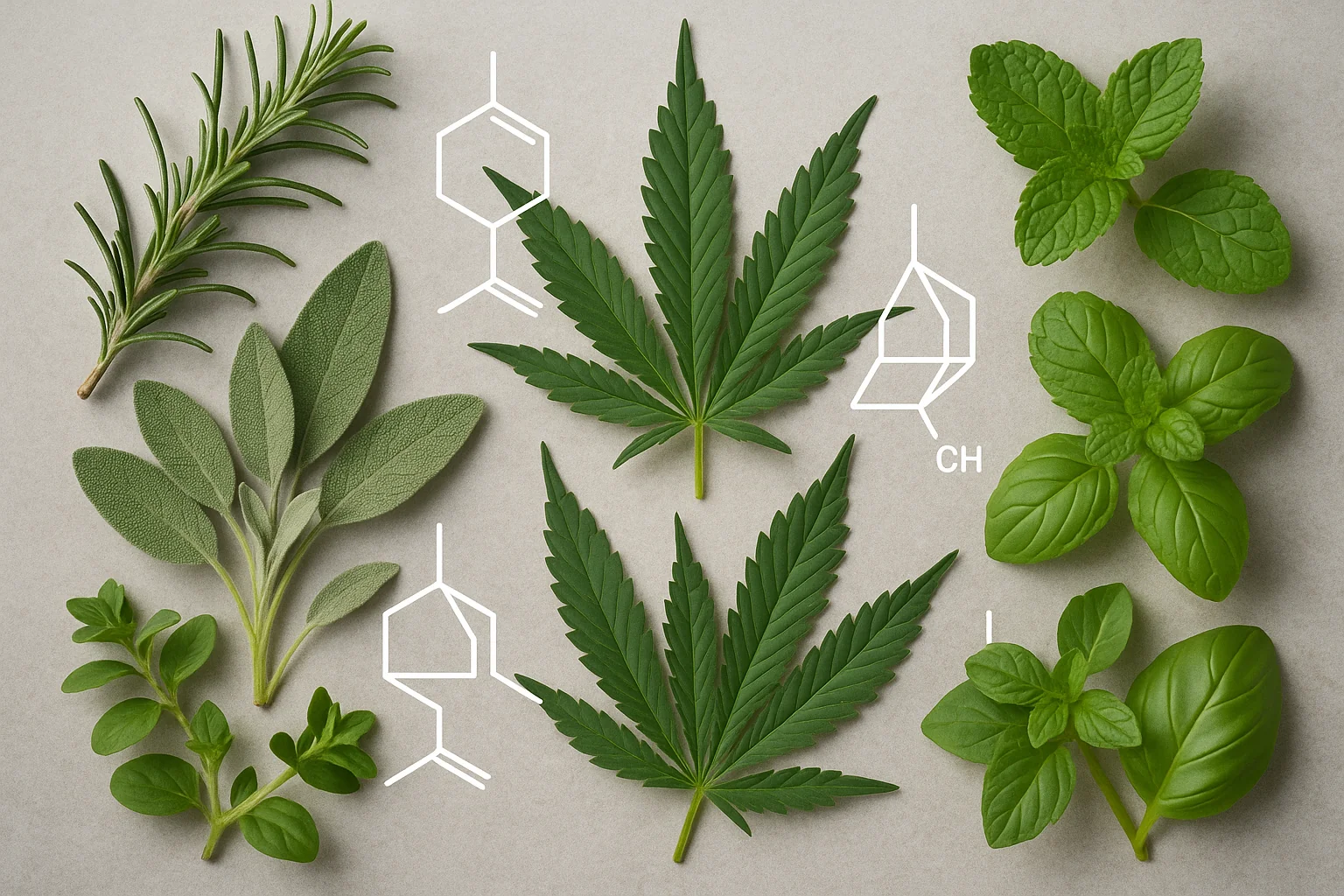
The five below usually constitute the majority of the terpene profile of hemp extract. It is worth noting that data on their effects mostly come from studies on terpenes themselves at concentrations significantly higher than those in oil. A broader list, including rarer compounds, can be found in the guide to cannabis terpenes.
| Terpene | Aroma | Assigned effect | Where else it occurs |
|---|---|---|---|
| Myrcene | earthy, musky | calming, relaxing | hops, mango, thyme |
| Beta-caryophyllene | peppery, spicy | anti-inflammatory via CB2 | black pepper, cloves |
| Linalool | floral, lavender | calming, sleep-supporting | lavender, basil |
| Limonene | citrusy | mood-enhancing | citrus peels, juniper |
| Alpha-pinene | pine, resinous | alertness-supporting | pine needles, rosemary, sage |
Myrcene dominates in most strains, and it is attributed to the distinction between “calming” and “stimulating” strains, popular in dispensaries. Russo formulates a hypothesis based on this that myrcene is the leading calming terpene in cannabis, but he bases it on preparations from hops and on animal observations of muscle relaxation and prolonged barbiturate sleep at high doses. The percentage threshold above which a strain is supposedly “calming” does not come from any of these studies; it circulates in store descriptions without citing a source.
Among this five, monoterpenes, namely pinene, limonene, and myrcene, decrease the fastest. If the oil smelled of pine on the day of purchase, and after six months it no longer does, it does not mean it has completely lost its scent; it means that these components disappeared first. Beta-caryophyllene, as a sesquiterpene with a larger and less volatile molecule, remains the longest, which is why its share increases in older raw material.
Does beta-caryophyllene really act like a cannabinoid?
Yes, and it is the only terpene about which this can be said with certainty. Gertsch et al. (PNAS, 2008) demonstrated that beta-caryophyllene selectively binds to the cannabinoid receptor CB2, with a binding affinity Ki of 155 nM, and acts on it as an agonist. CB2 is a receptor mainly present on immune system cells, not in the brain.
This finding has two consequences. First, it explains the anti-inflammatory action attributed to this compound: in the same study, beta-caryophyllene at a concentration of 500 nM inhibited lipopolysaccharide-induced expression of pro-inflammatory cytokines in peripheral blood. Second, the binding is selective for CB2, and the authors describe this compound as non-psychoactive.
A curiosity that organizes thinking about the entire category: beta-caryophyllene is a common food ingredient, present in black pepper, cloves, and oregano. So if someone had lunch with pepper today, they ingested a dietary cannabinoid, likely in a greater amount than from a few drops of oil. Terpenes are not exotic; they are simply everywhere.
It is worth drawing a conclusion from this that cools some marketing enthusiasm. The anti-inflammatory effect after oral administration has been demonstrated in mice, in a model of swelling induced by carrageenan, at a dose of 5 mg per kilogram of body weight; in animals lacking the CB2 receptor, the effect did not occur. In simple conversion to the body weight of an adult human, this results in several hundred milligrams, while the content of this terpene in CBD oil is measured in fractions of a percent. Thus, the study proves the mechanism, not that a few drops of oil have an anti-inflammatory effect through caryophyllene.
The other terpenes have weaker foundations. Limonene, linalool, or myrcene are sometimes described as affecting mood and sleep, but studies usually concern inhaling essential oils or administering pure compounds to animals in doses incomparable to the content in CBD preparations. This does not mean they do not work; it means it is unknown whether they work in this quantity and in this form.
Is the entourage effect proven?
No, to the extent suggested by marketing. The term itself and the most frequently cited argument come from Russo’s work (British Journal of Pharmacology, 2011), which gathered the pharmacology of individual cannabinoids and terpenes and indicated places where their interaction is likely. This is a review paper formulating a hypothesis, not a study confirming it; the author himself concludes it with a proposal for methods that should be used to study the entourage effect.
There is something in this work that Polish studies usually remain silent about, but which stands out in it in open text. In the conflict of interest note, Russo states that he is a senior medical advisor and consultant for GW Pharmaceuticals, a company that was then selling a drug based on full-spectrum extract. This does not invalidate any of the described mechanisms, but the reader has the right to know that the most frequently cited argument for full spectrum was formulated by an advisor to a full-spectrum producer.
The most concrete data comes from a completely different side. Pamplona et al. (Frontiers in Neurology, 2018) gathered eleven observational studies involving 670 patients with drug-resistant epilepsy and compared CBD-rich extracts with pure cannabidiol. An improvement in seizure frequency was reported by 71 percent of people on extract compared to 46 percent on isolate, with an average daily dose of 6.0 versus 25.3 mg per kilogram of body weight. However, when the authors applied stricter criteria, namely a reduction in seizures by at least half, the advantage disappeared: 37 percent versus 42 percent, with no statistically significant difference.
So before you treat this as evidence, three caveats. This is a meta-analysis of observational data, not a randomized study, so the groups were not comparable by design. It concerns one neurological indication at doses several dozen times higher than supplemental. And it does not resolve whether the difference is due to terpenes, other cannabinoids, or the difference in the pharmacokinetics of the extract. The authors themselves state that explaining the synergy requires confirmation in controlled studies.
It is worth noting that there is nothing stretched in the hypothesis itself. The interaction of plant substances is a described and uncontroversial phenomenon in pharmacology, and Russo points to specific, verifiable mechanisms: beta-caryophyllene acting through CB2, pinene inhibiting acetylcholinesterase, and the ability of monoterpenes to increase the permeability of other substances through the skin. The problem is not that the thesis is unbelievable, but that for years no one has tested it directly.
Is anyone comparing isolate with full spectrum today?
Yes, and this is the latest news on the matter. The test that was missing is simple to design: the same dose of CBD, once as an isolate, once as a full-spectrum extract, with blinding and a hard endpoint. We checked the clinical trial registry on August 15, 2026, and at least three such trials are now registered. NCT07298408 is a randomized crossover trial with triple blinding in 20 people with diabetic neuropathy, comparing isolate, full spectrum, and placebo, with completion planned for 2027. NCT06290063 is recruiting 385 older adults to compare full spectrum with broad spectrum and placebo, with completion in 2028. The third, NCT04197102 in post-traumatic stress disorder, has been suspended. None have results yet, so the statement “full spectrum works better” remains a supposition. The difference is significant, however: this is not a question that no one is asking, but a question for which the answer is just emerging.
For the reader, this means a simple time rule. If a producer today claims “proven entourage effect,” they are referring to a review from several years ago, not to the result of a randomized trial, because such a result simply does not exist yet. The first hard data on this matter may appear as early as 2027, and that from a small trial on twenty people with diabetic neuropathy, a population distant from someone buying oil for evening calming.
How to match the terpene profile to the goal?
The honest answer is: to a limited extent and rather by trial and error than from a table. Assigning terpenes to effects is mainly based on studies of essential oils at concentrations incomparably higher than in drops of CBD oil, where their content is measured in fractions of a percent.
From a practical point of view, a simpler rule can be helpful. Profiles dominated by myrcene and linalool, that is, those smelling earthy or floral, tend to work better in the evening. Profiles with a distinct citrus or pine note, rich in limonene and pinene, are often better received during the day. This is an observation from user reports, not a conclusion from clinical research, and I would treat it as a starting point, not a rule.
Do not ignore your own nose either. If the smell of the oil is repulsive to you, you will use it inconsistently or not at all, and with CBD, regularity is more important than the terpene composition. Scent preference is a practical argument in this case, not a whim.
There is one more mechanism that is rarely mentioned, which explains some of the perceived differences without referring to pharmacology. Scent affects us through associations and through the direct connection of smell with the limbic system, so a distinct lavender note may calm before any component has a chance to be absorbed. This is not a false effect or a reason to be dismissed, but a different pathway of action than the one suggested by the label.
If you want to test this for yourself, change one thing at a time. The same producer, the same CBD concentration, a different terpene profile, for two weeks each. Comparing products that differ simultaneously in potency, carrier, and brand will tell you nothing about terpenes, as there are too many variables, and the difference in the CBD dose itself will overshadow everything else.
What do you lose by choosing isolate instead of full spectrum?
All terpenes, all other cannabinoids, and flavor, while gaining predictability and the absence of THC. Which set is better depends on why you are reaching for the product.
An isolate is pure cannabidiol in the form of a white powder, without smell or taste. It works when THC must be completely excluded, when you need precise dosing in milligrams, or when you add it to a dish whose flavor you do not want to change. Full-spectrum preparations retain the complete range of plant components, including trace amounts of THC from the raw material, while the broad-spectrum variant is a compromise: terpenes remain, THC is removed. The legal threshold of 0.3 percent applies to the plant, not the finished product, and is counted as the sum of delta-9-THC and THCA.
There is no objectively better choice here, even though stores usually suggest otherwise. If you are subject to tests for the presence of psychoactive substances, isolate or broad-spectrum are the only reasonable choices, and no hypothesis about the interaction of components changes that. The differences between the variants have been detailed in the text about full spectrum and broad spectrum, and the impact on mental work in the article about CBD and concentration.
The last thing concerns verification. The terpene profile appears only in the certificate of analysis, in a separate section indicating the content in milligrams per gram or in percentages. The vast majority of producers only test cannabinoids because testing terpenes costs extra. A declaration of a rich terpene profile without such a section in the certificate is therefore a claim that cannot be verified. Prices and compositions of specific preparations have been compiled separately in the ranking of hemp oils.
If you do receive a certificate with terpenes, pay attention to two things. The testing date should correspond to the batch number on the bottle, as the terpene profile changes between harvests and ages of raw material much more significantly than the CBD content. Also, check whether the testing was done by an external laboratory, not the producer’s quality control department. Do not compare the total of terpenes with the number remembered from another description, as different laboratories designate different sets of compounds, and the results are not then comparable.
Terpenes added after extraction are a separate category of products. They may be derived from citrus and are chemically identical to those from cannabis. Such a preparation may smell more intense than a natural extract, but then the scent no longer says anything about the raw material itself.
Frequently asked questions
What are terpenes in CBD oil?
These are volatile aromatic compounds produced in the same glandular trichomes as cannabinoids, responsible for the smell and taste of cannabis. In full-spectrum oil, they remain together with CBD. The plant produces them to deter herbivores and attract pollinators, not for effects in humans.
What is the entourage effect?
This is a hypothesis that cannabinoids and terpenes work together differently than separately. It was formulated by Russo (British Journal of Pharmacology, 2011), who was then a medical advisor to a producer of full-spectrum extracts. Randomized trials comparing isolates with full spectrum in humans are registered, but none have results yet.
Which terpene in CBD helps with sleep?
Mircene and linalool are most often indicated, the same terpene that gives lavender its scent. However, the data comes from studies on terpenes themselves at concentrations many times higher than in oil, so transferring them to a few drops in the evening is a significant simplification.
Which terpene has anti-inflammatory effects?
Beta-caryophyllene is the one with the strongest basis in the entire group. Gertsch et al. (PNAS, 2008) demonstrated that it selectively binds to the CB2 receptor with a Ki of 155 nM, making it the only terpene that is also a dietary cannabinoid.
Is oil with terpenes better than isolate?
The only concrete data comes from a meta-analysis of observational studies in drug-resistant epilepsy: 71 percent of people on extract reported improvement compared to 46 percent on isolate, but with stricter criteria, the difference disappeared (Pamplona et al., 2018). This is one indication and observational data.
How to check the terpene profile of CBD oil?
In the certificate of analysis, in the section for terpene designations given in milligrams per gram or in percentages. Most producers only test cannabinoids, so the absence of such a section is the rule. Without it, a declaration of a rich terpene profile remains unverifiable.
Oils available in the store can be found in the cannabis oils category.
This article is for informational and educational purposes only and does not constitute medical advice. Before starting to use cannabis or CBD for therapeutic purposes, consult a doctor, especially if you are taking other medications, are pregnant, or breastfeeding.
Author: Michał Waluk · Published: 2026-06-22 · Updated: 2026-08-15