
Berberine natural substitute for metformin: properties, dosage and safety
Berberine lowers glycemia and lipids, but is not a substitute for metformin. What clinical studies have shown, how it inhibits liver enzymes, and who should avoid it.
Berberine is an isoquinoline alkaloid found in the roots of barberry, mahonia, and goldenseal, sold today as a metabolic supplement. Its popularity stems from a single Chinese pilot study from 2008, in which it lowered blood glucose similarly to metformin. Since then, the term “natural substitute for metformin” has been repeated in commercial descriptions and article titles, although no published study has tested whether berberine can replace metformin: comparisons involved adding berberine or administering it instead of the drug in small groups over several months, not discontinuing therapy in someone previously treated. The difference is crucial for anyone considering such a switch for themselves. Below, we compare what has actually been shown in clinical studies with what the supplement market attributes to berberine: mechanism of action, impact on glycemia and lipids, measured inhibition of liver enzymes, and groups that should avoid it.
KEY INFORMATION
• In the pilot study by Yin et al. (Metabolism: Clinical and Experimental, 2008), 36 people with newly diagnosed type 2 diabetes were randomly assigned to berberine or metformin, 0.5 g three times a day for three months; in the berberine group, hemoglobin A1c decreased from 9.5% to 7.5%.
• A review of 50 studies involving 4150 participants (Wang et al., Frontiers in Pharmacology, 2024) confirms a reduction in fasting glucose and LDL fraction, but does not resolve the question of replacing the drug.
• Berberine taken for two weeks inhibits CYP2D6, CYP2C9, and CYP3A4 in humans (Guo et al., European Journal of Clinical Pharmacology, 2012); hence the warnings about drug interactions.
• Berberine is not a drug, and the decision to change any diabetes treatment is made by the attending physician, not the supplement seller.
What is berberine and where does it come from?
Berberine is a quaternary isoquinoline alkaloid found in several species of medicinal plants. It gives their roots an intense yellow color, which is the easiest way to recognize it in raw material. It is most commonly obtained from common barberry (Berberis vulgaris), Oregon grape (Mahonia aquifolium), and species from the genus Coptis.
In traditional Chinese and Indian medicine, berberine-containing raw materials were mainly used for infectious diarrhea. Scientific interest shifted towards metabolism only when its effect on AMP-activated kinase was described, the same pathway that metformin acts on. This shift in topic, rather than tradition, is behind the current presence of berberine in supplement stores.
It is worth noting one distinction that is often blurred in commercial descriptions. Berberine is sold as a dietary supplement, not as a drug. This means that the content of the active substance in the preparation is declared by the manufacturer, and the clinical studies described below were conducted on batches prepared for the study, which no one compared with a market capsule.
How does berberine work in the cell?
Berberine inhibits complex I of the mitochondrial respiratory chain, thereby activating AMP-activated kinase (AMPK), an enzyme that responds to a decrease in the cell’s energy resources. This same target point was previously described for metformin, which explains the biochemical similarity of both substances.
This mechanism was described by Turner et al. (Diabetes, 2008) in experiments on L6 myotubes and isolated muscle mitochondria. They showed that berberine dose-dependently inhibits cellular respiration through a specific effect on complex I, similar to metformin and rosiglitazone, and AMPK activation occurs independently of LKB1 and CAMKK-beta kinases. Earlier, the activation of AMPK by berberine was described by Lee et al. (Diabetes, 2006).
However, proportions must be maintained. Both studies are conducted on cell lines and rodents, not on humans. They show why berberine might work, not how much it actually works in patients. The effects measured in humans are described in the next section and are clearly more modest than the enthusiasm with which this mechanism is often recounted in sales materials.
Does berberine match metformin?
The answer is: it is unknown, and the available comparisons are too small to resolve this. The work on which this entire thesis is based was a pilot study, and its authors themselves called it that.
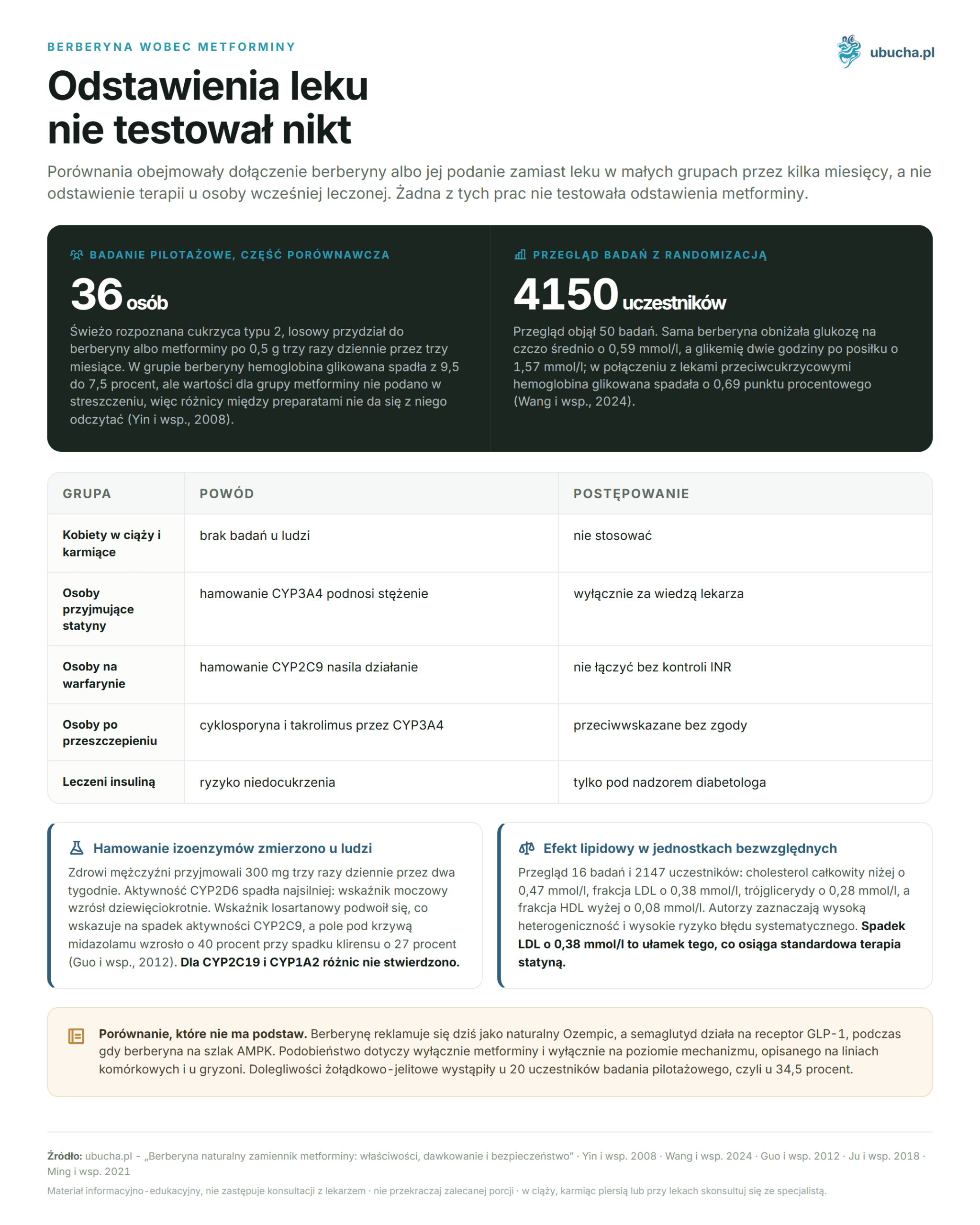
In the study Yin et al. (Metabolism: Clinical and Experimental, 2008), part A included 36 adults with newly diagnosed type 2 diabetes, randomly assigned to berberine or metformin at a dose of 0.5 g three times a day for three months. The hypoglycemic effect of berberine was similar to that of metformin, and in the berberine group, hemoglobin A1c decreased from 9.5% to 7.5%, fasting glucose from 10.6 to 6.9 mmol/l, and postprandial from 19.8 to 11.1 mmol/l. The values for the metformin group were not provided in the summary of the work, so the difference between the preparations cannot be read from it. In part B, 48 people with uncontrolled diabetes received berberine as an adjunct to treatment, and their hemoglobin A1c decreased from 8.1% to 7.3%. Transient gastrointestinal complaints occurred in 20 participants, or 34.5%.
A broader picture is provided by the systematic review Wang et al. (Frontiers in Pharmacology, 2024), which included 50 randomized studies and 4150 participants. Berberine alone reduced fasting glucose by an average of 0.59 mmol/l, and glycemia two hours after a meal by 1.57 mmol/l; in combination with antidiabetic medications, hemoglobin A1c decreased by 0.69 percentage points. The authors noted that the most commonly used dose was 0.9 to 1.5 g per day for one to three months, and they directly call for studies on the mechanism of interaction between berberine and drugs. None of these studies tested the discontinuation of metformin.
We have also noticed a recurring marketing ploy: berberine is now advertised as “natural Ozempic.” This comparison has no basis, as semaglutide acts on the GLP-1 receptor, while berberine acts on the AMPK pathway. The similarity concerns only metformin and only at the mechanistic level.
How does berberine affect cholesterol and triglycerides?
The lipid effect of berberine is better documented than the glycemic one, but expressed in absolute units, it turns out to be moderate. The review Ju et al. (Phytomedicine, 2018) included 16 randomized studies and 2147 participants with lipid disorders.
Berberine lowered total cholesterol by an average of 0.47 mmol/l, LDL fraction by 0.38 mmol/l, and triglycerides by 0.28 mmol/l, and when used alone, it raised HDL fraction by 0.08 mmol/l. The frequency of adverse effects did not differ significantly from control groups, and no serious complications were reported. The authors themselves attached a strong caveat to these conclusions: the included studies were characterized by high heterogeneity and a high risk of systematic error, so the results should be read cautiously.
The proposed mechanism concerns the PCSK9 protein, which degrades LDL receptors in hepatocytes. Less PCSK9 means more receptors capturing LDL from the blood. Cameron et al. (Atherosclerosis, 2008) demonstrated a decrease in PCSK9 expression by berberine in human HepG2 liver cell line. This is an observation from cell culture, not a measurement in patients, and should be read as such.
Quantitative comparison is, after all, sober: a decrease in LDL of 0.38 mmol/l is a fraction of what standard statin therapy achieves. Berberine is not an alternative to it, and a person who discontinues statins in favor of a supplement is replacing treatment with a measured impact on cardiovascular risk with a preparation whose impact on that risk has not been measured by anyone.
What medications interact with berberine?
This is the most serious practical consequence of using berberine and the only aspect directly studied in humans. Guo et al. (European Journal of Clinical Pharmacology, 2012) administered berberine to healthy men at a dose of 300 mg three times a day for two weeks in an alternating regimen with placebo, and then measured the activity of five cytochrome P450 isoenzymes using indicator drugs.
The activity of CYP2D6 decreased the most: the urinary ratio of dextromethorphan to dextrorphan increased ninefold. The losartan ratio doubled, indicating a decrease in CYP2C9 activity. CYP3A4 activity also decreased, as evidenced by a 40% increase in the area under the curve of midazolam and a 27% decrease in its oral clearance. No significant differences were found for CYP2C19 and CYP1A2. The authors conclude that when using berberine, one should consider drug interactions.
The practical implication is direct. These three enzymes metabolize, among others, statins, warfarin, antiarrhythmic drugs, metoprolol, cyclosporine, and tacrolimus. Inhibition of their breakdown means higher drug concentrations in the blood at unchanged doses, thus shifting towards toxic effects: myopathy with statins, bleeding with warfarin, conduction disorders with heart medications. This is not a theoretical phenomenon, but one measured in the study described above.
Separate caution applies to people treated for diabetes. Berberine lowers blood glucose, so when added to insulin or sulfonylureas, it can cause hypoglycemia. Any such combination requires the knowledge of the attending physician and more frequent measurements.
Who should not use berberine?
The list of contraindications arises directly from the properties described above and from the lack of data for some groups. The following summary organizes them according to the reason why a given group is excluded from consideration.
| Group | Reason | Procedure |
|---|---|---|
| Pregnant and breastfeeding women | No studies in humans, and berberine crosses biological barriers | Do not use |
| People taking statins | Inhibition of CYP3A4 raises statin levels, which promotes myopathy | Only with the knowledge of the attending physician |
| People on warfarin and acenocoumarol | Inhibition of CYP2C9 may enhance anticoagulant effects | Do not combine without monitoring INR |
| People who have undergone organ transplantation | Cyclosporine and tacrolimus are substrates of CYP3A4 | Contraindicated without the consent of a transplant physician |
| People treated with insulin or sulfonylureas | Risk of hypoglycemia when effects are summed | Only under the supervision of a diabetologist |
| People with a sensitive digestive tract | Gastrointestinal complaints in 34.5% of participants in the study by Yin et al. | Be aware of intolerance |
More about how supplements interact with chronic therapy can be found in the post about the safety of supplements for seniors, where the same problem is described from the perspective of polytherapy.
What has been shown in polycystic ovary syndrome?
Polycystic ovary syndrome is often associated with insulin resistance, so a substance that improves insulin sensitivity seems a natural candidate here. However, the only comparison with metformin in this group has a structure that does not allow for simple conclusions.
In the study Wei et al. (European Journal of Endocrinology, 2012), 89 women with this syndrome and insulin resistance were randomly assigned to three groups for three months: berberine with cyproterone acetate, metformin with cyproterone acetate, and placebo with cyproterone acetate. Compared to metformin, berberine resulted in a greater reduction in waist circumference, waist-to-hip ratio, total cholesterol, triglycerides, and LDL fraction, as well as a greater increase in HDL fraction and sex hormone-binding globulin.
However, an important detail of the design is that all three groups received cyproterone acetate, an antiandrogenic drug. Therefore, changes regarding androgens cannot be attributed solely to berberine. The authors summarized that the effects are likely related to changes in body composition with obesity and dyslipidemia, and they themselves called for further controlled studies. The claim that berberine regulates the menstrual cycle is not confirmed in this work.
If you are looking for a broader overview of ingredients studied for insulin sensitivity, we have gathered them in the post about supplements for insulin resistance.
Does berberine change gut microbiota?
Yes, and this is one of the few effects of berberine studied in humans in a large sample. The clue is sensible because berberine is absorbed very poorly from the intestine, so a significant portion remains in the lumen of the gastrointestinal tract and acts locally.
In a multicenter study Ming et al. (Genome Medicine, 2021), 300 people with newly diagnosed hyperglycemia were randomly assigned to four groups for 16 weeks of treatment: berberine, bifidobacteria, both interventions together, and placebo. The analysis included 297 participants. The groups receiving berberine achieved a significant decrease in fasting glucose compared to placebo, by 0.50 mmol/l for berberine alone, and a reduction in postprandial glycemia. Changes in microbiota composition from baseline were more pronounced in the groups with berberine than in the group with bifidobacteria alone and in the placebo group.
The authors cautiously conclude: berberine regulates the structure and function of gut microbiota, and bifidobacteria may enhance its hypoglycemic effect. They do not claim that the microbiota is responsible for the metabolic effect. This same mechanism of poor absorption also explains why abdominal complaints are the most common reason for discontinuing supplementation.
Frequently asked questions
Can berberine replace metformin?
There are no studies that have tested this. Comparisons involved small groups over three months, and the most frequently cited work by Yin et al. from 2008 was a pilot study on 36 people in the comparative part. Discontinuing an antidiabetic drug in favor of a supplement is a decision for the attending physician.
How does berberine affect hemoglobin A1c?
In a review of 50 studies involving 4150 participants, berberine added to antidiabetic medications reduced hemoglobin A1c by 0.69 percentage points (Wang et al., Frontiers in Pharmacology, 2024). In the study by Yin et al., the decrease in the berberine group was from 9.5% to 7.5% after three months.
Does berberine interact with medications?
Yes, and these interactions have been measured in humans. After two weeks of taking berberine, the activity of CYP2D6, CYP2C9, and CYP3A4 decreased (Guo et al., 2012). This concerns statins, warfarin, antiarrhythmic drugs, and immunosuppressants. Any chronic therapy requires a discussion with a physician.
Does berberine lower cholesterol?
In a review of 16 studies involving 2147 people, berberine lowered LDL fraction by an average of 0.38 mmol/l, total cholesterol by 0.47 mmol/l, and triglycerides by 0.28 mmol/l (Ju et al., Phytomedicine, 2018). The authors note a high risk of systematic error in the included studies.
What side effects does berberine cause?
The most common are gastrointestinal complaints. In the study by Yin et al., they occurred in 20 participants, or 34.5%, and were transient; no liver or kidney damage was observed. This is due to the poor absorption of berberine, which remains active in the intestinal lumen.
Is berberine safe during pregnancy?
It should not be used then. No studies have been conducted in this group, so safety cannot be established, and berberine is sold as a dietary supplement, not as a drug with a controlled composition. The same caveat applies to breastfeeding.
If you compare berberine with other substances studied for metabolism, the comparison of evidence is described separately in the post berberine vs metformin in light of scientific evidence.
This article is for informational and educational purposes and does not constitute medical advice. Before starting supplementation, consult your doctor, especially if you are taking medications regularly, are pregnant or breastfeeding, or have a chronic illness.
Author: Michał Waluk · Published: 2026-06-15 · Updated: 2026-08-11