
Vaporizer Ranking 2026: How to Choose a Dry Herb Model
sklep u Bucha has five dry herb vaporizers, not fifteen. Prices, temperature ranges, and monthly cost of each model as of August 2026.
The title of this post once promised fifteen vaporizers. We checked the catalog and the number did not match reality: sklep u Bucha currently offers five dry herb vaporizers. Instead of adding models no one sells here, we describe this quintet with prices taken from the store system as of August 8, 2026. The dry herb vaporizer market alone was valued at 2.8 billion USD in 2024, with a forecast of 6.1 billion by 2030 at a 13.9 percent CAGR (Grand View Research). From this text, you will learn how these five devices differ, what temperature to set, and how much cannabinoids actually reach the vapor.
KEY INFORMATION
• Arizer Solo transferred 82.7 percent THC to vapor, the highest among five tested devices (Lanz et al., PLoS ONE 2016).
• sklep u Bucha has five dry herb vaporizers priced from 374 to 499 PLN.
• Vapor at 200 and 230°C performed better than smoke, with 170°C performing worst (Pomahacova et al. 2009).
• Temperature settings range from 100°C to 240°C in the offer.
How many dry herb vaporizers does sklep u Bucha really have?
Five. All are portable, all electrically powered, and prices range between 374 and 499 PLN. We verified this on August 8, 2026 directly in the store system, not in descriptions or archived lists. There is not a single stationary device in this offer.
The previous version of this post listed fifteen models: Storz & Bickel Mighty+, Volcano Hybrid, and thirteen others. None of these can be bought here. The Storz & Bickel brand appears in the catalog only as a Volcano dry herb grinder accessory, not a heating device. The list sounded impressive but led nowhere.
Therefore, the number was removed from the title. Five devices are too few for a ranking of fifteen, and adding equipment the store does not carry would mislead readers. Instead, we describe five real units, each with a price taken from the system, and explain how we ranked them.
We did not include accessories in this five. Grinders, screens, odorless containers, and humidity regulators are in the catalog, but a dry herb grinder does not vaporize. Counting them would yield a dozen or so items and the title would again match, but dishonestly. The number in the headline should correspond to what the reader sees after clicking, not what looks good in search results.
Lists with round numbers in the title spoil faster than the catalog. A model withdrawn by the manufacturer disappears from sale within weeks, while a post with fifteen items remains on the site for years, still promising something unavailable. Therefore, this list only shows what we verified on the update date, with price and status date for each item. If a model disappears from the offer, it leaves an empty line instead of a dead link, as we do not link to individual products at all.
Dry Herb Vaporizer Ranking: Five Models from the Offer
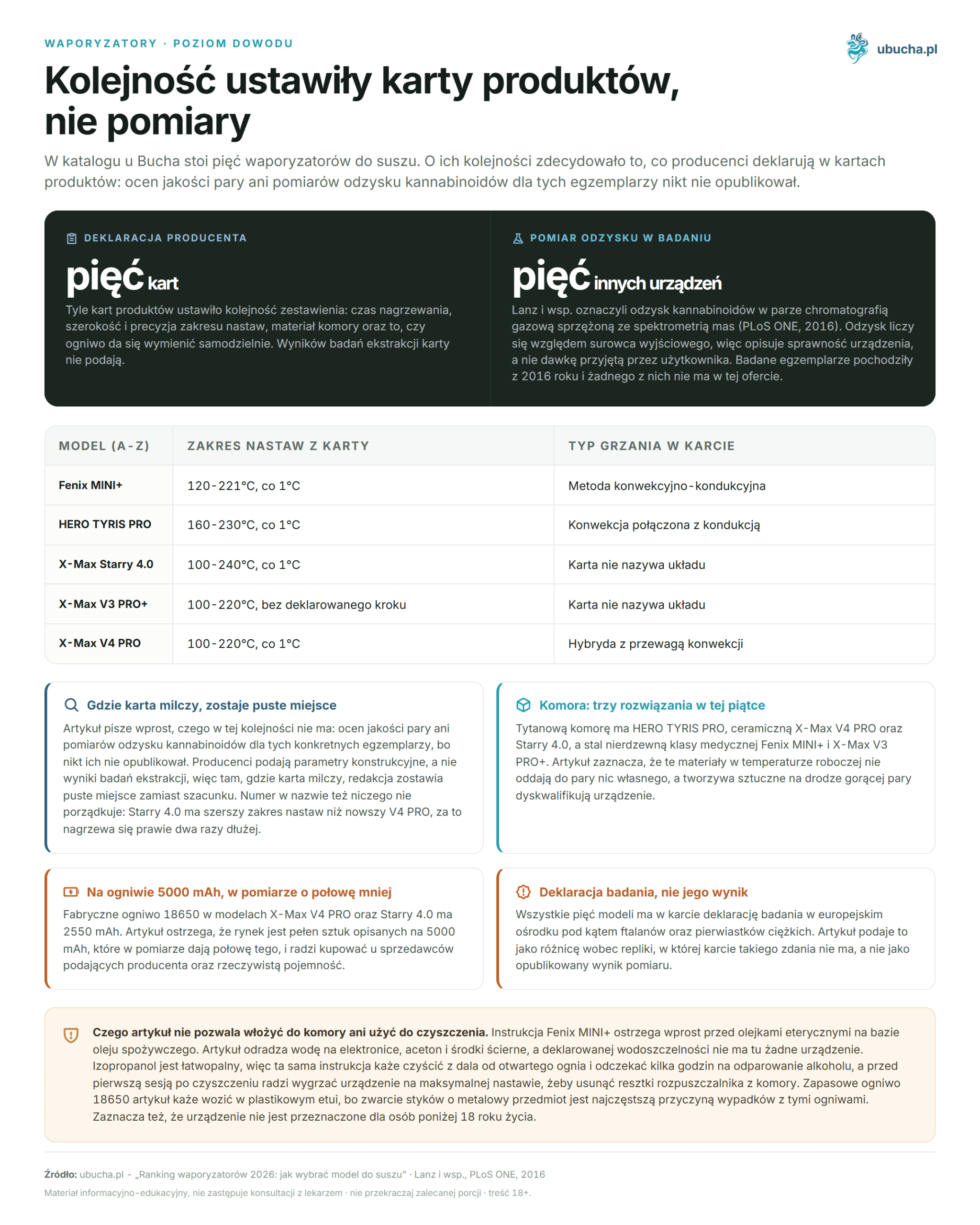
The order is based on what manufacturers declare in product sheets: heating time, width and precision of temperature range, chamber material, and whether the battery can be replaced by the user. The last column converts price into monthly cost over three years to compare models differing by a hundred or so PLN on a single scale.
| Rank | Model | Highlights | Temperature Range | Heating Type | Price | Monthly Cost (36 months) |
|---|---|---|---|---|---|---|
| 1 | X-Max V4 PRO X HERO Limited Edition | Heats in about 11 seconds, fully isolated vapor path, replaceable 18650 battery | 100-220°C in 1°C steps | hybrid with convection dominance | 499.00 PLN | 13.86 PLN |
| 2 | HERO TYRIS PRO | Titanium heating chamber, hybrid heating, vibration notifications | 160-230°C in 1°C steps | convection combined with conduction | 449.00 PLN | 12.47 PLN |
| 3 | X-Max Starry 4.0 X HERO Limited Edition | Widest temperature range in the offer, about 90 minutes runtime, ceramic chamber | 100-240°C in 1°C steps | manufacturer does not specify | 419.00 PLN | 11.64 PLN |
| 4 | Fenix MINI+ X HERO Limited Edition Plus | Smallest casing in the lineup, 5 x 8 x 2.5 cm, medical grade steel chamber | 120-221°C in 1°C steps | convection-conduction method | 419.00 PLN | 11.64 PLN |
| 5 | X-Max V3 PRO+ X HERO Limited Edition Plus | Lowest entry threshold, on demand heating, concentrate container included | 100-220°C | manufacturer does not specify | 374.00 PLN | 10.39 PLN |
The difference between first and last place is 125 PLN. The range is narrow enough that price rarely should decide: it’s easier to choose by how fast the device starts and whether you want battery access.
What is missing in this order? Vapor quality assessment or cannabinoid recovery measurements for these specific units, as none have published them. Manufacturers provide construction parameters, not extraction test results, so comparison is based on verifiable product sheet data. Where the sheet is silent, we leave blank instead of guessing. Treat the table ranking as a starting point for your own decision, not a verdict: with such close prices, the difference between first and fourth place boils down to one or two features that may weigh differently for you than for us.
Which vaporizer to choose? Three scenarios
If you search for “which vaporizer for dry herb,” the answer depends on what matters most, not ranking position. Below are three situations with different choices.
First time and unsure if you’ll keep it: take the lowest entry threshold, i.e., fifth place. The temperature range is wider than needed to start, and loss if you shelve it is smallest.
Daily use and you care about vapor quality: look at heating type in the last column and choose among the three models that specify it. Convection evens extraction at the cost of longer heat-up.
Device to carry with you: casing and heat-up time decide, not temperature range. The smallest model and the one heating in about eleven seconds are two different compromises for the same need.
What does the monthly vaporizer cost tell you?
Purchase price says little until spread over usage time. Over three years, the cheapest model costs 10.39 PLN monthly, the most expensive 13.86 PLN. The entire difference is 3.47 PLN per month, so it’s wiser to base your decision on specs than price tag.
Three years is a cautious assumption, not a forecast. Replaceable cells extend this horizon: in X-Max V4 PRO and Starry 4.0 you can swap the 18650 cell yourself when capacity drops. Devices with built-in batteries require service after cell depletion, which is often uneconomical for devices costing a few hundred PLN.
We noticed something not visible from the store shelf: price range in this category is very narrow. Five models fit within 125 PLN, so you don’t choose between cheap and expensive gear here. You choose among five devices from the same tier, differing in construction details.
Consumables add to this calculation. Spare screens cost a dozen or so PLN per set, seals similarly, and a 18650 cell is in the same price range. With one screen replacement per quarter and one cell every two years, it’s about one PLN monthly, roughly a ten percent addition to the chart amounts. All five manufacturers include spare sets in the box, so the first year usually costs nothing beyond purchase price.
How much cannabinoids really reach the vapor?
From half to four fifths, depending on the device. Lanz et al. tested five vaporizers in 2016 using gas chromatography-mass spectrometry and measured total THC and CBD in vapor. The spread between best and worst device was 28 percentage points.
Total CBD recovery followed a similar pattern: 70.0 percent for Arizer Solo, 56.1 for Plenty, 56.7 for DaVinci, and 51.4 for Volcano Medic. The only gas-powered device, Vape-or-Smoke, gave 45.9 percent and burned the material, as noted by the authors.
The previous version of this text attributed 55 percent to Volcano and called it the highest among tested models. The study says otherwise. Volcano Medic had the lowest CBD recovery among four electric devices, with Arizer Solo highest.
The second figure from this study matters more for daily use. Decarboxylation, the conversion of inactive cannabinoid acids to active forms, occurred at least 97.3 percent for THC and 94.6 percent for CBD in electric devices. In the gas-powered device it dropped to 87.7 percent. Digital temperature control makes a difference visible in numbers.
Before applying these numbers to your device, check how they were obtained. Authors measured cannabinoids in vapor by gas chromatography-mass spectrometry, and cannabinoid acids remaining in the chamber by liquid chromatography with diode detection. Recovery is relative to raw material content, describing device efficiency, not user dose. Tested units were from 2016 and none are in the current offer, so treat them as a reference point for the category.
Heating systems are analyzed separately in the text about convection, conduction and hybrid.
What is the difference between convection and conduction?
Conduction heats dry herb by contact with a hot chamber wall. Convection passes hot air through the herb, so the material does not touch heated metal. The first heats faster and is cheaper to build, the second provides more even extraction and cleaner taste.
In practice, most portable devices today are mixed designs. The manufacturer heats the chamber and simultaneously pushes air through it, combining conduction’s quick start with convection’s evenness. This costs a more complex design and higher price, as hybrids need better thermal insulation.
What does this mean for you when buying? If the taste of the first draw matters, look for convection dominance and an isolated vapor path. If you want to turn on the device and start within seconds, conduction or a hybrid with short heat-up is more convenient.
Chamber material is a separate matter, often confused with heating type. Ceramic and steel behave differently regardless of heat delivery: ceramic heats and cools slower, stabilizing temperature and reducing burning risk; steel reacts faster to setting changes. Titanium combines steel’s speed with lighter weight and corrosion resistance.
A third less discussed parameter is heating activation method. Session mode keeps the chamber hot for a set time, usually four or six minutes, then shuts off automatically. On demand mode heats only during inhalation. X-Max V4 PRO offers both modes, X-Max V3 PRO+ uses on demand heating, and HERO TYRIS PRO works in sessions from three to five minutes with auto shutoff.
Which of the five models declare hybrid heating?
Three of five. HERO TYRIS PRO describes its system as convection combined with conduction, X-Max V4 PRO as a hybrid with clear convection dominance, and Fenix MINI+ as a convection-conduction method. The other two do not specify heating type.
We checked all five product sheets; this is one of those details not visible when comparing prices. X-Max Starry 4.0 and X-Max V3 PRO+ describe chamber material, airflow regulation, and temperature range but do not name the heating system. We do not guess or add data not in the sheet.
The practical conclusion: if heating type matters most, your choice narrows to three devices. If range width or replaceable battery is more important, the product sheet fully informs for the other two.
Also watch the vapor path, not just the chamber. X-Max V4 PRO declares a fully isolated path where vapor contacts only the chamber and glass mouthpiece. Fenix MINI+ describes an isolated air channel. The goal is the same: hot vapor should not pass near electronics or structural plastics, which would carry unwanted substances.
Name similarity can mislead in comparison. The offer includes three X-Max devices: two generations of one line (V3 PRO+ and V4 PRO) and a separate Starry 4.0. The number in the name does not order them by age or capability: Starry 4.0 has a wider temperature range than newer V4 PRO but heats almost twice as long. The HERO Limited Edition suffix means a distributor-branded version with different accessories, not a different device design.
What temperature to set in a dry herb vaporizer?
Start at 190-200°C and adjust a few degrees up or down. Pomahacova et al. compared vapor at 170, 200, and 230°C with hemp cigarette smoke and found that the two higher settings had significantly better cannabinoid to byproduct ratios than smoke (Inhalation Toxicology, 2009).
All five devices cover this range, though each differently. Narrowest ranges are X-Max V3 PRO+ and V4 PRO at 100-220°C. Starry 4.0 has the widest at 100-240°C. HERO TYRIS PRO starts at 160°C, Fenix MINI+ ends at 221°C. Four of five have 1°C step regulation.
Lower settings around 180-195°C extract more terpenes and produce milder vapor with stronger aroma. Higher, 200-215°C, extract more cannabinoids and irritate the throat more. Above 230°C you risk smoldering instead of vaporizing.
There is no single good temperature for all. Dry herb moisture, grind size, and inhalation strength shift the optimum a few degrees either way. Thus, 1°C regulation is not a gimmick but a tool to find your setting in the first sessions.
A good habit is raising temperature during one session rather than fixing it once. Start at 185°C, after two draws add ten degrees, then finish near 210°C to extract remaining content. This scheme uses material more fully than a single fixed value and is possible in four models with 1°C steps. The fifth, X-Max V3 PRO+, lists 100-220°C without declared step, so adjust to its panel.
Does low temperature always mean cleaner vapor?
No, and this is the most surprising result of Pomahacova’s study. The worst cannabinoid to byproduct ratio was not at 230°C but at 170°C, the lowest tested setting. Low temperature alone does not mean cleaner vapor.
The mechanism is simple. At low settings, little cannabinoids vaporize, but volatile byproducts evaporate anyway due to lower boiling points. The ratio is unfavorable, and the user compensates with longer sessions and more draws, inhaling more of everything overall.
We noticed forum advice usually goes the other way: the lower, the healthier. This data does not confirm that. It’s more sensible to stay mid-range where the device works efficiently and shorten sessions rather than go down to 165-175°C and draw for ten minutes.
There is a limit on the high side. Above 230°C, thermal decomposition products increase, and at sufficiently high temperature the herb smolders. Lanz et al. observed burning in the only gas-powered device tested, which lacks digital temperature control. All five models here have electronic settings, so this problem does not apply.
This leads to a practical rule about session length. Two minutes at 200°C strain airways less than ten minutes at 170°C, despite intuition. It’s not just single draw temperature but total air volume passing through the chamber that counts. Auto shutoff after set time, present in all five models, manages this better than a watch. If you prefer lower settings for aroma, shorten sessions and accept some content remains in the chamber for later.
Replaceable battery or built-in accumulator?
Replaceable cells extend device life and save sessions away from home. Two models, X-Max V4 PRO and Starry 4.0, use 18650 cells with 2550 mAh capacity that you can remove and swap in seconds. HERO TYRIS PRO and Fenix MINI+ have built-in batteries.
Declared runtimes differ almost twofold. Starry 4.0 claims about 90 minutes, Fenix MINI+ up to 50 minutes with a 1600 mAh battery. All five charge via USB-C: about 80 minutes for Starry 4.0, 60 for Fenix MINI+.
Why does this matter only after two years? Lithium cells lose capacity with each charge cycle. A device with replaceable 18650 returns to form at the cost of a new cell, priced in tens of PLN. A device with built-in battery requires service, often uneconomical for a few hundred PLN device.
The flip side: built-in battery allows smaller casing. Fenix MINI+ measures 5 x 8 x 2.5 cm and is the most pocketable device here. You pay for size with shorter sessions and no battery swap in the field.
If you carry a spare cell, transport it in a plastic case, not loose with keys. Shorting contacts with metal objects is the most common cause of 18650 accidents and the only one easily avoidable. Buy from sellers listing manufacturer and actual capacity, as the market is full of cells labeled 5000 mAh but measuring half that. Factory cells in both X-Max models have 2550 mAh, a sensible reference point for spares.
What should the heating chamber be made of?
Ceramic, titanium, or medical grade stainless steel. These materials do not release anything into vapor at operating temperatures. Plastics in the vapor path disqualify a device regardless of price or looks.
The offer includes three solutions. HERO TYRIS PRO has a titanium chamber, replacing steel from the basic Tyris version. X-Max V4 PRO and Starry 4.0 use ceramic. Fenix MINI+ and X-Max V3 PRO+ have medical grade stainless steel chambers. Mouthpieces are glass in four models; Starry 4.0 adds two silicone ones.
How do they differ in daily use? Ceramic heats and cools slower, stabilizing chamber temperature and reducing burning risk. Steel and titanium react faster to setting changes, so the device is ready sooner. Titanium is lighter than steel and corrosion resistant, cited by TYRIS PRO manufacturer as reason for material change.
Screens affect vapor quality. All five models use stainless steel, replaceable screens, and manufacturers include spares. This is good, as resin-clogged screens choke airflow faster than any other part.
Dosing capsules change chamber handling and appear in four model kits. The load goes into a thin medical steel sleeve inserted and removed with residue after the session. The chamber does not contact resin, so cleaning is just wiping the capsule. The tradeoff is slightly slower heat transfer due to an extra wall between heater and herb. For short sessions the difference is negligible; at low settings you may need to raise temperature a few degrees.
What dry herb is suitable for vaporization?
Medium ground, about 60 percent relative humidity, with compact buds rather than dust at the package bottom. Overdry herb produces dust and passes through the screen. Too moist herb won’t release cannabinoids at set temperature and condenses in the mouthpiece.
Grind size matters more than commonly assumed. In conduction, material must contact the chamber wall, so coarse pieces remain unused inside. In convection, too fine dust blocks airflow and enters the channel. Medium grind, as recommended by X-Max V4 PRO sheet, is a compromise for both systems.
Chambers are small, affecting dosing. Fenix MINI+ holds 0.1-0.15 g. Other models use medical steel dosing capsules, two or three included. Capsules simplify cleaning and allow pre-preparing portions before leaving home.
In the dry herb category at sklep u Bucha, dozens of items have content and profile descriptions. For vaporization, look for compact buds with noticeable aroma upon opening. Herb smelling only of hay won’t develop character in a vaporizer, no matter the device price.
How much herb per session? With chambers around 0.1-0.15 g, one fill lasts several draws, so one gram suffices for seven to ten sessions depending on setting and chamber filling precision. This changes how you view raw material price: a five-gram pack lasts longer in vaporization than any other use form, as nothing escapes. Used material retains some content and suits baking or infusions, as seen in Lanz’s recovery spread.
How to store dry herb between sessions?
In a sealed, opaque container at room temperature with a humidity regulator inside. Light and oxygen degrade cannabinoids, and humidity fluctuations change herb behavior in the chamber from session to session, causing the same setting to produce dense vapor sometimes and none other times.
A humidity regulator is a sachet with a salt solution maintaining constant relative humidity, usually 62 percent, in the jar. It costs a few PLN and lasts several months. Without it, herb in a daily opened jar dries out in one or two weeks, producing dust that passes through the screen into the mouthpiece.
Temperature matters less than light here. Refrigeration does not help, as condensation when removing the jar raises humidity instead of stabilizing it. A cabinet away from radiators and windows suffices. Containers with hygrometers in the lid show humidity without opening, limiting air access.
Purchase quantity is also a decision, not an accident. Herb bought for a quarter loses some cannabinoids before use, as degradation is slow but constant. Jars, sachets, and odorless containers are collected in the storage category.
Choose container size based on current herb amount, not target stock. Herb in a large jar filled one quarter contacts a large air volume and oxidizes faster than the same herb in a small full vessel. So when stock shrinks weekly, it’s better to transfer the rest to a smaller container than add another sachet. Dark glass or opaque casing solves light exposure without hiding the jar deep in a cabinet.
Is a vaporizer suitable for herbs other than hemp?
Yes, and that was its original purpose. All five devices are described by manufacturers as herb vaporizers, not exclusively for hemp dry herb. Chamomile, lavender, and mint release oils in the same 150-200°C range these models operate in.
Herbal blends prepared for vaporization have an advantage over loose tea herbs. They are ground to chamber size and lack hard stems that burn faster than leaves and spoil taste. In the herbs category you’ll find ready blends labeled for vaporization.
What not to put in the chamber? Essential oils based on edible oil, which can destroy the device and are explicitly warned against in the Fenix MINI+ manual. Concentrates require separate inserts: Fenix MINI+ includes a quartz one, X-Max V3 PRO+ gets a dedicated container.
When changing raw material, remember hygiene. Before switching from aromatic herbs to hemp dry herb, clean chamber and screen, as lavender aroma remains in porous ceramic for several sessions and mixes with later vapor. This effect is weaker but not absent in steel and titanium.
Temperature ranges useful for aromatic herbs may be lower than for hemp dry herb, as volatile oils evaporate earlier than cannabinoids. This affects model choice. HERO TYRIS PRO starts at 160°C, leaving less room for experimentation with delicate herbs than the other four devices starting at 100 or 120°C. Its range suffices for hemp dry herb, with an upper limit of 230°C. When changing material, start at the lower range and raise temperature until vapor is noticeable.
How to clean a vaporizer for years of use?
After each session, empty the chamber and wipe the mouthpiece. Once a week, rinse mouthpiece and screen with isopropyl alcohol. Once a month, disassemble everything allowed by the manufacturer and soak metal parts. This takes a few minutes weekly and extends device life by years.
Cleaning kits come with all five models, though with different contents. Boxes include:
- a brush and tool for removing chamber residue,
- cotton swabs and sticks for mouthpiece and air channel,
- alcohol wipes for casing,
- spare screens and seals,
- tweezers and a tamper for Fenix MINI+.
Order matters more than you think. Remove dry residue cold first, then use alcohol. Dissolved resin spread over the chamber dries into a harder-to-remove layer than the original. After cleaning, wait for alcohol to evaporate and heat the device at max setting before the first session.
Fenix MINI+ manual specifies several hours for alcohol evaporation before reuse. This is not overcautious. Inhaling isopropanol fumes from a heated chamber is unpleasant and unnecessary. Treat screens and seals as consumables: replace screens that cannot be cleaned with spares instead of scrubbing to holes.
Clean frequency depends on usage, not calendar. One session daily means weekly mouthpiece rinse suffices. Multiple daily sessions cause residue buildup in two or three days, choking airflow noticeably. The cleaning signal is simple: draw resistance rises and vapor thins at the same setting. Dosing capsules delay this by several sessions, as most residue stays in them, not on chamber walls.
What not to use for vaporizer cleaning?
Water on electronics, acetone, and abrasives. 99 percent isopropyl alcohol on metal and glass parts does everything you need and evaporates without residue.
Immersing the device is a bad idea even if the casing looks sealed. None of the five vaporizers here have declared water resistance. Mouthpiece, screen, and dosing capsule can be soaked separately in alcohol; body with battery and display never.
Acetone dissolves glues and plastics used in casing, so one cleaning can irreversibly damage the device. Bleach and oxidizers dull steel and shorten silicone seal life. Wire brushes scratch ceramic, and scratches collect resin faster than smooth surfaces, making cleaning harder over time.
Fire safety is not excessive here. Isopropanol is flammable, so clean away from open flames and in ventilated rooms, as Fenix MINI+ manual reminds. The same manual advises heating the device at max setting before the first session after cleaning to remove solvent residues.
Silicone seals are easiest to damage accidentally during other tasks. Long soaking in alcohol reduces their elasticity, so treat briefly and separately or replace with spares. The same applies to silicone mouthpieces included with Starry 4.0. Glass and steel parts tolerate soaking without limits; ceramic too, provided you don’t scrub it with anything harder than a cotton swab. After soaking, rinse everything with clean water and dry completely before reassembly.
Is a dry herb vaporizer legal in Poland?
Yes. A vaporizer is an electric device and no law restricts its possession or sale. Restrictions apply only to what you put in it, not the device itself.
The anti-narcotics law (Dz.U. 2005 Nr 179 poz. 1485) defines fiber hemp as Cannabis sativa L. plants with total delta-9-tetrahydrocannabinol and tetrahydrocannabinolic acid in flowering or fruiting tops not exceeding 0.3 percent dry weight. The threshold was raised from 0.2 percent by the March 24, 2022 amendment effective May 7, 2022 (Dz.U. 2022 poz. 763).
Legally sold hemp dry herb in Poland fits this threshold, and batch analysis certificates confirm it. Aromatic herbs and herbal vaporization blends are not subject to these laws as they contain no regulated cannabinoids.
Beyond the law, common sense rules apply. The device is not intended for persons under 18. In public places, it’s sensible to follow the same restrictions as for e-cigarettes, even if the vaporized material is legal.
When buying dry herb, a meaningful document is the batch analysis certificate. It lists cannabinoid content measured in a lab for a specific batch number, not a seller’s strain declaration. The certificate number should match the package number; otherwise, it describes different goods. If the seller cannot show such a document, you cannot verify if the material fits the legal threshold. Abroad, regulations may differ, so transporting dry herb across borders is a separate issue, independent of device legality.
What mistakes do first-time vaporizer buyers make?
The three most common are buying a replica instead of original, ignoring heating type, and overlooking operating costs. Each costs more overall than the saved price difference.
A 200 PLN replica looks identical in photos to the original. The difference lies in what photos don’t show: vapor path material and whether anyone tested the device. All five models here declare testing in a European center for phthalates and heavy metals. You won’t find such a statement in replica sheets.
The second mistake is choosing by price and looks without checking heating method and startup time. The difference between eleven seconds in X-Max V4 PRO and thirty seconds in others seems minor on paper but is felt every session for years.
The third is ignoring what you buy later. Screens, seals, and 18650 cells cost several dozen PLN annually. A manufacturer including spare sets saves you at least the first of these purchases. A fourth less mentioned mistake is buying a device for group sessions but using it alone. Chambers in these models hold tenths of a gram and are designed for one person.
The fifth mistake concerns expectations, not the device. A person switching from smoking judges the vaporizer after the first session and finds it weak because vapor seems thinner than smoke. Visible vapor volume does not correlate with transferred ingredient amount. Lanz’s recoveries show this clearly: device differences reached 28 percentage points, and none produced dense clouds. Give yourself a week to adjust settings and grind before judging the device.
Which of the five models to choose?
It depends on what matters most. For fastest start and most refined vapor path, we recommend X-Max V4 PRO at 499 PLN. For longest session and widest temperature range, Starry 4.0 at 419 PLN. For lowest entry threshold, X-Max V3 PRO+ at 374 PLN.
HERO TYRIS PRO at 449 PLN suits those wanting a titanium chamber and vibration notifications, i.e., a device signaling readiness without screen checking. Fenix MINI+ at 419 PLN wins when the device must fit in a pocket and stay discreet. With such a narrow price range, you ultimately choose usage style, not budget.
What you won’t find here? A stationary vaporizer. If you want balloon or hose setups for group sessions, none of these five portable models replace that, and pretending otherwise would be misleading. Prices are from the store system as of August 8, 2026, so check before purchase as promotions are frequent.
If you want a simple decision path, start with two questions. Do you want battery access? If yes, choose X-Max V4 PRO or Starry 4.0. Do you want the device to disappear in your hand? Then Fenix MINI+ is the answer. If neither criterion dominates, price and heat-up time decide, as other parameter differences are small. All five have digital temperature control, replaceable screens, and phthalate testing declarations, so no choice here is a bad one.
Frequently Asked Questions
How many dry herb vaporizers does sklep u Bucha have?
Five, all portable and electric, priced from 374 to 499 PLN as of August 8, 2026. These are X-Max V4 PRO, HERO TYRIS PRO, X-Max Starry 4.0, Fenix MINI+, and X-Max V3 PRO+. The store does not carry stationary vaporizers.
Which vaporizer in the offer heats up the fastest?
X-Max V4 PRO, about 11 seconds according to the product sheet. HERO TYRIS PRO and X-Max Starry 4.0 take about 20 seconds, Fenix MINI+ about 25. X-Max V3 PRO+ works in on demand mode, activating the chamber only during inhalation instead of keeping it hot throughout the session.
What is the best temperature for hemp dry herb?
The range 190-210°C works well as a starting point. Pomahacova et al. found that the ratio of cannabinoids to byproducts in vapor obtained at 200 and 230°C was higher than in smoke from a hemp cigarette, with the worst result at the lowest tested setting, 170°C.
How much cannabinoids remain in the dry herb after a session?
From 17 to nearly 50 percent, depending on the device. Lanz et al. measured total THC recovery in vapor ranging from 54.6 percent for DaVinci to 82.7 percent for Arizer Solo. The rest remains in the chamber, so used dry herb is still suitable for baking and infusions.
Is a dry herb vaporizer legal in Poland?
Yes, the device itself is legal and not subject to restrictions. Regulations concern the raw material: the anti-narcotics law defines fiber hemp as those with THC content up to 0.3 percent dry weight, following the 2022 amendment which raised the threshold from 0.2 percent.
How often should you clean a vaporizer?
Clean the chamber after each session, the mouthpiece and screen once a week with isopropyl alcohol, and perform a full disassembly once a month. A resin-clogged screen chokes airflow and spoils taste faster than any other part, which is why manufacturers include spare sets. The dosing capsule delays this moment by several sessions.
Does a replaceable 18650 battery matter?
It does, but only after two years. You can replace the cell yourself in X-Max V4 PRO and Starry 4.0, whereas HERO TYRIS PRO and Fenix MINI+ have built-in batteries and require service after cell depletion. In return, the casing can be noticeably smaller.
All five vaporizers are in the vaporizers category at sklep u Bucha. Dry herb is collected in the dry herb category, herbal blends in herbs, and jars and humidity regulators in storage.
This article is informational and educational. It contains internal links to product categories available at sklep u Bucha. Prices and specifications may change: check current product data before purchase.
Author: Michał Waluk · Published: 2026-05-11 · Updated: 2026-08-24