Biohacking and Supplements 2026 - Nootropics, Adaptogens, CBD, Collagen, NMN Without the Hype

Nootropics, adaptogens, CBD, collagen, and NMN compared with studies: participant numbers, doses, evidence quality, and where marketing outpaces data.
Biohacking sells the promise of precision: measure, select a preparation, optimize. However, when checking sources behind the most frequently cited numbers, it turns out some do not come from the studies they reference. A 2022 meta-analysis of ashwagandha included 12 studies, not seven. The collagen review covered 11 studies on 805 people, not 19 on 1125. The caffeine with L-theanine combination was tested at different doses than most guides state, and the most cited Mediterranean diet study circulates in Polish texts in a version withdrawn by the journal. This article compares the most popular supplement stack ingredients with what is really in study abstracts: number of participants, dose, duration, and quality of evidence.
KEY INFORMATION
• Ashwagandha: meta-analysis of 12 randomized studies on 1002 people, evidence certainty rated low (Akhgarjand, Phytotherapy Research, 2022).
• Collagen: review of 11 studies on 805 people, hydrolysate 2.5-10 g daily for 8-24 weeks (Choi, Journal of Drugs in Dermatology, 2019).
• NMN in humans: one 10-week study in postmenopausal women with prediabetes (Yoshino, Science, 2021).
• CBD: provisional safe dose per EFSA is about 2 mg daily for a 70 kg person; safety cannot be established for people taking medications.
What is biohacking really in 2026?
Biohacking is self-directed health optimization based on measurement, experimentation, and observation of one’s own results. However, the term covers three practices with very different evidential weight, and confusing them causes most misunderstandings in this field.
The first is self-measurement: sleep, resting heart rate, heart rate variability, glucose from a sensor. Measurement is not an intervention, so it carries no pharmacological risk. The risk here is of a different kind: overinterpretation of noise. A single weaker result from a night measurement is not health information but just one point in a distribution.
The second practice is tailoring diet and supplements to lab test results or genetic profile. Here the evidence is weaker than test sales suggest, and I return to this in the biomarker section.
The third is experimental interventions: unregistered substances, peptides, high doses, and products bought outside regulated channels. This area lacks safety data and oversight, and responsibility falls entirely on the person doing it.
The practical conclusion from this division is simple. If the foundations don’t work, no preparation will replace them, and if they do, supplementation gains will be small. This is not a slogan but a consequence of orders of magnitude shown by numbers in the next section.
Why do sleep, diet, and exercise come before supplements?
Because they have data no supplement has. In a study comparing sleep deprivation with alcohol, 39 people underwent 28 hours without sleep and, separately, sessions with measured alcohol doses. After 17-19 hours without sleep, some test results equaled or were worse than results at 0.05 percent blood alcohol content, and reaction speed dropped by half in places (Williamson and Feyer, Occupational and Environmental Medicine, 2000).
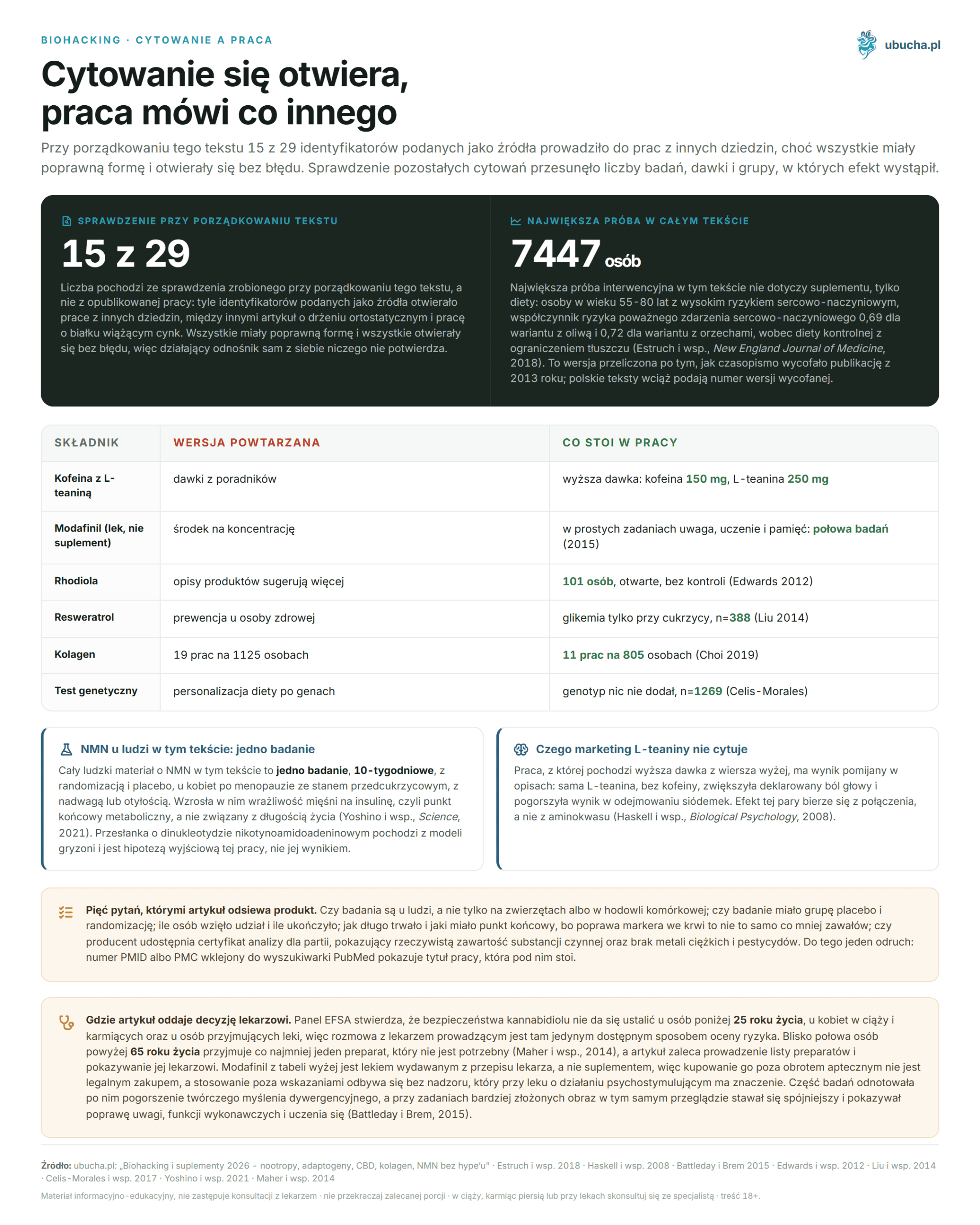
Diet has one of the largest intervention studies in this field. It included 7447 people aged 55-80 at high cardiovascular risk, assigned to Mediterranean diet with extra virgin olive oil, Mediterranean diet with nuts, or control low-fat diet. The hazard ratio for major cardiovascular events was 0.69 for the olive oil variant and 0.72 for the nuts variant (Estruch et al., New England Journal of Medicine, 2018).
It is worth knowing why the 2018 version is cited here. The original 2013 publication was withdrawn after protocol deviations were found, and authors recalculated results. Polish texts still cite the withdrawn version.
Strength training has its own data, independent of aerobic activity. A systematic review of 16 prospective studies showed muscle-strengthening exercises associate with 10-17 percent lower risk of death from any cause and cardiovascular disease, cancer, and diabetes, with the greatest reduction at about 30-60 minutes weekly (Momma et al., British Journal of Sports Medicine, 2022).
Which nootropics have the strongest evidence?
The best documented is caffeine with L-theanine, but at different doses than most guides state. In a placebo-controlled study, 50 mg caffeine was compared with the same dose combined with 100 mg L-theanine in 27 people. The combination improved speed and accuracy in an attention-switching task and reduced susceptibility to distracting information (Owen et al., Nutritional Neuroscience, 2008).
A second study from the same year used higher doses: 150 mg caffeine and 250 mg L-theanine, in a crossover randomized placebo design. The combination shortened reaction time, improved accuracy in a visual information processing test, and reduced reported mental fatigue (Haskell et al., Biological Psychology, 2008).
The same paper contains a result marketing of L-theanine does not cite. L-theanine alone, without caffeine, increased reported headache and worsened subtraction of sevens. The effect of the pair comes from the combination, not the amino acid alone.
Bacopa monnieri has a meta-analysis, but it measures something different than usually stated. The review included 9 randomized placebo-controlled studies on 518 people, all with administration lasting at least 12 weeks, analyzing 437 participants. Improvement concerned attention speed: shorter time in Trail B test and choice reaction time, not memory per se (Kongkeaw et al., Journal of Ethnopharmacology, 2014).
Is modafinil a nootropic for healthy people?
Modafinil is a prescription drug, not a supplement, which settles the matter practically before discussing efficacy. Buying it outside pharmacies is illegal, and off-label use occurs without supervision, which matters for a psychostimulant drug.
Cognitive data are less clear than headlines suggest. A systematic review covered modafinil effects in healthy, non-sleep-deprived people, published from January 1990 to December 2014. Authors found modafinil improves executive functions in simple test paradigms, but only half of studies showed improved attention and learning/memory (Battleday and Brem, European Neuropsychopharmacology, 2015).
There is also a result contradicting forum narratives. Some studies reported worsened divergent creative thinking. Only in more complex tasks did the picture become consistent, showing improved attention, executive functions, and learning.
Authors found no increased adverse effects or mood changes but emphasize methodological discrepancies and conclude with recommendations for future research. This describes an open field, not a confirmed concentration aid.
What do studies on Hericium erinaceus show?
The most cited study concerns older people with mild cognitive impairment, not healthy adults. Thirty participants aged 50-80 were randomized into two groups of 15. The active group took four 250 mg tablets containing 96 percent dried Hericium, three times daily (3 g/day) for 16 weeks (Mori et al., Phytotherapy Research, 2009).
Cognitive function scores based on a modified Hasegawa scale were significantly higher than placebo at weeks 8, 12, and 16, increasing over time. Four weeks after stopping, scores dropped significantly, suggesting an effect dependent on ongoing administration, not a lasting change.
A newer study included healthy adults and showed a more modest picture. Forty-one adults aged 18-45 received 1.8 g Hericium or placebo. After a single dose, participants performed the Stroop test faster at 60 minutes, but after 28 days only a trend toward lower subjective stress was observed, borderline significant (Docherty et al., Nutrients, 2023).
Authors call this a pilot study and caution about results due to small sample size. They also noted zero and some adverse results. Combining both studies gives one signal in a clinical population and one cautious acute signal in healthy people, not confirmed memory improvement.
Does ashwagandha really lower cortisol?
In the most cited study, it did, and this number withstands scrutiny. Sixty-four people with chronic stress were randomized to placebo or root extract, one 300 mg capsule twice daily for 60 days (600 mg/day). Serum cortisol decreased by 27.9 percent in the active group versus 7.9 percent in placebo, a statistically significant difference (Chandrasekhar et al., Indian Journal of Psychological Medicine, 2012).
The full text also notes important information for choosing a preparation. The specific commercial extract KSM-66 was studied, supplied by the manufacturer, obtained solely from root and standardized to at least 5 percent withanolides by HPLC. The result applies to this standardization, not any root powder.
A broader picture comes from a 2022 meta-analysis, often misquoted on study count. It included 12 randomized studies with 1002 participants aged 25-48. Ashwagandha reduced anxiety and stress compared to placebo, with dose-response analysis indicating benefit at 300-600 mg daily (Akhgarjand et al., Phytotherapy Research, 2022).
Authors add two caveats often omitted in citations. Heterogeneity among studies was very high, and evidence certainty was low for both outcomes. The conclusion: the effect is visible and repeatable, but the evidence base quality requires further high-quality research.
What is known about rhodiola and reishi?
Less than product descriptions suggest, and of lower quality. The most cited rhodiola study was neither randomized nor blinded. It was a multicenter open-label single-arm study where 101 people with life stress symptoms took WS 1375 extract 200 mg twice daily for four weeks (Edwards et al., Phytotherapy Research, 2012).
All questionnaires showed improvement, with first changes after three days. Without a control group, the study cannot separate preparation effect from expectation and natural symptom course, and improvement after three days argues more for the latter.
Reishi has a Cochrane review, and the result is not what appears on labels. The review included five randomized studies in oncology patients. Those receiving the mushroom with chemo- or radiotherapy responded more often, but confidence intervals included no effect (Jin et al., Cochrane Database of Systematic Reviews, 2016).
Authors conclude there is insufficient evidence to use reishi as first-line cancer treatment, and primary studies’ methodological quality was generally unsatisfactory. For consumer indications like sleep and immunity in healthy people, the review says nothing as it did not study these. I compare these three plants more broadly in the post on adaptogens for stress.
What do studies say about CBD for anxiety and sleep?
The two most cited works differ enough in quality to separate them. The first was a randomized, blinded study: 24 people with untreated social phobia received a single 600 mg cannabidiol dose or placebo before a simulated public speaking test; a separate group of 12 healthy people was included. Cannabidiol significantly reduced anxiety and discomfort during the speech (Bergamaschi et al., Neuropsychopharmacology, 2011).
The second was a retrospective review of 103 psychiatric clinic patients, with 72 analyzed: 47 with anxiety as main problem and 25 with sleep disorders. Anxiety scores decreased in the first month in 79.2 percent and remained lower, sleep scores improved in 66.7 percent but fluctuated over time (Shannon et al., The Permanente Journal, 2019).
Authors of the second study state controlled trials are needed. Documentation analysis without a comparison group cannot separate substance effect from concurrent treatment, natural symptom course, or patient expectations.
For practice, this means one distinction. The anxiety signal is real but comes from a single dose many times higher than typical daily sales and from uncontrolled observation. I discuss CBD combined with adaptogens separately in the post on synergy of CBD and adaptogens.
How much CBD is absorbed and what dose is safe?
The answer to the first question is: unknown. A systematic review of human cannabidiol pharmacokinetics collected 24 studies and found absolute bioavailability measured only after smoking, at 31 percent. No study established it for oral or sublingual routes (Millar et al., Frontiers in Pharmacology, 2018).
This removes from circulation a table repeated in Polish CBD texts, where sublingual route supposedly has 13-19 percent and oral 6-15 percent. These values do not come from human measurement. The review shows maximum concentration rises after a meal and in fat formulations, with time to peak between 0-4 hours.
The second question is answered by the latest EFSA panel position. The provisional safe dose is 0.0275 mg per kilogram body weight per day, about 2 mg daily for a 70 kg person, derived by benchmark dose method with uncertainty factor 400 (EFSA, NDA panel, 2026).
This dose applies only to supplements with cannabidiol purity at least 98 percent, without nanoparticles. The panel also states what cannot be established: CBD safety cannot be determined for people under 25, pregnant and breastfeeding women, and those taking medications. The internet claim of safety up to 1500 mg daily, attributed to a WHO report, is not supported by study abstracts it is linked to. The discrepancy between these numbers is 500-fold.
What is really known about CBG?
There is one paper describing users, which is a survey, not a clinical study. It included 127 people from the USA aged 21 and over who used cannabis products with predominance of cannabigerol in the previous six months. Most cited reasons were anxiety in 51.2 percent, chronic pain 40.9 percent, depression 33.1 percent, and insomnia 30.7 percent (Russo et al., Cannabis and Cannabinoid Research, 2022).
Reported effectiveness was high. Most rated their condition as much improved or improved, and 80 percent of those treating depression and 78.3 percent treating anxiety declared superiority over previous pharmacological treatment. Forty-four percent reported no adverse effects; most common were dry mouth and drowsiness.
Authors call their work the first survey of patients using CBG-predominant products and cautiously conclude it shows people use CBG and justifies randomized studies. It does not show CBG works.
It is worth noting what is missing, as Polish texts assign CBG a role in focus. The survey did not measure concentration or attention at all, and 51.2 percent refers to anxiety as reason for use, not improved focus. The version about morning CBG for concentration has no source in this paper.
Does collagen really work for skin?
Evidence exists, though more modest than most product descriptions state. A systematic review of randomized placebo-controlled studies included 11 papers and 805 patients. Eight used collagen hydrolysate at 2.5-10 g daily for 8-24 weeks, two used collagen tripeptide 3 g daily, one dipeptide (Choi et al., Journal of Drugs in Dermatology, 2019).
Authors formulate conclusions as preliminary but consistent: oral collagen supplementation improves skin elasticity and hydration and skin collagen density, with no adverse events reported. They emphasize lack of regulation on product quality and need to establish optimal dosing scheme.
The most cited single study included 114 women aged 45-65 who took 2.5 g of a specific bioactive peptide or placebo for 8 weeks. Wrinkle volume around eyes decreased by 20 percent versus placebo, and biopsies showed 65 percent higher type I procollagen and 18 percent elastin content (Proksch et al., Skin Pharmacology and Physiology, 2014).
Two clarifications are needed, as distorted versions circulate in Polish texts. This study had no 5 g dose arm, and a 6 percent increase in fibrillin content was not statistically significant. The effect persisted four weeks after stopping. More on types of preparations is in the post on collagen properties.
Do NMN and resveratrol slow aging?
In humans, this has not been studied at all; existing data concern something else. A 10-week randomized, placebo-controlled, double-blind study included postmenopausal women with prediabetes, overweight or obesity. Muscle insulin sensitivity and insulin signaling increased after NMN, unchanged after placebo (Yoshino et al., Science, 2021).
This is one study in a narrowly defined group with a metabolic endpoint, not lifespan-related. Authors cite rodent model rationale: obesity and aging impair nicotinamide adenine dinucleotide production, contributing to metabolic disorders. This is the study’s starting hypothesis, not proof of effect in healthy humans.
Resveratrol has more human data but performs worse than its reputation suggests. A meta-analysis of 11 randomized studies on 388 people showed significant fasting glucose, insulin, HbA1c, and insulin resistance index reduction only in diabetics. No significant effect was found in non-diabetics (Liu et al., The American Journal of Clinical Nutrition, 2014).
This reverses the typical sales narrative. If you are healthy and take resveratrol preventively, you are exactly in the group where the meta-analysis found no effect. I discuss this ingredient separately in the post on resveratrol properties.
How to recognize a marketing-driven supplement?
Five questions suffice to filter most products, all answerable in minutes. First: are there human studies, not just animal or cell culture? Second: did the study have placebo and randomization? Without these, improvement describes symptom course, not preparation effect.
Third: numbers. How many participated and completed? With samples of a few dozen, a single result resolves nothing, and authors usually note this, as seen in cited Hericium and NMN studies.
Fourth: time and endpoint. A supplement studied for four weeks says nothing about effects of year-long use, and blood marker improvement is not the same as fewer heart attacks or longer life. Fifth: does the manufacturer provide a certificate of analysis for the batch, showing actual active substance content and absence of heavy metals and pesticides?
There is also a reflex saving most time. Check citations before believing: paste the PMID or PMC number into PubMed search and read the title. While organizing this text, 15 of 29 identifiers led to studies in other fields, including an article on orthostatic tremor and one on zinc-binding protein. All were correctly formatted and opened without error.
What are real risks of combining supplements?
The greatest risk is not a single preparation but their number. A review of people over 65 states nearly half take at least one medically unnecessary drug, and polypharmacy is well documented to associate with adverse clinical effects (Maher et al., Expert Opinion on Drug Safety, 2014).
For cannabidiol, interaction risk is described specifically. A review based on registered CBD product characteristics found adverse effects in nearly half of users, dose-dependent, most common being increased aminotransferase activity, drowsiness, sleep disorders, infections, and anemia (Brown and Winterstein, Journal of Clinical Medicine, 2019).
The mechanism is known. Cannabidiol affects CYP3A4 and CYP2C19 isoenzymes and P-glycoprotein, pathways responsible for metabolism and excretion of many common drugs. Authors recommend considering dose reduction of substrates, monitoring adverse effects, or choosing alternative therapy, especially in patients with multiple diseases.
Also consider the regulator’s position cited above. Since CBD safety cannot be established in people taking medications, talking to the treating doctor before adding it to the stack is not a formality but the only available risk assessment method. The same applies to pregnant and breastfeeding women and those under 25.
Why measure biomarkers before supplementation?
To know what is lacking instead of guessing. Analysis of a representative US population study included 4495 adults and found vitamin D deficiency, defined as 25-hydroxyvitamin D concentration 20 ng/ml or lower, in 41.6 percent (Forrest and Stuhldreher, Nutrition Research, 2011).
A typical starting panel includes blood count with smear, lipid profile, fasting glucose with glycated hemoglobin, TSH, and 25-hydroxyvitamin D. Test range and frequency are set by a doctor depending on age, symptoms, and comorbidities. The point is to distinguish real from presumed deficiency before buying a preparation.
Genetic tests sold as diet personalization tools look different. A European randomized study included adults from seven countries, with 1269 completing intervention, comparing standard advice with personalized advice on three levels: diet only, diet with phenotype, and diet with phenotype and genotype (Celis-Morales et al., International Journal of Epidemiology, 2017).
The result is clear and opposite to sales promise. Personalized advice outperformed standard, but no evidence showed adding phenotype or genotype information improved effectiveness. The effect came from matching actual diet, not genetic variants.
Summary: what remains after checking sources
After matching all citations with sources, the picture narrows but strengthens. The best documented remain foundations: sleep, Mediterranean-pattern diet, and regular exercise including strength training. They have studies on thousands with hard endpoints, and no supplement in this text has such data.
In supplementation, the most repeatable signals are three things. Caffeine with L-theanine in attention tasks, ashwagandha in stress reduction with low evidence certainty, and collagen peptides in skin parameters. The rest is either promising and poorly studied, like bacopa and Hericium, or studied and disappointing, like resveratrol in non-diabetics.
Separately stands a conclusion not derivable from any single study. Supplement marketing regularly inflates study counts, shifts doses, and reverses result directions, doing so consistently enough that checking citations is now part of reading labels. The three most common distortions here concerned study count in meta-analyses, dose used, and population where effect occurred.
The practical conclusion is small and therefore credible. Three preparations for a specific measured deficiency suffice for most people, and each additional should have a named study and purpose. The assortment is gathered in the supplements category; check certificates of analysis for specific products, and leave decisions about combining supplements with medications to your doctor.
Frequently Asked Questions
Is biohacking pseudoscience?
Not entirely, but evidential weight is very uneven. Sleep, diet, and exercise have studies on thousands. Some supplements have single small studies, some only animal models. The problem is treating these three levels as equivalent.
Which nootropic has the best evidence?
The combination of caffeine with L-theanine. In a placebo-controlled study on 27 people, it improved speed and accuracy of attention switching at 50 mg caffeine and 100 mg L-theanine (Owen et al., Nutritional Neuroscience, 2008). A second study used 150 mg caffeine and 250 mg L-theanine and obtained similar results.
Does ashwagandha lower cortisol?
In a study on 64 people with chronic stress, serum cortisol decreased by 27.9 percent after 60 days of taking 300 mg twice daily, compared to 7.9 percent in placebo (Chandrasekhar et al., Indian Journal of Psychological Medicine, 2012). A meta-analysis of 12 studies confirms stress reduction but rates evidence certainty as low.
Does collagen work on wrinkles?
In a study on 114 women aged 45-65, taking 2.5 g bioactive peptide for 8 weeks reduced wrinkle volume around eyes by 20 percent versus placebo (Proksch et al., Skin Pharmacology and Physiology, 2014). A review of 11 studies on 805 people confirms improved skin elasticity and hydration.
Does resveratrol benefit a healthy person?
A meta-analysis of 11 randomized studies on 388 people showed improved glycemic control only in diabetics. No significant effect was found in non-diabetics (Liu et al., The American Journal of Clinical Nutrition, 2014).
How many supplements can be safely combined?
No number is established by research. However, polypharmacy associates with adverse clinical effects, and nearly half of people over 65 take at least one unnecessary preparation (Maher et al., Expert Opinion on Drug Safety, 2014). Keep a list and show it to your doctor.
Do genetic tests help tailor diet?
In a European randomized study completed by 1269 people, personalized advice outperformed standard, but adding genotype information did not improve effectiveness (Celis-Morales et al., International Journal of Epidemiology, 2017). The effect came from matching actual diet, not genetic variants.
What CBD dose is considered safe?
The EFSA panel derived a provisional safe dose of 0.0275 mg per kilogram body weight per day, about 2 mg daily for a 70 kg person (EFSA, 2026). Safety cannot be established for people under 25, pregnant and breastfeeding women, and those taking medications.
This article is for informational and educational purposes and does not constitute medical advice. Before starting cannabis or CBD for therapeutic purposes, consult a doctor, especially if you take other medications, are pregnant, or breastfeeding.
Author: Michał Waluk · Published: 2026-05-11 · Updated: 2026-08-10