
Turkey Tail Mushroom (Trametes versicolor): for Immunity and Gut Health (Table)
PSK, PSP, and microbiota without marketing: a meta-analysis of 8009 patients, a phase I study in nine women, and how a supplement differs from a preparation studied.
Turkey Tail Mushroom is one of the few fungi whose extracts have made it into meta-analyses involving thousands of patients, rather than just promotional materials. A meta-analysis of eight studies with central randomization included 8009 patients with gastric cancer after radical resection and showed that adding PSK to chemotherapy was associated with a lower risk of death (Oba et al., Cancer Immunology, Immunotherapy, 2007). This sounds strong, but it concerns a standardized pharmaceutical preparation administered under the supervision of an oncologist, not capsules from a supplement store. This article separates these two things and shows what was actually measured in Turkey Tail research and where the evidence ends at the manufacturer’s declaration.
KEY INFORMATION
• PSK added to chemotherapy for gastric cancer: hazard ratio for death 0.88 (95% CI 0.79-0.98) in a meta-analysis of 8009 patients (Oba et al., Cancer Immunology, Immunotherapy, 2007).
• PSK and PSP are two different preparations from two different strains of the same fungus (Fisher and Yang, Anticancer Research, 2002).
• In a phase I study, a dose of up to 9 g per day was tolerated, but nine adverse events were reported, including one severe (Torkelson et al., ISRN Oncology, 2012).
• PSP changed the microbiota composition consistent with prebiotic action in 22 healthy volunteers (Pallav et al., Gut Microbes, 2014).
• A shelf supplement is not the same preparation that was studied in oncology.
What is Turkey Tail Mushroom and where does the name turkey tail come from?
Turkey Tail Mushroom (Trametes versicolor, formerly Coriolus versicolor) is a common wood-decaying fungus from the Polyporaceae family, growing on dead hardwood in Europe, Asia, and North America. The English name turkey tail comes from the concentric bands in shades of brown and beige.
In Poland, you can find it all year round, most often on stumps and thicker branches of hardwood trees. The fruiting body is thin and hard, so it is not suitable for eating. Everything that interests researchers is found in water and alcohol extracts from the fruiting body or mycelium, not in the cap itself.
The fungus has a long history in Eastern medicine and is mentioned in Chinese herbal literature under the name Yun Zhi. This tradition explains why Japanese and Chinese researchers studied it earlier than European ones, but it does not prove anything in itself: the age of use does not replace controlled group studies. Modern documentation of Turkey Tail begins only in the 1970s when a polysaccharide bound to protein, PSK, was isolated from it.
In the European Union, Turkey Tail is now sold as a dietary supplement. This has specific legal consequences: the supplement manufacturer cannot claim it treats or prevents diseases, even if it refers to oncological studies. A pharmaceutical preparation and a supplement are two different categories, even though the raw material may be the same. You can find more about this distinction in the class of medicinal fungi in our guide to medicinal mushrooms.
What are the differences between PSK and PSP?
These are two separate preparations, not two names for the same substance. PSK (polysaccharide K, krestin) was obtained in Japan from the CM-101 strain of Turkey Tail, while PSP (polysaccharopeptide) was obtained in China from the COV-1 strain. Both are polysaccharides bound to protein, both have documented activity in human studies, but PSK has been studied much longer (Fisher and Yang, Anticancer Research, 2002).
This distinction is practically significant because results from one preparation are often transferred in marketing texts to the other, and from there to any Turkey Tail powder. Meanwhile, PSK from oncological studies is a substance with a defined composition, produced by one method from one strain. An extract from the fruiting body purchased in a store has a different profile, different molecular weight of polysaccharides, and different protein content.
The mechanism of action of both preparations is described as modification of the biological response: stimulation of NK cells and lymphocytes and changes in cytokine secretion. Authors of reviews from 2002 and 2012 consistently note that these mechanisms have not been fully explained, despite about forty years of research (Sun et al., Current Medicinal Chemistry, 2012). It is worth remembering this, as popular descriptions present this mechanism as an established fact. Polysaccharides of this type belong to a broader family of beta-glucans, which we describe separately in the post about beta-glucans and immunity.
What have clinical studies shown about Turkey Tail?
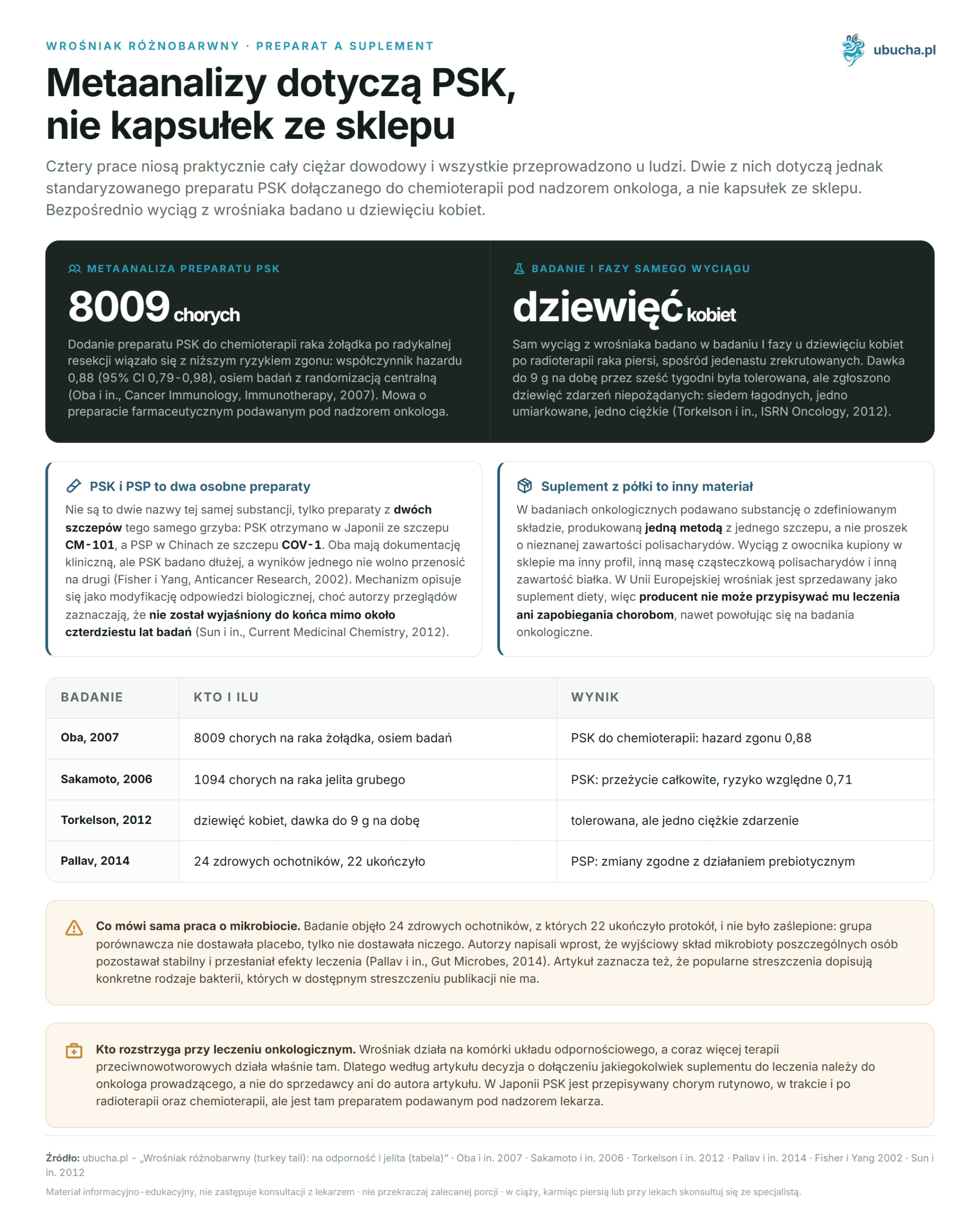
Four studies carry practically the entire weight of evidence: two meta-analyses of earlier Japanese oncological studies, one phase I study in women after breast cancer treatment, and one microbiota study in healthy volunteers. The table below provides information on who was studied, with what, and with what results. The numbers describe these studies and are not recommendations for the reader.
| Study | Who and how many | Preparation | Result |
|---|---|---|---|
| Oba et al., 2007 Cancer Immunology, Immunotherapy |
8009 patients with gastric cancer after radical resection, eight studies with central randomization | PSK added to chemotherapy | Hazard ratio for death 0.88 (95% CI 0.79-0.98; P = 0.018), no significant heterogeneity |
| Sakamoto et al., 2006 Cancer Immunology, Immunotherapy |
1094 patients with colorectal cancer after radical resection, three studies, at least five-year observation | PSK added to chemotherapy | Relative risk for overall survival 0.71 (95% CI 0.55-0.90; P = 0.006) and for disease-free survival 0.72 (95% CI 0.58-0.90; P = 0.003) |
| Torkelson et al., 2012 ISRN Oncology |
Nine women after breast cancer radiotherapy, out of eleven recruited; phase I study with dose escalation | Extract from Turkey Tail, 3, 6, or 9 g per day in divided doses for six weeks | Dose up to 9 g per day tolerated; nine adverse events (seven mild, one moderate, one severe); increase in lymphocyte count at 6 and 9 g |
| Pallav et al., 2014 Gut Microbes |
24 healthy volunteers randomly assigned to PSP, amoxicillin, or no treatment; 22 completed the protocol | PSP from Turkey Tail, stool samples taken seven times over eight weeks | Consistent changes in microbiota corresponding to prebiotic action; baseline microbiota composition overshadowed treatment effect |
Does Turkey Tail change gut microbiota?
Yes, but the study that confirmed this in humans is small and speaks more cautiously than product descriptions repeat. In Pallav’s study, 24 healthy volunteers were randomly assigned to PSP, amoxicillin, or a no-treatment group. The authors found that PSP induced clear and consistent changes in the microbiota, consistent with prebiotic action.
Two caveats from the same study rarely make it into promotional materials. First, the control group did not receive a placebo, they received nothing, so the study was not blinded. Second, the authors explicitly stated that the baseline microbiota composition of individuals remained stable and overshadowed treatment effects. In other words: what you come with weighed more than what you received.
Popular summaries of this study add specific types of bacteria that are not in the available summary of the publication. We did not confirm such a calculation at the source, so we do not provide it here. For comparison, this study also showed the other side of the coin: amoxicillin increased the proportion of Escherichia and Shigella, and the changes persisted for another 42 days after the antibiotic was stopped. This finding is strong and little discussed.
What is known about Turkey Tail in oncology, and what is not known?
It is known that PSK added to chemotherapy after radical surgery improved survival in two meta-analyses: for gastric cancer, the hazard ratio was 0.88, and for colorectal cancer, it was 0.71 for overall survival. In Japan, PSK is routinely prescribed to cancer patients during and after radiotherapy and chemotherapy.
However, it is not known whether a shelf supplement does anything of the same. Studies involved a standardized preparation, not a powder with unknown polysaccharide content. It is also unknown whether results from earlier Japanese studies, summarized in meta-analyses from 2006 and 2007, transfer to chemotherapy conducted today, as protocols have changed significantly over this time.
A separate issue is safety during oncological treatment. Turkey Tail acts on immune system cells, and more and more cancer therapies also act there. Therefore, the decision to add any supplement to treatment belongs to the attending oncologist, not to the seller or the author of the article. If you are undergoing therapy, treat this as the only statement from this section that has practical application.
How to choose a Turkey Tail supplement?
Three things are decisive: the type of raw material, the declared polysaccharide content, and independent testing of batches. The label should indicate whether the capsule contains an extract from the fruiting body or biomass of mycelium grown on a grain substrate. The latter is sometimes sold under the same name and carries a share of substrate residues that no one declares.
The declared polysaccharide or beta-glucan content allows for comparison between two products. Without it, the weight of the capsule says nothing, as it is unclear how much of it constitutes the active substance. We did not find any publication that established a percentage threshold distinguishing an effective product from an ineffective one, so treat this number as a comparative tool, not as a guarantee.
The third thing is a certificate of analysis for a specific batch, issued by a laboratory unrelated to the manufacturer. It checks both content and contamination: heavy metals accumulate in fungi particularly readily, as the mycelium absorbs them from the substrate. Tea made from dried fruiting bodies is a traditional and inexpensive form, but it does not allow for estimating how much active substance actually passed into the brew.
How does Turkey Tail differ from Reishi, Chaga, and Lion’s Mane?
Primarily in that it has meta-analyses with thousands of patients behind it, not single studies. The other fungi in this category have different profiles of active compounds and different research histories, so comparing them in a single ranking is misleading.
Reishi (Ganoderma lucidum) contains triterpenoids in addition to polysaccharides, which Turkey Tail does not have, and is often described as an adaptogen. Lion’s Mane (Hericium erinaceus) is mainly studied in the context of the nervous system, which is a completely different area, as we describe more broadly in the post about Lion’s Mane. Chaga (Inonotus obliquus) carries melanins and phenolic compounds with antioxidant action, but we have not found evidence in humans on a scale comparable to PSK meta-analyses for it.
Among these four, Turkey Tail has the most extensive clinical documentation and is therefore a reasonable starting point. For comparison in the same category, shiitake and maitake are also suitable, described in a separate post. The Bucha store currently has extracts of Reishi, Chaga, and Lion’s Mane in the herbs category.
Frequently Asked Questions
What is Turkey Tail Mushroom?
It is a common wood-decaying fungus Trametes versicolor, formerly classified as Coriolus versicolor, growing on dead hardwood in Europe, Asia, and North America. The English name turkey tail comes from the concentric bands resembling a turkey’s tail. The fruiting body is hard and inedible, so extracts from the fruiting body or mycelium are used.
What is the difference between PSK and PSP?
These are two separate preparations from two strains of the same fungus: PSK was obtained in Japan from the CM-101 strain, while PSP was obtained in China from the COV-1 strain. Both are polysaccharides bound to protein and both have clinical documentation, but PSK has been studied longer (Fisher and Yang, Anticancer Research, 2002). Results from one should not be transferred to the other.
Does Turkey Tail improve survival in cancer?
Two meta-analyses of Japanese studies suggest this, but they concern the PSK preparation added to chemotherapy after radical surgery, not a supplement. In gastric cancer, the hazard ratio for death was 0.88 among 8009 patients (Oba et al., 2007), and in colorectal cancer, it was 0.71 among 1094 patients (Sakamoto et al., 2006).
Does Turkey Tail affect the gut?
A study in humans involved 24 healthy volunteers and showed that PSP induces consistent changes in the microbiota corresponding to prebiotic action (Pallav et al., Gut Microbes, 2014). The control group did not receive a placebo, they received nothing, and the authors noted that the baseline microbiota composition overshadowed the treatment effects.
Is Turkey Tail safe?
In a phase I study, a dose of up to 9 g per day for six weeks was tolerated by nine women after radiotherapy, but nine adverse events were reported, including one severe (Torkelson et al., ISRN Oncology, 2012). No nausea or gastrointestinal complaints were recorded in this study. Individuals allergic to fungi should exercise caution.
Can Turkey Tail be combined with chemotherapy?
Only after consultation with the attending oncologist. In Japan, PSK is routinely prescribed to patients during and after radiotherapy and chemotherapy, but it is a preparation administered under medical supervision. A supplement purchased independently does not have the same composition, and oncological treatment increasingly acts on the same immune system cells.
This article is for informational and educational purposes only and does not constitute medical advice. Before starting supplementation, consult your doctor, especially if you are taking medications regularly, are pregnant or breastfeeding, or have a chronic illness.
Author: Michał Waluk · Published: 2026-07-15 · Updated: 2026-08-15