
Beta-glucan for immunity: how it works and how much to take (table)
Beta-glucan binds to the Dectin-1 receptor and trains innate immunity. Check what clinical studies have really shown and how raw material sources differ.
Beta-glucans are polysaccharides that make up the cell walls of yeasts, fungi, and cereal grains, and immunologists have been interested in them for several decades because they are one of the few dietary components that have a recognized receptor in the immune system. However, a layer of promises has grown around this mechanism, which clinical studies do not confirm in the form in which they circulate on the internet. This text separates these two layers: it describes what is known about the action of beta-glucan at the cellular level, how oat sources differ from yeast sources, and what exactly studies involving humans have shown, including those that showed nothing. Along the way, we clarify two claims repeated in commercial descriptions: about a thirty percent reduction in the number of infections and about an increase in secretory immunoglobulin A in the respiratory tract. Neither of them is confirmed in the studies usually cited in their support.
KEY INFORMATION
• Beta-glucan with a 1,3/1,6 structure binds to the Dectin-1 receptor on macrophages, as described in a 2002 study in the Journal of Experimental Medicine.
• The mechanism of trained immunity involves epigenetic reprogramming of innate immune cells, not immediate stimulation.
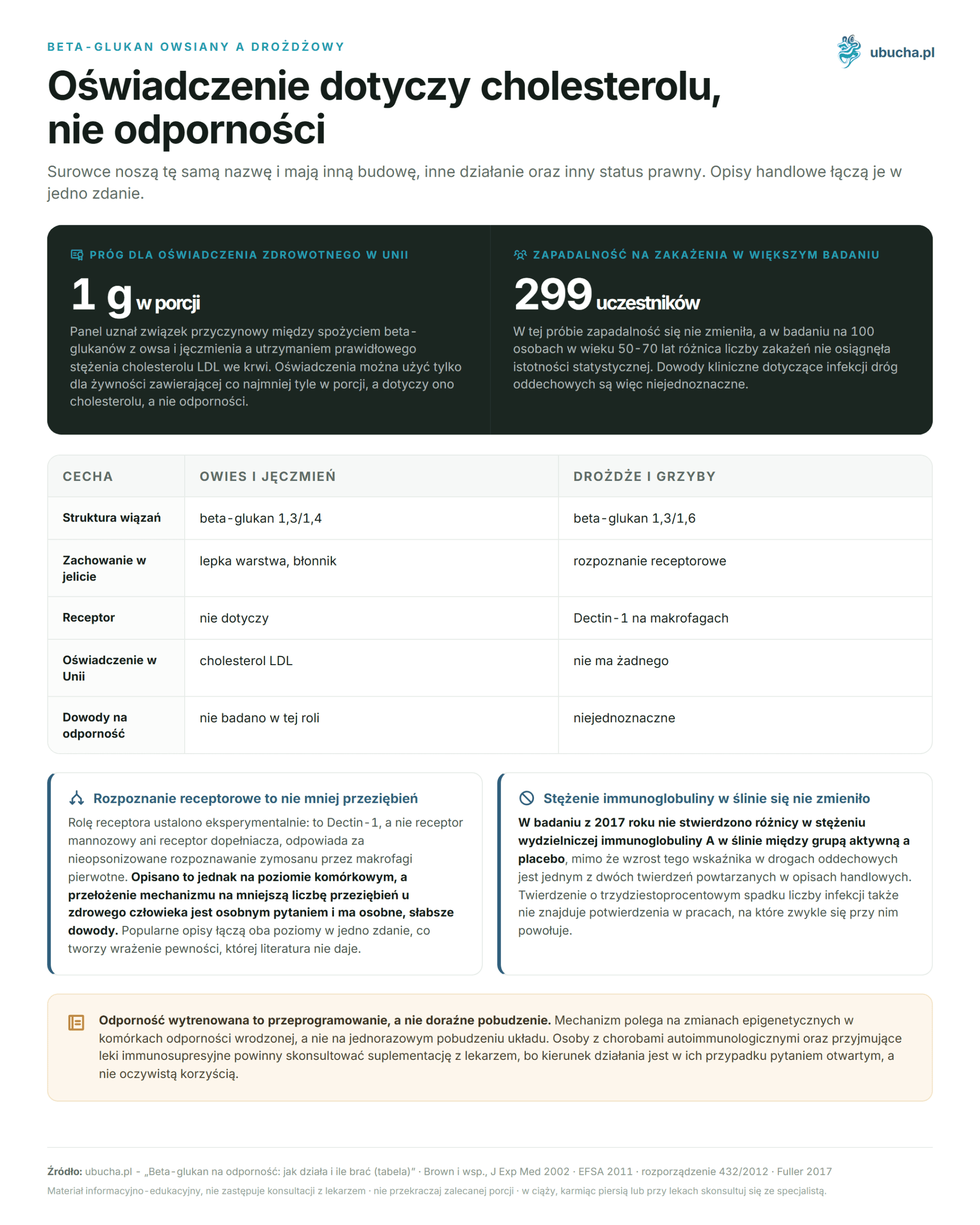
• Clinical evidence regarding respiratory infections is inconclusive: in a study of 100 people aged 50-70, the difference in the number of infections did not reach statistical significance, and in a study of 299 people, the incidence did not change.
• The only health claim allowed in the EU for beta-glucans from oats and barley concerns cholesterol, not immunity.
• People with autoimmune diseases and those taking immunosuppressive drugs should consult supplementation with a doctor.
How does beta-glucan affect immunity?
Through recognition by the receptor, not through general “enhancement”. Beta-glucan with a 1,3/1,6 structure, derived from yeasts and fungi, is bound by the Dectin-1 lectin receptor present on the surface of macrophages and other phagocytic cells. This recognition triggers a controlled cellular response, not an avalanche-like one.
The role of this receptor has been established experimentally. In a study published in 2002 in the Journal of Experimental Medicine, it was shown that it is Dectin-1, not the mannose receptor or complement receptor CR3, that is responsible for the unopsonized recognition of zymosan by primary macrophages, and that it is the sought-after beta-glucan receptor of leukocytes (Brown et al., J Exp Med 2002). The authors pointed to Dectin-1 as a target for research on the immunomodulatory properties of beta-glucans.
However, it must be pointed out where what has been proven ends. Receptor recognition has been described at the cellular level, while the translation of this mechanism into a lower number of colds in a healthy person is a separate question and has separate, weaker evidence. Popular descriptions combine both levels into one sentence, creating an impression of certainty that the literature does not provide. The circulating claim about the increase in secretory immunoglobulin A in the respiratory tract is an example of this: in the study by Fuller described below from 2017, no difference in IgA concentration in saliva was found between the active group and placebo.
What is the difference between oat beta-glucan and yeast beta-glucan?
By the structure of the bonds, and therefore by completely different actions. Beta-glucan from oats and barley has a 1,3/1,4 structure and primarily behaves like soluble dietary fiber: it creates a viscous layer in the small intestine that slows glucose absorption and limits the reabsorption of bile acids.
This effect is the only one for which the European Union has allowed a health claim. The EFSA panel recognized a causal relationship between the consumption of beta-glucans from oats and barley and the maintenance of normal LDL cholesterol levels in the blood (EFSA, scientific opinion from 2011). According to regulation 432/2012, claims can only be used for foods containing at least 1 g of beta-glucans per serving, and consumers must be informed that the effect is achieved with a daily intake of 3 g from oats, oat bran, barley, or barley bran.
Yeast and fungal beta-glucan, on the other hand, has a 1,3/1,6 structure, meaning a main chain with numerous side branches, and it is the ligand for Dectin-1. For this fraction, no health claim regarding immunity has been allowed in the EU, which does not mean that there is no research, only that the collected material has not been sufficient to establish a causal relationship. We describe fungal sources of beta-glucans separately in the entry about turkey tail.
What do studies on respiratory infections show?
A mixed picture, in which the signal concerns rather the course of the infection than its incidence. Three controlled studies, conducted in different populations and with different doses, provide answers that cannot be summarized in one percentage number, and that is exactly how they are most often summarized.
| Study | Who and how many participants | Dose and time | Result |
|---|---|---|---|
| Talbott 2009 | 75 marathon runners, 35 men and 40 women, aged 18-53 | placebo or 250 mg or 500 mg of beta-glucan 1,3/1,6 daily for 4 weeks after the marathon | both active groups had significantly fewer upper respiratory infection symptoms and better mood scores than placebo |
| Fuller 2017 | 100 people aged 50-70 living independently | 250 mg of yeast beta-glucan or placebo for 90 days in winter | 28 confirmed infections in placebo versus 17 in the active group, odds ratio 0.55 with a confidence interval of 0.24-1.26 and p = 0.149, i.e., without significance; no difference in IgA in saliva |
| Dharsono 2019 | 299 adults reporting at least 3 infections in the previous year | 900 mg of brewer’s yeast beta-glucan or placebo for 16 weeks in winter | incidence and overall severity unchanged; significantly milder physical symptoms in the first week of the episode |
The study in the older population did not reach the significance threshold for the number of infections, although the direction of the difference was favorable, and the authors noted a strong trend towards a reduction in the number of days with symptoms and emphasized the need for larger trials (Fuller et al., Nutrition 2017). The study on a larger group of frequently ill individuals directly stated a lack of impact on incidence while simultaneously alleviating symptoms in the first days of the episode (Dharsono et al., J Am Coll Nutr 2019).
The third study was conducted on marathon runners, i.e., in a group with temporarily reduced immunity after intense exertion, and there both doses were associated with significantly fewer infection symptoms than placebo (Talbott and Talbott, J Sports Sci Med 2009). The practical conclusion is therefore more cautious than the headlines: the evidence supports milder infection courses, not that there will be fewer infections. A broader review of supportive ingredients can be found in the entry about natural immunity supplements.
What is trained immunity?
The ability of innate immune cells to remember previous contact, although it was classically attributed solely to lymphocytes. This concept explains why the effect of beta-glucan, if it occurs, appears with a delay and lasts longer than would be expected from the mere presence of the substance in the body.
Research by Mihai Netea’s team described the mechanism: monocytes and macrophages, after contact with certain stimuli, undergo epigenetic and metabolic reprogramming, allowing them to respond more quickly and strongly to subsequent, even unrelated pathogens (Netea et al., Science 2016). The change is recorded in the structure of chromatin, not in antibodies, and concerns the readiness of the cell, not its specificity.
For the reader, this means a simple consequence: beta-glucan is not an immediate remedy. Cell reprogramming takes time, so starting supplementation during an acute infection has no mechanistic basis, and clinical studies have been conducted exclusively in a preventive scheme, with administration over many weeks before or during the season. It should also be remembered that trained immunity is a described biological phenomenon, not proof of the effectiveness of a specific supplement.
Is beta-glucan safe?
In available studies with a control group, no tolerance issues were reported, and oat beta-glucan is a common component of the daily diet. In a study involving 100 people aged 50-70, who were given 250 mg of yeast beta-glucan for 90 days in winter, the authors stated directly that supplementation was well tolerated. However, data on longer administration of concentrated preparations are limited and come from trials involving hundreds, not thousands, of people.
Caution is advised in several situations. People with autoimmune diseases, such as lupus or rheumatoid arthritis, should consult supplementation with a doctor, as stimulating innate immunity could theoretically exacerbate an existing process. The same applies to individuals who have undergone organ transplantation and are taking immunosuppressive drugs, as the impact on the effectiveness of therapy has not been studied.
For pregnant and breastfeeding women, there is a lack of data to assess the safety of concentrated preparations, so it is wiser to stick to natural sources present in the diet, namely oats and edible mushrooms. The situation for children is similar: oat beta-glucan is a natural component of meals, while concentrated preparations require discussion with a pediatrician. The issue of supplementation in the youngest is discussed more broadly in the entry about immunity supplements for children.
How to read the label of a beta-glucan supplement?
Starting with the source of the raw material, as it determines which mechanism is even in play. The 1,3/1,6 fraction comes from baker’s or brewer’s yeast and from fungi, and it is the ligand for Dectin-1. The 1,3/1,4 fraction comes from oats and barley, and its documented action concerns lipid metabolism.
The second thing is standardization. A good preparation states the percentage content of beta-glucan in the extract, as without this number, the mass of the capsule says nothing about the amount of the active fraction. Mushroom preparations should also be checked for whether the raw material is the fruiting body or the substrate with mycelium, as the content of polysaccharides can be incomparable in these two cases.
The third thing is confirmation of quality by independent testing. Analysis performed by an external laboratory usually includes heavy metals and microbiological purity, which is especially important for fungal raw materials. It is also worth avoiding mixtures advertised as immune complexes, in which beta-glucan is one of many ingredients without stated content. You can find beta-glucan preparations in the supplements category, and discuss dosing with a doctor or pharmacist, as this text describes studies, not recommendations.
Frequently asked questions
How does beta-glucan affect immunity?
Beta-glucan with a 1,3/1,6 structure is recognized by the Dectin-1 receptor on macrophages, as shown in a 2002 study in the Journal of Experimental Medicine. Recognition triggers the response of innate immune cells. However, the translation of this mechanism into a lower number of infections in humans has separate and weaker evidence.
Does beta-glucan reduce the number of colds?
The evidence is inconclusive. In a study of 100 people aged 50-70, the difference in the number of confirmed infections did not reach statistical significance, and in a study of 299 adults, the incidence did not change. However, both reported milder symptom progression, so the signal concerns the course, not incidence.
What is the difference between beta-glucan 1,3/1,6 and 1,3/1,4?
The 1,3/1,6 fraction from yeast and fungi is a ligand for the Dectin-1 receptor on innate immune cells. The 1,3/1,4 fraction from oats and barley acts as soluble fiber, and this is the only health claim allowed in the EU, relating to maintaining normal LDL cholesterol levels.
Does beta-glucan help during an ongoing infection?
There is no basis for expecting this. The mechanism of trained immunity involves epigenetic reprogramming of cells and requires time, and all clinical studies have been conducted in a preventive scheme, with administration over many weeks. During an ongoing cold, hydration and rest are more important.
Is beta-glucan safe for children and pregnant women?
Oat beta-glucan is a natural component of the diet and is not questionable in this form. For concentrated preparations, there is a lack of data to assess safety during pregnancy and breastfeeding, and for children, the decision to supplement should be discussed with a pediatrician, especially in cases of chronic diseases.
How to recognize a good quality beta-glucan supplement?
By clearly stating the source of the raw material, by standardization for the percentage content of beta-glucan in the extract, and by available testing from an independent laboratory for heavy metals and microbiological purity. For mushroom preparations, it is also important to know whether the raw material is the fruiting body or the substrate with mycelium.
This article is for informational and educational purposes and does not constitute medical advice. Before starting supplementation, consult with a doctor, especially if you are taking medications regularly, are pregnant or breastfeeding, or have chronic illnesses.
Author: Michał Waluk · Published: 2026-08-09 · Updated: 2026-08-11