
Magnesium for Stress and Sleep: Differences Between Forms and How to Choose the Right One
Forms of magnesium in studies: what has really been measured regarding absorption, migraines, cramps, and insulin resistance. Three popular claims turned out to be reversed.
Magnesium is a cofactor in over three hundred enzymatic reactions, and a clinical review published in Scientifica estimates that nearly two-thirds of the Western population does not meet the recommended daily intake of this element (Schwalfenberg and Genuis, Scientifica, 2017). This sounds like a simple argument for supplementation, but several claims along the way do not withstand scrutiny at the source. For nighttime calf cramps, the Cochrane review yielded negative results. For migraines, two studies from the same year produced opposing results. This text organizes the differences between forms of magnesium based on what has actually been measured and shows where the evidence is strong and where it simply does not exist.
KEY INFORMATION
• Nearly two-thirds of the Western population does not meet the recommended intake of magnesium (Schwalfenberg and Genuis, Scientifica, 2017).
• Magnesium citrate dissolves in water at 55%, while oxide is practically insoluble in it (Lindberg, Journal of the American College of Nutrition, 1990).
• In migraines, Peikert’s study showed a 41.6% reduction in the number of attacks compared to 15.8% in placebo, but Pfaffenrath’s study from the same year was stopped because there was no advantage over placebo.
• The Cochrane review found it unlikely that magnesium prevents muscle cramps in older adults (Garrison, Cochrane Database of Systematic Reviews, 2020).
• Popular ranges of bioavailability for individual magnesium salts do not come from studies; publications provide numbers only for a few forms.
Does the form of magnesium really matter?
It does, but not to the extent suggested by tables circulating on the internet. The chemical form determines the solubility of the salt in gastric contents, and solubility translates into how much of the element gets into the blood. The difference is measured and significant where two specific salts have been compared. It is, however, unmeasured where comparisons provide precise ranges for six or seven forms at once.
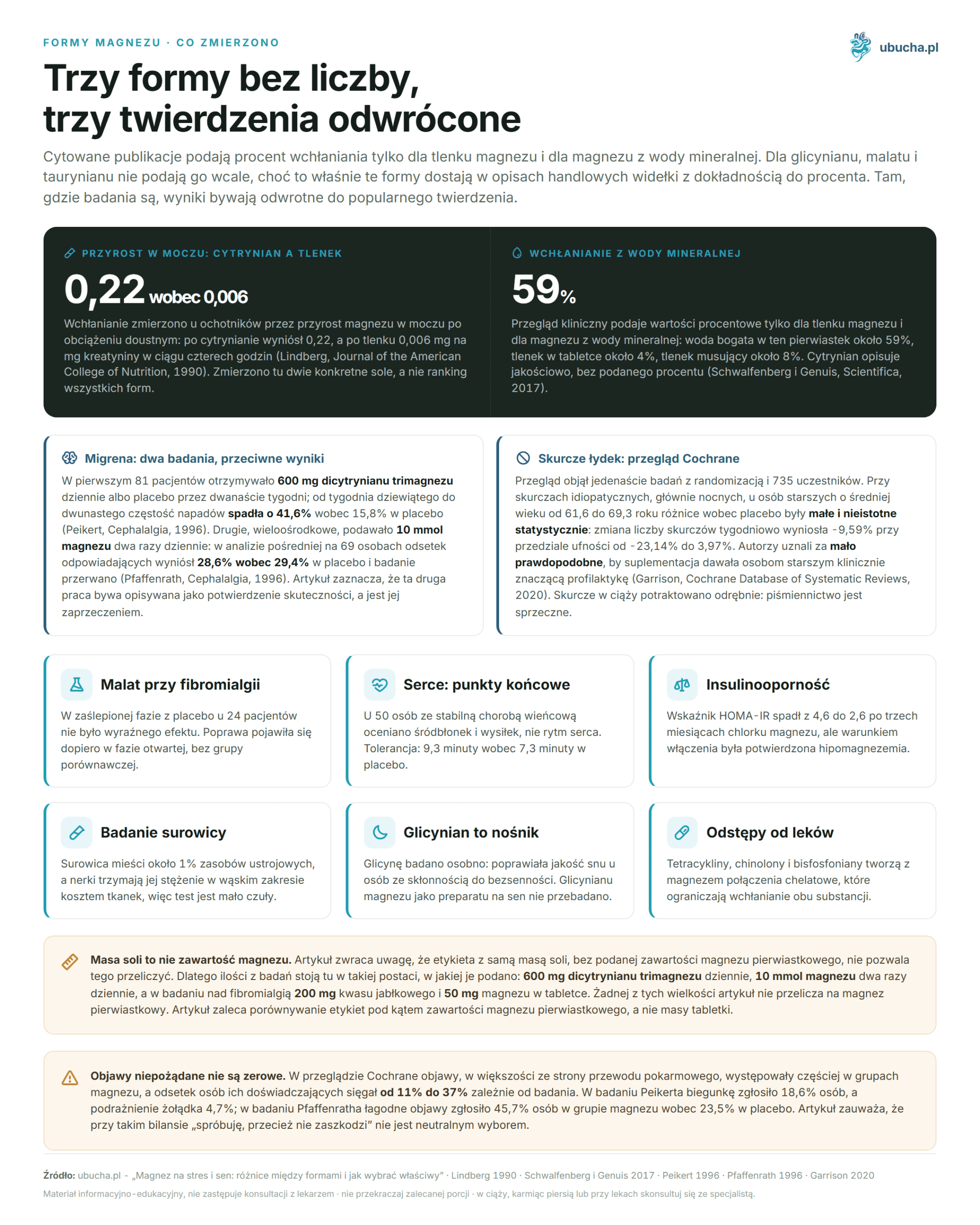
A study comparing citrate with oxide tested both. In laboratory conditions, magnesium oxide was found to be practically insoluble in water and dissolved only 43% even when simulating peak secretion of hydrochloric acid. Citrate dissolved at 55% already in plain water. Then absorption was measured in volunteers by the increase of magnesium in urine after oral loading: after citrate it was 0.22, and after oxide 0.006 mg per mg of creatinine over four hours (Lindberg, Journal of the American College of Nutrition, 1990).
This is a hard result and is enough to discourage oxide as a source of magnesium for the body. However, it is not sufficient to build a ranking of all salts, as such comparisons have simply not been conducted.
Which form of magnesium is absorbed the best?
The honest answer is: we know which is absorbed the worst, and we have numbers only for part of the rest. A clinical review states that magnesium oxide in tablet form is absorbed at about 4%, and the same oxide in effervescent form at about 8%. In comparison, magnesium from mineral water rich in this element is absorbed at about 59%. Citrate is described in the same review as significantly better absorbed than oxide, but without providing a percentage.
Note the two bottom rows of the chart. For glycinate, malate, and taurinate, the cited works do not provide numerical values, even though they appear with precision to the percentage in commercial descriptions. A label with just the mass of the salt, without the content of elemental magnesium provided, does not allow for this to be calculated.
Why is glycinate on lists of sleep and stress supplements?
The reason is the carrier, not magnesium itself. Glycinate is a combination of magnesium with glycine, an amino acid that has its own effects on sleep. A review by a Japanese team describes that taking glycine before sleep significantly improved subjective sleep quality in individuals prone to insomnia, and studies on rats showed the mechanism: oral glycine lowered deep body temperature while increasing skin blood flow (Bannai and Kawai, Journal of Pharmacological Sciences, 2012).
A decrease in deep temperature accompanies natural sleep onset, so the mechanism is consistent with the observation. However, this does not mean that magnesium glycinate has been tested as a sleep supplement. Glycine has been tested separately, and magnesium separately, and on different endpoints. Combining these two results into one claim about a supplement is a conclusion that none of these works makes.
Magnesium itself acts on the nervous system by modulating GABA receptors and blocking NMDA receptors. A review dedicated to magnesium in depression summarizes that the mechanisms of antidepressant action are not fully understood, and magnesium levels in plasma and serum do not seem to be a proper indicator of depressive disorders, as study results are ambiguous (Serefko, Pharmacological Reports, 2013). More about glycine itself can be found in the text about glycine for sleep and regeneration.
Does magnesium prevent migraines?
Two studies from 1996 answer this question differently, and both were randomized and placebo-controlled. In the first, 81 patients with migraines received 600 mg of trimagnesium dicitrate daily or placebo for twelve weeks. In weeks nine to twelve, the frequency of attacks decreased by 41.6% in the magnesium group and by 15.8% in the placebo group, with p below 0.05. The number of days with migraines and the use of rescue medications also decreased. Adverse effects included diarrhea in 18.6% and stomach irritation in 4.7% (Peikert, Cephalalgia, 1996).
The second study, multicenter, administered 10 mmol of magnesium twice daily for twelve weeks to patients with two to six attacks per month. An interim analysis was conducted on 69 individuals. The percentage of those responding to treatment was 28.6% in the magnesium group and 29.4% in the placebo group, and no advantage was found regarding the number of days with migraines and the number of attacks. This was the main reason for stopping the study. Mild adverse effects, mainly loose stools and diarrhea, were reported by 45.7% of individuals in the magnesium group compared to 23.5% in placebo (Pfaffenrath, Cephalalgia, 1996).
This second work is sometimes described in supplement materials as confirmation of magnesium’s effectiveness. It is a contradiction. With such a divergence in results, it makes sense to treat magnesium as an option to consider with a neurologist, rather than as a method with established effectiveness.
Does magnesium help with nighttime calf cramps?
In older adults, most likely not. A Cochrane review included eleven studies with randomization and 735 participants. In studies on idiopathic cramps, mainly nocturnal, conducted in older adults with an average age of 61.6 to 69.3 years, differences compared to placebo were small and statistically insignificant. The percentage change in the number of cramps per week after four weeks was -9.59% with a confidence interval from -23.14% to 3.97%, and the absolute difference was -0.18 cramps per week with a range from -0.84 to 0.49 (Garrison, Cochrane Database of Systematic Reviews, 2020).
The authors made a blunt conclusion: it is unlikely that magnesium supplementation provides clinically significant prevention of cramps in older adults. Neither intensity analyses nor duration of cramps changed this. Cramps during pregnancy were treated separately, where the literature is conflicting and further research is needed.
An additional observation from the same review is practical. Adverse symptoms, mostly from the gastrointestinal tract, occurred more frequently in magnesium groups, with the percentage of individuals experiencing them ranging from 11% to 37% depending on the study. With such a balance, “I’ll try it, it won’t hurt” is not a neutral choice.
Does magnesium malate work for fibromyalgia and fatigue?
The study on which this recommendation stands did not show an effect in the blinded part. A pilot trial with 24 patients with primary fibromyalgia used a preparation containing 200 mg of malic acid and 50 mg of magnesium in a tablet, three tablets twice daily, in four-week placebo-controlled courses. In this phase, no clear effect attributed to the preparation was observed (Russell, Journal of Rheumatology, 1995).
Significant reductions in pain and tenderness appeared only in a six-month open phase, with increasing the amount of the preparation to six tablets twice daily. The open phase has no comparison group or blinding, so it does not separate the effect of the preparation from the natural course of the disease and patient expectations. The authors themselves recommended that future placebo-controlled studies use higher amounts and last at least two months.
The conclusion is therefore much weaker than suggested by descriptions of magnesium malate. Malic acid indeed participates in the citric acid cycle, which is in the ATP production pathway in mitochondria, and this is a reasonable mechanistic premise. However, a mechanistic premise does not replace clinical results, and the only blinded study of this preparation did not yield results.
A separate issue is transferring this recommendation to chronic fatigue and recovery after exercise, where this preparation was not even studied. If someone uses malate and feels an improvement, there is no reason to stop using it, but it is worth knowing that it is based on personal experience, not on evidence from a controlled study.
What does magnesium do for the heart, blood pressure, and insulin sensitivity?
Here, the evidence is stronger, although it concerns specific patient groups. In a randomized double-blind study, 50 individuals with stable coronary artery disease received oral magnesium or placebo for six months. Endothelial-dependent brachial artery dilation improved in the magnesium group, while it did not improve in placebo. Exercise tolerance after six months was 9.3 minutes in the magnesium group compared to 7.3 minutes in the placebo group, and ischemic changes in the ST segment occurred in four individuals compared to ten in placebo (Shechter, Circulation, 2000).
This work is often cited as evidence of protection against arrhythmia after a heart attack. It concerned oral magnesium in patients with stable coronary artery disease, and the endpoints were endothelial function and exercise tolerance, not rhythm disturbances.
A separate study included individuals without diabetes but with insulin resistance and simultaneously with hypomagnesemia. After three months of taking magnesium chloride, the HOMA-IR index decreased from an average of 4.6 to 2.6, and serum magnesium levels increased from 0.61 to 0.81 mmol per liter, both results with p below 0.0001. In the placebo group, nothing changed (Guerrero-Romero, Diabetes and Metabolism, 2004). The inclusion criterion was confirmed deficiency, so transferring this result to individuals with normal magnesium levels has no basis. More broadly on this area, we write in the summary of supplements for insulin resistance.
How to recognize magnesium deficiency and what to remember when supplementing?
Testing magnesium in serum is a poorly sensitive test, as serum contains about 1% of body stores, and the kidneys maintain its concentration in a narrow range at the expense of tissues. A review dedicated to magnesium in depression states directly that concentrations in plasma and serum do not seem to be a proper indicator, at least in this indication. Diagnosis is therefore based in practice on the clinical picture and on the assessment of intake.
Groups at increased risk of deficiency are well described: individuals with diabetes, where glucosuria drives renal excretion, those chronically taking proton pump inhibitors, abusing alcohol, treated with loop and thiazide diuretics, and older adults. In these situations, discussing magnesium supplementation with a doctor makes sense regardless of serum test results.
When taking magnesium, intervals matter. Tetracyclines, quinolones, and bisphosphonates form chelate complexes with magnesium that limit the absorption of both substances, so they are spaced according to the drug leaflet. High amounts of calcium and zinc compete with magnesium for the same intestinal transporters, and iron behaves similarly. Magnesium salts themselves, especially poorly absorbable ones, act osmotically and at higher amounts loosen stools. About how this fits into the evening supplement regimen, we write in the text about evening supplementation protocol.
Frequently Asked Questions
Which form of magnesium is absorbed the worst?
Magnesium oxide. It is absorbed in about 4% in tablet form, about 8% in effervescent form, and is practically insoluble in water. Citrate dissolves in water at 55% and resulted in a significantly higher increase of magnesium in urine after oral loading (Lindberg, Journal of the American College of Nutrition, 1990).
Is the bioavailability of glycine magnesium 50-80%?
No such number is provided by any of the works cited in this article. Publications provide percentage values only for magnesium oxide and for magnesium from mineral water, while citrate is described qualitatively. Precise ranges for glycine, malate, and taurinate come from commercial materials, not from the literature.
Does magnesium help with nighttime calf cramps?
A Cochrane review covering eleven studies found it unlikely that magnesium provides clinically significant prevention of cramps in older adults. Differences compared to placebo were small and not significant. For cramps during pregnancy, the data is conflicting. Gastrointestinal symptoms occurred more frequently in the magnesium groups.
Does magnesium work for migraines?
The results are conflicting. Peikert’s study showed a 41.6% reduction in attack frequency compared to 15.8% in placebo with 600 mg of trimagnesium dicitrate over twelve weeks. Pfaffenrath’s study from the same year was stopped after an interim analysis because the response rate was 28.6% compared to 29.4% in placebo.
Is taurine magnesium better for the heart?
There are practically no clinical studies with oral magnesium taurinate in cardiology. The result in patients with stable coronary artery disease concerned oral magnesium without taurine, and the endpoints were endothelial function and exercise tolerance (Shechter, Circulation, 2000). In heart disease, supplementation is decided by a cardiologist.
How much magnesium should be taken daily?
This is not established by the article. The requirement depends on age, sex, pregnancy, kidney diseases, and medications taken, and serum testing poorly reflects it. A clinical review indicates that nearly two-thirds of the Western population does not meet the recommendations, but the amount of supplementation is determined by a doctor or pharmacist.
Does magnesium help you sleep?
The cited works do not provide direct evidence that magnesium alone shortens the time to fall asleep. Glycine, the carrier in glycine magnesium, improved subjective sleep quality in individuals prone to insomnia and lowered deep body temperature. These are two different claims and should not be confused. More broadly: natural ways to sleep.
Magnesium preparations along with the declared form of salt and the content of elemental magnesium can be found in the supplements category; compare labels for the latter value, not the mass of the tablet.
This article is for informational and educational purposes only and does not constitute medical advice. Before starting supplementation, consult with a doctor, especially if you are taking medications regularly, are pregnant or breastfeeding, or have chronic illnesses.
Author: Michał Waluk · Published: 2026-06-22 · Updated: 2026-08-11