
The Evolution of the Endocannabinoid System: Which Animals Have It and Which Do Not
Which animals have CB1 and CB2 receptors, and which do not. Hydra, insects, dogs, and humans in light of research on the evolution of the endocannabinoid system.
The endocannabinoid system is usually described as a mammalian mechanism. This is a limitation. The receptors that THC acts on originated in a common ancestor of today’s chordates, and the enzymes that handle the signaling molecules of this system are found throughout the animal kingdom (Elphick, Philosophical Transactions of the Royal Society B, 2012). The hydra (Hydra vulgaris), an animal without a brain and with a dispersed nervous network, has cannabinoid binding sites and anandamide in amounts comparable to those in a mammalian brain (De Petrocellis et al., Neuroscience, 1999). Therefore, cannabis did not create this system and did not tune into it through common evolution. It encountered a mechanism that functioned long before it. Below you will find which groups of animals cannabinoid receptors have actually been found in, where they are absent, and why dogs react to THC differently than humans.
KEY INFORMATION
• CB1 and CB2 type receptors originated in a common ancestor of today’s chordates and have not been found outside of chordates (Elphick, Philosophical Transactions of the Royal Society B, 2012).
• In five species of insects, including the honeybee, no specific binding of cannabinoid ligands was detected (McPartland et al., Journal of Comparative Neurology, 2001).
• The hydra has cannabinoid binding sites, anandamide, and the activity of the enzyme that breaks it down (De Petrocellis et al., Neuroscience, 1999).
• In Colorado, the number of dog poisonings increased fourfold over five years, and two dogs died after consuming baked goods made with hemp butter (Meola et al., Journal of Veterinary Emergency and Critical Care, 2012).
How old is the endocannabinoid system?
It depends on which part of it we are asking about, and this distinction determines the answer. CB1 and CB2 type receptors originated in a common ancestor of today’s chordates, which is relatively recent. The enzymes that produce and break down endocannabinoids are much older and are found throughout the animal kingdom (Elphick, Philosophical Transactions of the Royal Society B, 2012).
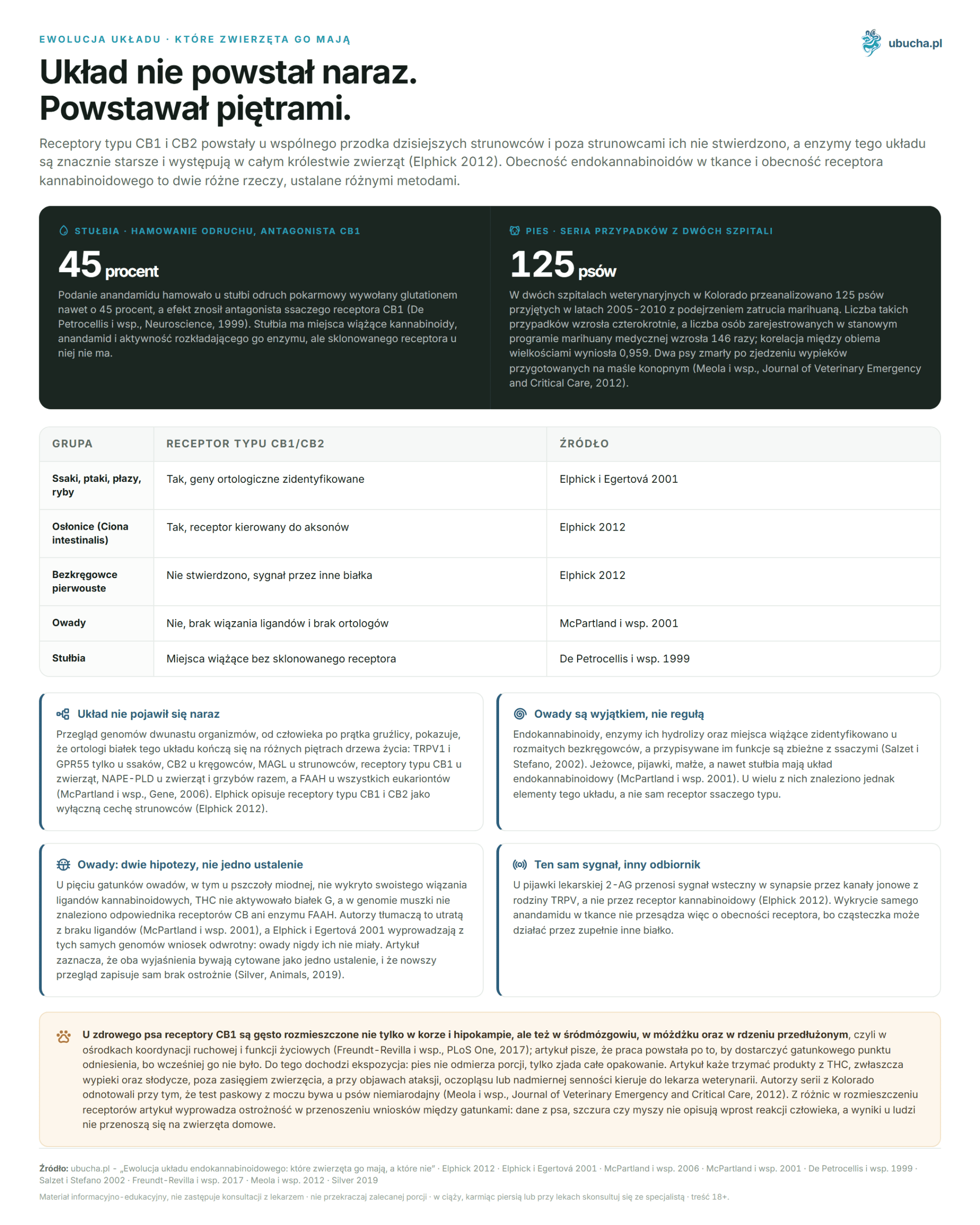
The scale of this difference is shown in a review of the genomes of twelve organisms, from humans to Mycobacterium tuberculosis. The orthologs of individual proteins in the system end at different levels of the tree of life: TRPV1 and GPR55 only in mammals, CB2 in vertebrates, MAGL in chordates, CB1 type receptors in animals, NAPE-PLD in animals and fungi together, and FAAH in all eukaryotes (McPartland et al., Gene, 2006). The system did not appear all at once. It consisted of elements that arose at intervals of hundreds of millions of years.
The oldest well-documented case is the hydra, the first animal with a nervous network. It has specific cannabinoid binding sites, anandamide, its precursor, and the activity of the enzyme that breaks down anandamide. Administration of anandamide inhibited the feeding reflex induced by glutathione by as much as 45 percent, and the effect was reversed by an antagonist of the mammalian CB1 receptor (De Petrocellis et al., Neuroscience, 1999). If you want to see how the same system operates today in humans during exercise, we described it in the context of runner’s high.
Which animals have CB1 and CB2 receptors?
All studied vertebrates. Genes corresponding to the mammalian CB1 have been identified in fish, amphibians, and birds, indicating that the receptor is present throughout the vertebrate lineage (Elphick and Egertová, Philosophical Transactions of the Royal Society B, 2001). In the tunicate Ciona intestinalis, an invertebrate chordate, the CB1/CB2 type receptor is directed to axons, thus serving as a regulator of signal conduction (Elphick, Philosophical Transactions of the Royal Society B, 2012).
Outside of chordates, the situation changes. Elphick describes CB1 and CB2 type receptors as an exclusive feature of chordates, while the action of endocannabinoids themselves is observed much more broadly, only through other proteins. In the medicinal leech, 2-AG transmits retrograde signaling at the synapse through ion channels from the TRPV family, not through a cannabinoid receptor (Elphick, Philosophical Transactions of the Royal Society B, 2012).
| Group | CB1/CB2 Type Receptor | Source |
|---|---|---|
| Mammals, birds, amphibians, fish | Yes, orthologous genes identified | Elphick and Egertová 2001 |
| Tunicates (Ciona intestinalis) | Yes, receptor directed to axons | Elphick 2012 |
| Protostome invertebrates | Not detected, signal runs through other proteins | Elphick 2012 |
| Insects | No, lack of ligand binding and lack of orthologs | McPartland et al. 2001 |
| Hydra | Binding sites without cloned receptor | De Petrocellis et al. 1999 |
The table shows a boundary that is not visible in popular descriptions: the presence of endocannabinoids in tissue and the presence of cannabinoid receptors are two different things, established by different methods. It is worth remembering this when comparing phytocannabinoids with endocannabinoids.
Why do insects lack cannabinoid receptors?
There is enough data to state the absence, but not enough to determine the cause. In the honeybee, fruit fly, and three other insect species, specific binding of synthetic cannabinoid ligands was not detected. THC did not activate G proteins in their tissues, and no equivalent of CB receptors or the FAAH enzyme was found in the fruit fly genome (McPartland et al., Journal of Comparative Neurology, 2001).
The authors of this work refer to the phenomenon as loss and explain it by the lack of ligands: insects produce little arachidonic acid, from which anandamide and 2-AG are formed, so a receptor deprived of fuel could have disappeared. This is not the only explanation on the table. Elphick and Egertová, analyzing the genomes of the fruit fly and nematode, concluded the opposite: CB1 type receptors may have evolved only after the divergence of the deuterostome and protostome lines, meaning that insects never had them (Elphick and Egertová, Philosophical Transactions of the Royal Society B, 2001).
We have noticed that both explanations are often cited as a single finding, while they are two separate hypotheses based on the same genomes. A newer comparative review records this fact cautiously: insects lack a system that is common among animals outside of them (Silver, Animals, 2019). Caution is warranted here, as the cause determines whether to search for traces of the gene or to stop.
What about other invertebrates?
Many of them have elements of this system, although not the mammalian type receptor itself. Endocannabinoids, enzymes for their hydrolysis, and binding sites have been identified in various species of invertebrates, and their attributed functions are consistent with those in mammals: suppression of sensory stimuli, control of feeding, reproductive control, neural transmission, and anti-inflammatory action (Salzet and Stefano, Prostaglandins Leukotrienes and Essential Fatty Acids, 2002). The authors of this review draw an evolutionary conclusion: since the system has proven so effective, it has been preserved.
Specific groups are mentioned in the work on insects as a comparative background. Sea urchins, leeches, mollusks, and even the hydra have an endocannabinoid system. This contrast makes insects an exception rather than the rule (McPartland et al., Journal of Comparative Neurology, 2001). In the medicinal leech, a functioning retrograde signaling mechanism based on 2-AG has even been described, but the receptor is not a cannabinoid receptor, but a channel from the TRPV family (Elphick, Philosophical Transactions of the Royal Society B, 2012). Evolution preserved the signaling molecule but changed the recipient.
The significance of this section is primarily methodological. Detecting anandamide itself in tissue does not determine the presence of a receptor, as the molecule may act through entirely different proteins. Statements like “the endocannabinoid system is present in all animals” are therefore a shorthand that obscures what is most interesting in this story: the same signal can be received by different receptors.
Why does a dog react to THC more strongly than a human?
This is due to the distribution of receptors and the method of exposure. In a healthy dog, CB1 receptors are densely distributed not only in the cortex and hippocampus but also in the midbrain, cerebellum, and medulla oblongata, thus in centers for motor coordination and vital functions (Freundt-Revilla et al., PLoS One, 2017). A dog also does not measure portions: it eats the whole package.
The scale of the problem was described in Colorado. In two veterinary hospitals, 125 dogs admitted between 2005 and 2010 with suspected marijuana poisoning were analyzed. The number of such cases increased fourfold during this time, while the number of people registered in the state medical marijuana program increased 146 times; the correlation between the two figures was 0.959. Two dogs died after consuming baked goods made with hemp butter. The authors also noted that urine strip tests can be unreliable in dogs (Meola et al., Journal of Veterinary Emergency and Critical Care, 2012).
The practical conclusion is simple and does not require numbers: keep THC products, especially baked goods and sweets, out of reach of animals, and if symptoms of ataxia, nystagmus, or excessive drowsiness occur, go to a veterinarian. Products intended for animals are a separate category, which we described in the text about CBD for dogs, cats, and horses. In Polish law, industrial hemp is defined as those in which the sum of delta-9-THC and THCA does not exceed 0.3% when calculated on a dry mass basis, rounded to one decimal place; the threshold is calculated from the sum of both compounds, not just delta-9-THC (art. 4 pkt 5 of the Act of July 29, 2005 on counteracting drug addiction, consolidated text Journal of Laws 2023 item 1939, as amended by the Act of March 24, 2022, Journal of Laws 2022 item 763).
What does the evolution of this system say about cannabis?
It indicates that the plant hit a target that was created without its involvement. CB1 and CB2 type receptors have a history of chordates behind them, while the signaling molecules and enzymes of this system are even older (Elphick, Philosophical Transactions of the Royal Society B, 2012, McPartland et al., Gene, 2006). Cannabis produces compounds that fit into a ready lock.
This also leads to caution in transferring conclusions between species. Since the distribution of receptors varies even within mammals, data from dogs, rats, or mice do not directly describe human reactions, and results in humans do not transfer to pets. The work on the distribution of CB1 in dogs was created precisely to provide a species-specific reference point, as there was none before (Freundt-Revilla et al., PLoS One, 2017).
The second issue concerns nomenclature. Since endocannabinoid enzymes are older than receptors, speaking of a single universal system in all animals obscures what is most interesting: the system developed in stages and in some branches of the tree of life never closed. Insects are an extreme case, but not an isolated one (Silver, Animals, 2019).
Frequently Asked Questions
Do fish have an endocannabinoid system?
Yes. Genes corresponding to the mammalian CB1 receptor have been identified in fish, amphibians, and birds, indicating that this receptor is present throughout the vertebrate lineage (Elphick and Egertová, Philosophical Transactions of the Royal Society B, 2001). Electrophysiological studies in lampreys have also shown that retrograde signaling by endocannabinoids operates commonly in vertebrates (Elphick, Philosophical Transactions of the Royal Society B, 2012).
What is the oldest animal with an endocannabinoid system?
The hydra (Hydra vulgaris), the first animal with a nervous network. Specific cannabinoid binding sites, anandamide, its precursor, and the activity of the enzyme that breaks down anandamide have been detected in it. Anandamide inhibited the feeding reflex induced by glutathione in hydra, and the effect was reversed by an antagonist of the mammalian CB1 receptor (De Petrocellis et al., Neuroscience, 1999).
Do insects have cannabinoid receptors?
No. In the honeybee, fruit fly, and three other species, specific binding of synthetic cannabinoid ligands was not detected, THC did not activate G proteins, and no equivalent of CB receptors or the FAAH enzyme was found in the fruit fly genome (McPartland et al., Journal of Comparative Neurology, 2001). Newer comparative reviews confirm this absence (Silver, Animals, 2019).
Do bees respond to cannabinoids?
Not through cannabinoid receptors. The honeybee was one of five insect species in which no specific binding of synthetic cannabinoid ligands or activation of G proteins by THC was found (McPartland et al., Journal of Comparative Neurology, 2001). Claims about the influence of these compounds on bee swarming or foraging have no support in this work.
Why are dogs more sensitive to THC than humans?
CB1 receptors are densely distributed in dogs not only in the cerebellum and medulla oblongata, which are centers for coordination and vital functions (Freundt-Revilla et al., PLoS One, 2017). Additionally, there is exposure. In a series of 125 dogs from Colorado, two animals died after consuming baked goods made with hemp butter (Meola et al., Journal of Veterinary Emergency and Critical Care, 2012).
If you are looking for products intended for animals, you can find them in the animal products category.
This article is for informational and educational purposes only and does not constitute medical advice. Before starting to use cannabis or CBD for therapeutic purposes, consult a doctor, especially if you are taking other medications, are pregnant, or breastfeeding.
Author: Michał Waluk · Published: 2026-08-09 · Updated: 2026-08-11