
The endocannabinoid system adapts to exercise: anandamide, PEA, and oleamide
Runner's high is no longer attributed to endorphins. What was really measured in studies on anandamide, PEA, and oleamide after exercise and what is still unknown.
For decades, runner’s high was attributed to endorphins. Today, the endocannabinoid system is more often pointed out, with the most frequently cited evidence being the work of Fuss’s team from 2015. However, it is worth knowing what this work actually measured, as popular summaries attribute a result that the authors do not explicitly state. Below, we break down three molecules mentioned in this context: anandamide, palmitoylethanolamide, and oleamide. The first has the strongest data in humans, while the other two are mainly cited on credit. For each, we write what was measured, in whom, and under what conditions, and where measurement ends and inference begins. This distinction has practical significance, as it underpins most advice on training-related supplementation.
KEY INFORMATION
• Fuss and colleagues demonstrated in mice that cannabinoid receptors mediate the reduction of anxiety and pain after running; euphoria cannot be studied in mice, and the authors state this explicitly (PNAS 2015).
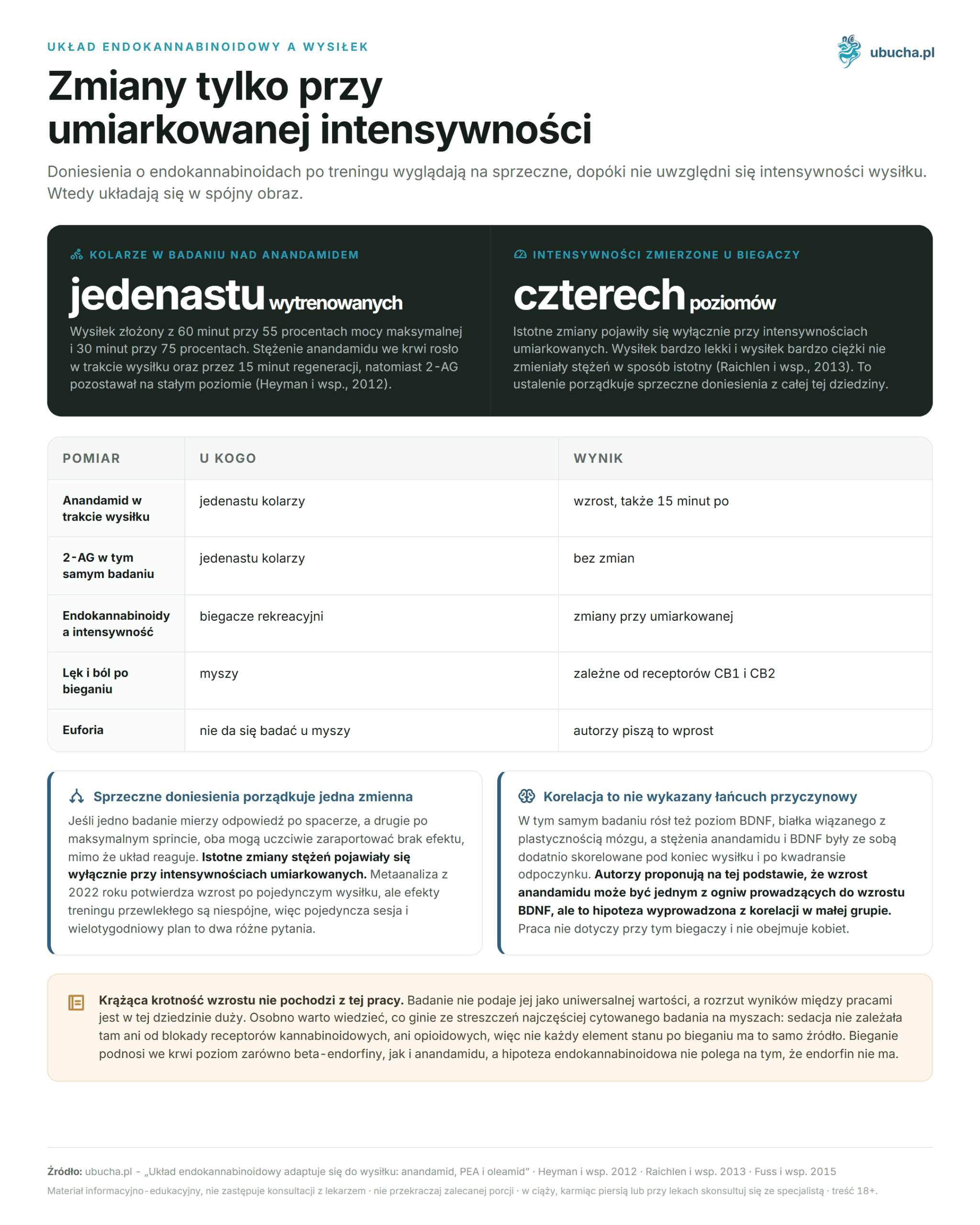
• In eleven trained cyclists, anandamide levels increased during exercise and for 15 minutes after it, while 2-AG remained unchanged (Heyman et al., Psychoneuroendocrinology 2012).
• The response depends on intensity: significant changes occurred only at moderate exercise, while very light and very heavy efforts did not change concentrations significantly (Raichlen et al., European Journal of Applied Physiology 2013).
• A meta-analysis from 2022 confirms the increase after a single exercise session, but the effects of chronic training are inconsistent.
What did Fuss’s study really show about runner’s high?
It showed that in mice, cannabinoid receptors mediate two effects of running: the reduction of anxiety and the reduction of pain perception. The reduction of anxiety required intact CB1 receptors on GABAergic neurons in the forebrain, while the alleviation of pain depended on peripheral CB1 and CB2 receptors (Fuss et al., PNAS 2015).
Two things from this work are lost in popular summaries, changing the interpretation of the result. First, sedation did not depend on the blockade of cannabinoid or opioid receptors, so not every element of the state after running has the same source. Second, the authors state explicitly that euphoria cannot be studied in a mouse model. A statement like “CB1 blockade alleviated euphoria in mice” is therefore an overinterpretation: behaviors corresponding to the reduction of anxiety and pain were alleviated, not subjective elation.
The authors also note that running raises the levels of both beta-endorphins and anandamide in the blood. The endocannabinoid hypothesis does not imply that there are no endorphins, but rather that their increase alone is insufficient to explain central effects. We elaborated on this topic in our post about runner’s high.
How does exercise change anandamide levels in the blood?
It raises them, and measurably so, although studies on humans are small. In the work of Heyman and colleagues, eleven healthy, trained cyclists performed an effort consisting of 60 minutes at 55 percent of maximum power and 30 minutes at 75 percent. Anandamide concentration in the blood increased during exercise and for 15 minutes of recovery, while 2-AG remained at a constant level (Heyman et al., Psychoneuroendocrinology 2012).
In the same study, BDNF levels also increased, a protein associated with brain plasticity, and the concentrations of anandamide and BDNF were positively correlated at the end of exercise and after fifteen minutes of rest. The authors propose that the increase in anandamide may be one of the links leading to the increase in BDNF after training. This is a hypothesis derived from correlation in a group of eleven people, not a demonstrated causal chain.
It is worth remembering what this work does not say. It does not provide the magnitude of the increase as a universal value, it does not concern runners, and it does not include women. The circulating “two to three times” does not come from this study, and the variability of results between studies in this field is large. More about the molecule itself is discussed in our post about anandamide.
Does exercise intensity matter?
It does, and decisively so. Raichlen and colleagues measured circulating endocannabinoids in recreationally trained runners after running on a treadmill at four different intensities. Significant changes appeared only at moderate intensities. Very light and very heavy efforts did not significantly change concentrations (Raichlen et al., European Journal of Applied Physiology 2013).
This finding clarifies contradictory reports. If one study measures the response after a walk, and another after a maximum sprint, both can honestly report a lack of effect, even though the system responds to exercise in between. The authors note that this corresponds to the descriptions of the runners themselves, where mood changes also depend on intensity, and that every subsequent study in this field must control intensity.
The conclusion for the trainee is simple and does not require a calculator. The range in which conversation is still possible, but sentences become shorter, is roughly where the endocannabinoid response was measured. A training session skipped and a training session on the verge of vomiting are two different stimuli, not two versions of the same.
What are PEA and oleamide, and what do we really know about them?
They are fatty acid amides structurally related to anandamide, but they act differently and have been studied in different contexts. Palmitoylethanolamide, or PEA, acts anti-inflammatorily through the nuclear receptor PPAR-alpha. Lo Verme and colleagues showed that PEA activates this receptor in culture, and in two models of inflammatory edema, it inhibits inflammation in wild-type mice, but not in mice lacking PPAR-alpha (Lo Verme et al., Molecular Pharmacology 2005). This is a study about the anti-inflammatory mechanism, not about exercise.
Oleamide has a completely different history. Cravatt and colleagues isolated it from the cerebrospinal fluid of sleep-deprived cats, determined its chemical structure, and demonstrated that when administered to rats, it induces physiological sleep (Cravatt et al., Science 1995). The study concerns sleep deprivation, not physical exhaustion, and its summary does not indicate the receptors through which oleamide would act. The popular attribution of regulating slow-wave sleep after training is a conclusion added beyond the evidence.
| Molecule | What was measured and in whom | What was not demonstrated |
|---|---|---|
| Anandamide | Increase in blood after exercise in humans, dependent on intensity | That the increase in blood translates to a specific effect in the brain |
| PEA | Anti-inflammatory action through PPAR-alpha in animal models | That supplementation accelerates post-exercise recovery |
| Oleamide | Presence in cerebrospinal fluid after sleep deprivation, inducing sleep in rats | That it increases after physical exercise in humans |
Does PEA supplementation accelerate recovery after training?
In the only study we found addressing this question, it did not accelerate recovery. Schouten and colleagues conducted a double-blind crossover study involving eleven healthy men who took PEA at a dose of 350 mg or a placebo before a session of eccentric exercises. Strength and jump height decreased after exercise in both conditions, and PEA did not improve muscle soreness, strength, or jump height; it also did not change muscle damage and recovery indicators (Schouten et al., Medicine and Science in Sports and Exercise 2024).
Separately, it is known that PEA concentrations in the muscle change with activity and pain status. Ghafouri and colleagues measured them using microdialysis in the quadriceps muscle of women with chronic neck and shoulder pain and healthy individuals. PEA concentrations were higher in patients than in the control group, and two different neck exercise programs affected them differently (Ghafouri et al., Pain Medicine 2014).
Together, they paint a picture that is hard to turn into a purchasing recommendation. The molecule is a real element of the local response to muscle load, and its oral administration did not provide benefits in the recovery study mentioned here. We discuss the entire family of these compounds in our post about PEA, OEA, and related molecules.
Does regular training permanently change the endocannabinoid system?
This has not been demonstrated. A systematic review with a meta-analysis included 33 studies and 57 measurement trials. The increase in anandamide after a single exercise occurred in 74.4 percent of trials, and a meta-analysis of ten studies confirmed a consistent increase in anandamide and 2-AG regardless of the type of exercise, species studied, and their health status. The effects of chronic training are summarized by the authors as inconsistent (Desai et al., Cannabis and Cannabinoid Research 2022).
The variability of results between studies was large, and the authors link it to exercise intensity, training level, timing of blood sampling, and whether the subject was fasting. This explains why statements like “athletes have higher levels of anandamide at rest” do not have strong support today: resting measurement is particularly sensitive to these same variables.
Separately, the hypothesis of clinical endocannabinoid deficiency, formulated by Russo in 2004 and reviewed in 2016, concerns migraines, fibromyalgia, and irritable bowel syndrome, and is based on differences in anandamide concentration in cerebrospinal fluid in migraine patients and imaging evidence of reduced system activity in post-traumatic stress disorder (Russo, Cannabis and Cannabinoid Research 2016). The author presents it as a theory requiring further research, not as a finding, and it is not a theory about a sedentary lifestyle.
Does CBD after training prolong the action of anandamide?
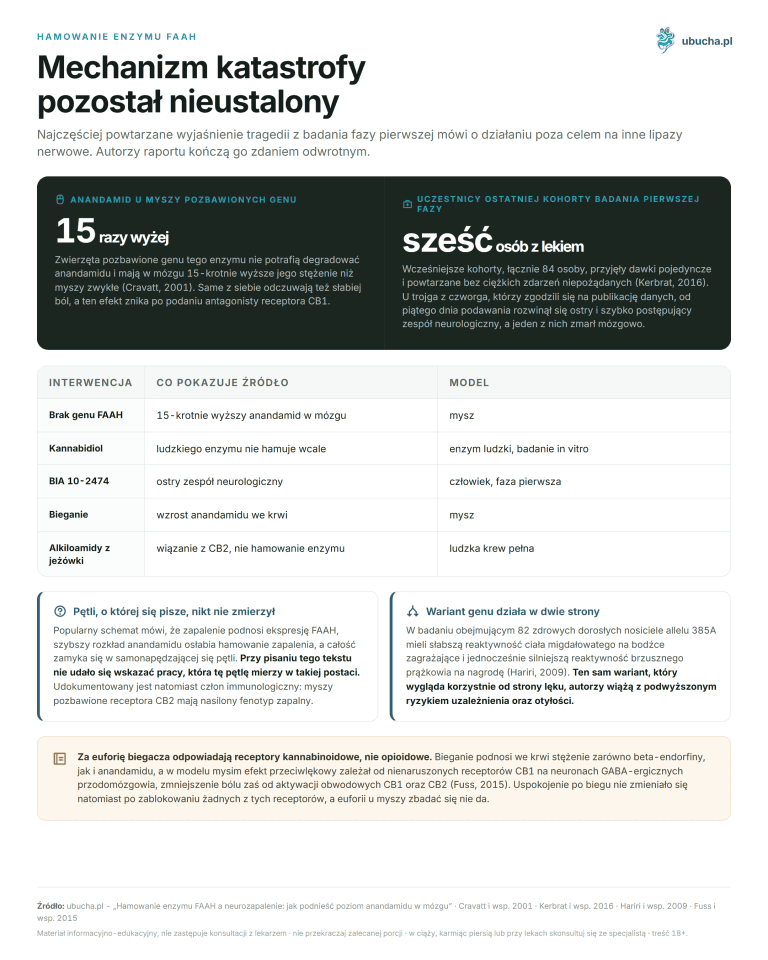
This is the most frequently repeated thesis on this topic and also the least well-documented. The reasoning goes like this: cannabidiol inhibits the FAAH enzyme, which breaks down anandamide, so anandamide should act longer. The problem lies in the concentrations. A systematic review by McPartland and colleagues gathered data from studies on rodents and reports an average concentration for half-maximal inhibition of FAAH by cannabidiol at about 19.8 micromolar per liter, while concentrations achieved in the body after oral administration are significantly lower. The authors state explicitly that at such low peak values, many effects described in vitro in the micromolar range, especially for cannabidiol, can be considered insignificant (McPartland et al., British Journal of Pharmacology 2015).
The same review describes cannabidiol as a ligand with very low affinity for the CB1 receptor, which nevertheless influences its activity in the body indirectly. The authors’ conclusion is methodological and worth remembering beyond this one example: mechanistic studies in vitro do not always predict pharmacology in a living organism.
We have noticed that athletes asking about cannabidiol after training imagine it as an additional dose of anandamide. This is not the right metaphor, as cannabidiol does not deliver anything. But the metaphor of a “prolonger” is also not safe: human FAAH is not inhibited at all (Elmes, J Biol Chem, 2015). We described the enzyme and this study in our post about inhibiting the FAAH enzyme.
Frequently asked questions
What did Fuss’s study show about runner’s high?
In mice, cannabinoid receptors mediated the reduction of anxiety and pain after running: anxiety through CB1 receptors on GABAergic neurons in the forebrain, pain through peripheral CB1 and CB2. Sedation was not alleviated by blocking either system, and euphoria, as the authors state, cannot be studied in a mouse model (PNAS 2015).
How does exercise affect anandamide levels?
In eleven trained cyclists, anandamide levels increased during exercise and for 15 minutes of recovery, while 2-AG remained unchanged (Heyman et al., Psychoneuroendocrinology 2012). A meta-analysis from 2022 confirms the increase of both compounds after a single exercise session, with a large variability in results between studies.
Does every type of exercise raise endocannabinoids?
No. At four running intensities, significant changes in concentrations occurred only at moderate exercise, while very light and very heavy efforts did not significantly change them (Raichlen et al., European Journal of Applied Physiology 2013). Therefore, studies in this field must control intensity; otherwise, results appear contradictory.
Is it worth taking PEA for recovery after training?
There is a lack of evidence for this. In a double-blind crossover study involving eleven men, PEA at a dose of 350 mg did not improve muscle soreness, strength, or jump height after eccentric exercise and did not change muscle damage indicators (Schouten et al., Medicine and Science in Sports and Exercise 2024). The molecule reacts to muscle load, but that is not the same thing.
Does CBD enhance the effect of endocannabinoids after exercise?
This has not been demonstrated. Human FAAH is not inhibited by cannabidiol, and the rodent enzyme is only inhibited at micromolar concentrations, significantly higher than those achieved in the body, which is why the authors of the review consider many such in vitro effects to be practically insignificant (McPartland et al., British Journal of Pharmacology 2015). Treat this as a hypothesis, not as a mechanism confirmed in humans.
Hemp oils available in the store can be found in the oils category.
This article is for informational and educational purposes only and does not constitute medical advice. Before starting to use cannabis or CBD for therapeutic purposes, consult your doctor, especially if you are taking other medications, are pregnant, or breastfeeding.
Author: Michał Waluk · Published: 2026-08-09 · Updated: 2026-08-17