
Cannabinoids in Plants Other Than Hemp: Helichrysum and CBGA
Helichrysum produces cannabigerolic acid independently of hemp, beta-caryophyllene binds to the CB2 receptor, and Radula liverwort provides a THC analog. What do studies say.
Hemp has a monopoly on cannabinoids only in imagination. Cannabigerolic acid, the parent compound from which other hemp cannabinoids are derived, is also produced by a certain African plant from the aster family, completely unrelated to hemp. Beta-caryophyllene from black pepper binds to the CB2 receptor more strongly than many compounds designed in the lab. The liverwort from New Zealand produces a molecule that crosses the blood-brain barrier and acts through the CB1 receptor. Each of these statements is based on work published in a peer-reviewed journal, not on a compilation circulating on herbal forums. At the same time, much of what is repeated about these plants has no supporting research, so it is equally important to show where the source material ends. Below we have gathered both: what can be said about these plants based on original works, and what cannot be said.
KEY INFORMATION
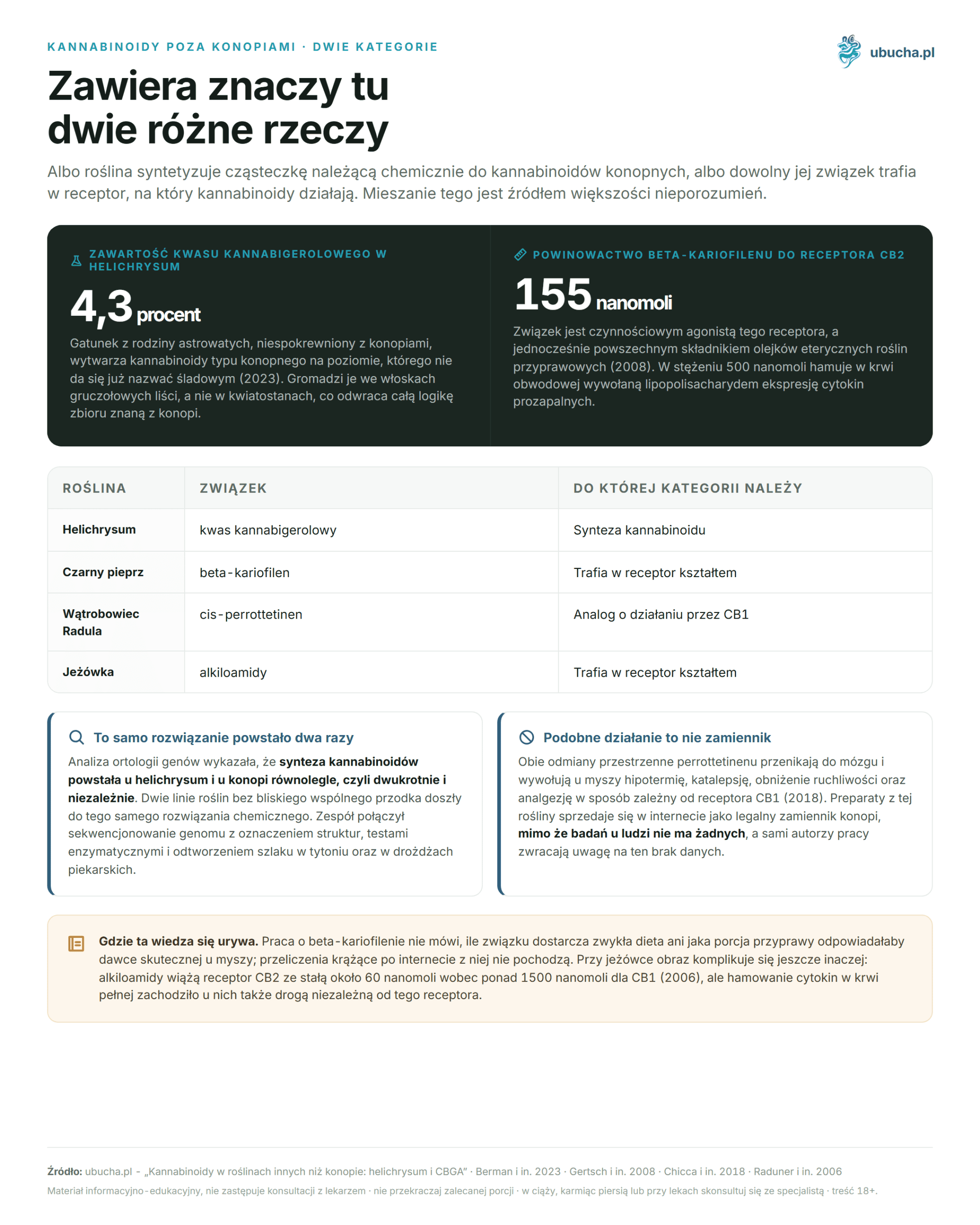
• Helichrysum umbraculigerum produces hemp-type cannabinoids, including cannabigerolic acid at a level of 4.3 percent, and stores them in glandular hairs of leaves, not in inflorescences (Berman et al., Nature Plants 2023).
• Orthology analysis showed that cannabinoid synthesis evolved in helichrysum and hemp in parallel, meaning twice independently.
• Beta-caryophyllene selectively binds to the CB2 receptor with a binding affinity of 155 nanomoles and is its functional agonist (Gertsch et al., PNAS 2008).
• Perrottetinen from Radula liverwort penetrates the brain and induces hypothermia, catalepsy, decreased mobility, and analgesia in mice in a CB1-dependent manner.
• Alkylamides from echinacea act on the CB2 receptor, but the Cochrane review found no benefits from echinacea in treating colds.
What does it really mean that a plant contains cannabinoids?
It means one of two very different things, and mixing them is the source of most misunderstandings. The first is the presence of a molecule that chemically belongs to hemp cannabinoids. The second is the ability of any compound to stimulate the receptors that cannabinoids act on, regardless of its structure.
The endocannabinoid system includes cannabinoid receptors, endogenous cannabinoids, and enzymes responsible for their synthesis and breakdown. The most numerous are CB1 receptors, but some cannabinoids also engage CB2 receptors, TRP family channels, and PPAR receptors (Lu and Mackie, Biological Psychiatry 2016). This multitude of target points means that many plant molecules with completely non-cannabinoid structures aspire to be classified as cannabinoid-active compounds.
The practical distinction looks like this. Helichrysum belongs to the first category because it truly synthesizes cannabigerolic acid. Beta-caryophyllene from pepper and alkylamides from echinacea belong to the second: they are sesquiterpenes and fatty acid amides that fit into the CB2 receptor by shape, not origin. We discuss how the boundary between the various classes of these compounds runs in the comparison of phytocannabinoids, endocannabinoids, and synthetic compounds.
What does helichrysum do that hemp does not?
It produces the same cannabinoids through a different evolutionary pathway. Helichrysum umbraculigerum is a species from the aster family, unrelated to hemp, that produces hemp-type cannabinoids. The content of cannabigerolic acid reaches 4.3 percent, a level that can no longer be called trace (Berman et al., Nature Plants 2023).
There are more differences from hemp than just kinship. In helichrysum, cannabinoids accumulate in glandular hairs of leaves, not in inflorescences, which reverses the entire logic of harvesting known from hemp. Berman’s team combined de novo genome sequencing with chemical structure determination, enzymatic tests, and pathway reconstruction in the tobacco Nicotiana benthamiana and baker’s yeast. In addition to core biosynthetic enzymes, they also described modifying enzymes that yield previously unknown cannabinoid metabolites.
However, the most important conclusion concerns evolution. Gene orthology analysis showed that cannabinoid synthesis arose in helichrysum and hemp in parallel, meaning twice and independently. Two lines of plants that do not have a close common ancestor arrived at the same chemical solution. The authors present the discovery as an untapped source of cannabinoids and a set of tools for production in host organisms. The cannabigerolic acid itself and its relationship to the active form are described in the text about acidic forms of cannabinoids.
Why is beta-caryophyllene from pepper considered a cannabinoid?
Because it meets the functional definition, and in a particularly well-documented way. Beta-caryophyllene selectively binds to the CB2 receptor with a binding affinity of 155 nanomoles and acts as its functional agonist. It is also a common component of essential oils from numerous culinary and spice plants and a major component of hemp itself (Gertsch et al., PNAS 2008).
The evidence does not end with binding. After binding to the CB2 receptor, beta-caryophyllene inhibits adenylate cyclase and induces transient increases in intracellular calcium in primary human monocytes. At a concentration of 500 nanomoles, it inhibits lipopolysaccharide-induced expression of pro-inflammatory cytokines in peripheral blood. The strongest argument comes from an animal model: when administered orally, the compound clearly reduced the inflammatory response in normal mice but not in mice lacking the CB2 receptor, attributing the effect specifically to this receptor.
It is worth knowing where this knowledge ends. Gertsch’s work does not state how much beta-caryophyllene a typical diet provides or what portion of spice would correspond to an effective dose in mice. Conversions from milligrams to kilograms of mouse weight to grams of pepper in the kitchen circulate on the internet, but they do not come from this work, and we do not provide them here. The role of the CB2 receptor as a regulator of inflammation is, however, widely described, including in a review indicating that mice lacking this receptor have an exacerbated inflammatory phenotype (Turcotte et al., Cellular and Molecular Life Sciences 2016).
Does Radula liverwort really act like THC?
It acts similarly, though not identically, and this is the best-studied case of a plant CB1 agonist outside of hemp. Liverworts of the genus Radula contain a bibenzyl called cis-perrottetinen, structurally resembling delta-9-trans-tetrahydrocannabinol. Preparations from this plant are sold online as a legal substitute for hemp, despite the lack of pharmacological data (Chicca et al., Science Advances 2018).
The Chicca team synthesized both spatial variants of the compound and tested them on animals. Both penetrate the brain and induce hypothermia, catalepsy, decreased mobility, and analgesia in mice, and all these effects occur in a CB1-dependent manner. The natural variant was additionally tested on major brain receptors and showed selective cannabinoid pharmacology, without spreading effects to other systems.
One difference from THC deserves a separate mention, as it works in favor of perrottetinen. Both variants of the compound lowered the baseline level of prostaglandins in the brain in a CB1-dependent manner, mimicking endogenous 2-arachidonoylglycerol in this respect. This is the opposite of one of the mechanisms associated with the side effects of delta-9-THC. The authors summarize perrottetinen as a psychoactive moss cannabinoid and as an illustration of convergent evolution of bioactive cannabinoids in the plant world. This does not make it a safe substitute: there are no studies in humans.
How do alkylamides from echinacea work?
Through the CB2 receptor, more strongly than endogenous cannabinoids, but not only through it. Two alkylamides from echinacea bind to the CB2 receptor with a binding affinity of about 60 nanomoles, compared to over 1500 nanomoles for the CB1 receptor, indicating clear peripheral selectivity (Raduner et al., Journal of Biological Chemistry 2006).
The picture complicates when measuring effects. These compounds raised calcium levels in cells with the CB2 receptor, and the effect was abolished by an antagonist of this receptor, confirming the receptor pathway. At the same time, they inhibited lipopolysaccharide-induced expression of tumor necrosis factor and interleukins in human whole blood in a manner independent of CB2, as the same effect was produced by an alkylamide that does not bind to this receptor. The authors conclude the work with a caveat that the action of these compounds does not boil down to binding with CB2. The widespread version that alkylamides inhibit the enzyme that breaks down anandamide does not appear in this work.
Separately stands the question of the clinical efficacy of echinacea itself. The Cochrane review included 24 double-blind studies and 4631 participants. None of the twelve comparisons regarding cold prevention yielded statistically significant results, although a pooled post hoc analysis suggested a relative risk reduction of 10-20 percent. Of the seven studies measuring the duration of colds, one showed a significant effect. The authors’ conclusion is straightforward: no benefits from echinacea preparations in treating colds were demonstrated (Karsch-Völk et al., Cochrane Database of Systematic Reviews 2014).
Which of these plants have real significance today?
The level of evidence determines this, not the attractiveness of the story. Beta-caryophyllene has documented receptor binding, a cellular mechanism, and confirmation in an animal model with a control group lacking the receptor. Helichrysum has freshly described biochemistry and genome, but no studies in humans. Perrottetinen has animal data and zero clinical evidence. Echinacea has the most clinical studies of all mentioned and the most disappointing overall result.
It is noteworthy that there is a certain pattern: the better the chemistry of a plant is understood, the more cautious the conclusions its researchers formulate. The work on helichrysum ends with the statement that the plant is a source of raw material and an engineering tool, not a promise of a supplement. The work on perrottetinen states directly that there are data gaps. This discrepancy between the tone of the literature and the tone of popular summaries is itself information for the reader.
The practical conclusion is simple. None of these plants is today a substitute for hemp cannabinoids with a studied profile, and beta-caryophyllene from spice remains the closest to everyday use. Those looking for pure cannabigerol in the form of a hemp product will find it in the category of hemp oils, and a broader introduction to this compound is provided in the entry on cannabigerol.
| Compound and Plant | Target Point | Strongest Evidence |
|---|---|---|
| Beta-caryophyllene (pepper, spices) | CB2 receptor, functional agonist | Anti-inflammatory effect in normal mice, none in CB2-deficient mice |
| Cannabigerolic acid (helichrysum) | The same compound as in hemp | Genome, enzymatic tests, pathway reconstruction in yeast |
| Perrottetinen (Radula) | CB1 receptor | CB1-dependent symptoms in mice after penetrating the brain |
| Alkylamides (echinacea) | CB2 receptor and independent pathway | Receptor binding; clinical studies without benefits in treatment |
Frequently Asked Questions
Are cannabinoids from helichrysum the same as those from hemp?
Cannabigerolic acid is the same compound, and helichrysum contains it at a level of 4.3 percent. The pathway and storage location differ: the plant belongs to the aster family, has developed cannabinoid synthesis parallel to hemp, and stores them in glandular hairs of leaves instead of in inflorescences.
Does chocolate contain cannabinoids?
A paper published in Nature in 1996 has a title referring to brain cannabinoids in chocolate (di Tomaso et al., Nature 1996). Europe PMC does not provide its abstract, so we do not repeat any concentrations or conclusions of physiological significance for a person eating chocolate.
Does eating pepper and cloves affect CB2 receptors?
Beta-caryophyllene from these spices binds to the CB2 receptor and inhibits lipopolysaccharide-induced expression of pro-inflammatory cytokines in peripheral blood. However, the source paper does not state how much of this compound is provided by a typical diet, so calculating spice portions to an effective dose has no basis.
Are Radula liverwort preparations safe?
It is unknown, and they are sold as a legal substitute for hemp. Studies have only involved mice and showed the compound’s penetration into the brain along with hypothermia, catalepsy, and CB1 receptor-dependent analgesia. There is no data on safety in humans, standardization, or pharmacokinetics.
Does echinacea shorten colds through cannabinoid receptors?
A Cochrane review involving 24 double-blind studies found no benefits from echinacea preparations in treating colds. The binding of its alkylamides to the CB2 receptor is well documented in cell studies, but it does not translate into a confirmed clinical effect.
This article is for informational and educational purposes only and does not constitute medical advice. Before starting to use hemp or CBD for therapeutic purposes, consult with a doctor, especially if you are taking other medications, are pregnant, or breastfeeding.
Author: Michał Waluk · Published: 2026-08-09 · Updated: 2026-08-11