
CBD for Pets - How Do Oils Support Dogs, Cats, and Horses?
How much CBD to give to a dog, cat, and horse? Doses calculated directly from published research protocols, without numbers invented for the purpose of guides.
CBD oils reached veterinary clinics faster than research could keep up, and this is where most of the confusion around dosing comes from. Some numbers circulating in guides for caregivers do not come from any scientific work, and some are copied from studies that said something different. This text is based solely on published protocols: it provides doses exactly as used in studies on dogs, cats, and horses, along with the timing of administration and duration of observation. You will also find what the studies did not confirm, as the lack of evidence in animal supplementation can be more important than evidence. All decisions about administering a product to a chronically treated animal should be made with the attending veterinarian.
KEY INFORMATION
• The best-documented protocol for dogs is 2 mg of CBD per kilogram of body weight every 12 hours for 4 weeks, used in osteoarthritis.
• In drug-resistant epilepsy, a dose of 2.5 mg/kg twice daily reduced the median seizure frequency by 33%, but the percentage of dogs with improvement by half did not differ from placebo.
• A cat at the same dose of 2 mg/kg achieves significantly lower blood concentrations than a dog (43 vs 301 ng/ml), so it is not a species that requires smaller doses due to overdose.
• Increased alkaline phosphatase activity appears in most studies on dogs, which is why monitoring liver tests is part of the protocol, not a precautionary measure.
• In a study on healthy dogs, no significant pharmacokinetic interaction between CBD and phenobarbital was found.
Do dogs and cats have an endocannabinoid system?
Yes. Dogs and cats have cannabinoid receptors CB1 and CB2 and produce their own endocannabinoids, just like humans. CB1 predominates in the nervous system, while CB2 is found in immune cells and peripheral tissues. This is why the same molecule elicits a response in them, although it may not provoke the same reaction as in humans.
The species difference that has practical significance lies not in the receptors but in pharmacokinetics. A comparative study involved eight dogs and eight cats receiving the same preparation at a dose of 2 mg/kg every 12 hours for 12 weeks. After a single dose, the maximum serum concentration was 301 ng/ml in dogs and 43 ng/ml in cats, the area under the curve was 1297 and 164 ng-h/ml respectively, and the time to maximum concentration was 1.4 and 2 hours. The authors summarize this in one sentence: cats absorb or eliminate CBD differently than dogs and achieve lower serum concentrations.
It is worth remembering the direction of this difference, as it is often reversed in guides. A cat at the same dose has less substance in its blood, not more. A separate problem is the tolerance of the administration itself: in the same study, cats reacted to the oil with excessive licking and head shaking. Those who want to trace which species have this system at all can find it in the text about the evolution of the endocannabinoid system.
In what problems has CBD been studied in animals?
Evidence from controlled studies exists for two indications in dogs: pain in osteoarthritis and drug-resistant epilepsy as an adjunct therapy. Everything else, including separation anxiety, sound phobias, motion sickness, and geriatric support, is based on caregiver observations and clinical practice, not randomized studies.
In osteoarthritis, a randomized, blinded, placebo-controlled study (Gamble et al., 2018) showed a significant decrease in pain and an increase in activity on the Canine Brief Pain Inventory and Hudson Activity Score scales, as well as less pain in the veterinarian’s assessment. Caregivers did not report adverse effects, while biochemical analysis showed an increase in alkaline phosphatase activity.
The second study added CBD administered orally to an existing pain protocol, which included an anti-inflammatory drug, gabapentin, and amitriptyline. In the group receiving CBD, the pain severity score was significantly lower after one week, two weeks, and four weeks, and the pain impact score on functioning was lower after one week, two weeks, and twelve (Brioschi et al., 2020). The group consisted of nine dogs, so the result is promising but not conclusive, as the authors state directly.
In epilepsy, the picture is mixed, and this is more important information than the fact of improvement itself. I discuss the result in the section on interactions, as it has direct implications for treatment decisions.
What doses of CBD have been used in studies on dogs?
Two doses are supported by published protocols: 2 mg per kilogram of body weight every 12 hours for joint pain and 2.5 mg/kg twice daily for epilepsy as adjunct therapy. The table below is a simple conversion of both protocols to body weight, not a therapeutic recommendation. The twelve-hour interval is not accidental: in the pharmacokinetic study preceding the clinical part, the half-life was 4.2 hours and was the same at a dose of 2 mg/kg and at four times higher 8 mg/kg.
| Dog Weight | Protocol 2 mg/kg every 12 h (one dose / day) | Protocol 2.5 mg/kg every 12 h (one dose / day) |
|---|---|---|
| 5 kg | 10 mg / 20 mg | 12.5 mg / 25 mg |
| 10 kg | 20 mg / 40 mg | 25 mg / 50 mg |
| 20 kg | 40 mg / 80 mg | 50 mg / 100 mg |
| 30 kg | 60 mg / 120 mg | 75 mg / 150 mg |
| 40 kg | 80 mg / 160 mg | 100 mg / 200 mg |
The conversion to drops is made from the contents of the bottle, not from the percentage concentration on the label. A 5% product in a 10 ml bottle contains about 500 mg of CBD; with the standard 200 drops in such a bottle, one drop is about 2.5 mg. Therefore, a 20 kg dog in the 2 mg/kg protocol needs about 16 drops of the 5% product or 8 drops of the 10% product at a time.
If you want to start with a dose lower than the research protocol, it is justified for caution, but you should know that effectiveness has been studied for the values in the table. The upper safety limit is much higher: in an escalation study in healthy beagles, a product dominated by CBD was administered up to about 62 mg/kg and was found to be as safe as placebo, with 94.9% of reported adverse effects being mild. A separate summary of doses by weight shows these conversions over a wider range of body weights.
Why is a cat not a small dog?
Because at the same dose per kilogram, a cat has significantly less substance in its blood than a dog, and at the same time, it tolerates the administration of oil worse. These are two separate differences, and most guides confuse them, recommending cats doses reduced by several dozen percent without providing the source of such a conversion.
The only published long-term protocol for cats used the same dose as for dogs: 2 mg/kg every 12 hours for 12 weeks. Hematology and biochemistry did not show clinically significant changes, although one cat had an elevated alanine aminotransferase level throughout the study (Deabold et al., 2019). The following values are the same protocol converted to the body weight of a cat. There is no published study that has tested a lower dose in cats, so any value lower than the one given is the caregiver’s caution, not a protocol with proven effectiveness.
| Cat Weight | Single Dose in Protocol 2 mg/kg | Daily Dose when given every 12 h |
|---|---|---|
| 3 kg | 6 mg | 12 mg |
| 4 kg | 8 mg | 16 mg |
| 5 kg | 10 mg | 20 mg |
| 7 kg | 14 mg | 28 mg |
An escalation study in twenty healthy cats (Kulpa et al., 2021) allows estimating the safety margin. Increasing doses were brought up to 30.5 mg/kg CBD in all animals, all adverse effects were mild and transient, and more serious symptoms, such as lethargy, hypothermia, ataxia, and third eyelid protrusion, occurred with products containing THC, not with CBD itself. Gastrointestinal complaints were more often associated with the MCT carrier.
What distinguishes a product for animals from a product for humans?
Three things: the absence of ingredients toxic to animals, controlled THC content, and a concentration adjusted to allow measuring a few milligrams, not several dozen. The first is absolute, while the other two are matters of convenience and precision.
Xylitol cannot be found in anything that goes to a dog, as it causes a rapid drop in glucose levels and liver damage. Essential oils, especially peppermint, eucalyptus, and tea tree oil, primarily affect cats, as their liver struggles with phenolic compounds. The list of excluded ingredients should also include garlic and onions, which damage red blood cells, and cocoa due to theobromine.
THC is a separate matter, and it is THC, not CBD, that is responsible for most severe symptoms in studies. In the escalation study on dogs and in a similar study on cats, moderate and severe adverse events, such as lethargy, hypothermia, and ataxia, were concentrated in groups receiving THC-containing products (Vaughn et al., 2020). The CBD-dominant product performed in this comparison like a placebo.
A product intended for humans can be given to a dog if it does not contain flavors, sweeteners, or additives from the above list, and its composition is documented by laboratory analysis. We have outlined the criteria for evaluating such documentation in the text about how to distinguish a good oil from a weak one.
How to give oil to a dog or cat?
The easiest way is on the mucous membrane of the mouth, that is, on the gum or under the tongue, and this is how the preparation was administered in the study on joint pain in dogs. Administration with food is permissible when the animal resists, but then you lose control over how much has actually been taken.
- Measure the dose with a dropper out of the animal’s reach, so it does not associate the bottle with a struggle.
- Approach from the side, not from above, and gently lift the lip.
- Apply drops to the gum or under the tongue, not deep into the throat.
- Leave the animal alone for about a minute and do not give water during this time.
- Repeat after 12 hours if you are using the protocol twice daily.
The form of the preparation matters for absorption. In a study comparing three methods of administration in thirty healthy dogs, namely microencapsulated granules, oral oil, and transdermal cream, the highest systemic exposure was provided by oral oil (Bartner et al., 2018). Exposure increased proportionally to the dose, and the half-life ranged from about two to over three hours, depending on the dose size.
If a cat reacts to the oil with licking and head shaking, this is a behavior also noted in clinical studies and does not indicate poisoning. Usually, it is enough to change the timing of administration or space out the dose, and in case of persistent reluctance, it is better to establish a different form of the preparation with a veterinarian than to increase the holding strength.
Does CBD work in horses?
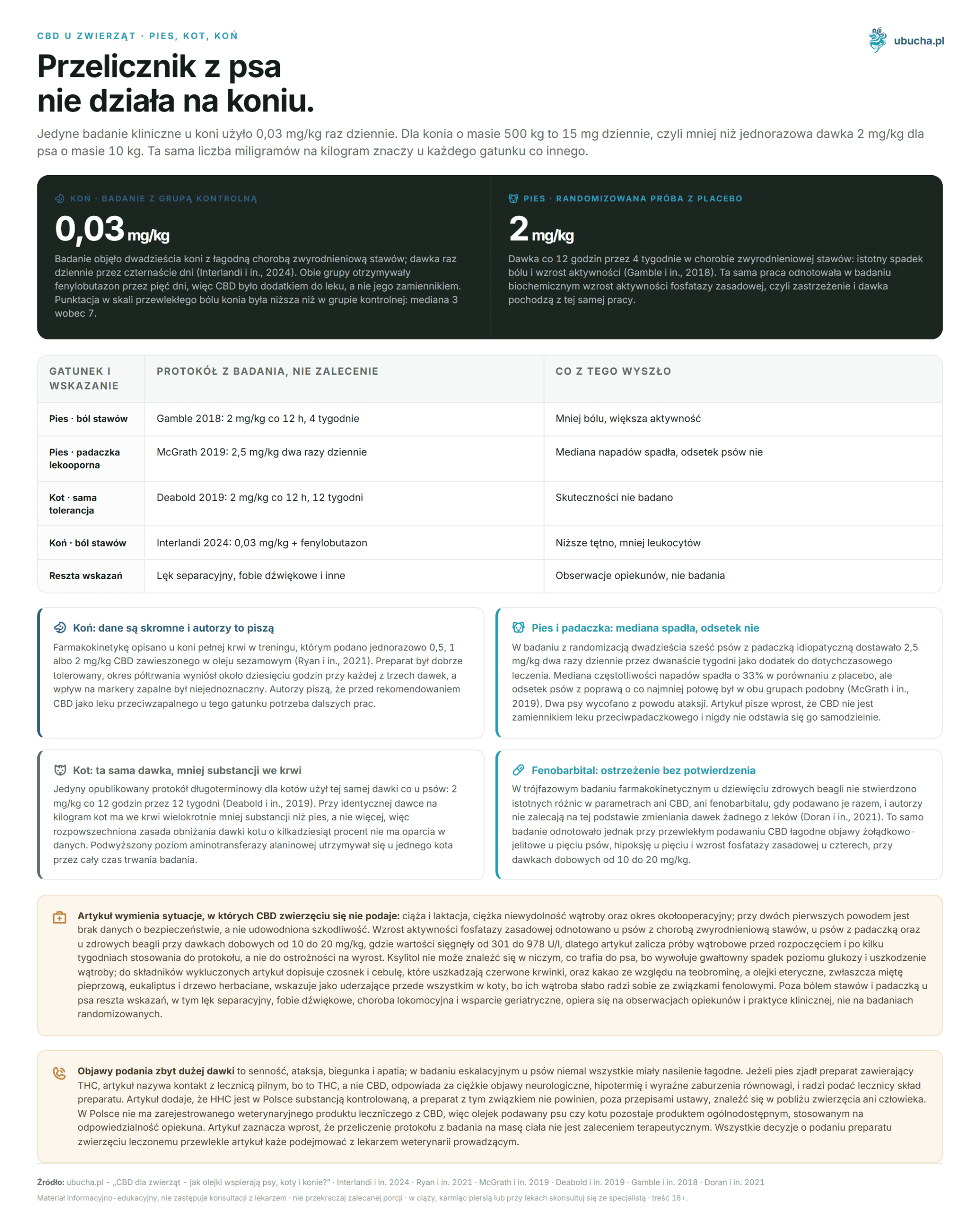
Data on horses are much more limited than on dogs, and the authors of pharmacokinetic studies themselves state that further work is needed before recommending CBD as an anti-inflammatory drug in this species. However, there is one clinical study with a control group that provides a specific, verifiable dose.
Pharmacokinetics were described in thoroughbred horses in training, which were given a single dose of 0.5, 1, or 2 mg/kg of CBD suspended in sesame oil (Ryan et al., 2021). The preparation was well tolerated, with no significant behavioral, gastrointestinal, or cardiac disturbances. The half-life was about ten hours at each of the three doses. The effect on inflammatory markers was ambiguous.
The clinical study involved twenty horses with mild osteoarthritis. Both groups received phenylbutazone for five days, and the experimental group additionally received 0.03 mg/kg of CBD in hemp oil once daily for fourteen days (Interlandi et al., 2024). In the CBD group, heart and respiratory rates decreased, the number of leukocytes decreased, and the oxidative stress index was lower, and the score on the horse chronic pain scale was lower than in the control group (median 3 vs 7).
Note the scale of the dose. For a 500 kg horse, 0.03 mg/kg is 15 mg daily, which is less than the single dose for a ten-kilogram dog in the pain protocol. Transferring dog conversions to horses gives values detached from the only clinical study we have.
When should CBD not be given to an animal?
During pregnancy and lactation, in severe liver failure, and during the perioperative period. In the first two situations, the reason is the lack of safety data, not proven harm, and it is worth maintaining this distinction in conversations with veterinarians.
The liver deserves a separate paragraph here, as the signal repeats in almost every study. Increased alkaline phosphatase activity was noted in dogs with osteoarthritis, in dogs with epilepsy, and in healthy beagles at daily doses from 10 to 20 mg/kg, where values reached from 301 to 978 U/l. In one cat in a twelve-week study, an elevated alanine aminotransferase level persisted. The practical conclusion: before starting and after several weeks of use, do liver tests.
Symptoms of administering too high a dose include drowsiness, ataxia, diarrhea, and lethargy. In the escalation study in dogs, almost all had mild severity, and with THC-containing preparations, hypothermia and significant balance disturbances were added. If a dog ingested a THC product, contact with a veterinary clinic is urgent, as THC is responsible for severe neurological symptoms, not CBD.
A critical review by the WHO Expert Committee states that CBD is generally well tolerated and has a good safety profile, and reported adverse effects may result from interactions with other medications taken (WHO ECDD, 2018). The document pertains to humans and laboratory models, so it does not replace veterinary data.
Does CBD interact with veterinary medications?
The most frequently repeated warning concerns phenobarbital, and it does not find confirmation in the study that checked it. In a three-phase pharmacokinetic study in nine healthy beagles, no significant differences in pharmacokinetic parameters for either CBD or phenobarbital were found when administered together (Doran et al., 2021). The authors do not recommend changing the doses of either drug on that basis.
However, the same study provided a different kind of warning. With chronic administration of CBD, mild gastrointestinal symptoms occurred in five dogs, five experienced hypoxia at daily doses from 10 to 20 mg/kg, and four showed increased alkaline phosphatase. The risk is therefore liver burden at high doses, not a shift in the concentration of the anticonvulsant.
The effectiveness in epilepsy requires an honest description. In a randomized study in which twenty-six dogs with idiopathic epilepsy received 2.5 mg/kg twice daily for twelve weeks as an adjunct to their existing treatment, the median seizure frequency decreased by 33% compared to placebo, but the percentage of dogs with improvement of at least half was similar in both groups (McGrath et al., 2019). Two dogs were withdrawn due to ataxia.
The practical conclusion for caregivers is that CBD is not a substitute for anticonvulsant medication and should never be discontinued independently. If you want to understand the difference between hemp seed oil and a product with extract, we explain it in the text hemp oil vs CBD oil.
What does Polish law say about hemp products for animals?
Polish law does not recognize the category of hemp products intended for animals. There is no registered veterinary medicinal product with CBD, so oil given to a dog or cat remains formally an over-the-counter product, used at the caregiver’s responsibility, preferably after consulting with a veterinarian.
The basis regarding the raw material is, however, unequivocal. According to Article 4 point 5 of the Act of July 29, 2005 on Counteracting Drug Addiction (Journal of Laws 2023, item 1939), as amended by the Act of March 24, 2022 (Journal of Laws 2022, item 763), fiber hemp is defined as plants in which the sum of delta-9-THC and tetrahydrocannabinolic acid does not exceed 0.3% when calculated on a dry mass basis, rounded to one decimal place. The threshold is calculated as the sum of both compounds, not just delta-9-THC, and this distinction changes the result of laboratory testing. Until May 6, 2022, the value was 0.20%.
The national threshold corresponds to the EU threshold, but it does not derive from it, as these are two separate regulations with the same numerical value. The EU value of 0.3% for hemp varieties eligible for agricultural support was introduced by Regulation (EU) 2021/2115, applicable from January 1, 2023.
CBD itself does not appear on any list of controlled substances. HHC, on the other hand, is a controlled substance in Poland, and a preparation containing this compound should not be near an animal or human outside the provisions of the law.
Frequently Asked Questions
How long does it take to see the effects of CBD in dogs?
In a study on joint pain, significant improvement was noted after two weeks of administration, and in a study with polypharmacy therapy after just one week. There is no basis to expect an effect after a single dose, which is why research protocols lasted from four to twelve weeks.
Can I give my dog oil intended for humans?
Yes, if the product does not contain xylitol, flavors, essential oils, or ingredients such as garlic and cocoa, and its composition is confirmed by laboratory analysis. The THC content is more significant than the CBD concentration itself, as THC is responsible for severe neurological symptoms in dogs.
Does CBD make animals addicted?
There is no data indicating such a mechanism. A critical review by WHO states that there are no signs of addictive potential in humans, and in animal models, no development of tolerance to CBD or substitution of THC has been observed. This document does not record studies on physical dependence in companion animals.
What to do if my dog ate an entire bottle of oil?
Contact a veterinary clinic and provide the composition of the product. With a product dominated by CBD, expect drowsiness, ataxia, and mild diarrhea. If the product contained THC, contact is urgent, as THC is associated with hypothermia and significant balance disturbances.
Can CBD be given together with phenobarbital?
A pharmacokinetic study in healthy dogs did not show significant interaction between these substances and does not recommend adjusting doses on that basis. The decision is still made by the attending veterinarian, as high daily doses of CBD increased alkaline phosphatase activity and gastrointestinal symptoms appeared.
Does a cat need a smaller dose than a dog?
The only published long-term protocol used the same dose of 2 mg/kg for cats as for dogs. A cat achieves significantly lower serum concentrations at this dose, so the widespread principle of reducing the dose by several dozen percent is not supported by data. A cautious start is reasonable, but establish it with a veterinarian.
We have gathered products intended for animals in the for animals category, and always precede administering them to a chronically treated animal with a conversation with a veterinarian.
This article is for informational and educational purposes and does not constitute medical advice. Before starting to use cannabis or CBD for therapeutic purposes, consult with a doctor, especially if you are taking other medications, are pregnant, or breastfeeding.
Author: Michał Waluk · Published: 2026-05-06 · Updated: 2026-08-10