
Runners high and the endocannabinoid system (FAQ)
Endorphins do not cross into the brain, and evidence for the role of endocannabinoids in humans is still incomplete. What studies by Raichlen, Sparling, and Fuss have shown.
For half a century, runners high was attributed to endorphins, although one obstacle was known from the beginning: beta-endorphin does not cross the blood-brain barrier, so the opioid produced peripherally is unlikely to act centrally (Fuss et al., PNAS, 2015). Researchers’ attention then shifted to endocannabinoids, primarily anandamide, which is lipophilic and easily crosses the barrier. However, the evidence is uneven. In mice, specific receptors can be disabled to see what stops working, so the mechanism is well described there. In humans, blood concentrations are measured and self-reported feelings are queried, and a systematic review of clinical studies concludes that conclusive evidence is still lacking. This article shows what exactly was measured, on whom, and with what effort, as well as where what is known ends and what is repeated out of habit begins.
KEY INFORMATION
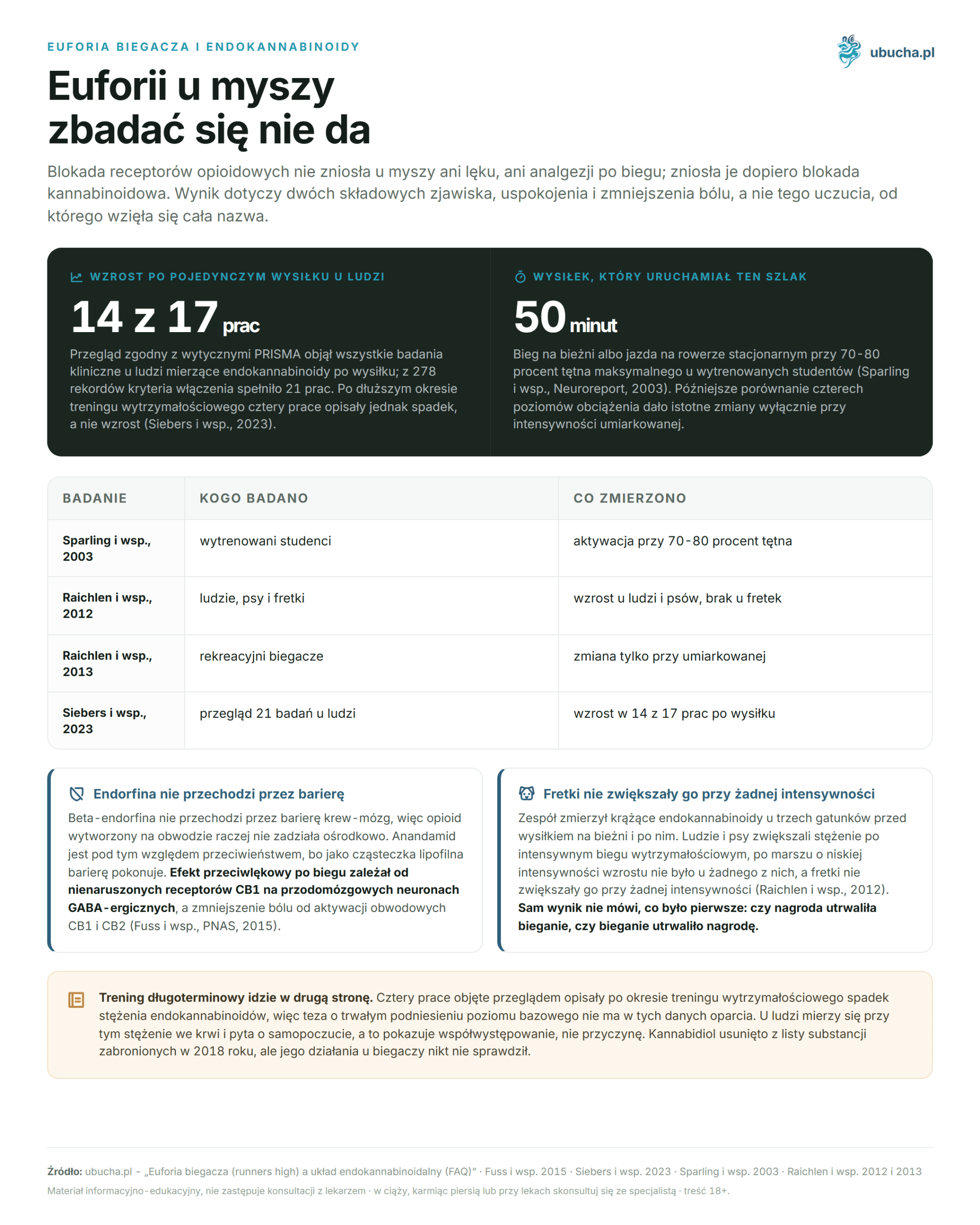
• Beta-endorphin does not cross the blood-brain barrier, and blocking opioid receptors with naloxone did not eliminate either anxiety or analgesia in mice after running (Fuss et al., PNAS, 2015).
• In a systematic review of studies in humans, an increase in endocannabinoids after a single effort was shown in 14 out of 17 studies, but reliable evidence for their role in runners high is still lacking (Siebers et al., The Neuroscientist, 2023).
• The endocannabinoid system was activated by moderate effort: 50 minutes at 70-80% of maximum heart rate (Sparling et al., Neuroreport, 2003).
• Humans and dogs increased endocannabinoid levels after intense endurance running, while ferrets did not increase it at any intensity (Raichlen et al., Journal of Experimental Biology, 2012).
Do endorphins really cause runners high?
Most likely not, although running does indeed raise their levels in the blood. The problem is transport: beta-endorphin does not cross the blood-brain barrier, making the central action of opioids produced peripherally unlikely. Anandamide is the opposite in this regard, as a lipophilic molecule that crosses the barrier.
A pharmacological experiment on mice provided clarity. Fuss and colleagues administered naloxone, which blocks opioid receptors, to running animals. The anxiolytic effect after running persisted despite this blockade, and mice after running tolerated pain stimuli longer regardless of whether they received naloxone or a carrier.
Only the blockade of the endocannabinoid system changed the picture. The anxiolytic effect depended on intact CB1 receptors on forebrain GABAergic neurons, and the reduction of pain depended on the activation of peripheral CB1 and CB2 receptors (Fuss et al., PNAS, 2015). The authors note two limitations that are rarely mentioned: sedation was not eliminated by either cannabinoid or opioid blockade, and the euphoria itself could not be studied in mice. Therefore, the result pertains to two components of the phenomenon, calming and pain reduction, and not to the feeling from which the entire name derives.
How strong is the evidence for the role of anandamide in humans?
Weaker than most popular summaries suggest. A systematic review conducted according to PRISMA guidelines included all clinical studies in humans measuring endocannabinoids after exercise, from the discovery of these compounds to April 2021. Out of 278 records, 21 studies met the inclusion criteria, which in itself speaks to the scale of this field.
The results are distributed bilaterally. After a single effort, an increase in endocannabinoids was shown in 14 out of 17 studies, so the signal itself is repeatable. However, after a longer period of endurance training, four studies reported a decrease rather than an increase. The authors of the review state directly that reliable evidence for the involvement of endocannabinoids in runners high in humans has not yet been obtained, and they point to the reason: methodological obstacles (Siebers et al., The Neuroscientist, 2023).
The difference between mice and humans is fundamental and worth naming. In mice, a receptor can be removed to check what stops working. In humans, blood concentrations are measured and feelings are queried, which shows correlation, not causation. The mechanisms of action of the molecule itself are described separately in the entry on anandamide.
What type of effort activates the endocannabinoid pathway?
Moderate, sustained for several minutes. The first measurement in humans was conducted by Sparling and colleagues on trained students who ran for 50 minutes on a treadmill or pedaled on a stationary bike at 70-80% of maximum heart rate. This was sufficient for moderate intensity effort to activate the endocannabinoid system (Sparling et al., Neuroreport, 2003).
Raichlen then checked whether intensity could be shifted in either direction. In a study on recreationally trained runners, he compared four levels of exertion and obtained significant changes in endocannabinoid levels only at moderate intensity. Very light and very intense efforts did not significantly change them (Raichlen et al., European Journal of Applied Physiology, 2013).
| Study | Who was studied | Stimulus | What was measured |
|---|---|---|---|
| Sparling et al., 2003 | Trained students | 50 minutes of running or cycling at 70-80% of maximum heart rate | Activation of the endocannabinoid system |
| Raichlen et al., 2012 | Humans, dogs, and ferrets | Treadmill, high intensity or walking | Increase in humans and dogs after running, none after walking, none in ferrets |
| Raichlen et al., 2013 | Recreationally trained runners | Four levels of intensity | Significant change only at moderate intensity |
| Siebers et al., 2023 | Review of 21 studies in humans | Single effort and long-term training | Increase in 14 out of 17 studies after a single effort, decrease in 4 studies after long-term training |
Why would evolution reward long-distance running?
Raichlen hypothesized that the neurobiological reward for endurance effort explains why some species run habitually despite high energy costs and injury risks. He tested it comparatively, not just through reasoning, which distinguishes this hypothesis from typical adaptation stories that no one has tried to disprove.
The team measured circulating endocannabinoids before and after treadmill exercise in three species: humans, dogs, and ferrets. Humans and dogs, species adapted for long-distance running, increased endocannabinoid levels after intense endurance running. There was no increase after low-intensity walking in either. Ferrets, which are not adapted for such locomotion, did not increase levels at any intensity (Raichlen et al., Journal of Experimental Biology, 2012).
The authors call this the first evidence that differences in neurotransmitter signaling between species may explain differences in their locomotor behaviors. The result itself does not say what came first: whether the reward reinforced running or running reinforced the reward. Which animals have an endocannabinoid system and which do not is detailed separately in the entry on the evolution of this system.
Does regular training permanently shift this system?
Data suggest rather the opposite direction than intuition would suggest. Four studies included in the systematic review reported a decrease in endocannabinoid levels after a period of endurance training, while a single effort predominantly showed an increase (Siebers et al., The Neuroscientist, 2023). The popular thesis that regular running permanently raises baseline levels has no support in this data and is often repeated as a certainty.
A broader review of interventions affecting the endocannabinoid system lists physical effort among lifestyle modifications that modulate this system, alongside diet, weight control, and substances. However, the authors conclude that few clinical studies evaluating such interventions have been conducted, and most evidence comes from preclinical studies (McPartland et al., PLoS ONE, 2014).
A fair summary would thus be: a single run of moderate intensity consistently raises endocannabinoid levels, and what long-term training does to them is unresolved. How the endocannabinoid system adapts to training loads is detailed in the entry on the adaptation of this system to effort.
What is known about CBD in trained individuals?
Only that it is allowed in sports and that data on its effects are scarce. Among all phytocannabinoids, CBD was removed from the World Anti-Doping Agency’s list of prohibited substances in 2018 and is the only one with a clear status regarding anti-doping regulations. Other phytocannabinoids remain prohibited, and THC is treated as a threshold substance, meaning that only exceeding a set concentration counts. For an athlete competing in events subject to anti-doping regulations, this distinction is practically significant, as full-spectrum products contain THC by definition.
Interest in CBD among athletes has grown rapidly since that decision, but a review of the literature on the impact of cannabis on performance and recovery states that the effects of CBD itself remain largely unstudied (Burr et al., Sports Medicine, 2021). Therefore, there is no basis to promise enhancement of runners high through a product taken before training.
The hypothesis of such enhancement is biologically sensible, as CBD inhibits the breakdown of anandamide, but sensibility is not evidence. Until studies are conducted to test it in runners, the only reliable answer remains an admission of ignorance.
Frequently asked questions
What is runners high?
It is a fleeting feeling of euphoria, reduced anxiety, sedation, and diminished pain perception, described by some individuals during and after prolonged endurance exercise. Not everyone experiences it, and not after every workout. Research links it to the endocannabinoid system, but conclusive evidence in humans is still lacking.
Why do endorphins not explain runners high?
Beta-endorphin does not cross the blood-brain barrier, so the opioid produced peripherally is unlikely to act centrally. In a study on mice, blocking opioid receptors with naloxone did not eliminate either the anxiolytic effect after running or the prolonged pain tolerance. Only the blockade of cannabinoid receptors eliminated these effects.
What type of effort activates the endocannabinoid pathway?
Moderate and prolonged. In the first measurement in humans, 50 minutes of running or stationary cycling at 70-80% of maximum heart rate was sufficient. Later comparisons of four levels of exertion showed significant changes only at moderate intensity, not at very light or very intense levels.
Do other sports also trigger this effect?
Running is not an exception here. In the first measurement in humans, alongside the treadmill, a stationary bike was used, and both forms of exercise activated the endocannabinoid system at the same load. The character and duration of aerobic effort matter more than the specific discipline.
Does regular running permanently increase anandamide levels?
Data does not support this. A systematic review after a single effort showed a dominant increase in endocannabinoids, while after a longer period of endurance training, four studies reported a decrease. The direction of long-term change remains unresolved, and it should not be assumed that training shifts this system upward.
Does CBD enhance runners high?
It is unknown. The World Anti-Doping Agency removed CBD from the list of prohibited substances in 2018, but a review of the literature on cannabis in sports states that the effects of CBD remain largely unstudied. The hypothesis of enhancement through the inhibition of anandamide breakdown has not been tested in runners.
The products mentioned in the last section can be found in the oils category.
This article is for informational and educational purposes only and does not constitute medical advice. Before starting to use cannabis or CBD for therapeutic purposes, consult a doctor, especially if you are taking other medications, are pregnant, or breastfeeding.
Author: Michał Waluk · Published: 2026-08-09 · Updated: 2026-08-11