
CBD Oil for Dogs and Cats: Dosage by Weight (Table)
The only CBD dose with evidence of efficacy in dogs is 2 mg/kg every 12 hours. The table converted to body weight, data on cats, and symptoms of THC poisoning.
The first randomized clinical trial of CBD in dogs was conducted by Gamble’s team from Cornell University in 2018. Dogs with osteoarthritis received oil at a dose of 2 mg CBD per kilogram of body weight every 12 hours for four weeks and achieved a significant reduction in pain and an increase in activity. This is the only dosage that has evidence of efficacy in dogs and the starting point for the entire table in this article. There is no such study for cats: the only work that administered CBD to them for twelve weeks checked tolerance, not efficacy. Below you will find a conversion of the dose of 2 mg/kg to body weight, absorption data for both species, and a description of symptoms that are caused in veterinary practice by THC, not CBD.
KEY INFORMATION
• The only CBD dose with evidence of efficacy in dogs is 2 mg/kg every 12 hours for four weeks (Gamble et al., 2018).
• No efficacy study has been conducted in cats. At the same dose, a cat reaches a maximum CBD concentration in the blood about seven times lower than a dog (Deabold et al., 2019).
• Ataxia, disorientation, and incontinence are symptoms of THC poisoning, not CBD preparations (Amissah et al., 2022).
• In dose escalation studies, CBD-dominant oil was tolerated by dogs up to about 62 mg/kg, and by cats up to 30.5 mg/kg, with cats more frequently reacting to the MCT carrier.
• Xylitol causes acute liver failure in dogs, so check the composition of products intended for humans before the first administration.
What dosage of CBD is confirmed by studies in dogs and cats?
Studies confirm one value: 2 mg of CBD per kilogram of body weight every 12 hours. This was the dosage used in a randomized trial in dogs with osteoarthritis and the same in a twelve-week tolerance assessment in dogs and cats. No work has checked a scheme with a starting and standard dose.
The Gamble trial had a crossover design with placebo, with blinding of the veterinarian and caregiver. Each arm lasted four weeks, with two weeks of break in between. The dog’s pain questionnaire and Hudson’s activity scale showed a reduction in pain and an increase in activity with p below 0.01, and veterinary assessment showed a reduction in pain with p below 0.02. Pharmacokinetics were measured at two doses, 2 and 8 mg/kg, and in both, the half-life was 4.2 hours (Gamble et al., Frontiers in Veterinary Science, 2018).
This same work brings an observation that popular texts omit. In biochemical studies of serum, an increase in alkaline phosphatase activity was noted during CBD administration, with p below 0.01. Caregivers did not report any adverse effects, so the signal only came from the laboratory. This is a sufficient argument for a control blood test if you are administering oil for more than a few weeks.
The second study, Deabold et al., involved eight healthy dogs and eight healthy cats, who were given 2 mg/kg orally every 12 hours for twelve weeks. Hematology and biochemistry did not show clinically significant changes, but in one cat, alanine aminotransferase activity remained above the reference range throughout the trial (Deabold et al., Animals, 2019). The gradual dose increase scheme used in humans has no equivalent in this literature: in both works, the dose was constant from day one.
How many milligrams of CBD per dose for a given body weight?
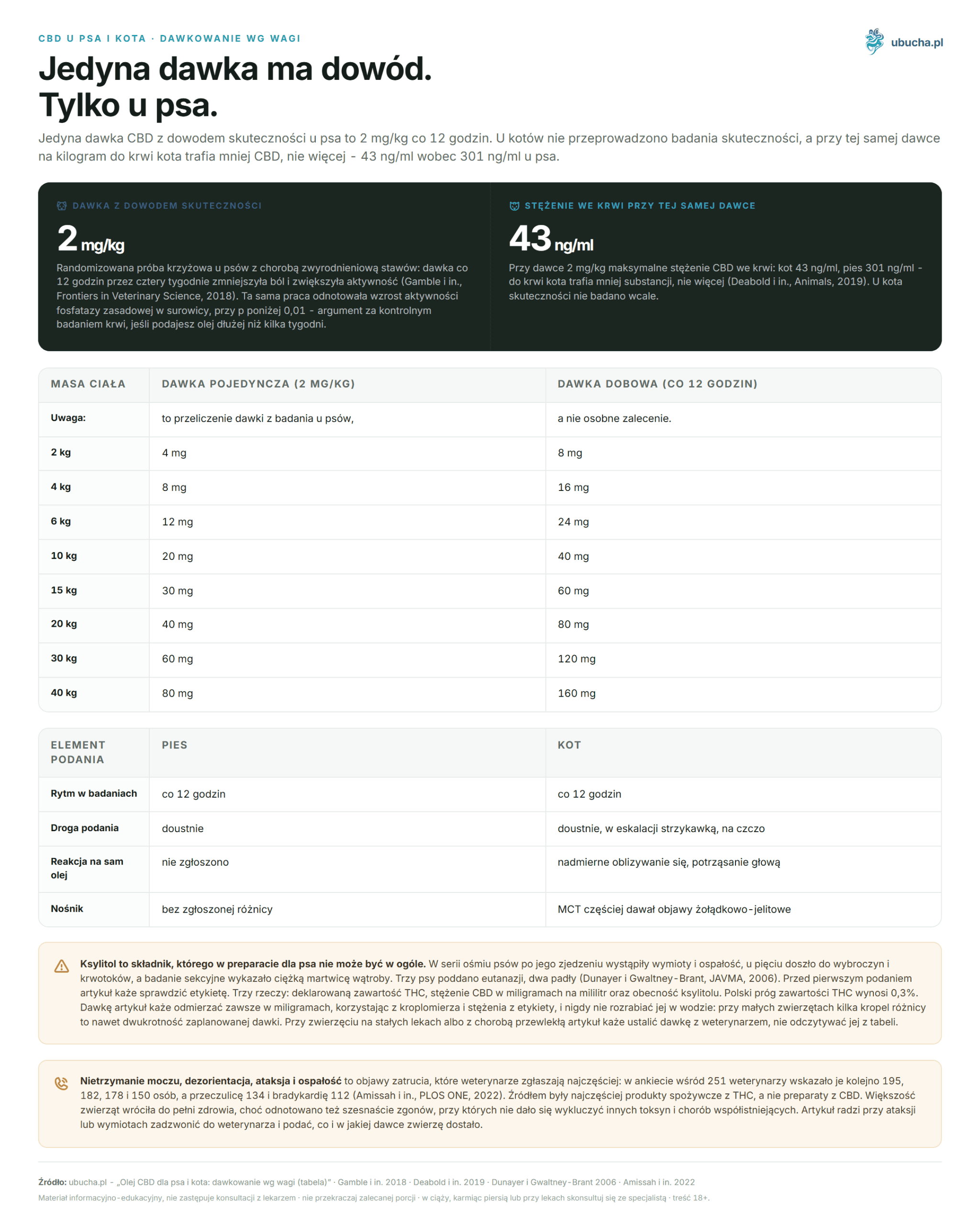
At a dose of 2 mg/kg every 12 hours, a 10 kg dog receives 20 mg per dose and 40 mg per day, while a 4 kg cat receives 8 mg and 16 mg respectively. The table below is a conversion of this one dose to body weight, not a separate recommendation.
| Body Weight | Single Dose (2 mg/kg) | Daily Dose (two doses every 12 hours) |
|---|---|---|
| 2 kg | 4 mg | 8 mg |
| 4 kg | 8 mg | 16 mg |
| 6 kg | 12 mg | 24 mg |
| 10 kg | 20 mg | 40 mg |
| 15 kg | 30 mg | 60 mg |
| 20 kg | 40 mg | 80 mg |
| 30 kg | 60 mg | 120 mg |
| 40 kg | 80 mg | 160 mg |
| Basis for conversion: 2 mg CBD per kilogram of body weight every 12 hours. This dosage has been evaluated for efficacy (Gamble et al., 2018) and tolerance (Deabold et al., 2019) in dogs, and only for tolerance in cats. | ||
The table does not have a column for the starting or maximum dose because none of the described studies checked the step-by-step approach to reaching a dose. The values are given in milligrams of pure CBD, not in drops. The number of drops can only be calculated from the label, which provides the concentration in milligrams per milliliter: an oil with a concentration of 50 mg/ml gives a dose of 20 mg from 0.4 ml.
The same milligram means something different for a dog and a cat, as a different amount enters the bloodstream. The difference is described in the next section. If the animal is on permanent medication or has a chronic disease, determine the dose with a veterinarian instead of reading it from the table and administering it independently.
Does a cat need a different dose than a dog of the same weight?
Not in the way it is usually repeated. At the identical dose of 2 mg/kg, a cat reaches a maximum CBD concentration in the blood of 43 ng/ml, while a dog reaches 301 ng/ml. The area under the curve is 164 and 1297 ng·h/ml respectively. Therefore, less substance enters the cat’s bloodstream, not more.
The authors of this work describe the difference cautiously: cats absorb or excrete CBD differently than dogs, achieving lower serum concentrations. The time to maximum concentration was 2 hours in cats, 1.4 hours in dogs (Deabold et al., 2019). The widespread justification that a cat needs a smaller dose because it metabolizes cannabinoids more slowly and accumulates them faster is not confirmed by these measurements.
A separate dose escalation study involved twenty healthy cats. They were given up to eleven increasing doses, safely reaching 30.5 mg/kg of CBD. All observed adverse events were mild, transient, and resolved without medical intervention, and hematology and biochemistry did not change significantly clinically. Gastrointestinal symptoms occurred more frequently with MCT carrier preparations (Kulpa et al., Journal of Feline Medicine and Surgery, 2021).
The reason for caution in cats is therefore different than is usually written. It is not about accumulation, but about the lack of any efficacy study, about elevated aminotransferase in one of the eight cats in the twelve-week trial, and about the reaction to the oil itself. Species differences go much deeper than dosage, as the endocannabinoid system has a different history in different animals.
How to administer CBD oil to a dog and cat?
In both studies, the oil was administered orally every 12 hours, and this is the only tested rhythm. In cats, reactions to the administration itself were noted: excessive licking and head shaking. No such reports were made for dogs, which simplifies the entire procedure.
| Administration Element | Dog | Cat |
|---|---|---|
| Rhythm in studies | every 12 hours | every 12 hours |
| Route of administration | orally | orally, in the escalation study with a syringe, on an empty stomach |
| Reaction to the oil itself | none reported | excessive licking, head shaking |
| Carrier | no reported difference | MCT was more often associated with gastrointestinal symptoms |
The practical conclusion from the cats’ reactions to the oil is that it is worth splitting the administration into two actions: first measure the dose, then give it with a small portion of wet food, instead of putting the oil directly into the mouth. Do not mix the oil in water, as it does not dissolve in it and settles on the walls of the bowl, so you do not know how much the animal actually received.
Always measure the dose in milligrams, using a dropper and the concentration from the label. With small animals, a few drops difference can even double the planned dose. A broader overview of applications can be found in the text about how oils work in dogs, cats, and horses.
What symptoms should concern you and what usually causes them?
In a survey among 251 veterinarians from Canada and the United States, the most frequently reported symptoms of cannabis poisoning in animals were incontinence, disorientation, ataxia, and lethargy. The source was most often THC-containing products, not CBD preparations.
The numbers from this survey organize the scale of the phenomenon. Incontinence was indicated by 195 veterinarians, disorientation by 182, ataxia by 178, lethargy by 150, hyperesthesia by 134, and bradycardia by 112. Poisoning most often affected dogs, and the most frequently suspected cause was unmonitored edibles. Most animals returned to full health, although sixteen deaths were also recorded, in which other toxins and comorbid diseases could not be ruled out (Amissah et al., PLOS ONE, 2022).
A retrospective analysis of 125 dogs in Colorado showed a fourfold increase in marijuana poisonings over five years, along with an increase in the number of medical marijuana licenses issued. Two dogs died after eating baked goods made with THC butter (Meola et al., Journal of Veterinary Emergency and Critical Care, 2012).
The distinction is supported by escalation studies. In dogs, CBD-dominant oil was found to be as safe as placebo, up to the tenth dose corresponding to about 62 mg/kg. Adverse events occurred in all groups, but 94.9% of them were mild, and moderate and severe ones were concentrated in groups receiving THC oil (Vaughn et al., Frontiers in Veterinary Science, 2020). In case of ataxia or vomiting, call the veterinarian and directly tell them what and in what dose the animal received.
What to check on the label before the first administration?
Three things: declared THC content, CBD concentration in milligrams per milliliter, and the presence of xylitol. The first determines whether the product is even legal, the second allows you to measure the dose from the table, and the third can be deadly for a dog.
The Polish threshold for THC content is 0.3% and is calculated as the sum of delta-9-THC and tetrahydrocannabinolic acid (THCA) in flowering or fruiting plant tops from which the resin has not been removed, rounded to one decimal place. The basis is Article 4 point 5 of the Act of July 29, 2005 on Counteracting Drug Addiction (Journal of Laws 2023, item 1939), as amended by the Act of March 24, 2022 (Journal of Laws 2022, item 763). The national threshold corresponds to the EU threshold, but it does not derive from it: these are two separate regulations of the same value. Cannabidiol itself does not appear on any list of controlled substances.
Xylitol is an ingredient that cannot be present in a product for dogs at all. In a series of eight dogs after its ingestion, vomiting and lethargy occurred, five developed bruising and bleeding, and necropsy revealed severe liver necrosis. Three dogs were euthanized, and two died (Dunayer and Gwaltney-Brant, JAVMA, 2006). Sweeteners end up in products intended for humans, so read the composition to the end.
The question remains about medications. A review of registration data in humans showed that CBD interacts with the enzymes CYP3A4 and CYP2C19 and with P-glycoprotein, meaning it affects the metabolism and excretion pathways of many drugs (Brown and Winterstein, Journal of Clinical Medicine, 2019). There are no analogous data for dogs and cats, so for an animal on permanent medication, the decision about the oil is made by the veterinarian, not the caregiver.
Frequently Asked Questions
How many mg of CBD daily for a 10 kg dog?
According to the Gamble study, which is 2 mg per kilogram every 12 hours, a 10 kg dog receives 20 mg per dose and 40 mg per day. This dosage was evaluated in dogs with osteoarthritis for four weeks. Determine the dosage for a specific animal with a veterinarian.
Does a cat need a smaller dose of CBD than a dog of the same weight?
Measurements do not confirm this. At the same dose of 2 mg/kg, a cat reached a maximum concentration of 43 ng/ml, while a dog reached 301 ng/ml, so less substance entered the cat’s bloodstream. The real reason for caution is different: no efficacy study has been conducted in cats.
How to give CBD oil to a cat that doesn’t want it?
Measure the dose separately, then give it with a small portion of wet food. In a twelve-week study, cats reacted to the oil itself with excessive licking and head shaking. Do not mix the oil in water, as it does not dissolve in it and settles on the walls of the bowl.
What symptoms indicate poisoning and does CBD cause it?
Veterinarians most often report incontinence, disorientation, ataxia, and lethargy. These symptoms have been described for poisoning with cannabis containing THC, usually after consuming unmonitored edibles. CBD-dominant oil in an escalation study in dogs was found to be as safe as placebo.
Can human CBD oil be given to an animal?
Cannabidiol itself is the same molecule, so the problem lies with the rest of the composition. Check the declared THC content against the threshold of 0.3%, the concentration in milligrams per milliliter, and the absence of xylitol, which causes acute liver failure in dogs. For an animal taking medications, leave the decision to the veterinarian.
We have gathered products intended for dogs and cats in the category CBD for animals.
This article is for informational and educational purposes and does not constitute medical advice. Before starting to use cannabis or CBD for therapeutic purposes, consult a doctor, especially if you are taking other medications, are pregnant, or breastfeeding.
Author: Michał Waluk · Published: 2026-08-09 · Updated: 2026-08-10