
Quick Recipe for Marijuana (CBD) Cookie - Decarboxylation, Cannabutter, Dosage
Recipe for cookies with CBD herb: decarboxylation, hemp butter, dosage calculation. Plus what recipes don’t say - when home baking is a crime.
A cookie with hemp herb is a regular butter cookie where the butter is replaced with hemp butter, and the main challenge lies in three steps: decarboxylation of the herb, fat infusion, and calculating how many milligrams of cannabinoids are in one piece. Below we detail each with temperatures, times, and a dosage formula, then show what has actually been measured in humans about ingested cannabinoids and what remains unmeasured. A separate section answers a question usually omitted in recipes: what the Anti-Narcotics Act says about home processing of herb dispensed on prescription. The recipe is designed for fibrous hemp herb, as only for it do all numbers in this text make sense.
KEY INFORMATION
• EFSA set a temporary safe daily dose of CBD at 0.0275 mg/kg body weight, about 2 mg for a 70 kg person (EFSA NDA Panel, 2026).
• Home processing of pharmacy-dispensed herb into butter and baking is not covered by any legal exemption.
• Absolute bioavailability of CBD was measured in humans only for inhalation and is 31 percent (Millar et al., 2018).
• Decarboxylation converts THCA to THC, so legal herb delivers more THC to the cookie than the label suggests.
Which herb is legally suitable for baking?
One that meets the definition of fibrous hemp: the sum of delta-9-THC and tetrahydrocannabinolic acid in flower or fruiting tops, from which resin has not been removed, does not exceed 0.3 percent on a dry weight basis, rounded to one decimal place. Anything above this is cannabis other than fibrous hemp, i.e., a narcotic.
Two common misunderstandings in this definition. First: the threshold counts as the sum of delta-9-THC and THCA, not just delta-9-THC alone. A lab reporting only delta-9-THC does not answer the legality question. Second: the national threshold matches the EU threshold from Regulation 2021/2115 but does not derive from it - these are two separate regulations with the same numeric value.
The 0.3 percent value has applied in Poland since May 7, 2022. Previously it was 0.20 percent, so older culinary guides give outdated numbers. If you find a text distinguishing “0.3 percent for herb and 0.2 percent for extracts,” put it aside - no such division exists in any regulation.
Separate matter: hemp food products from seeds. Limits there are expressed in milligrams per kilogram, not percent, and are 3.0 mg/kg for seeds and seed products and 7.5 mg/kg for hemp seed oil. These values do not apply to herb used for butter infusion.
Legal basis: Art. 4 points 5 and 37 of the Anti-Narcotics Act as amended by the Act of March 24, 2022, Journal of Laws 2022 item 763.
How to interpret a laboratory test result of herb?
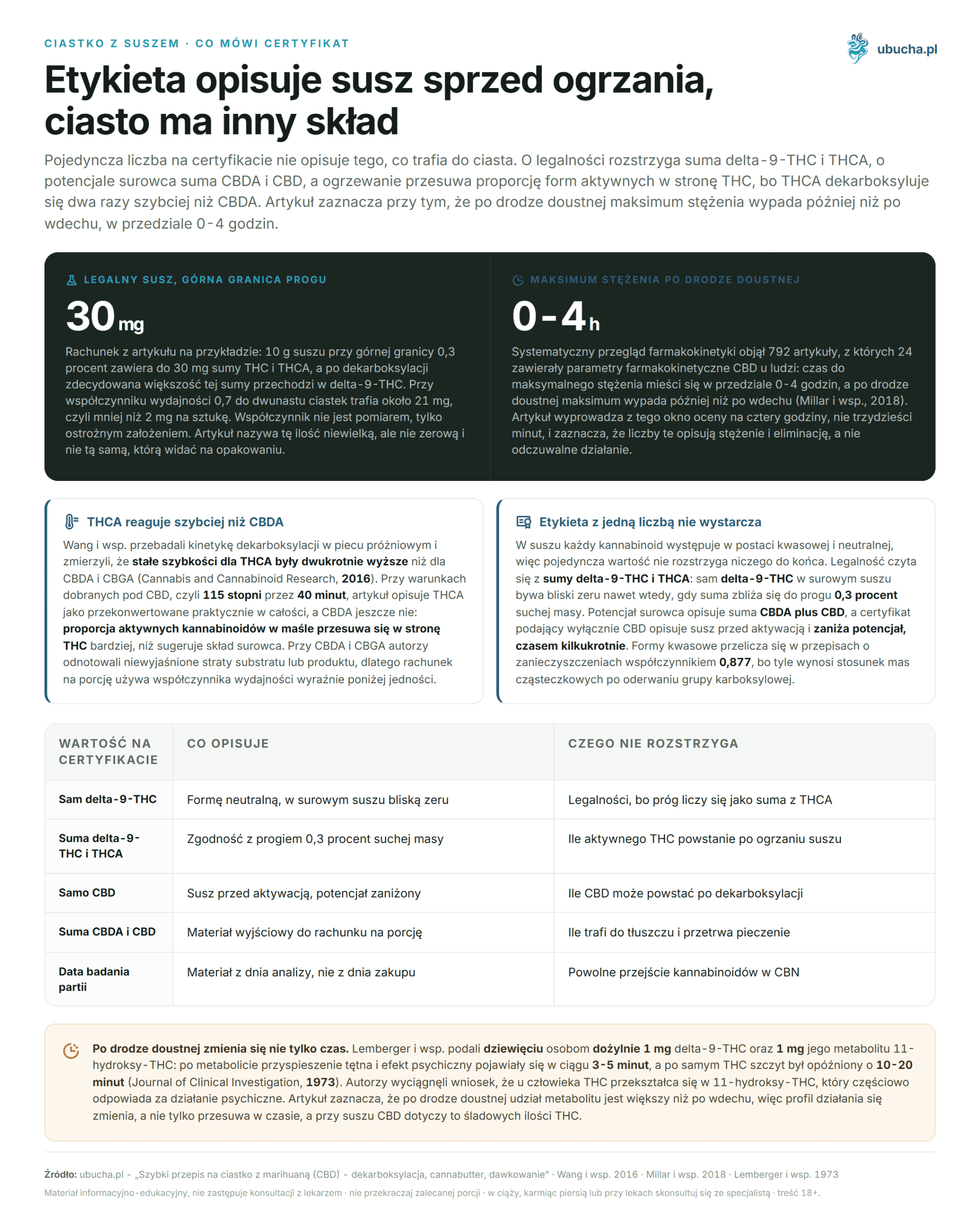
A single number label is insufficient because each cannabinoid in herb exists in two forms: acidic and neutral. A reliable certificate reports CBDA and CBD separately, and THCA and delta-9-THC separately. Wang et al. emphasize that effective analytical methods must detect both forms simultaneously, as only together do they describe the raw material composition.
For legality assessment, read the sum of delta-9-THC and THCA rounded to one decimal place. Delta-9-THC alone in raw herb can be near zero even when the sum approaches the threshold because before heating most is still in acidic form. A lab reporting only delta-9-THC does not answer the compliance question.
For dosage calculation, you need the other sum: CBDA plus CBD. This indicates how much CBD can form after decarboxylation and is used in the dosage calculation section. If the certificate reports only CBD, it describes the herb before activation and underestimates the raw material’s potential, sometimes several times.
It is useful to know how acidic forms are converted. In food contamination regulations, the sum is expressed as delta-9-THC using a factor of 0.877 for THCA - the ratio of molecular masses after removing the carboxyl group. This factor also explains why grams of acidic form never yield the same grams of active form.
The last item on the certificate is the date. Herb ages, and cannabinoids slowly convert to CBN, so a test from a year ago describes different material than what you have. When buying for baking, ask for the batch, not the product.
How much CBD can be eaten daily without risk?
Less than most edible recipes state, and about an order of magnitude less than typical home cannabutter yields. The EFSA Panel on Nutrition and Novel Foods in 2026 derived a temporary safe daily dose of CBD at 0.0275 mg per kilogram body weight, about 2 mg daily for a 70 kg adult.
This number comes from benchmark dose modeling on subchronic studies with an uncertainty factor of 400. It applies only to supplements with at least 98 percent pure CBD, free of nanoparticles, produced safely, and with excluded genotoxicity. Homemade butter from herb meets none of these conditions, so this is not a “cookie dose” - it is a reference point showing how far typical recipes are from a cautious threshold.
The panel also stated what cannot be determined. CBD safety cannot be established for people under 25 years old, pregnant or breastfeeding women, or those taking medications simultaneously. Animal studies showed consistent liver toxicity; in humans, hepatotoxic potential was noted, especially combined with drugs. CBD crosses the placenta and accumulates systemically; prenatal exposure has been linked to long-term sex-dependent neurodevelopmental effects. Immunotoxicity has not been studied.
The practical takeaway for home bakers is simple. If you count doses in tens of milligrams, you are outside the area for which anyone calculated a safety margin. This is not a ban, just information that culinary recipes do not provide.
Source: EFSA NDA Panel, Update of the statement on safety of cannabidiol as a novel food, EFSA Journal 2026.
Is it allowed to bake a cookie at home from herb dispensed on prescription?
No. Dispensing herb at a pharmacy entitles the patient to consume it in the issued form, not to give it a new form. The Anti-Narcotics Act defines processing as giving a narcotic a new form, and manufacturing, processing, or modifying without required permission is a crime. No regulation exempts a patient with a valid prescription from this rule.
Kitchen crushing of herb, heating it in the oven, and transferring cannabinoids to fat is exactly this description. It does not matter that you do it for yourself, do not sell the result, or bought the herb legally at a pharmacy. The qualification depends on what you did with the raw material, not why.
Invoking the pharmaceutical raw material provision does not help. The Act allows cannabis other than fibrous hemp as raw material for magistral drugs, which by definition are prepared in pharmacies by pharmacists based on prescriptions. A home kitchen is not a pharmacy, and hemp butter is not a magistral drug.
Consequences are real. Manufacturing, processing, or modifying narcotics without permission is punishable by imprisonment, and possession outside the Act’s provisions is separately punishable - basic offense up to 3 years, significant quantity from 1 to 10 years. This is not theoretical risk in a footnote but the reason we wrote this recipe for fibrous hemp herb.
Legal basis: Anti-Narcotics Act of July 29, 2005, consolidated text Journal of Laws 2023 item 1939, Art. 4 point 20 in connection with Art. 53, and also Art. 33a and Art. 62 paragraphs 1 and 2.
How to decarboxylate herb and why must it not be skipped?
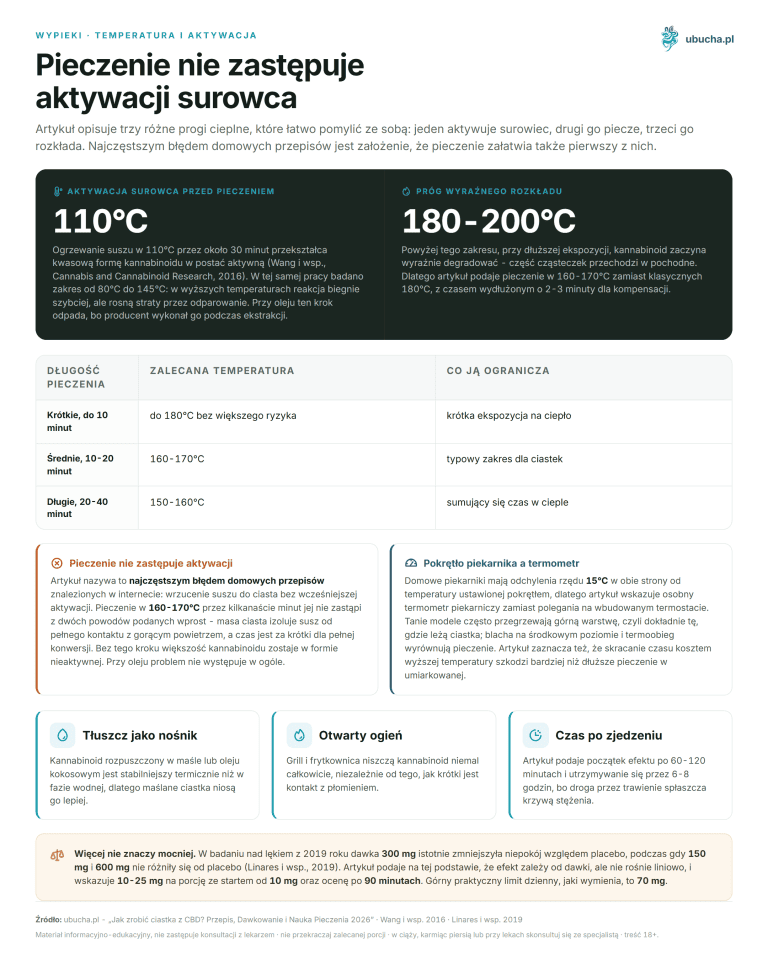
In raw herb, cannabinoids mainly exist in acidic form: CBDA instead of CBD, THCA instead of THC. Heating removes the carboxyl group and converts acidic forms to neutral. Without this step, the cookie will mostly contain CBDA, and dosage calculations per piece become meaningless.
Wang et al. studied the kinetics of this reaction in a vacuum oven at 80, 95, 110, 130, and 145 degrees Celsius for up to 60 minutes. Concentration dependence on time was exponential, i.e., a first-order reaction. Rate constants for THCA were twice those for CBDA and CBGA - THCA disappears faster. THCA decarboxylation was clean, without byproducts, while CBDA and CBGA showed unexplained substrate or product losses.
For the kitchen, this means two things. First, there is no single “correct” temperature: higher means faster, and the choice is a compromise between time and losses. Second, for CBDA, you cannot assume all that disappears converts to CBD. Therefore, in dosage calculation, we use an efficiency factor clearly below one.
A home procedure that works for CBD herb: preheat oven to 115 degrees, crush 7-10 g herb by hand or with a manual grinder (not to powder), spread thinly on a parchment-lined tray, cover with another parchment sheet, bake 40 minutes, shaking the tray every 10-15 minutes. The herb should be brittle and golden brown after removal. Black means burning and irreversible loss.
More on the chemistry of this step in our article on decarboxylation step by step. Data source: Wang et al., Cannabis and Cannabinoid Research 2016.
How to make hemp butter that won’t turn bitter?
Cannabinoids are lipophilic, so the carrier must be fat. Butter with 82 percent fat content works best in baking because it does not change the cookie’s taste like coconut oil does. Water in the pot is not decorative: it protects fat from burning and collects some plant impurities that would otherwise remain in the butter.
Proportions for one batch: 250 g unsalted butter, 7-15 g decarboxylated herb, 250 ml water, food-grade cheesecloth or cotton filter. Melt butter with water on the lowest heat, add herb, stir with a wooden spoon. Maintain 70-85 degrees for two hours, stirring every 15-20 minutes. The mixture must not boil. If water evaporates, add a little more.
Strain everything through cheesecloth on a sieve without squeezing the herb. Squeezing transfers chlorophyll to the fat, which causes the bitterness complained about by home bakers. Chill in the fridge for 4-6 hours, remove the solidified fat layer, discard the water.
Successful butter is yellow-golden with a slight greenish tint, smells herbal-nutty, and after chilling has a smooth texture without water droplets inside. Dark green color and burnt smell indicate overheating or excessive squeezing. Store in a glass jar in the fridge for 5-7 days or freezer for up to three months, always labeled.
Fat alternatives work on the same principles: coconut oil extracts more efficiently but dominates flavor, and ghee contains no milk proteins. A separate guide on this step is in our article on hemp butter step by step.
How to bake twelve cookies with hemp butter?
The base recipe is classic butter cookies where regular butter is replaced with hemp butter: 200 g cannabutter at room temperature, 150 g sugar, one medium egg, 250 g wheat flour type 450, teaspoon baking powder, teaspoon vanilla flavoring, pinch of salt. Total time about 35 minutes if butter is ready.
Cream cannabutter with sugar using a mixer for 2-3 minutes until light. Add egg with flavoring and mix another half minute. In a separate bowl, sift flour with baking powder and salt, then combine dry with wet. Mix only until flour disappears: overmixing develops gluten and cookies become chewy.
Chill dough for 30 minutes wrapped, form 12 balls about 4 cm diameter (each weighs 50-55 g), place on parchment-lined tray spaced 4 cm apart. Bake at 175 degrees for 12-14 minutes until golden edges. The center should look slightly underbaked; it will finish while cooling. Cool 5 minutes on tray, then transfer to rack.
Size changes dose proportionally. Twenty-four smaller pieces of 25 g bake 9-10 minutes and each contains half the dose of the base version. Six large pieces of 100 g bake 16-18 minutes and dose doubles. For the first batch with new butter, choose smaller cookies - easier to err on the low side than high.
Do not raise temperature above 180 degrees or bake longer than 15 minutes. The cookie interior remains much cooler than the oven chamber, but the surface does not, and degradation happens fastest there.
How to calculate how much CBD is in one cookie?
Starting point: three numbers - grams of herb, declared CBD percentage, and number of cookies per batch. One gram of 9 percent CBD herb contains 90 mg CBD, so 10 g gives 900 mg. Divided by 12 pieces, that’s 75 mg per cookie - but only on paper, as some cannabinoids are lost at each step.
The formula we use: dose per cookie in mg equals grams of herb times CBD percent times 10, divided by number of cookies, times efficiency factor. At home, assume 0.7. This factor is not a measurement but a cautious assumption: it accounts for incomplete CBDA conversion, incomplete extraction into fat, losses on cheesecloth, and degradation during baking.
| Herb | CBD Content | CBD in Batch (mg) | After 0.7 Efficiency | Per 12 Cookies |
|---|---|---|---|---|
| 3 g | 9 percent | 270 | 189 | about 16 mg |
| 5 g | 9 percent | 450 | 315 | about 26 mg |
| 7 g | 9 percent | 630 | 441 | about 37 mg |
| 10 g | 9 percent | 900 | 630 | about 52 mg |
Compare these values with EFSA’s temporary safe dose, about 2 mg daily for a 70 kg person. The weakest cookie in the table exceeds it eightfold. This does not mean it is unsafe - it means no one calculated a margin you could rely on for such a portion.
Where to start if you’ve never eaten edibles?
Start with the smallest portion you can cut and patience measured in hours, not minutes. A review of CBD pharmacokinetics in humans reports time to maximum concentration between 0 and 4 hours, with oral maximum later than inhalation. Adding more after half an hour is blind: the first dose has not yet shown its effect.
A practical protocol: first session - quarter cookie, then four hours without more. Second session, another day - half cookie if no effect before. Subsequent sessions: increase by a quarter every few days until you find a dose that relaxes but does not make you sleepy.
Keep records. Sounds trivial, but it’s the only way to distinguish weak butter from your own tolerance. Note cookie weight, calculated dose, time eaten, time of first effect, and what you ate before. After three batches, you have your own curve worth more than any online table.
What not to do: don’t test a new batch in the evening before workday, don’t mix with alcohol, don’t eat a second cookie “because I feel nothing.” The cumulative effect of two doses appears simultaneously and with stronger butter can mean over 100 mg in one hit.
Also set conditions so the first session costs nothing if it goes wrong. Free evening, someone at home who knows what you’re eating, no plans for next four hours, zero alcohol. This is not overcaution: oral dose decisions cannot be undone or spread out if too high.
If you take medications regularly, read the interactions section below and talk to a doctor or pharmacist before the first batch, not after.
When does the cookie start working and how long does it last?
The honest answer: less is known than guides suggest. A systematic review by Millar et al. covered 792 articles, 24 of which included CBD pharmacokinetic parameters in humans. Time to maximum concentration is within 0-4 hours, with smoking and inhalation peaking faster than oral and sublingual routes.
Half-life depends more on administration route than most assume: 1.4-10.9 hours after sublingual spray, 2-5 days after chronic oral dosing, 24 hours after intravenous, and 31 hours after smoking. These numbers describe elimination, not felt effect, so you cannot read a simple “cookie works 4-8 hours” from them.
A controlled comparison of administration routes by Newmeyer et al. gave volunteers smoked, vaporized, and oral cannabis at the same dose. Significant heart rate increase occurred half an hour after smoking and vaporizing, but only after 1.5 and 3 hours after oral dose. Subjective effects orally were significant only in occasional users.
From this comes a practical rule worth more than a clock: four hours is the minimum assessment window because only then is it known the dose showed maximum. Adding more earlier does not speed effect but shifts and increases it.
Sources: Millar et al., Frontiers in Pharmacology 2018 and Newmeyer et al., Drug and Alcohol Dependence 2017.
Why does oral route act differently than inhalation?
Because the liver stands between the gut and brain. Everything absorbed from the digestive tract goes via the portal vein to the liver before entering systemic circulation. Cytochrome P450 enzymes metabolize part of the dose there, and for THC, the metabolite is a separate active substance.
Lemberger et al. gave nine people 1 mg intravenous delta-9-THC and 1 mg of its metabolite 11-hydroxy-THC. The metabolite caused heart rate increase and psychoactive effect within 3-5 minutes, while THC peak was delayed 10-20 minutes. Effects correlated with plasma 11-hydroxy-THC concentration. Authors concluded THC converts to 11-hydroxy-THC in humans, partly responsible for psychoactive effects.
For the cookie, this means oral route has a larger metabolite share than inhalation, changing the effect profile, not just timing. For CBD herb, this concerns trace THC amounts, but for higher THC herb, the difference can be dramatic and explains stories of brownies that “hit differently.”
The same mechanism applies to CBD’s other side. Absolute bioavailability was measured only after smoking and is 31 percent. For oral and sublingual routes, no study has done this despite intravenous preparations being available. Any table stating “6-19 percent orally” cites data that do not exist.
We explained this mechanism more in our article on why edible CBD hits stronger and later than herb - metabolite 11-hydroxy. Source: Lemberger et al., Journal of Clinical Investigation 1973.
How much THC gets into a cookie from legal herb?
More than simple label math suggests, and this is the most often overlooked detail in home baking. The 0.3 percent threshold includes the sum of delta-9-THC and THCA. Raw herb mostly contains THCA, which is not psychoactive. Decarboxylation, the step you consciously do for CBD, converts THCA to active THC incidentally.
Example calculation: 10 g herb at the 0.3 percent upper limit contains up to 30 mg total THC and THCA. After decarboxylation, most converts to delta-9-THC, and with 0.7 efficiency, about 21 mg goes into twelve cookies, less than 2 mg per piece. It’s little but not zero and not the same number as on the package.
Wang et al. measured THCA decarboxylates twice as fast as CBDA. Under CBD-optimized conditions - 115 degrees for 40 minutes - THCA is practically fully converted while CBDA is not. The active cannabinoid ratio in butter shifts toward THC more than raw composition suggests.
Practical takeaway for larger batches: with 15 g herb per butter batch, THC amounts can be noticeable to someone naive to it. If baking for someone who wants no THC, reduce herb amount or choose CBD oil as carrier and skip decarboxylation.
Is it allowed to sell or share such cookies?
Baking for yourself is one thing, marketing is another. Cannabis sativa extracts containing cannabidiol were not significantly consumed in the EU before May 15, 1997, so they fall under the Novel Food Regulation 2015 and require authorization before food market introduction. No authorization for CBD has been issued yet.
The process is ongoing, and in 2026 EFSA published an update. Data gaps identified in 2022 remain, and new studies have methodological limitations: nonstandard protocols, short observation, and concomitant treatment. The panel derived a temporary safe dose but specified it applies only to supplements with at least 98 percent purity.
Two practical consequences. First, sanitary notification in Poland when introducing a supplement is not a novel food authorization and does not change ingredient status. Second, selling homemade CBD baked goods, even at fairs or via social media, means marketing food containing an unauthorized ingredient.
Sharing with friends without money is not selling but not neutral either. You are responsible for what you serve, and a cannabutter cookie looks like a regular one and does not warn by taste. Be clear about contents and calculated dose before anyone reaches for the plate.
Legal basis: Regulation (EU) 2015/2283 on novel foods and EFSA 2026 position update.
Can you drive after a hemp cookie?
Not the same day and not based on your own feeling. Testing for substances acting like alcohol is under Article 129j of the Road Traffic Act - Article 129i concerns alcohol and is often confused in guides. Blood sampling is based on 129j, not criminal procedure code inspection rules.
The 1 ng/ml value circulating on forums as a “threshold” is the detection limit of the method per implementing regulation, not a responsibility threshold. For saliva, the regulation specifies no limit. The inconvenient conclusion: there is no number below which you can feel safe.
Detection windows can be long. Newmeyer et al. note THC can be detected in blood up to 30 days after frequent use. In their study, none of occasional users tested positive after 1.5 hours post-inhalation or 12 hours post-oral dose. Amounts in cookies from legal herb are small but the mechanism is the same.
Consequences depend on offense qualification. Driving under influence is a crime under Art. 178a par. 1 Penal Code punishable by up to 3 years imprisonment and a fine of at least 5000 PLN. A milder offense under Art. 87 par. 1 Code of Petty Offenses is a fine of at least 2500 PLN. Most guides do not distinguish these.
Detection data source: Newmeyer et al., Clinical Chemistry 2016.
Which recipe variants work best?
The base recipe is a starting point, not a goal. Changes concern texture, baking time, and how strongly the addition masks the herbal butter taste. The table below collects the most tested variants with baking time adjustments easy to forget.
| Variant | Change | Baking Time | Watch Out For |
|---|---|---|---|
| Chocolate | Add 100 g 70% dark chocolate to dry ingredients | No change | Best masks butter taste |
| Nutty | Add 80 g chopped nuts | No change | Extra fat makes texture more crumbly |
| Gluten-free | 200 g almond flour plus 50 g rice flour plus half teaspoon xanthan gum | 10-12 minutes | Almond flour browns faster |
| Vegan | Egg replaced with half banana or tablespoon flaxseed with 3 tablespoons water | No change | Banana sweetens, reduce sugar to 130 g |
| Low-carb | Erythritol instead of sugar, 200 g almond flour plus 50 g coconut flour | 10-12 minutes | Xylitol is toxic to dogs |
One note on the vegan version. If replacing butter with plant fat, check fat content: spreadable margarines often have below 60 percent fat, the rest water, which dilutes extraction and spoils cookie structure. Only fats above 80 percent fat are suitable for infusion.
One proportion is inviolable: 200 g hemp butter for 12 cookies. All dosage math assumes all weighed butter goes into dough and distributes evenly. If you reduce butter and add regular butter to make dough less fatty, dose per piece drops proportionally and the table no longer applies. Change additions, not the carrier.
How to store cookies and label them?
In an airtight container in the fridge for up to five days or freezer for three months. Cookies with egg and butter behave like any other such baked goods, so the two-day cooling rule applies regardless of cannabinoid content. Thaw in the fridge for several hours, not microwave.
Freeze individually or in pairs wrapped in foil, then in a zip bag. Thawed texture is slightly more crumbly but that’s the only noticeable change. In the fridge, the biggest problem is odor absorption, so a container with a rubber seal matters.
Labeling is not a formality or exaggeration. A cannabutter cookie looks exactly like a regular one and its content has no warning taste. Label container with content name, baking date, and calculated dose per piece, then keep out of reach of children and pets. Dogs and cats react more strongly to cannabinoids and often end up in vet clinics.
If a child ate a cookie, call emergency number 112 or poison control and secure the container with label so the doctor can estimate dose. Do not induce vomiting on your own.
A more convenient way than freezing baked cookies: freeze butter. A 250 g batch suffices for several bakes, keeps three months frozen, and thawed retains structure better than baked dough. Divide immediately into 200 g portions, label herb amount used for infusion, and bake fresh when desired instead of thawing week-old stock.
Practical storage rules for raw herb are collected separately in our article on proper storage of marijuana and CBD herb.
Which medications interact with CBD?
Those competing for the same liver enzymes, a large group. EFSA’s 2026 update highlights CBD’s hepatotoxic potential in humans especially when combined with other drugs and states safety for medicated persons is impossible to establish.
Practically, four groups require caution: anticoagulants, antiepileptics, antidepressants from SSRI and SNRI groups, and statins. Also immunosuppressants and some sedative analgesics. The list is not closed because the mechanism concerns metabolic pathways, not substances.
A warning sign after eating a cookie is not sleepiness itself but its intensity and duration. Strong sedation preventing normal function, diarrhea, heart palpitations, anxiety, or disorientation lasting more than a few hours warrant contacting a doctor, not waiting it out. Inform that you consumed a CBD product and provide estimated dose.
Separately: do not mix cookies with alcohol or grapefruit juice. Grapefruit inhibits the same enzyme pathway, raising CBD levels uncontrollably and also increasing drug levels during pharmacotherapy.
Talking to a pharmacist requires one thing to remember. Popular drug interaction checkers lack CBD in their database or list it as a supplement without described interactions, so a blank result does not mean no risk. Be clear about amount and frequency planned and ask about the pathway, not the product.
Short version for medicated persons: talk to a doctor or pharmacist before the first batch, not after the first worrying symptom.
What to do if cookies don’t turn out?
Most home edible failures boil down to six causes, all reversible in the next batch. The table below matches symptoms with likely causes and specific corrections instead of separate sections.
| Symptom | Most Likely Cause | Correction Next Batch |
|---|---|---|
| No noticeable effect | Skipped or incomplete decarboxylation, overheated butter | Oven thermometer, infusion without boiling, increase herb by half |
| Effect too strong | Too much herb for number of cookies | Quarter cookie as dose, reduce herb by half |
| Bitter taste, dark green butter | Squeezing herb in cheesecloth, infusion too long | Gravity draining only, shorten infusion to 90 minutes |
| Cookies spread on tray | Butter too warm, dough not chilled | Chill formed balls 30 minutes in fridge |
| Hard, dry texture | Overbaking or overworked flour | Remove when center soft, sift and weigh flour |
| Mold after three days | Cookies stored before fully cooled | Cool on rack, paper at container bottom |
One thing is not a defect though it looks like one. If after two hours you feel nothing, it usually means the butter works but the window for maximum dose has not passed. Delay assessment by another two hours and dose increase decision to the next day.
Test butter batch before baking, not after. Weigh half a gram of finished butter, spread on a slice, eat, and wait four hours without adding anything. Half a gram from 250 g batch is one five-hundredth of total, so dose is tiny and sensation tells if infusion worked at all. Twelve cookies from failed butter are twelve lost doses; one slice is one.
How does a cookie differ from other CBD forms?
Primarily in that the oral route is least understood. The table below compares what was actually measured, not what online summaries repeat. Bioavailability values come from one systematic review and three of four rows say: not established.
| Form | Time to Max Concentration | Half-life | Absolute Bioavailability |
|---|---|---|---|
| Cookie, capsule, oral route | Later than inhalation, within 0-4 h window | 2-5 days with chronic dosing | Not established |
| Sublingual spray and oil | Within 0-4 h window | 1.4-10.9 h | Not established |
| Smoking and vaporizing | Faster than oral route | 31 h | 31 percent |
| Intravenous administration | Immediate | 24 h | By definition 100 percent |
One phenomenon from this review directly applies to the kitchen: maximum concentration rises after a meal and in fat-based preparations. This is why we make butter, not tea, and why it’s better to eat a cookie with food, not on an empty stomach.
Choosing a form is choosing predictability. Inhalation gives quick dose control and the only measured bioavailability. A cookie gives a repeatable kitchen-measured portion and prolonged effect but without data to refer to.
Hence a second practical rule often forgotten when changing form. Milligrams cannot be converted between administration routes. A dose that worked for you sublingually has no equivalent in a cookie because for none of these routes do we know the fraction of dose that actually reaches bloodstream. When changing form, start dose selection anew, just like the first time.
What do terpenes do and do they survive baking?
Terpenes are responsible for herb aroma and flavor and explain why two strains with the same CBD content smell completely different. Myrcene gives earthy notes, linalool lavender, beta-caryophyllene peppery, limonene citrus, and pinene resinous. Fresh herb contains a dozen or so in various proportions.
The problem is volatility. Most start evaporating at temperatures lower than baking uses, and decarboxylation lasts forty minutes. That’s why this recipe targets 115 degrees instead of higher and why herb is covered with a second parchment sheet. A closed jar during infusion works similarly.
What we cannot do is promise a number. Claims like “terpenes enhance CBD effect by 25-30 percent” circulate in industry texts without supporting studies, and we removed them along with a source that did not contain them. The entourage effect is a conditional hypothesis, not a measured value.
What remains is what can be done without citing others’ numbers: bake shorter and cooler, keep butter sealed, and if aroma matters, add spices after mixing ingredients. A pinch of black pepper adds beta-caryophyllene regardless of herb, cinnamon and cocoa mask herbal taste better than any technological trick.
One trick that simply does not work as guides promise: adding concentrated terpenes to hot mass. If you try, mix them after butter cools, not during infusion, because at 80 degrees they evaporate faster than they spread. Amount counts in drops per batch, not per cookie, and exceeding this scale yields bitter and soapy taste.
What equipment is really needed?
Three things affect the result, the rest is convenience. First, an oven thermometer. Home ovens can be off by several degrees, and for decarboxylation, the difference between 115 and 135 degrees decides how many terpenes remain and how far conversion goes. Place thermometer in the middle rack and compare reading with setting after ten minutes heating.
Second, a scale accurate to 0.1 g. Standard kitchen scales weigh to 1 g, and for 5 g herb, one gram is 20 percent of the portion. All dosage math depends on this number, so input error transfers to every cookie.
Third, a probe thermometer for butter. Infusion must be at 70-85 degrees and this is the only way to know if it really is. Boiling is visible but means 100 degrees, when losses start rising.
Other equipment: fine mesh sieve, food-grade cheesecloth or cotton herb bag, glass jar with airtight lid for water method, and sealed containers for storage. All found in regular kitchen stores; nothing must be specialized.
What you don’t need: sous-vide device, electric grinder, or press. The first is replaced by a pot with thermometer, the second grinds herb to powder you don’t want, and the third does exactly what filtration avoids.
Consider also an infusion vessel. A thick-bottomed saucepan distributes heat evenly, so the mixture does not boil in one spot while the thermometer reads 80 degrees. A thin metal pan is the most common cause of unnoticed overheating. The jar-in-water-bath method also works: water bath by definition does not exceed 100 degrees.
Summary: what to remember before the first batch
Start by asking about herb origin because it decides everything else. Fibrous hemp herb up to 0.3 percent total delta-9-THC and THCA - bake. Herb dispensed on prescription - do not process, as prescription does not exempt from responsibility for giving raw material a new form.
Then three technical numbers: 115 degrees for 40 minutes for decarboxylation, 70-85 degrees for two hours for butter infusion, 175 degrees for 12-14 minutes for baking. And one factor: 0.7 as a cautious assumption of overall process efficiency.
Finally, two things missing from most recipes. EFSA’s temporary safe CBD dose is about 2 mg daily for a 70 kg person, a fraction of what one cookie in the table above provides. And the dose assessment window is four hours, not thirty minutes, because only after that time is maximum concentration known.
We verified every citation from the original text with the publisher. Three of four identifiers led to works from completely different fields, and the fourth to the correct work but not containing the cited number. That’s why the numbers above are narrower and less flashy than those they replaced.
If you remember one sentence from this text, let it be about raw material origin. The rest is technique you can improve batch to batch: adjust temperature with thermometer, remove bitterness by filtering without squeezing, divide too strong dose into quarters. A wrong raw material choice cannot be fixed because it’s not about cookie taste but legal qualification of what you’re doing in the kitchen.
Frequently Asked Questions
Can a patient with a medical marijuana prescription bake a cookie?
No. The prescription entitles consumption of herb in issued form, not giving it a new form. The Anti-Narcotics Act treats this as processing and does not exempt patients. Raw material for magistral drugs is processed by pharmacies, not home kitchens.
How many grams of herb per 250 g butter?
From 3 to 15 grams depending on target potency. With 9 percent CBD herb and 0.7 efficiency, about 16 mg CBD per cookie at 3 grams and about 78 mg at 15 grams, counting twelve pieces per batch. Beginners should use the lower end.
After how long to assess cookie dose?
After four hours. CBD pharmacokinetics review in humans reports time to max concentration between 0 and 4 hours, with oral max later than inhalation. Adding more earlier accumulates effect but does not speed it.
How much THC gets into a cookie from legal herb?
With 10 grams herb at threshold, up to 30 mg total THC and THCA per butter batch, less than 2 mg per cookie after losses. Decarboxylation converts THCA to active THC, so real content is higher than label suggests.
What is CBD bioavailability after eating a cookie?
Not established. Millar et al. 2018 review states absolute bioavailability measured only after smoking at 31 percent. No study for oral or sublingual despite intravenous preparations.
Can you drive after a hemp cookie?
Not the same day. Testing under Article 129j Road Traffic Act; 1 ng/ml is detection limit, not responsibility threshold. No saliva limit specified.
How long do cookies stay fresh?
Up to five days in airtight container in fridge, up to three months in freezer. Thawed texture is slightly more crumbly. Always label container with content, baking date, and dose per piece, then keep away from children and pets.
Can CBD oil be used instead of herb?
Yes, then skip decarboxylation. Mix oil into melted butter or finished dough. Dose can be calculated more precisely than with herb: 5 ml of 10 percent oil is 500 mg CBD, about 41 mg per cookie for twelve pieces. You lose the herb’s aroma profile.
Herb suitable for infusion is in the hemp herb category, with declared cannabinoid content for each item.
This article is informational and educational and does not constitute legal advice. The legal status described applies as of publication date: cannabis regulations may change. Consult a lawyer or current legal acts before decisions.
Author: Michał Waluk · Published: 2026-05-11 · Updated: 2026-08-10