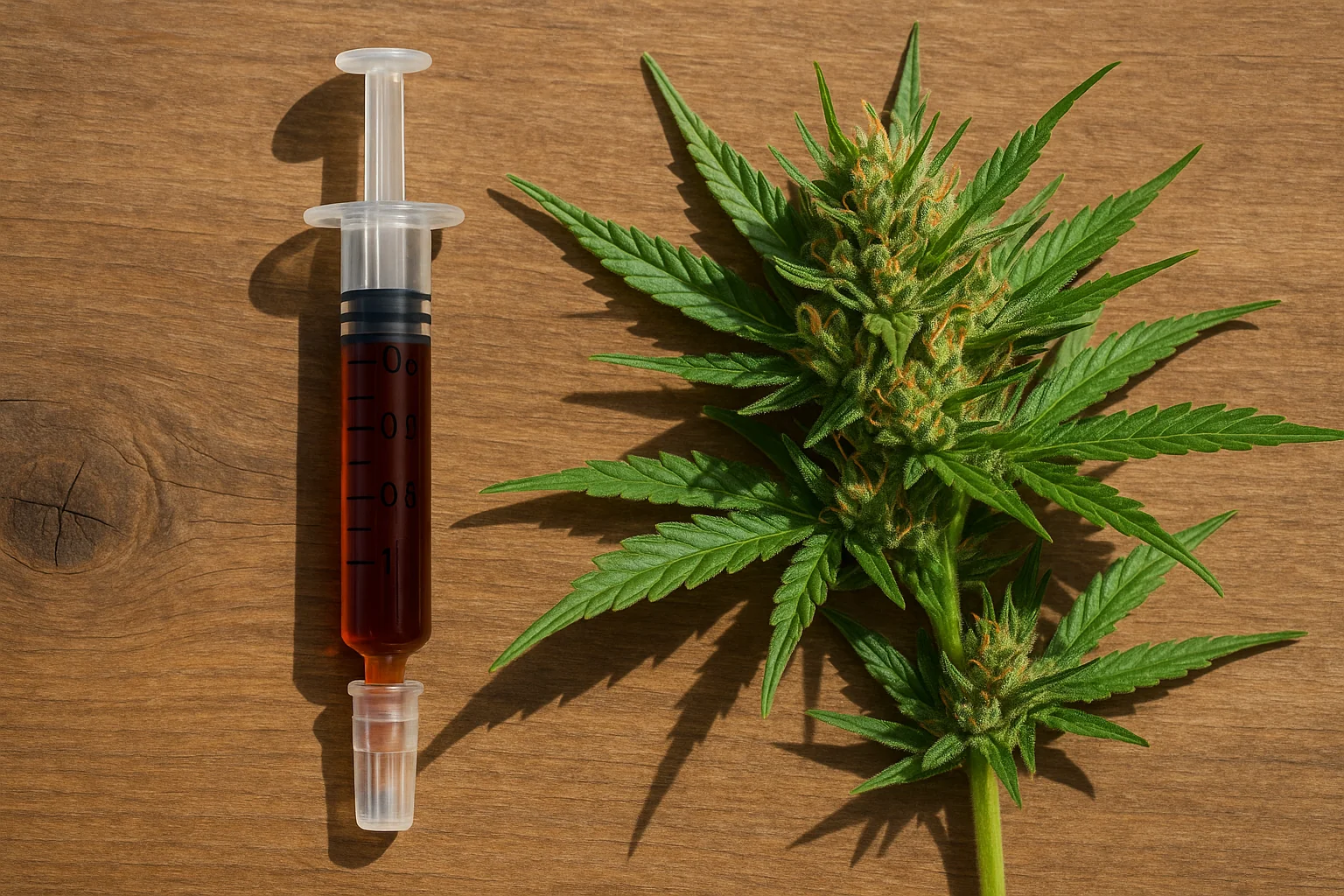

RSO and FECO: what is Rick Simpson oil and how to dose it (guide)
Hash oil, or RSO and FECO, without legends: what is full cannabis extract, what do studies really say about it, and what is its legal status in Poland.
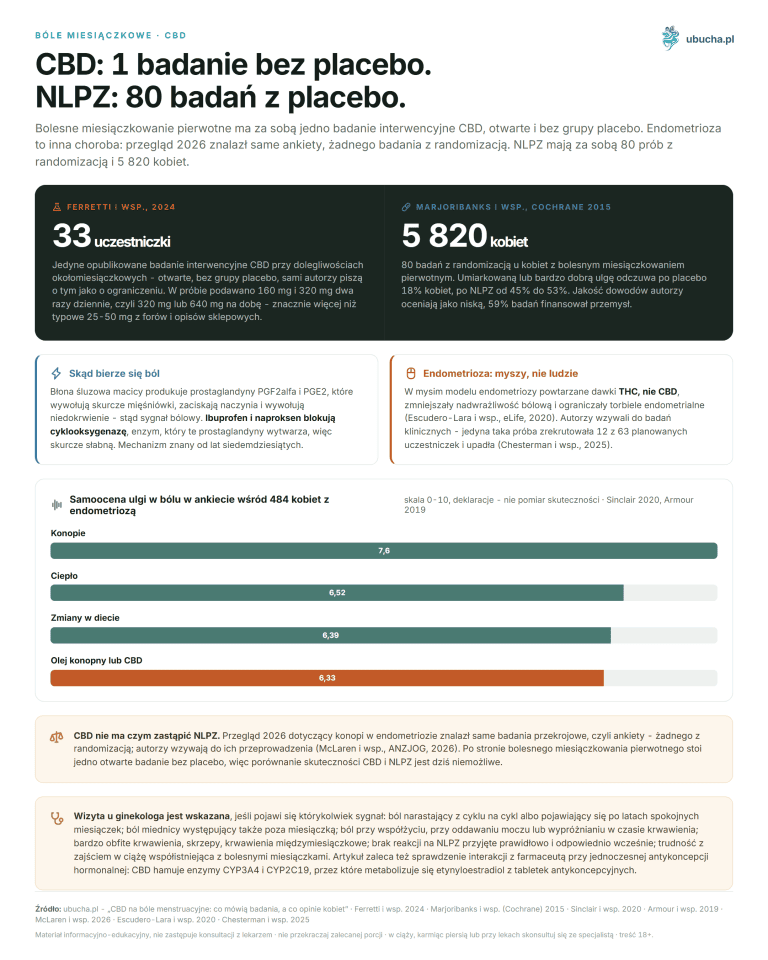
RSO, also known in Polish as hash oil, is a topic where the story has outpaced science by two decades. Thousands of patient accounts describe the thick cannabis extract as a remedy for diseases where medicine throws up its hands, yet there is not a single clinical study with a placebo testing this particular form. This does not mean that nothing is known about cannabinoids. A lot is known, just not what the legend repeats. This article separates these layers: where the name came from, how RSO differs from FECO and hash oil, what the Polish legal basis is, what research really shows, and why concentrated extract is primarily a problem of drug interactions. You will not find a dosing scheme or preparation instructions here.
KEY INFORMATION
• Cannabis other than hemp and all extracts from it are listed in Poland as a narcotic of group I-N, item 113 (Dz.U. 2024 poz. 1139).
• The legal route to such an extract is solely through a prescription Rpw and a pharmacy; Article 33a of the Act refers to raw materials for prescription medications, i.e., prepared in a pharmacy.
• A CBD-rich extract increased the area under the curve of omeprazole by 207%, losartan by 77%, and midazolam by 56% in 18 healthy individuals; THC alone did not inhibit any of the studied enzymes (Bansal et al., 2023).
• The entourage effect remains a hypothesis for which methods of verification have been proposed, not an established mechanism.
Where did the name RSO come from?
The name comes from Rick Simpson, a Canadian who in the early 2000s described his own story: a diagnosis of skin cancer, a self-prepared concentrated cannabis extract applied to the lesion under a bandage, and the lesion disappearing after a few days. He spread the account himself through a documentary film and lectures, and it built a global movement of patients preparing the extract at home or buying it in the gray market.
This specific story cannot be verified. There is no medical documentation, no case description in a peer-reviewed journal, no independent confirmation of the diagnosis. Treat it as the author’s account of himself, because that is exactly what it is.
It is worth separating two things that have merged into one in this story. One issue is whether cannabinoids have anti-cancer activity in laboratory models, and another is whether homemade extract treats cancer in humans. The first question has a rich literature. The second has none, and attempting to replace oncological treatment with extract is primarily a risk of lost time. Resignation rarely looks like a decision: it often involves postponing the next visit while waiting for improvement from a self-selected preparation.
How does RSO differ from FECO and hash oil?
In practice, all three names describe the same thing: a full extract from the whole plant, thick as tar or toffee, obtained using an alcohol solvent. Hash oil is a colloquial name for this form, older than the acronym RSO, which only entered circulation in the early 2000s. The differences are customary, not chemical. The name RSO is associated with THC-rich extracts made using the Simpson method, while the acronym FECO (Full Extract Cannabis Oil) is more often used to describe extracts made with pharmaceutical ethanol, including those dominated by CBD.
Hashish should not be confused with hash oil. Hashish is mechanically collected resin from the plant, without a solvent, and remains a solid material. Hash oil is produced differently: the solvent washes the resin from the raw material along with other compounds, and after evaporation, a thick paste remains. The Polish name is misleading in that it suggests hashish as the raw material, while it can just as well be dried flower.
The composition depends primarily on the raw material, not the name on the label. An extract from a THC-rich strain will yield a psychoactive product that is controlled in Poland. An extract from hemp will yield a product dominated by CBD, with no intoxicating effects. Both may be sold as “full cannabis extract,” so the only reliable information about the content is the certificate of analysis. We outlined how to read it in the CBD oil purchasing checklist.
| Feature | THC-rich RSO / FECO | CBD-rich FECO | Classic CBD oil |
|---|---|---|---|
| Common name | Hash oil, hash oil | Cannabis paste, full CBD extract | CBD oil, CBD oil |
| Solvent | Ethanol or isopropanol | Pharmaceutical ethanol | Carbon dioxide, ethanol, carrier oil |
| Form | Thick resin or paste | Thick oil or paste | Liquid oil with a dropper |
| Intoxicating effect | Yes, strong | None or trace | None |
| Status in Poland | Narcotic I-N, item 113 | Depends on the raw material and analysis result | Outside the list of controlled substances |
| Where legally | Pharmacy, prescription Rpw | Cannabis product store | Pharmacy, store, online sales |
| What determines the content | Batch analysis certificate | Batch analysis certificate | Batch analysis certificate |
Are RSO and hash oil legal in Poland?
Extracts from cannabis other than hemp, regardless of whether you call it RSO, FECO, or hash oil, are classified as narcotics in Poland. The Minister of Health’s list includes in group I-N under item 113 “cannabis herb other than hemp and extracts, pharmaceutical tinctures, as well as all other extracts from cannabis other than hemp” (consolidated text Dz.U. 2024 poz. 1139, read August 2026). The boundary between hemp and other cannabis is determined by the sum of delta-9-THC and THCA in flowering or fruiting tops: up to 0.3% calculated on dry mass, rounded to one decimal place.
There is only one legal route. Article 33a of the Act on Counteracting Drug Addiction (Dz.U. 2023 poz. 1939) allows cannabis herb and extracts other than hemp to be a pharmaceutical raw material for preparing prescription medications, with permission from the President of URPL issued for 5 years. The prescription medication is prepared by a pharmacy, based on a prescription Rpw. The entire patient pathway is outlined in the entry about what medical marijuana is.
Hence the conclusion that is usually not mentioned in guides about RSO. A prescription does not legalize home processing. The law defines processing as giving a narcotic a new form (Article 4 point 20), and Article 53 includes the manufacturing, processing, and altering of narcotics. A patient who makes a thick extract at home from pharmacy-grade flower is giving the raw material a new form, and no provision of the law exempts them from this. Therefore, there is no description of the procedure in this text.
How is RSO dosed and why won’t you find a scheme here?
You won’t find it because the dose of a prescription medication is determined by the prescribing physician, not an article. This is not a precautionary statement: prescription extracts vary in content between batches, patients differ in tolerance, and most people reaching for RSO are simultaneously taking other medications. The number printed in a guide would simply be unhelpful for them.
However, it is worth knowing what the original Simpson protocol entailed, as it still circulates on forums. It involved reaching daily doses measured in grams of thick extract within a few weeks, which is a level at which strong intoxicating effects, disorientation, and drowsiness are the norm, not an adverse effect. This protocol has never been a medical standard and does not stem from any guidelines.
For cannabidiol itself, there is a ceiling that is worth not exceeding. The EFSA panel derived a provisional safe dose of 0.0275 mg per kilogram of body weight per day, which is about 2 mg for a person weighing 70 kg, using the benchmark dose method with an uncertainty factor of 400. This value applies only to supplements with a purity of at least 98% cannabidiol, without nanoparticles. The same document states that safety cannot be established in individuals under 25 years of age, in pregnant and breastfeeding women, and in those taking other medications (EFSA Panel on Nutrition, 2026). The third of these groups is a significant portion of readers of texts about RSO.
What do studies really say about full extracts?
They say nothing about RSO itself, as no one has tested it in a randomized placebo-controlled study. However, there is literature on cannabinoids as such, and it is worth reading within its own limits. A review in Nature Reviews Cancer summarizes that cannabinoids limit tumor growth and progression in animal cancer models, describes molecular mechanisms and resistance mechanisms, and classifies clinical studies as preliminary and still ongoing (Velasco et al., Nature Reviews Cancer, 2012).
The second pillar of the RSO story is the entourage effect, which is the thesis that the whole extract works more strongly than an isolated single compound. The work that popularized this term in relation to cannabis describes terpenes and lesser-known phytocannabinoids and proposes methods to study their interactions. The author speaks directly about synergy conditionally, as something that still needs to be proven (Russo, British Journal of Pharmacology, 2011). This is a hypothesis with a research program, not an established fact, and selling it as evidence of the superiority of extract over isolate is an abuse.
The practical consequence for the reader is simple. The statement “full extract works stronger” has no backing in human studies today. The statement “full extract contains more compounds” has backing in every chromatographic analysis. They are not the same. More about cannabidiol itself has been gathered in the entry about what CBD is.
What drug interactions does concentrated extract carry?
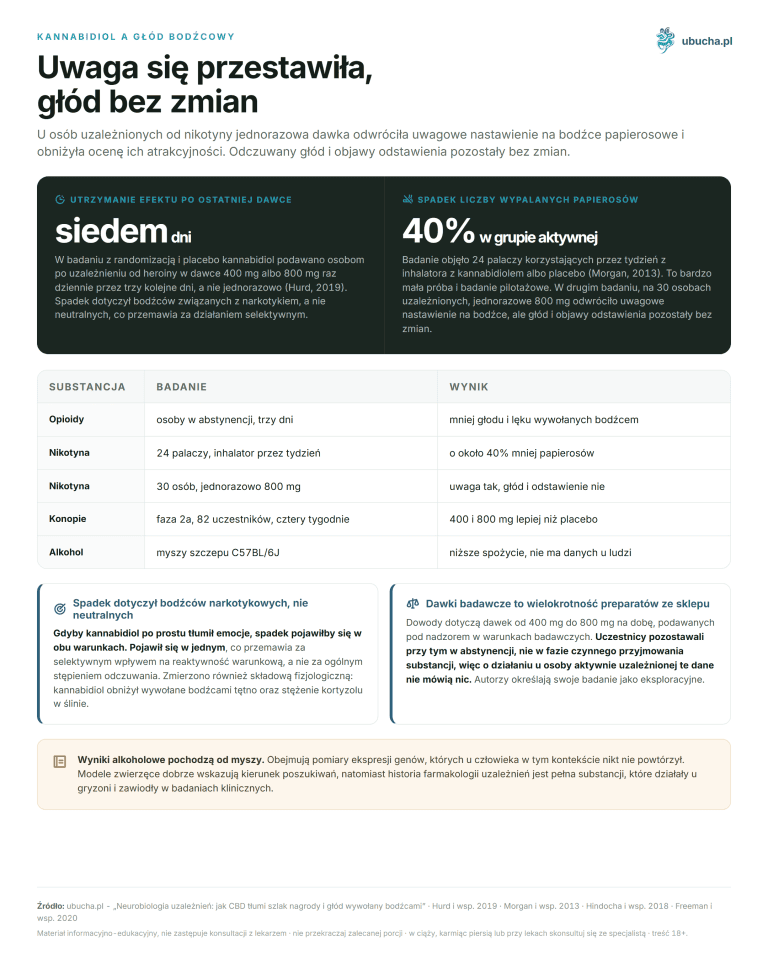
This is a real risk of concentrated extracts and has been measured. In a crossover study, 18 healthy adults consumed a cookie with cannabis extract, and half an hour later a cocktail of drugs probing the activity of five liver enzymes. The CBD-rich extract increased the area under the curve of omeprazole by 207%, losartan by 77%, midazolam by 56%, and caffeine by 39%, without changing the metabolism of dextromethorphan. The extract containing only THC did not inhibit any of the studied enzymes (Bansal et al., Clinical Pharmacology and Therapeutics, 2023).
Two things result from this contrary to common knowledge. Most interactions are due to cannabidiol, not THC, so “safer because it has no THC” can be misleading. Secondly, the same mechanism raised the concentration of THC in plasma by 161%, because CBD inhibits its breakdown. Therefore, a full-spectrum extract is not simply the sum of its components even in pharmacokinetics.
The best-documented example of this interaction comes from pediatric neurology. In thirteen children with drug-resistant epilepsy, taking clobazam and cannabidiol simultaneously, the concentration of clobazam increased on average by 60%, and its active metabolite norclobazam by 500% after four weeks. The dose of clobazam had to be reduced in ten of them, and adverse effects subsided precisely after this reduction (Geffrey et al., Epilepsia, 2015). It is no coincidence that the European registration of the drug Epidyolex, whose active substance is cannabidiol, includes supportive treatment of seizures in Lennox-Gastaut syndrome and Dravet syndrome in patients from 2 years of age, exclusively in combination with clobazam (European Medicines Agency).
How to store thick extract?
Extracts in paste form spoil more slowly than liquid oils, but spoil just like any plant material: due to light, oxygen, and heat. Tetrahydrocannabinol gradually oxidizes to cannabinol, a compound with a different action profile and weaker affinity for the CB1 receptor. The effect is subtle, as the appearance of the paste hardly changes.
Practical advice boils down to three habits. Keep the extract cool, in a sealed container made of dark glass or in a syringe, and minimize contact of the contents with air with each use. After cooling, the paste hardens, so it is warmed in the hands or in lukewarm water before measuring, never over a flame or in a microwave.
A separate issue is heating for inhalation, as temperature determines what reaches the lungs. This difference between vaporization and combustion recurs in every text about concentrates; we described it in connection with dabbing and vaporization. The same principle applies to prescription thick extract as to any prescription medication: the method of administration is determined by the doctor or pharmacist, not the guide.
Frequently Asked Questions
What is RSO oil?
RSO is a thick, dark extract from the whole cannabis plant, obtained using an alcohol solvent and concentrated into a resin form. It contains cannabinoids, terpenes, and other plant substances in a concentrated form. The name comes from Rick Simpson, who popularized this form in the early 2000s.
Are RSO and FECO the same?
Chemically yes, but commonly not quite. Both acronyms describe a full extract from the whole plant. The name RSO is associated with THC-rich extracts made using the Simpson method, while FECO more often describes extracts made with pharmaceutical ethanol, including those dominated by cannabidiol.
Is RSO legal in Poland?
Extracts from cannabis other than hemp are classified as a narcotic of group I-N, item 113 of the list (Dz.U. 2024 poz. 1139). Legal access is through a prescription medication prepared in a pharmacy based on Article 33a of the Act on Counteracting Drug Addiction.
Can a patient with a prescription make an extract at home?
No. The law defines processing as giving a narcotic a new form (Article 4 point 20), and Article 53 includes manufacturing, processing, and altering. A prescription allows possession of the medication, not giving the raw material a new form in one’s own kitchen.
Do studies confirm that RSO treats cancer?
No. There is no randomized placebo-controlled study regarding this form. A review in Nature Reviews Cancer describes the inhibition of tumor growth by cannabinoids in animal models and classifies clinical studies as preliminary (Velasco et al., 2012).
What drugs does concentrated extract interact with?
In 18 healthy individuals, a CBD-rich extract increased exposure to omeprazole by 207%, losartan by 77%, and midazolam by 56%, while the extract containing only THC did not inhibit the studied enzymes (Bansal et al., 2023). For chronic medications, the decision is made by the attending physician.
Is hash oil the same as RSO?
In practice yes: it is a thick cannabis extract obtained using a solvent. Hash oil is a colloquial name for this form, while RSO and FECO are later adopted acronyms for the same form. Hashish, which is mechanically collected resin without a solvent, is something else entirely.
If you are looking for a legal cannabis oil available without a prescription, check the cannabis oil category; for each product, check the batch analysis certificate, not the name on the label.
This article is for informational and educational purposes and does not constitute medical advice. Before starting to use cannabis or CBD for therapeutic purposes, consult a doctor, especially if you are taking other medications, are pregnant, or breastfeeding.
Author: Michał Waluk · Published: 2026-08-09 · Updated: 2026-08-24