
What Is Medical Marijuana? Complete Guide 2026 (Poland)
What is medical marijuana in Poland: Art. 33a, prescription valid 30 days, requirement for personal patient examination, and evidence from Cochrane and JAMA reviews.
Medical marijuana evokes extreme emotions: for some, it is a medicine taken from patients by bureaucracy; for others, a legal gateway to recreation. Polish law treats it differently than either story. Hemp dried herb from the pharmacy is a pharmaceutical raw material for compounding prescription drugs, not a finished product with a leaflet. This text shows exactly what the regulations say as read from the Journal of Laws register, which indications have evidence from systematic reviews today, why teleconsultation is insufficient for issuing a prescription, and how responsibility for driving looks. You will not find doses or prices here. We further explain why we consciously do not provide them and show which popular numbers from the Polish internet have no basis in sources. Every regulation cited in this text was read in the legal acts register, and every scientific paper checked in the Europe PMC database.
KEY INFORMATION
• Hemp dried herb on prescription is raw material for compounded drugs, approved by the President of URPL (Art. 33a, Journal of Laws 2023 item 1939).
• Prescription is valid for 30 days, and the prescribed amount cannot exceed 90 days of use.
• The doctor must personally examine the patient (§ 7 sec. 2a point 2, Journal of Laws 2025 item 1678).
• The strongest evidence concerns chronic pain and spasticity (Whiting, JAMA 2015).
What is medical marijuana under Polish law?
Under Polish law, medical marijuana is not a separate medicine but a pharmaceutical raw material. Article 33a of the Act on Counteracting Drug Addiction states that hemp herb other than fibrous, resin, and extracts from such hemp may constitute raw material intended for compounding prescription drugs, after obtaining marketing authorization issued by the President of the Office for Registration of Medicinal Products (consolidated text: Journal of Laws 2023 item 1939).
This construction has practical consequences. Dried herb from the pharmacy does not have the product characteristics of a medicinal product in the sense that a painkiller tablet does. The pharmacist dispenses it as raw material, from which the doctor has prescribed a specific method of use, and responsibility for the choice of strain and regimen lies with the person issuing the prescription.
The provision entered the Act by amendment on July 7, 2017, and has been in force since November 1, 2017 (Journal of Laws 2017 item 1458). In Polish cannabis texts, another reference circulates, usually “Journal of Laws 2017 item 2150.” Under it lies the Regulation of the Minister of Agriculture of November 9, 2017, on labeling foodstuffs, so statements based on that are inaccurate.
It is worth distinguishing three legal situations that often merge in conversations. The table below shows how they differ in basis and access method.
| Situation | Legal basis | Access |
|---|---|---|
| Pharmacy hemp dried herb | Art. 33a of the Act on Counteracting Drug Addiction | prescription for intoxicant, pharmacy |
| Dried herb from fibrous hemp | Art. 4 point 5 of the same Act | retail sale, no prescription |
| Possession outside Act provisions | Art. 62 of the same Act | prohibited act under penalty |
How does pharmacy dried herb differ from dried herb from fibrous hemp?
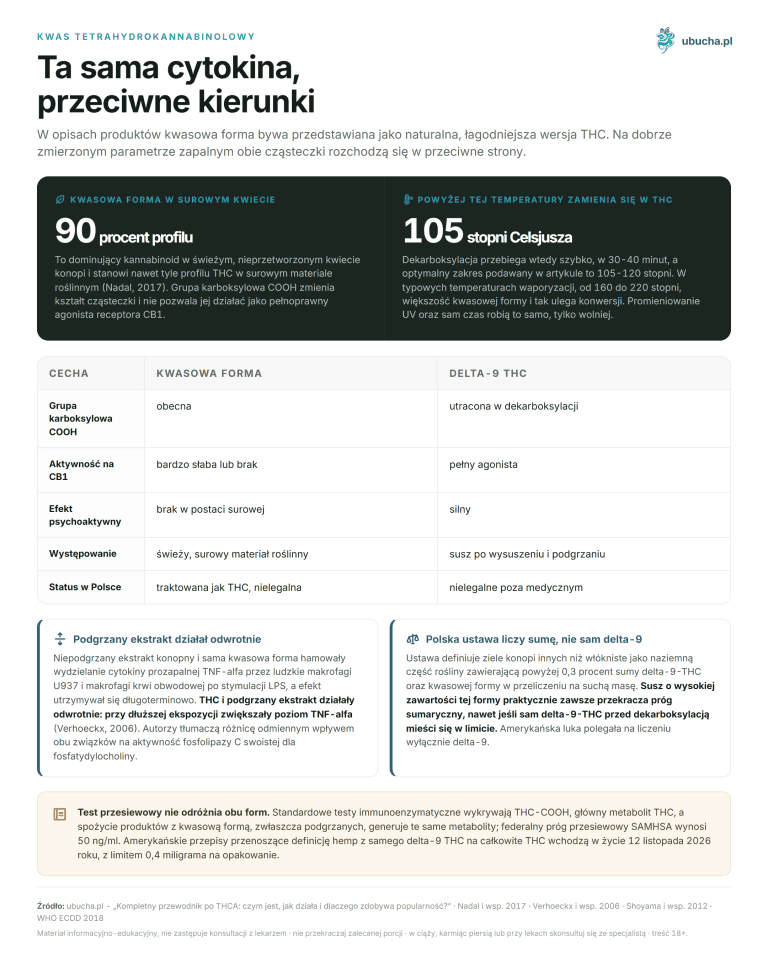
The boundary runs by the content of psychoactive substance in the plant, not by trade name or flower appearance. Fibrous hemp are plants in which the sum of delta-9-THC and tetrahydrocannabinolic acid (THCA) in flowering or fruiting tops does not exceed 0.3% dry weight, rounded to one decimal place.
This distinction changes the laboratory test result. Analysis measuring only delta-9-THC omits THCA, the acidic form that converts to THC only under heat. A sample described as compliant by one method may exceed the threshold by another, so the lab must report the sum of both compounds. The basis is Article 4 point 5 of the Act as amended by the Act of March 24, 2022 (Journal of Laws 2022 item 763), effective from May 7, 2022. Previously, the threshold was 0.20%.
The often repeated statement that the Polish threshold comes from an EU regulation is inaccurate. These are two separate regulations with the same numerical value: national in the Act on Counteracting Drug Addiction and EU in Regulation 2021/2115, applied since January 1, 2023. Correctly, the national threshold corresponds to the EU threshold.
For the reader, however, another difference is more important. You buy dried herb from fibrous hemp yourself and are responsible for what you do with it, whereas pharmacy dried herb is part of treatment conducted by a doctor. The quality of both cannot be compared without documentation, as explained more in the text on regulation of hemp products and COA testing.
Which indications have the strongest evidence today?
The broadest review collected 79 studies with 6462 participants and assessed cannabinoids in several indications at once. Moderate-quality evidence was found only for two: chronic pain and spasticity. For nausea and vomiting after chemotherapy, weight gain in HIV infection, sleep disorders, and Tourette’s syndrome, the quality of evidence was low (Whiting et al., JAMA 2015).
The numbers from this review are more modest than the popular story about cannabis effectiveness suggests. Relief in pain was noted in 37% of cannabinoid users versus 31% in placebo, and the average improvement on a 0 to 10 pain intensity scale was 0.46 points. Complete response in chemotherapy-induced nausea and vomiting was 47% versus 20%, but based on three studies.
In spasticity, the average change on the Ashworth scale was 0.36 points favoring cannabinoids, with a confidence interval from 0.69 to 0.05 points. The effect is thus distinguishable from zero and simultaneously small.
It is also worth seeing the evidence base behind the scenes. Of 79 studies, only four were assessed as having low risk of bias. Symptom improvement was visible in most trials but not all reached statistical significance. The authors also noted increased risk of short-term adverse events, including serious ones.
| Indication | Quality of evidence | Review result |
|---|---|---|
| Chronic pain | moderate | relief in 37% vs 31% on placebo |
| Spasticity | moderate | improvement of 0.36 points on Ashworth scale |
| Chemotherapy-induced nausea | low | complete response in 47% vs 20% |
| Sleep, Tourette, weight in HIV | low | signal of improvement, few studies |
What does Cochrane say about neuropathic pain?
The Cochrane review included 16 studies with 1750 participants and examined cannabis preparations in chronic neuropathic pain. Pain relief of at least 50% was achieved by 21% of participants versus 17% on placebo, and at least 30% relief was noted in 39% versus 33% (Mücke et al., Cochrane 2018).
The authors’ conclusion is more cautious than most summaries of this review in the Polish internet: potential benefits of cannabis preparations in neuropathic pain may be outweighed by potential harms. The reason is visible in the latter half of the data. Nervous system disorders were reported by 61% of cannabinoid users versus 29% on placebo, and psychiatric disorders 17% versus 5%.
Ten percent of participants in the active group and 5% in placebo withdrew due to adverse events. The quality of evidence was rated from very low to moderate, partly because studies excluded people with addictions and serious comorbidities, often precisely those patients who in practice ask doctors about cannabis.
In popular summaries, this same review is sometimes cited as evidence for about 30% pain reduction versus placebo. That number is not in it. Thirty percent is the relief threshold at which patient percentages were counted, and the difference between groups was a few percentage points.
Do cannabinoids work for cancer pain?
A separate Cochrane review collected 14 studies with 1823 participants and concerned only pain in adults with cancer. The conclusion is clear and inconvenient: there is moderate-certainty evidence that nabiximols and THC do not relieve moderate to severe opioid-resistant cancer pain (Häuser et al., Cochrane 2023).
In four parallel-group studies including 1333 people, no clinically significant superiority over placebo was found in overall impression of improvement or average pain intensity. There was also no difference in the number of people discontinuing treatment due to adverse events or in the frequency of serious adverse events.
Low-certainty evidence indicates that a synthetic THC analog administered for eight weeks did not reduce pain related to chemotherapy or radiochemotherapy in head and neck cancer and non-small cell lung cancer patients. Cannabidiol oil added no value to specialist palliative care in advanced cancer.
The authors also noted that they found no study using dried herb. All this knowledge comes from standardized preparations, so directly transferring it to pharmacy dried herb is an overreach. For the oncology patient, this means a simple thing: talking with the attending physician makes sense, promises from internet forums do not.
One observation from this review is sometimes mistaken for evidence of superiority. A single dose of synthetic THC analog performed better than placebo but not better than a low dose of codeine in five single-dose studies totaling 126 people. The comparison with placebo thus only shows the substance works, not that it works better than a cheap drug known for decades.
What is known about drug-resistant epilepsies?
Here evidence comes from a randomized, double-blind trial, so weighs more than practice observations. It included 120 children and young adults with Dravet syndrome and treatment-resistant seizures. The median number of convulsive seizures per month dropped from 12.4 to 5.9 with cannabidiol, and from 14.9 to 14.1 in placebo (Devinsky et al., NEJM 2017).
Reduction of seizures by at least half was achieved by 43% of participants versus 27% on placebo. Overall condition improved by at least one category on a seven-point caregiver rating scale in 62% versus 34%. Five percent of children in the active group and none in placebo were completely seizure-free.
The other side of the result is equally important. Diarrhea, vomiting, fever, drowsiness, fatigue, and abnormal liver function tests were more frequent than on placebo, and more participants withdrew from cannabidiol treatment. These data come from treatment where cannabidiol was added to standard antiepileptic therapy, not replacing it.
It is worth noting what this study does not say. It concerned one epilepsy syndrome and purified cannabidiol, not dried herb or cannabinoid mixtures. Inferring about other epilepsy forms or other preparations is unsupported by data.
Does medical marijuana help with PTSD and anxiety disorders?
This is the area where expectations diverge most from evidence. A systematic review with meta-analysis included 83 studies, including 40 randomized with 3067 participants, and examined cannabinoids in depression, anxiety, ADHD, Tourette’s syndrome, post-traumatic stress disorder, and psychosis (Black et al., Lancet Psychiatry 2019).
For PTSD, the authors found one randomized study with ten participants. Ten, not a thousand. Every statement about cannabis effectiveness in this diagnosis today is based on a trial from which no clinical conclusion can be drawn.
Pharmaceutical THC, with or without cannabidiol, improved anxiety symptoms in people treated for other reasons, mainly chronic pain and multiple sclerosis, but the quality of this evidence was rated very low. In one study, THC worsened negative psychosis symptoms. Across the set, cannabinoids were associated with more adverse events and more treatment discontinuations due to them than placebo.
The authors’ conclusion is clear: evidence that cannabinoids treat mental disorders is lacking, and available evidence does not allow recommendations. For a person seeking help for anxiety or depression, this review says to start with a psychiatrist, not dried herb.
Note the proportions in the study set. Depression was addressed in 42 works, including 23 randomized, anxiety in 31, and psychosis in 11. PTSD, which is most loudly discussed in marketing materials, had twelve studies, only one randomized. The topic’s loudness online does not correspond to the weight of evidence.
How to read numbers from cannabis studies?
The most common mistake in cannabis texts is confusing the difference between groups with the percentage of people helped. When a review states relief was achieved by 21% of patients versus 17% on placebo, the effect of the preparation is that four-point difference, not twenty-one percent. The rest of the improvement would also occur with a placebo pill.
The second measure that clarifies the picture is the number needed to treat for one person to benefit. In the Cochrane review on neuropathic pain, it was 20 for at least half pain relief and 11 for 30% relief. The same work gives the counterpart for harms: one additional nervous system event per three treated, and one psychiatric event per ten.
The third thing is evidence quality, marked in reviews by the GRADE system. The same numerical result with very low quality means something completely different than with moderate quality, as it indicates how likely further studies are to reverse it. In cannabis reviews, low and very low ratings dominate.
So when you read a sentence about cannabinoid therapy effectiveness, check three things at once: difference versus placebo, number of participants, and evidence quality rating. Without them, every number sounds stronger than it deserves.
What do cannabis evidence not say?
There are more gaps than findings, and it is worth naming them directly. The Cochrane review on neuropathic pain states that no information on long-term risk was found in analyzed studies. Studies lasted from two to twenty-six weeks, while therapy in chronic pain patients may last years.
The cancer pain review noted no study using dried herb. All comparable knowledge comes from standardized preparations administered as oromucosal spray or capsules, not vaporized flower tops dispensed in pharmacies.
Studies on effectiveness usually excluded people with addiction history and serious comorbidities. This means a patient with multiple diagnoses, a typical recipient of such an article, is poorly or not at all represented in these data.
On safety assessment, the EFSA panel notes that gaps indicated in the 2022 opinion remain open, and new studies have methodological limitations: non-standardized protocols, short observation time, and concomitant treatment. None of the analyzed studies concerned effects on the immune system. Such a list of unknowns is neither an argument against nor for therapy. It is a reason to make decisions with a doctor who knows your documentation.
Why is teleconsultation insufficient for dried herb prescription?
Because the regulation requires personal examination of the patient. A prescription for a preparation containing an intoxicant is issued after prior personal examination of the patient by the prescriber if the prescribed preparation is listed in Annex 2 to the regulation (§ 7 sec. 2a point 2, consolidated text: Journal of Laws 2025 item 1678).
In this annex, under position 4, is hemp herb other than fibrous with extracts and pharmaceutical tinctures, and under position 5 is hemp resin. Pharmacy dried herb is thus exactly the case where remote visit does not replace examination.
The regulation provides narrow exceptions. The personal examination requirement does not apply to a doctor providing services under a primary healthcare contract, excluding night and holiday care, if continuing treatment with the same preparation (§ 7 sec. 2d). A prescription issued without examination under Article 42 sec. 2 of the Medical Professions Act requires that no more than three months have passed since the last patient examination (§ 7 sec. 2b).
A guide advertising remote visits as an equivalent way to the first dried herb prescription sends the reader for a document that the doctor should not issue according to the regulation. Before scheduling a consultation, check how the entire prescription obtaining procedure step by step looks.
How long is a prescription valid and for how many days of treatment?
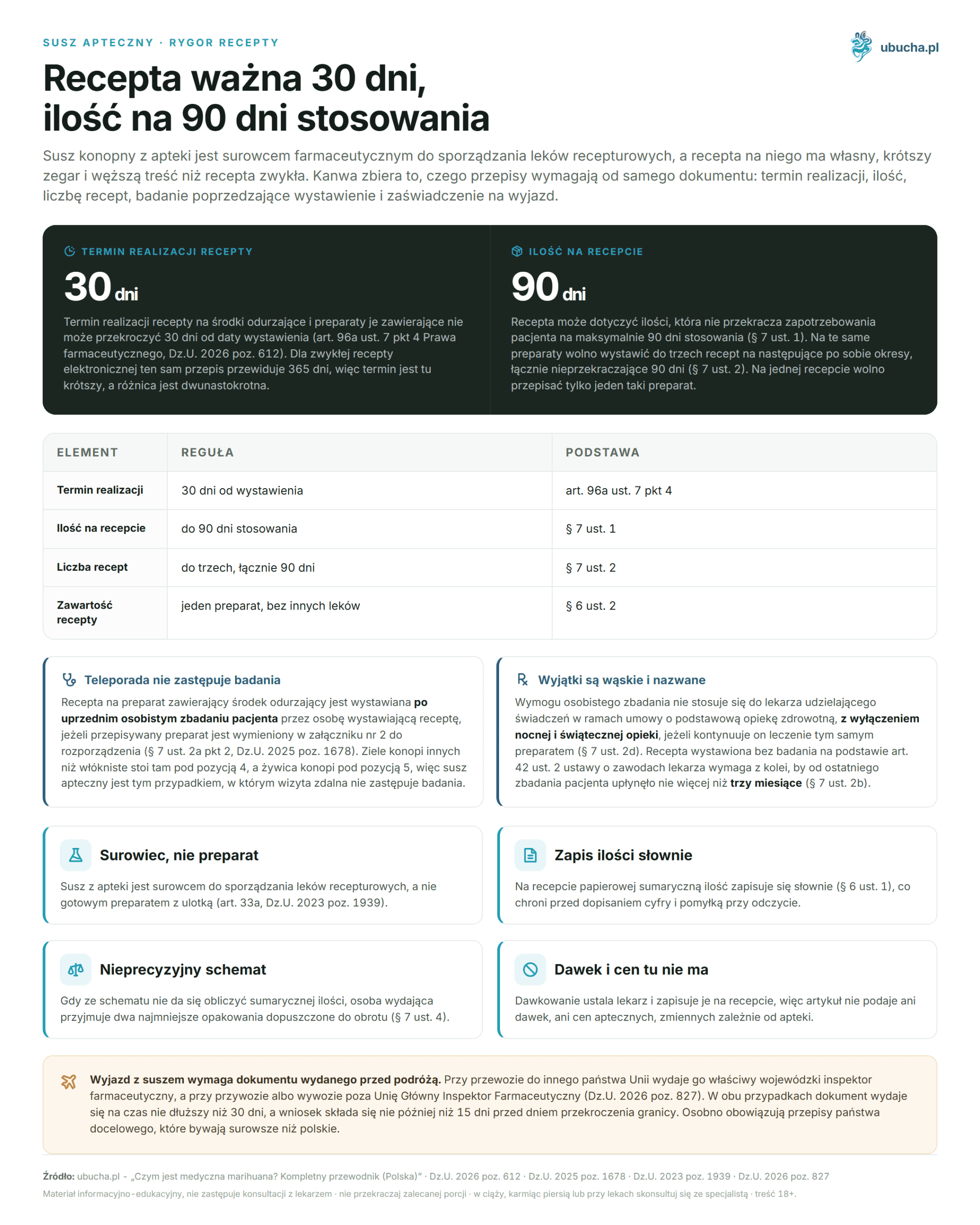
The fulfillment period for prescriptions for intoxicants, psychotropic substances, and preparations containing them cannot exceed 30 days from the date of issue (Article 96a sec. 7 point 4 of the Pharmaceutical Law, consolidated text: Journal of Laws 2026 item 612). For a regular electronic prescription, the same provision allows 365 days, so the difference is twelvefold.
Quantity is regulated separately. A prescription may cover an amount not exceeding the patient’s need for a maximum of 90 days of use, and up to three prescriptions may be issued for consecutive periods, totaling no more than 90 days (§ 7 sec. 1 and 2 of the prescription regulation). Only one such preparation may be prescribed on one prescription, and no other medicines may be added (§ 6 sec. 2).
The prescription must also specify the dosing regimen (§ 7 sec. 3). If the total amount cannot be calculated from it, the pharmacist assumes two smallest packages approved for marketing. This is why patients are sometimes surprised when they receive less than expected at the pharmacy.
| Element | Rule | Basis |
|---|---|---|
| Fulfillment period | 30 days from issue | Art. 96a sec. 7 point 4 |
| Quantity on prescription | up to 90 days of use | § 7 sec. 1 |
| Number of prescriptions | up to three, total 90 days | § 7 sec. 2 |
| Prescription content | one preparation, no other medicines | § 6 sec. 2 |
What must a dried herb prescription contain?
A prescription for a preparation containing an intoxicant has mandatory additional elements compared to a regular prescription. Besides data required by the Pharmaceutical Law, it must state the total amount of the substance or the amount expressed as the number of dosing units and dose size, with the amount written in words on paper prescriptions (§ 6 sec. 1 of the prescription regulation).
The written amount is not a formality. It protects against unauthorized addition of digits and reading errors, and the same risk applies to every preparation in this group, not only cannabis.
The prescription must also indicate the dosing regimen (§ 7 sec. 3). If the total amount cannot be calculated from the regimen, the dispenser assumes two smallest packages approved for marketing in Poland, and for reimbursed medicines, two smallest packages from the reimbursement list (§ 7 sec. 4). This rule practically determines how much dried herb the patient will receive at the pharmacy if the regimen is imprecise.
Keep this in mind at the first visit. If the dosing regimen is described vaguely, the amount dispensed may differ from what you agreed during the conversation, and correcting the prescription requires contacting the prescriber.
Why won’t you find doses or prices here?
Because both would be pretending knowledge this text does not have. Dosing for medical indications is set by the doctor and recorded on the prescription, and an online article does not know your comorbidities or medications. Providing a number would look like a recommendation, which it is not.
This decision is also based on safety assessment. The EFSA panel in its updated opinion on cannabidiol as a novel food states that safety cannot be established for people under 25 years old, pregnant or breastfeeding women, and people taking medications simultaneously (EFSA NDA Panel, 2026). Readers of medical indication texts usually belong to the last group.
Another matter is a number that circulated for years in Polish cannabis texts: the allegedly safe daily dose given by WHO. The source address for this information is inactive, and the latest EFSA assessment indicates a value several orders of magnitude lower. We removed it here and do not replace it with another.
We do not provide pharmacy prices for a simpler reason. They change more often than the article, depend on strain, packaging, and pharmacy, and any number entered here in April would be outdated by July. For current cost, ask the pharmacy filling the prescription before choosing a preparation.
What substances does hemp dried herb contain?
Besides THC and cannabidiol, the herb contains dozens of other phytocannabinoids and terpenoids, volatile compounds responsible for aroma. A pharmacological review lists limonene, myrcene, alpha-pinene, linalool, beta-caryophyllene, caryophyllene oxide, nerolidol, and phytol among them, noting they have their own biological activity (Russo, British Journal of Pharmacology 2011).
This is the origin of the popular term entourage effect. However, it is worth reading how the author formulates this thesis. He writes about synergy which “if proven” increases chances for new therapeutic products and proposes methods to study it. It is a hypothesis to be tested, not an established mechanism, although marketing materials often present it as fact.
Terpenoids are components of the daily diet and have GRAS status in the United States. The review notes they act at concentrations of single nanograms per milliliter of serum after inhalation from ambient air, which is interesting but says nothing about therapeutic efficacy.
The practical conclusion for the patient is this: a strain description is not the same as the expected effect. If you want to understand differences between strains, start with basics described in the guide on what you should know about marijuana.
Is vaporization less harmful than smoking?
Data indicate yes, though mainly from observational studies. In a large internet sample, vaporizer use was associated with fewer respiratory symptoms than smoking, even after adjusting for age, sex, cigarette smoking, and amount of cannabis used (Earleywine and Barnwell, Harm Reduction Journal 2007). The effect was greater the more material the respondent used.
The reason is combustion chemistry. Comparison of marijuana and tobacco cigarette smoke showed ammonia concentrations up to twenty times higher in marijuana mainstream smoke and cyanide, nitrogen oxides, and aromatic amines three to five times higher (Moir et al., Chemical Research in Toxicology 2008).
Regular cannabis smoking causes visible damage to large airways and is associated with chronic bronchitis symptoms that resolve after cessation. At the same time, no clear link with chronic obstructive pulmonary disease has been shown, and lung risk from even regular use is considered much lower than tobacco (Tashkin, Annals of the American Thoracic Society 2013).
For a patient with a prescription, this is a practical, not ideological argument. The method of administration is discussed at the visit along with dosing, as it affects onset and duration of action.
However, vaporization data have a limitation the authors do not hide. They come from an internet survey where symptoms were self-reported, not from a randomized trial. Fewer respiratory symptoms in vaporizer users is thus an observation, not causal proof, though consistent with combustion chemistry knowledge.
What adverse effects were reported in studies?
The list is long and repeats across reviews. Most frequently mentioned are dizziness, dry mouth, nausea, fatigue, drowsiness, euphoria, vomiting, disorientation, balance disorders, and hallucinations. The JAMA review noted increased risk of short-term adverse events, including serious ones.
The scale of this risk is often omitted in texts promoting therapy. In the Cochrane review on neuropathic pain, nervous system disorders occurred in 61% of cannabis users versus 29% on placebo, and psychiatric disorders in 17% versus 5%. These are not marginal numbers.
A separate problem is drug interactions. Lists circulating online of drugs “not to combine with cannabis” are sometimes supported by references to papers on completely different topics, so treat them as a signal to discuss, not as a source. The EFSA panel states directly that safety of cannabidiol cannot be established in people taking medications simultaneously. Your doctor or pharmacist will check interaction lists for your medication set with a full list of your drugs.
The EFSA panel in cannabidiol safety assessment noted consistent signals of liver toxicity in animal data and potential hepatotoxicity in humans, especially combined with drugs. Placental transfer and accumulation in the body were also noted. This is another reason to make therapy decisions with access to test results, not based on an article.
| Type of event | Active group | Placebo |
|---|---|---|
| Nervous system disorders | 61% | 29% |
| Psychiatric disorders | 17% | 5% |
| Discontinuation due to adverse events | 10% | 5% |
Does medical marijuana cause addiction?
Yes, but less often than nicotine and alcohol. In an analysis of large population data, the cumulative probability of transitioning from first use to addiction was 8.9% for cannabis, 67.5% for nicotine, 22.7% for alcohol, and 20.9% for cocaine (Lopez-Quintero et al., Drug and Alcohol Dependence 2011).
Polish cannabis texts cite different values from the same work, usually nicotine 32%, alcohol 15%, and cocaine 17%. Each is underestimated compared to the paper, and substance order is sometimes switched. Cannabis addiction is real and simultaneously less likely than two legal substances, a moderate conclusion in both directions.
The second number from this work is often omitted but says more than the first. Half of cannabis addiction cases appeared about five years after first use, versus about 27 years for nicotine and 13 years for alcohol. Transition to addiction is thus rarer but faster.
Risk increases in people with mental disorders and previous addictions. This is the same group excluded from efficacy studies, so safety evidence in this population is simply lacking.
The authors also note one more thing. Predictors of transition from use to addiction repeat across substances, suggesting common mechanisms, not separate risk assigned to a particular plant. For the patient, this means a simple conclusion: if you had problems with alcohol or sleeping pills in the past, tell your doctor before starting therapy, as it changes the decision balance.
Can a patient with a prescription drive a car?
A prescription does not exempt from responsibility for driving under influence. The law does not recognize a privileged patient category, so a driver after dried herb is liable like anyone else. A meta-analysis of nine observational studies showed acute cannabis use nearly doubles the risk of road collisions, with even higher risk in fatal accidents (Asbridge et al., BMJ 2012).
Driving under the influence of an intoxicant is a crime under Article 178a § 1 of the Penal Code, punishable by imprisonment up to 3 years (Journal of Laws 2025 item 383). Driving after use is an offense under Article 87 § 1 of the Code of Offenses, punishable by a fine not less than 2500 PLN (Journal of Laws 2025 item 734).
The popular statement about a 1 ng/ml threshold requires correction. The regulation on testing for substances acting like alcohol sets the detection limit for delta-9-THC at 1 ng/ml in blood and 20 ng/ml for metabolite in urine (Journal of Laws 2014 item 948). This is a laboratory parameter, not a criminal responsibility threshold. The act does not specify a threshold for saliva.
Blood test results indicate whether the method detected the substance, not whether the driver was unfit to drive. Assessment of condition, i.e., distinguishing between after use and under influence, is based on the entire evidence, including expert opinion. The practical conclusion for the patient is one: separate appointment and driving times, and ask your doctor about intervals if in doubt.
Can pharmacy dried herb be taken abroad?
Yes, but only with a document issued before departure, and the procedure has strict deadlines. For transport to another EU country, the document is issued by the relevant provincial pharmaceutical inspector, according to instructions for the certificate provided in Article 75 of the Schengen Implementing Convention (§ 5 of the regulation, Journal of Laws 2026 item 827).
For import or export outside the EU, the document is issued by the Chief Pharmaceutical Inspector upon application by the person taking the medicinal product, attaching the prescription or medical documentation confirming use (§ 6 sec. 1).
In both cases, the document is issued for a period not longer than 30 days, based on an application submitted no later than 15 days before crossing the border. Practical conclusion: a vacation trip with dried herb must be planned at least two weeks in advance, and the document will not cover a longer stay.
Separate rules of the destination country apply, which may be stricter than Polish ones. A certificate issued in Poland is a document for Polish and EU procedure, not a permit to possess in any country worldwide.
The regulation also describes the document form: it is issued on pink paper with security features for public documents of category three, and the electronic copy remains with the issuing authority (§ 6 sec. 3 and 4). If someone offers you a scan or a certificate from an intermediary, it is not the document.
What are the penalties for possession without a prescription?
Possession of intoxicants contrary to the Act is punishable by imprisonment up to 3 years (Article 62 sec. 1 of the Act on Counteracting Drug Addiction). If the act involves a significant amount, the penalty is from one to ten years (sec. 2). For lesser amounts, a fine, restriction of liberty, or imprisonment up to one year is provided (sec. 3).
The lower limit for significant amount has practical meaning, excluding imprisonment. In popular texts, this provision is summarized as “up to 10 years,” which loses this distinction.
Article 62a provides for discontinuation of proceedings if the act involves an insignificant amount for personal use and punishment would be pointless due to circumstances and social harm degree. The Act states discontinuation may occur even before investigation or inquiry initiation.
The Act does not define significant or insignificant amounts by grams. Jurisprudence does, so any online conversion like “over twenty plants” or “up to five grams” should be treated as simplification, not legal content.
The same mechanism applies to processing. The Act defines processing as giving the intoxicant a new form, so homemade butter or baked goods from pharmacy dried herb are not allowed by the prescription. Article 33a refers to raw material for compounded drugs made in pharmacies and contains no exemption for patient responsibility for home processing.
What does the August 2026 amendment change?
For a patient with a prescription, nothing. The Act of July 3, 2026, amending the Act on Counteracting Drug Addiction and some other Acts enters into force on August 27, 2026 (Journal of Laws 2026 item 1004). Its text does not mention THC abbreviation or cannabinoid, and all references to hemp concern fibrous hemp and agricultural procedures.
The amendment deals with substitution treatment, laboratories, reporting to the Chief Pharmaceutical Inspector, and renaming an EU agency. It does not change the psychoactive substance content threshold, substance classification, or retail sale rules for fibrous hemp products.
Two changes concern only fibrous hemp growers. The deadline for reporting data changes in the producers register was extended from 14 to 30 days (Art. 47c sec. 3), and a fine of 10,000 PLN was introduced for obstructing control of entities conducting purchase (Art. 52b sec. 2). The Act also clarified that cultivation for own needs is conducted without possibility of resale (Art. 45).
Why is it worth writing at all? Because every amendment to the drug law triggers waves of headlines about alleged legalization or threshold increase. This one does neither, and correct statements before August 27 remain correct after that date.
Frequently Asked Questions
What is medical marijuana under Polish law?
It is a pharmaceutical raw material, not a finished medicine. Article 33a of the Act on Counteracting Drug Addiction allows hemp herb other than fibrous, resin, and extracts thereof to be used as raw material for compounding prescription drugs, after approval for marketing by the President of URPL (Journal of Laws 2023 item 1939).
Is a teleconsultation sufficient for a prescription for dried herb?
No. A prescription for a preparation from Annex 2 to the prescription regulation is issued after a prior personal examination of the patient (§ 7 sec. 2a point 2, Journal of Laws 2025 item 1678). Hemp herb is listed there under position 4, and resin under position 5. Exceptions are narrow and concern continuation of treatment.
How long is a prescription for pharmacy dried herb valid?
The fulfillment period cannot exceed 30 days from the date of issue (Article 96a sec. 7 point 4 of the Pharmaceutical Law, Journal of Laws 2026 item 612). The prescription itself may cover an amount for a maximum of 90 days of use, and the doctor may issue up to three prescriptions for consecutive periods.
Which indications have the strongest evidence?
A review of 79 studies with 6462 participants found moderate-quality evidence only for chronic pain and spasticity (Whiting et al., JAMA 2015). For chemotherapy-induced nausea, sleep disorders, and Tourette’s syndrome, the quality of evidence was low, and for opioid-resistant cancer pain, no superiority over placebo was found.
Can a patient with a prescription drive a car?
A prescription does not exempt from responsibility. Driving under the influence of an intoxicant is a crime under Article 178a § 1 of the Penal Code, punishable by up to 3 years imprisonment. A meta-analysis of nine studies showed nearly twice the risk of collisions after cannabis use (Asbridge et al., BMJ 2012).
Is pharmacy dried herb the same as dried herb from fibrous hemp?
No. Fibrous hemp are plants in which the sum of delta-9-THC and THCA does not exceed 0.3% dry weight in flower tops (Article 4 point 5 of the Act). Pharmacy dried herb comes from hemp other than fibrous, requires a prescription, and is subject to regulations on intoxicants.
Does medical marijuana cause addiction?
Yes, but less often than nicotine and alcohol. The cumulative probability of transitioning from first use to addiction was 8.9% for cannabis versus 67.5% for nicotine and 22.7% for alcohol (Lopez-Quintero et al., 2011). Half of cases appeared about five years after first use.
Can pharmacy dried herb be taken abroad?
Only with a document issued by the provincial pharmaceutical inspector when traveling to an EU country or by the Chief Pharmaceutical Inspector outside the EU. The document is issued for no longer than 30 days, and the application must be submitted no later than 15 days before crossing the border (Journal of Laws 2026 item 827).
This article is for informational and educational purposes and does not constitute medical advice. Before starting cannabis or CBD for therapeutic purposes, consult a doctor, especially if you take other medications, are pregnant, or breastfeeding.
Author: Michał Waluk · Published: 2026-05-04 · Updated: 2026-08-10