How to Choose CBD Oil? Complete Shopping Checklist for New Customers 2026
How to choose CBD oil: certificate of analysis, extraction method, type of extract, oil base, and cost per 100 mg. What studies showed about label compliance with content.
You are buying your first CBD oil and you have two bottles in front of you. Both declare 10%, both cost similarly, both sound convincing. How do you know which one contains what it promises? From the label alone, you cannot tell, and this is not a metaphor. In the analysis of 202 CBD products from the open market, 74% deviated from the declared potency by at least 10%, and 44 of them contained heavy metals (Gidal et al., Frontiers in Pharmacology, 2024). The label is a declaration from the manufacturer, not a measurement result. Below you will find what to look for instead: a certificate from an external laboratory, a description of the extraction and source of the raw material, and one calculation that brings different bottles to a common scale.
KEY INFORMATION
• Of 84 CBD products purchased online, only 26 were within the compliance range with the label (Bonn-Miller et al., JAMA, 2017).
• In those same 84 samples, THC was detected 18 times.
• The certificate of analysis from an external laboratory is the only evidence of composition available before purchase.
• Compare products by the cost of 100 mg of CBD, not by the price of the bottle.
Why is the CBD oil label not enough?
Because the label declares, and the laboratory measures, and these two numbers often diverge more than intuition suggests. Bonn-Miller and colleagues purchased 84 CBD products online from 31 companies and tested their composition. Compliance with the label within 10% was achieved by 26 products.
The rest were distributed in both directions: 36 products contained more CBD than declared on the label, and 22 contained less (Bonn-Miller et al., JAMA, 2017). In 18 of 84 samples, THC was detected at concentrations reaching 6.43 mg/ml, although none of these products were sold as THC products. Subsequent analyses did not reverse this picture. A study of 80 products from the American market showed compliance at 54% (Johnson et al., Journal of Cannabis Research, 2022), and a European study of 12 oils purchased from online stores in December 2020 found correct declarations in half of the cases, with measured concentrations ranging from 19.58 to 54.09 mg per milliliter (Vida et al., Frontiers in Pharmacology, 2023).
The conclusion for the buyer is simple and convenient, as it shortens the list of things to check. There is no point in comparing the declarations of two manufacturers, since the declaration is what can be untrue. Compare documents that someone else has signed: batch test results.
What to check in the certificate of analysis before purchase?
The certificate of analysis, described in the industry as COA, is a report from an external laboratory for a specific batch of the product. Check five things in it: who performed the testing, when, which batch it concerns, how much CBD was measured, and what else was searched for besides cannabinoids.
The laboratory should be independent of the manufacturer and have an accreditation number, preferably issued by the Polish Center for Accreditation or an equivalent body in the country of origin. The date of testing and batch number must match the bottle you are holding, as a report from three years ago describes different plant material and a different process. Besides the CBD content, the certificate should include a heavy metals panel, a pesticide panel, and solvent residue analysis. This is not excessive caution: in the analysis of 202 products, heavy metals were detected 52 times in 44 products, most often lead, and solvent residues were detected 446 times in 181 products. Of 232 tested pesticides, 26 were found a total of 55 times in 30 products (Gidal et al., Frontiers in Pharmacology, 2024).
A certificate available on the product page is worth more than a “upon request” certificate, as the former can be verified before payment, while the latter can only be checked afterward. If you want to go through such a document line by line, we have a separate text: how to read a CBD certificate.
Which extraction method yields cleaner oil?
Supercritical carbon dioxide, because it is the only one that disappears from the product by itself. CO2 under high pressure behaves like a solvent and extracts phytochemicals from the plant, and after pressure reduction, it returns to gas form. In the finished oil, there is nothing to remove, so there is nothing to overlook.
Ethanol extraction is cheaper and more efficient, also extracting a wider range of plant components, including chlorophyll, which darkens the color and worsens the taste. The method is acceptable under one condition: the manufacturer must demonstrate in the certificate that alcohol residues have been removed to below the standard for class three solvents. Maceration in vegetable oil, a home extraction method, yields variable and difficult-to-reproduce content, so it rarely appears in commercial production.
A separate category is hydrocarbon solvents. Hexane, xylene, and methanol were among the substances with the highest measured concentrations in the cited analysis of 202 products. Although the regulatory threshold was exceeded by 1% of detected solvent residues and 3% of detected heavy metals, the frequency of detections shows how rarely the process is fully closed. If the manufacturer does not specify what they use for extraction, assume they have nothing to boast about.
Full spectrum, broad spectrum, or isolate: what are the differences?
They differ in how much of the plant remains in the bottle. Full spectrum retains the entire profile of phytochemicals along with trace THC. Broad spectrum is the same profile after THC removal. Isolate is purified CBD with a purity above 99%, without terpenes and other cannabinoids.
| Feature | Full spectrum | Broad spectrum | Isolate |
|---|---|---|---|
| Composition | Entire plant profile | Profile without THC | Pure CBD, over 99% |
| THC | Traces | Removed | None |
| Taste and smell | Plant-like, pronounced | Plant-like, milder | Neutral |
| Risk of positive test | Real with THC present | Minimal | Minimal |
| State of evidence | Observational data, disputed | No clinical comparisons | Best defined composition |
The marketing of full spectrum is based on the entourage effect, the assumption that the components of the plant enhance each other. A meta-analysis of eleven observational studies involving 670 patients with drug-resistant epilepsy, treated for three to twelve months, showed more frequent reports of improvement with CBD-rich extracts than with purified CBD: 71% versus 46%, with an average daily dose of 6.0 versus 25.3 mg per kilogram of body weight (Pamplona et al., Frontiers in Neurology, 2018). When applying a stricter threshold, a reduction in seizure frequency of at least half, the difference disappeared: 37% versus 42%, with p equal to 0.52. Adverse effects were more frequent with purified CBD, both mild (76% versus 33%) and severe (26% versus 7%). The work has published corrections to some numbers, so when citing it, refer to the corrected version. A 2023 literature review summarizes this dispute directly: preclinical and clinical data are contradictory, and a significant portion of the argument comes from user reports (Christensen et al., Biomedicines, 2023). Therefore, treat full spectrum as a preference, not as a proven advantage. Additionally, there is a matter that the label itself does not resolve: in the analysis of 202 products, 26% did not meet the definition of the type declared on the packaging, so the label “broad spectrum” may be inconsistent with the measured composition (Gidal et al., 2024).
Can full spectrum oil give a positive test result?
It can, but it is the THC present in the product that is responsible, not CBD itself. This distinction determines the choice of extract type for a professional driver or someone tested at work, as it changes the question from “how much CBD am I taking” to “what else is in the bottle”.
In a study on six healthy adults, in an intra-subject design, 100 mg of pure CBD was administered orally and in vapor form, and separately, also in vapor form, cannabis flower containing the same amount of CBD and 3.7 mg of THC. Urine was collected for five days after each administration. After pure CBD, only one of 218 samples exceeded the lowest cutoff, 20 ng/ml, and none were confirmed by a definitive method. After the THC flower, nine samples tested positive at the 20 ng/ml cutoff, two at the 50 ng/ml cutoff used in workplace tests, and four were confirmed (Spindle et al., Journal of Analytical Toxicology, 2020).
Important caveat regarding the scope of this result. The THC product was administered only by inhalation, so the study does not directly indicate what a swallowed full spectrum oil would do. However, it shows where the risk lies: with pure CBD, there was practically none, and it only appeared together with THC.
The practical conclusion is that for background tests, an isolate or broad spectrum with a certificate showing no detectable THC is safer. A declaration of “zero THC” without laboratory confirmation guarantees nothing, as THC has been detected in products that did not declare it at all. More about the difference between extract types can be found in the text full spectrum vs broad spectrum.
What does the percentage on the bottle really mean?
The percentage is the share of CBD in the volume of the oil, in other words, a different way of writing the number of milligrams in the bottle. A 5% oil in a 10 ml package contains 500 mg of CBD, a 10% oil in the same package contains 1000 mg, and a 20% oil contains twice as much. This is arithmetic, not a property of the product.
This leads to something that is easy to overlook when changing bottles: the same number of drops from a stronger oil is a different number of milligrams. The percentage changes the density of dosing, meaning how small portions can be measured with a dropper, and nothing else. Concentration is also not an indication. In the literature, a consumer dose of CBD for healthy individuals has not been established, and clinical studies cited by the industry were conducted at therapeutic doses in patients with specific diagnoses, under medical supervision. If the manufacturer assigns health problems to percentages, they are going beyond what is known.
We have noticed in conversations with customers that the most common disappointment comes not from choosing the wrong concentration, but from comparing bottles of different sizes. Comparing the price per 100 mg organizes this in a minute. A full discussion of the percentages themselves is available in a separate text: what concentration of CBD to choose.
What oil base works best?
There is no single best one; there are three sensible options, and each has a cost. CBD dissolves in fats, so the oil base determines the taste, durability, and how easily a drop can be measured. The choice between them is a compromise, not a ranking of quality.
MCT oil, or fractionated coconut oil, is the most resistant to oxidation and practically neutral in taste, making it easier for those sensitive to bitterness to dose. It does not come from hemp, which can be surprising for buyers looking for a fully hemp product. Hemp seed oil provides a consistent label composition and brings its own omega-3 and omega-6 fatty acids, but due to the same content of unsaturated fatty acids, it oxidizes faster and requires cool storage. Olive oil is sometimes used in smaller manufacturers: it is stable and well-studied in culinary terms, but its density makes precise measurement with a dropper difficult, and its scent dominates over the extract’s aroma.
The composition beyond the base should be short. Natural mint or lemon flavor is not a problem. Artificial colors, preservatives, and alcohol as a carrier in sublingual oil have no technological justification.
Why does the origin of the raw material determine purity?
Because hemp absorbs from the soil what is in it, including heavy metals. This feature even has industrial applications: the plant is studied as a tool for cleaning soils contaminated with metals (Placido and Lee, Plants, 2022). In raw material for oil, this is a disadvantage, not an advantage.
Therefore, the cultivation certificate is not a decorative element of the label. Look for information about the country and region of cultivation, about the European Union organic certification or equivalent, and about the variety from the EU catalog of agricultural plant varieties. Some manufacturers provide the name of the plantation and the standard of good agricultural practice, which allows tracing the supply chain to a specific field. A manufacturer that does not disclose where they source their plant material leaves themselves a loophole to change suppliers without changing the label.
The legal layer in Poland is unequivocal. Industrial hemp is a plant in which the sum of delta-9-THC and tetrahydrocannabinolic acid in flowering or fruiting tops does not exceed 0.3% when calculated on a dry mass, and the sum itself is rounded to one decimal place. The basis is Article 4 point 5 of the Act on Counteracting Drug Addiction, consolidated text Journal of Laws 2023 item 1939, as amended by the Act of March 24, 2022 (Journal of Laws 2022 item 763), effective from May 7, 2022. Previously, the threshold was 0.20%.
For the buyer, two things follow from this. The threshold describes the plant, not the finished product, so on the oil certificate, look for a separate result for THC. It is important that the sum of the two compounds, not just delta-9-THC, is considered, so the position “total THC” calculated on the certificate with a coefficient of 0.877 does not correspond to the sum referred to in the law.
How to recognize a seller to avoid?
By the language of promises and by what is missing on the site. A European study of the online CBD oil market checked 16 stores: ten of them suggested health benefits indirectly, one attributed the product’s use in COVID-19, and a total of thirty alleged indications were collected.
In the same study, three of the twelve purchased products had no information on how to use them (Vida et al., Frontiers in Pharmacology, 2023). A dietary supplement cannot have assigned medicinal properties or disease prevention, so formulations like “cures” or “eliminates” violate food labeling regulations before misleading anyone. A reliable description sounds more cautious and refers to publications.
The rest of the signals are more prosaic: lack of name and address of the entity responsible for placing the product on the EU market, lack of a Polish version of the label, lack of contact other than a form, lack of information about the extraction method. From our experience, a store that cannot answer a question about the batch number and date of testing usually does not have access to this data, and does not hide it with premeditation. The effect for the buyer is the same.
How much should CBD oil cost?
As much as the price for 100 mg of CBD indicates, because only this number compares bottles of different sizes and strengths. Calculate it yourself: price divided by the number of milligrams in the package, times one hundred. A more expensive bottle at checkout can turn out to be cheaper in calculation.
| 10 ml bottle | CBD in the bottle | How many servings of 100 mg |
|---|---|---|
| 5% | 500 mg | 5 |
| 10% | 1000 mg | 10 |
| 20% | 2000 mg | 20 |
We do not provide prices for individual products, as the store’s offer changes faster than the article, and the price written in the text begins to age on the day of publication. However, the range provides a reference point: in the category of hemp oils in the store at Bucha, the cost of 100 mg of CBD was between 9.50 and 13.00 PLN on August 15, 2026, with the lowest value coming from the strongest bottle. This rule repeats among most manufacturers, as the bottle, dropper, and batch testing cost the same regardless of content. This does not mean that a stronger oil is a better purchase for everyone: a smaller bottle will be used up before the expiration date after opening.
A very low price is not in itself evidence of fraud, but combined with a lack of a batch certificate, it leaves nothing to rely on. In that case, you are paying for a declaration, and label compliance studies show how much that declaration can be worth.
How to store CBD oil after opening?
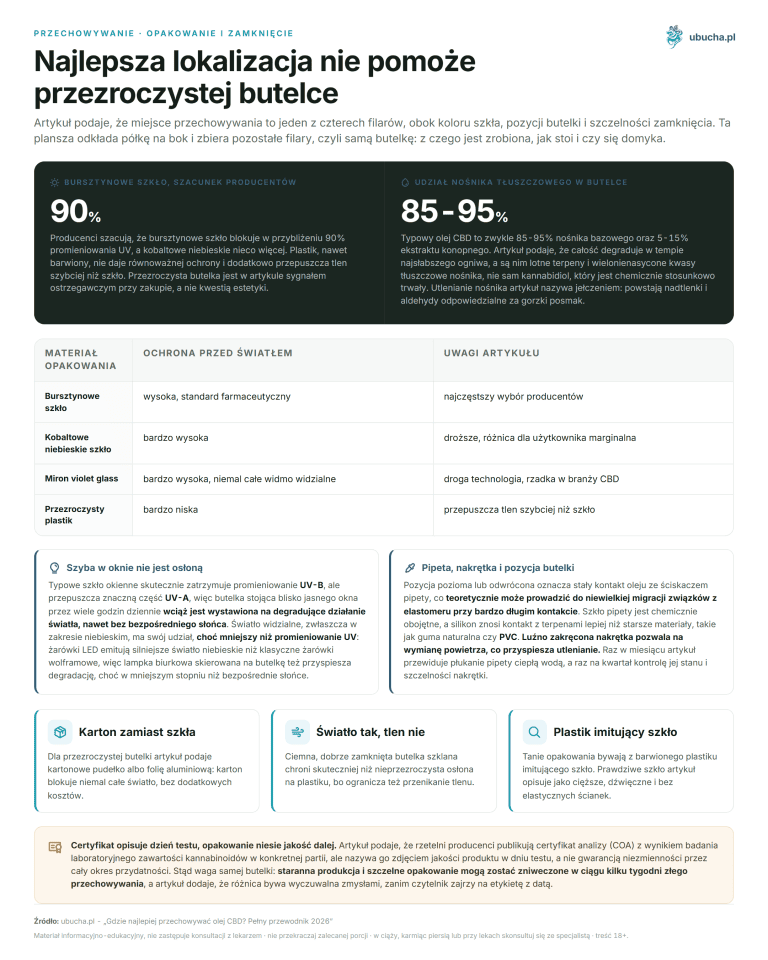
In darkness, in coolness, and tightly closed, because cannabinoids and carrier fats break down under the influence of light, heat, and oxygen. The bottle should be glass and tinted, preferably amber or green. Clear glass allows radiation that accelerates degradation.
Hemp seed oil-based oils should be kept in the refrigerator, as unsaturated fatty acids oxidize faster. MCT oil-based products only need to be placed in a cool, dark cupboard away from the stove and windowsill. The shelf life after opening is stated by the manufacturer and usually falls within the range of 6-12 months. Cloudiness after cooling does not indicate spoilage: it is a natural crystallization of fats that disappears after warming the bottle in your hand.
Cap it after each use and do not leave an open bottle on the counter while measuring. Several minutes of contact with air with each portion adds up over months to noticeable loss. The bathroom is the worst place for such a bottle, as temperature and humidity fluctuate several times a day. A kitchen cupboard away from the oven or a shelf in the refrigerator works better, and at the same time reminds you of the product, instead of allowing it to expire in a drawer. You can find details in the text about how to store CBD oil.
Frequently Asked Questions
What to check before buying CBD oil?
Certificate of analysis from an external laboratory along with the date of testing and batch number, extraction method, type of extract, oil base, and manufacturer details on the label. Without a certificate, you only have the seller’s declaration, and in the analysis of 202 CBD products, 74% deviated from the declared potency by at least 10% (Gidal et al., 2024).
What is the difference between full spectrum and broad spectrum oil?
Full spectrum retains the entire profile of phytochemicals from the plant along with trace THC, broad spectrum has the same profile after THC removal, and isolate is the same CBD above 99% purity. The advantage of full spectrum is based on observational data and remains a subject of dispute (Christensen et al., Biomedicines, 2023).
Which CBD extraction method is the cleanest?
Supercritical carbon dioxide, because it evaporates after pressure reduction and does not remain in the product. Ethanol is acceptable when the certificate confirms the removal of residues. The matter has a practical dimension: solvent residues were detected in 181 of the 202 tested products (Gidal et al., 2024).
Is cheaper CBD oil worse?
Price alone does not determine quality, as label compliance studies found deviations in products across all price ranges. Compare the cost of 100 mg of CBD instead of the price of the bottle, and treat the batch certificate as a decisive argument. A very low price without a certificate is a sufficient reason to refrain from purchasing.
Can CBD oil give a positive THC test result?
Pure CBD at a dose of 100 mg did not exceed the cutoff in a urine test for six healthy adults, while inhaled flower containing 3.7 mg of THC alongside CBD gave four confirmed positive results (Spindle et al., Journal of Analytical Toxicology, 2020). The risk comes from THC present in the product, not from CBD itself.
How long does CBD oil maintain quality after opening?
Manufacturers usually state 6-12 months after opening, and you will find this date on the packaging. Keep the oil in a dark glass bottle, away from light and heat, tightly closed. Cloudiness after cooling is normal and disappears after warming the bottle to room temperature.
Hemp oils with batch certificates can be found in the oils section in the store at Bucha.
This article is for informational and educational purposes only and does not constitute medical advice. Before starting to use cannabis or CBD for therapeutic purposes, consult a doctor, especially if you are taking other medications, are pregnant, or breastfeeding.
Author: Michał Waluk · Published: 2026-06-08 · Updated: 2026-08-15