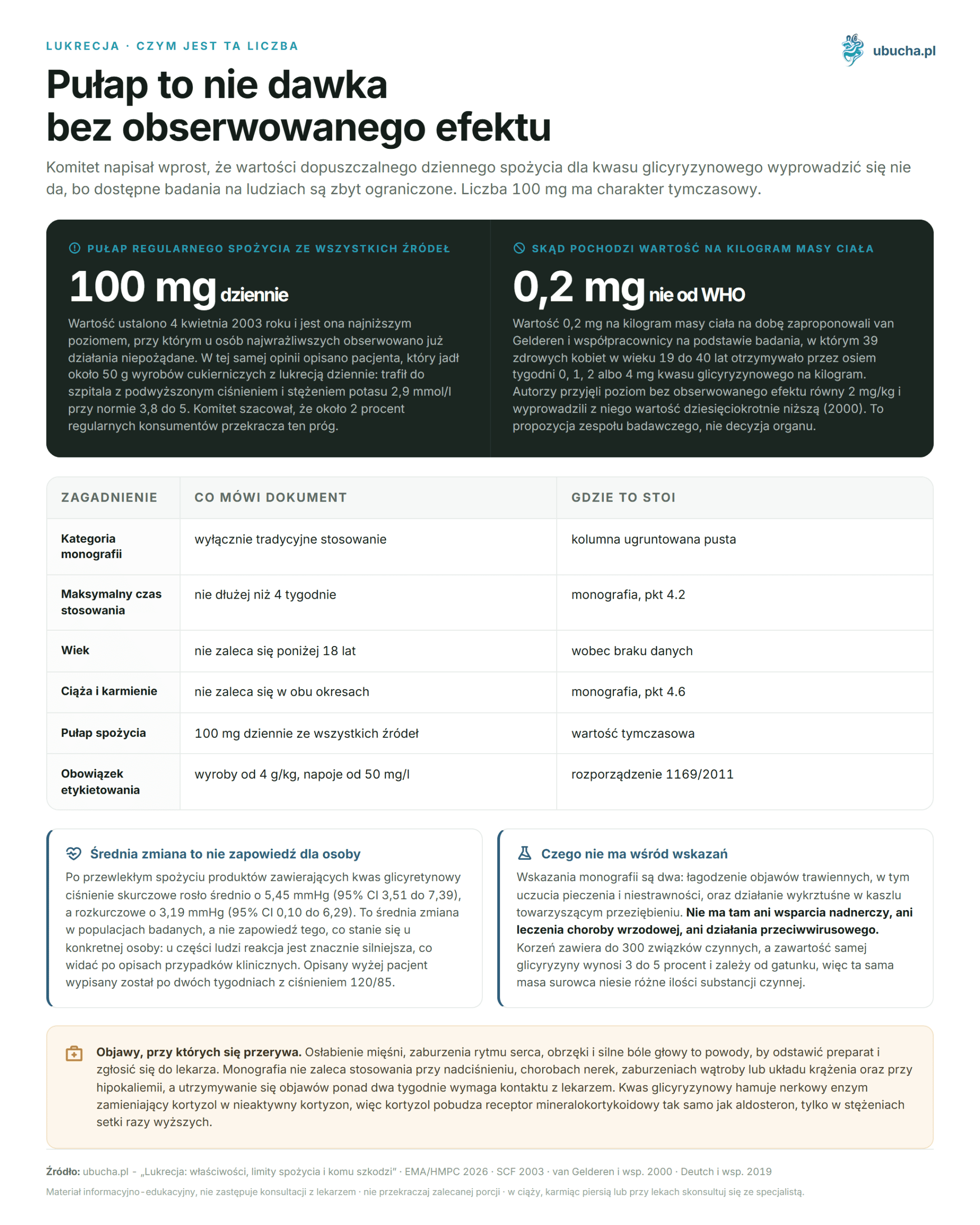

Licorice: properties, consumption limits and who it harms (table)
Licorice has an EU monograph only as a traditional medicine, a limit of 100 mg of glycyrrhizin daily, and a real risk of hypertension and hypokalemia. What do the documents say.
Licorice (Glycyrrhiza glabra) is often described as a mild herb for tea, yet it is a raw material that sends people to the hospital. Its main component, glycyrrhizic acid, inhibits the enzyme that protects the kidneys from cortisol and causes pseudo-hyperaldosteronism: increased blood pressure, water retention, and decreased potassium. The European Union mandates warnings about it on candy packaging, and the European scientific committee has set an upper limit for regular consumption. At the same time, several numbers and indications circulate around this raw material that have no basis in the sources they refer to. Some attribute values to international bodies that these bodies have never established, while others extend the permissible duration of use twice beyond what the EU monograph allows. This text shows what regulatory documents and human studies say about licorice, where we have checked this precisely, and under what symptoms one should discontinue use and consult a doctor.
KEY INFORMATION
• Licorice root has an EU monograph only in the category of traditional use, for two indications: digestive disorders and cough associated with colds (EMA/HMPC/108399/2024, adopted March 4, 2026).
• The monograph limits use for digestive disorders to four weeks and does not recommend it for individuals under 18 years of age.
• The Scientific Committee on Food stated that regular consumption should not exceed 100 mg of glycyrrhizic acid daily from all sources. Acceptable daily intake values could not be derived.
• Regulation (EU) No 1169/2011 mandates that confectionery products containing 4 g/kg or more must carry a warning for individuals with hypertension.
• Alarm symptoms: muscle weakness, heart rhythm disturbances, swelling, severe headaches. Discontinue use and consult a doctor.
• Do not use during pregnancy, while breastfeeding, with hypertension, kidney, liver, and heart diseases, or with hypokalemia.
How does licorice affect the body?
Glycyrrhizic acid is a prodrug. In the intestine, it is sequentially converted into 3beta-monoglucuronyl-18beta-glycyrrhetinic acid and 18beta-glycyrrhetinic acid, and only these metabolites inhibit the renal enzyme 11beta-HSD2, which normally converts cortisol into inactive cortisone. When the enzyme is blocked, cortisol stimulates the mineralocorticoid receptor just like aldosterone, but circulates at concentrations hundreds of times higher. The result is sodium and water retention, potassium loss, and increased vascular resistance.
A review published in the journal Foods in 2019 describes this pathway and states that the root contains up to 300 active compounds, with glycyrrhizin content ranging from 3 to 5 percent, depending on the species (Deutch et al., Foods 2019, PMC6836258). The authors declare no external funding and no conflicts of interest. The same review cites a meta-analysis by Penninkilampi from 2017: after chronic consumption of products containing glycyrrhetinic acid, systolic blood pressure increased on average by 5.45 mmHg (95% CI 3.51 to 7.39), and diastolic by 3.19 mmHg (95% CI 0.10 to 6.29).
It is important to remember what these numbers refer to. This is the average change in the studied populations, not a prediction of what will happen to a specific individual. In some people, the reaction is much stronger, as seen in clinical case descriptions.
How much glycyrrhizin is too much and who established this?
The answer is: 100 mg of glycyrrhizic acid daily from all sources combined, as a ceiling for regular consumption. This was established by the Scientific Committee on Food of the European Commission in an opinion issued on April 4, 2003 (SCF/CS/ADD/EDUL/225 Final). The Committee stated explicitly that acceptable daily intake values for glycyrrhizic acid cannot be derived because available human studies are too limited: small groups and short observation times. The number 100 mg is therefore temporary and is actually the lowest level at which adverse effects have already been observed in the most sensitive individuals.
To understand the scale: in the same opinion, a patient was described who consumed about 50 g of licorice-containing confectionery daily, which corresponded to approximately 100 mg of glycyrrhizic acid. He was hospitalized with elevated blood pressure and a potassium level of 2.9 mmol/l, with a normal range of 3.8 to 5. After discontinuing licorice, he was discharged after two weeks with a blood pressure of 120/85. The Committee estimated that about 2 percent of regular consumers exceed the threshold of 100 mg daily.
There is also a value of 0.2 mg per kilogram of body weight per day circulating. This does not come from the World Health Organization. It was proposed by van Gelderen and colleagues in the journal Human and Experimental Toxicology based on a study in which 39 healthy women aged 19 to 40 received 0, 1, 2, or 4 mg of glycyrrhizic acid per kilogram of body weight for eight weeks. The authors proposed a no-observed-effect level of 2 mg/kg and derived a value ten times lower (van Gelderen et al., Hum Exp Toxicol 2000, PMID 11125713). This is a proposal from a research team, not a decision from an authority.
What does the EU monograph and labeling regulations say about licorice?
The Committee on Herbal Medicinal Products adopted the first revision of the monograph for licorice root on March 4, 2026 (EMA/HMPC/108399/2024). The entire monograph falls under the category of traditional use. The column for established medical use is empty, meaning that the basis is not clinical evidence but long-standing practice. There are two indications: alleviating digestive symptoms, including burning sensation and indigestion, and expectorant action in cough associated with colds. There is no mention of adrenal support, treatment of peptic ulcer disease, or antiviral action.
| Issue | What the document says | Where it stands |
|---|---|---|
| Monograph category | Only traditional use, art. 16d(1) of Directive 2001/83/EC | EMA/HMPC/108399/2024, point 2 |
| Maximum duration of use | No longer than 4 weeks for digestive disorders; persistence of symptoms beyond 2 weeks requires contacting a doctor | there, point 4.2 |
| Age | Not recommended for use under 18 years due to lack of data | there, points 4.2 and 4.4 |
| Pregnancy and breastfeeding | Not recommended for use during pregnancy or for women of childbearing age not using contraception; not recommended during breastfeeding | there, point 4.6 |
| Warnings | Not recommended for hypertension, kidney diseases, liver or circulatory disorders, and hypokalemia | there, point 4.4 |
| Overdose symptoms | Water retention, hypokalemia, hypertension, heart rhythm disturbances, hypertensive encephalopathy | there, point 4.9 |
| Consumption ceiling | Regular consumption should not exceed 100 mg of glycyrrhizic acid daily from all sources; temporary value | SCF/CS/ADD/EDUL/225 Final, April 4, 2003 |
| Labeling obligation | Confectionery products from 4 g/kg and beverages from 50 mg/l (300 mg/l above 1.2 percent alcohol) must carry a warning for individuals with hypertension | Regulation (EU) No 1169/2011, Annex III points 3.2 and 3.3 |
Annex III of Regulation (EU) No 1169/2011 provides for an even lower threshold for the information about the composition: from 100 mg/kg or 10 mg/l, the product must carry the statement “contains licorice.” Only from 4 g/kg does the warning about hypertension apply.
Who does licorice harm and when to consult a doctor?
Discontinue use and contact a doctor if muscle weakness, palpitations or irregular pulse, increasing swelling of the legs or face, or severe headache with a feeling of pressure occurs. The monograph lists water retention, hypokalemia, hypertension, heart rhythm disturbances, and hypertensive encephalopathy as overdose symptoms. It associates them with use longer than four weeks or with the intake of large amounts of the raw material.
A review of 104 case reports published in Nutrients in 2023 shows how far this can go. Symptoms are usually mild, but in some cases, there were heart rhythm disturbances, muscle paralysis, rhabdomyolysis, and coma. The authors note that contrary to popular belief, neither female sex nor older age proved to be risk factors, and diagnosis is practically based on a thorough interview, as measuring glycyrrhetinic acid in the blood is rarely performed (Ceccuzzi et al., Nutrients 2023, PMC10537237).
The direction of interactions has practical significance here. Licorice weakens the effect of blood pressure-lowering medications, so the risk is uncontrolled hypertension, not a drop in blood pressure. It should not be combined with diuretics, cardiac glycosides, corticosteroids, or stimulant laxatives, as each of these combinations exacerbates electrolyte disturbances. Separately, the monograph warns against drugs metabolized by CYP3A4: taking 300 mg of glycyrrhizin daily for 14 days moderately reduces systemic exposure to midazolam and omeprazole, thus weakening their effect.
What have studies involving humans really shown?
The best-documented effect is the reduction of sore throat after intubation. In a randomized double-blind study, 236 patients undergoing thoracic surgery gargled with licorice extract or sugar solution before anesthesia. Sore throat after half an hour was reported by 19 percent of those who used licorice compared to 36 percent after the sugar solution, after one and a half hours 10 versus 35 percent, and after four hours 21 versus 45 percent (Ruetzler et al., Anesthesia and Analgesia 2013, PMID 23921656). The study appeared in an anesthesiology journal, not in JAMA, and concerned a gargle, not an oral preparation.
The opposite result was given by licorice devoid of glycyrrhizin, sold as DGL. In a double-blind study with a crossover design published in Gut, patients with chronic peptic ulcer disease received DGL extract or placebo for two four-week periods. The authors concluded that they could not demonstrate any effect of the extract on ulcer healing (Engqvist et al., Gut 1973, PMC1412766). The statement about “promising results” of DGL in peptic ulcer disease has no support in this work.
In pregnancy, the data go one way. In a Finnish cohort of 321 children examined at around 8 years of age, high maternal exposure to glycyrrhizin, above 500 mg per week, was associated with poorer outcomes in verbal abilities, visual-spatial skills, and narrative memory, by 0.31 to 0.41 standard deviations (Räikkönen et al., Am J Epidemiol 2009, PMID 19808634). In a follow-up study from 2017, involving 378 children with an average age of 12.5 years, the IQ was lower by 7 points (95% CI 3.1 to 11.2), and the chance of ADHD-type problems was 3.3 times higher. However, the authors explicitly note that no differences in cortisol levels were found (Räikkönen et al., Am J Epidemiol 2017, PMID 28158597). The widespread version of this story, stating that cortisol was elevated in children, contradicts the measurement.
Frequently Asked Questions
How much glycyrrhizin is safe to consume daily?
The Scientific Committee on Food stated in its opinion of April 4, 2003, that regular consumption should not exceed 100 mg of glycyrrhizic acid daily from all sources combined. It noted that acceptable daily intake values cannot be derived because human studies are too small and too short. The number is temporary.
Did the World Health Organization establish a limit of 0.2 mg per kilogram of body weight?
No. The value of 0.2 mg/kg was proposed by van Gelderen and colleagues in 2000, derived from their own study on 39 healthy women using a tenfold safety factor. This is a proposal from a research team published in a scientific journal, not a limit established by an international body.
How long can licorice root preparations be used?
The EU monograph from March 4, 2026, limits use for digestive disorders to four weeks. If symptoms persist for more than two weeks during use, one should contact a doctor. For cough, the limit is one week. The monograph does not recommend use for individuals under 18 years of age.
What symptoms indicate that use should be discontinued?
Muscle weakness, palpitations or irregular pulse, increasing swelling of the legs and face, and severe headaches. The monograph also lists hypertensive encephalopathy among the effects of overdose. A review of case reports noted rhabdomyolysis and coma in some of them. Each of these symptoms requires discontinuation of use and contacting a doctor.
What medications does licorice interact with and in which direction?
Licorice weakens the effect of blood pressure-lowering medications, risking loss of control over hypertension. It should not be combined with diuretics, cardiac glycosides, or corticosteroids, as it exacerbates electrolyte disturbances. It also reduces systemic exposure to drugs metabolized by CYP3A4, thus weakening their effect.
Is licorice safe during pregnancy?
The EU monograph does not recommend use during pregnancy or for women of childbearing age not using contraception, nor during breastfeeding. Finnish studies linked high maternal licorice consumption to poorer cognitive outcomes in children. The passage of glycyrrhetinic acid through the placenta has been demonstrated in rats, not in humans.
Does DGL licorice treat stomach ulcers?
A double-blind study published in Gut found no effect of DGL extract on the healing of stomach ulcers. The EU monograph does not list peptic ulcer disease among its indications. The digestive indication concerns alleviating symptoms, including burning sensation and indigestion, not treating ulcers.
More about how herbs change the action of concurrently taken medications can be found in our guide on herb-drug interactions. A separate text describes thyme for cough and respiratory ailments, which is the second indication for which licorice is used.
This article is for informational and educational purposes and does not replace consultation with a doctor. If you are pregnant, breastfeeding, taking medications, or have chronic conditions, consult the use of supplements or herbs with a specialist.
Author: Michał Waluk · Published: 2026-08-09 · Updated: 2026-08-16