
Spasticity in Multiple Sclerosis: Why Muscle Tone is Controlled by CB1 and Not CB2
Spasticity in multiple sclerosis and cannabinoid receptors: what CB1 does, what CB2 does, how nabiximols works, and what clinical studies have really shown about it.
Multiple sclerosis is a disease affecting tens of thousands of people in Poland: the registered morbidity in 2022 was 53.2 thousand patients (NFZ health report, 2025). Spasticity, or painful muscle spasms and stiffness, affects over 60% of patients. Baclofen and tizanidine help only some of them, and they also cause drowsiness and dizziness. Nabiximols, a cannabis-based product registered for this indication, works for those in whom those medications have failed. This article explains why the CB1 receptor is responsible for this, where the limits of this explanation lie, and what clinical studies have really shown, as their results are weaker than most guides repeat. We also clarify two statements that circulate as certainties in texts about cannabis and have no support in sources.
KEY INFORMATION
• Spasticity affects over 60% of MS patients (Collin et al., Neurological Research 2010).
• Nabiximols is a prescription drug in Poland, registered through mutual recognition, not centrally by the EMA.
• In Collin’s study, the baseline analysis did not show a significant difference compared to placebo.
• Blocking CB1 exacerbates spasticity in animals more than blocking CB2.
What is spasticity and why does MS cause it?
It is increased muscle tone resulting from the loss of inhibition, not from excess excitation in the muscle itself. Demyelination of the corticospinal tracts disrupts the descending inhibition of spinal motoneurons. Efficient neural communication along motor pathways relies on a balance of excitatory and inhibitory signals. When myelin is damaged, inhibitory signals do not reach the spinal cord with the same efficiency.
The result is excessive excitation of alpha motoneurons in the anterior horns of the spinal cord, which are the cells directly responsible for the contraction of muscle fibers. The muscle receives a command to contract without a balancing command to relax. Clinically, this is seen as increased deep reflexes, clonus, and painful involuntary spasms.
The severity is assessed using the Ashworth scale or its modified version, and in clinical studies, more often by a numerical rating scale from 0 to 10, where the patient self-determines the severity of the symptom. The latter is statistically convenient but has a drawback to keep in mind when reading results: it measures the patient’s perception, not the resistance of the muscle measured by the examiner. The two scales do not have to agree for the same person.
Why is CB1 responsible for spasticity and not CB2?
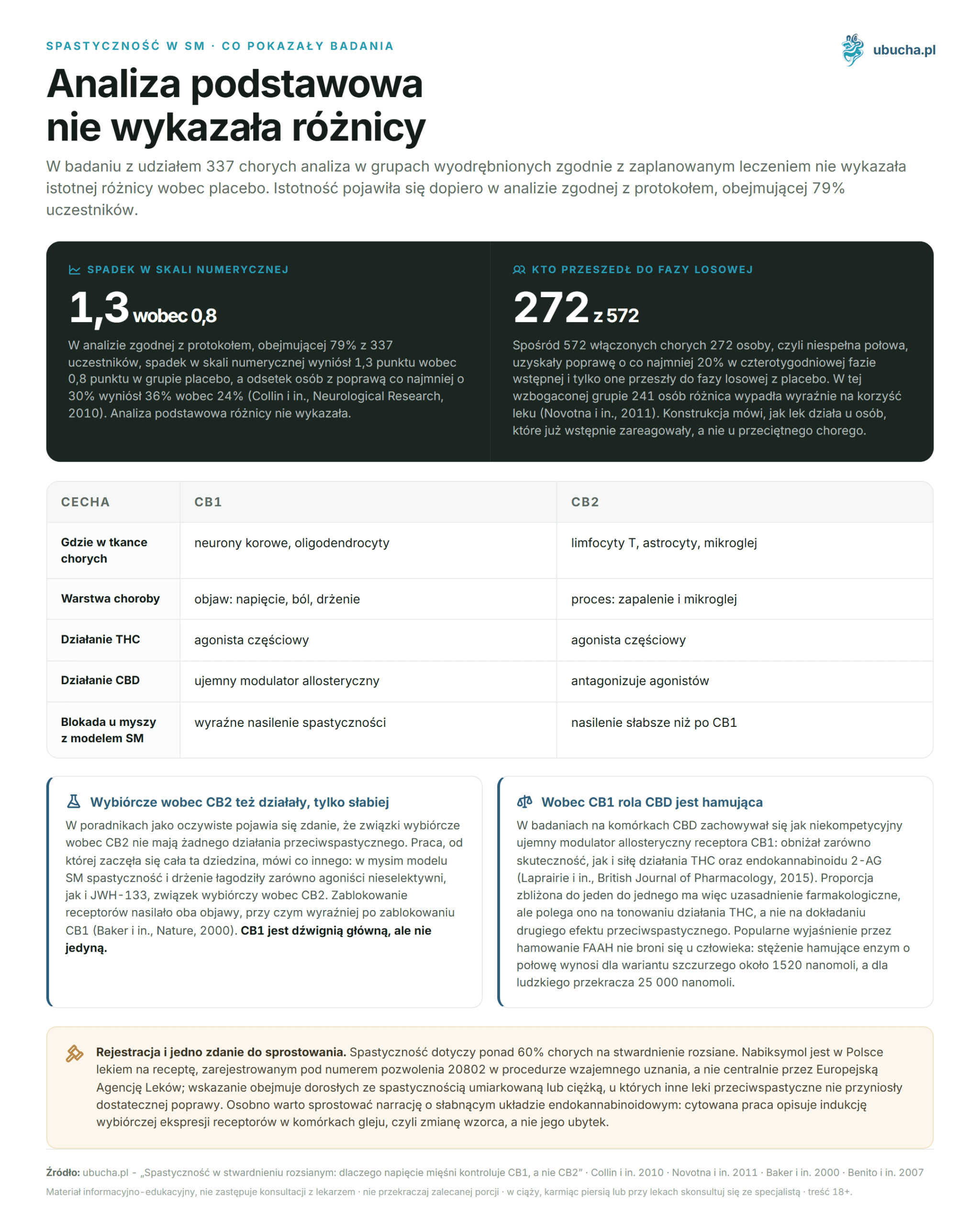
Because CB1 is located in neurons, while CB2 is mainly in immune cells. A study of brain tissue taken post-mortem from MS patients showed that CB1 is expressed in cortical neurons, oligodendrocytes and their precursor cells, as well as in macrophages and infiltrating T lymphocytes. CB2, on the other hand, was found in T lymphocytes, astrocytes, and perivascular and reactive microglia (Benito et al., Journal of Neuroscience 2007).
The distribution explains the division of roles. Muscle tone arises in the synapses of motor neurons, so the receptor present in neurons has a direct influence there, while the receptor present in immune cells interacts with inflammation, which is another layer of the disease. The same work showed that microglia with the CB2 receptor are evenly distributed in active plaques, while in chronically active plaques, they concentrate on their periphery.
However, one must be cautious of the statement that appears in guides as obvious: that selective CB2 compounds have no antispastic effect. The work that started this entire field says otherwise. In a mouse model of MS, both non-selective agonists and JWH-133, a selective CB2 compound, alleviated spasticity and tremors. Blocking the receptors exacerbated both symptoms, more clearly after blocking CB1 (Baker et al., Nature 2000). CB1 is thus the main lever, but not the only one.
How does THC act on CB1 and reduce muscle tone?
By presynaptic inhibition, which means reducing the amount of neurotransmitter released into the synaptic cleft. THC is a partial agonist of CB1 and CB2 receptors, and the strength of its action depends on how many receptors are present in a given tissue, how efficiently they transmit signals, and how many endocannabinoids are circulating in it at that moment (Pertwee, British Journal of Pharmacology 2008).
The cascade looks as follows: activated CB1 couples with Gi/Go protein, inhibits adenylate cyclase, lowers cAMP levels, opens potassium channels, and closes calcium ones. The presynaptic terminal becomes hyperpolarized and releases less glutamate. The alpha motoneuron receives a weaker stimulus, and the muscle receives fewer contraction commands.
This explanation, however, has a limit that is easy to forget. Presynaptic inhibition by CB1 affects both excitatory and inhibitory transmitters, so the direction of the net effect depends on which synapses the receptor is currently more densely populated. In the motor system, the inhibitory effect predominates, but it is not a simple relationship of more THC, less tone. Partial agonism also means that above a certain level of receptor activation, the effect stops increasing, while adverse effects continue to rise.
What does CBD bring to this mechanism?
Less than the popular version suggests, and through different receptors. Let’s start with a clarification: the often-repeated statement that CBD raises anandamide levels by inhibiting the FAAH enzyme does not hold in humans. The inhibitory concentration of the enzyme for the rat variant is about 1520 nanomoles, while for the human variant, it exceeds 25,000 nanomoles, which a pharmacological review directly describes as excluding FAAH from the list of real targets for CBD in humans (Mlost et al., Int J Mol Sci 2020).
The targets that are defended in the same review look different. CBD activates TRPA1, TRPV1, and TRPV4 channels at low nanomolar concentrations. It acts on the nuclear receptor PPAR-gamma, which is especially important in the context of inflammation. It is also a positive allosteric modulator of glycine receptors, and the enhancement of currents through the alpha-3 subtype of these receptors correlated with the suppression of chronic neuropathic pain in animal models.
Regarding CB1 itself, CBD’s role is even inhibitory. In cell studies, CBD behaved as a non-competitive negative allosteric modulator of the CB1 receptor: it reduced both the efficacy and potency of THC and the endocannabinoid 2-AG on the signaling pathways dependent on that receptor (Laprairie et al., British Journal of Pharmacology 2015). A ratio close to one to one in the product thus has pharmacological justification, but it is based on toning down THC’s action, not adding a second antispastic effect.
What do clinical studies on nabiximols show?
A positive result, but clearly weaker than it sounds in marketing summaries. In a study involving 337 patients, the analysis in groups separated according to planned treatment did not show a significant difference compared to placebo. Significance appeared only in the protocol-compliant analysis, which included 79% of participants: a decrease on the numerical scale of 1.3 points compared to 0.8 points in the placebo group, and the percentage of individuals with at least a 30% improvement was 36% compared to 24% (Collin et al., Neurological Research 2010).
A year later, a study with a different design was published that circumvented this problem. Of the 572 enrolled patients, 272 individuals, or just under half, achieved at least a 20% improvement in a four-week preliminary phase, and only they proceeded to the random phase with placebo. In this enriched group of 241 individuals, the difference was clearly in favor of the drug, and along with it, the frequency of spasms, sleep disturbances, and overall change assessment made by the patient, caregiver, and doctor improved (Novotna et al., European Journal of Neurology 2011).
The enriched design is fair to clinical practice because it reflects how the drug is used, but it narrows the inference. It tells how it works in individuals who have already responded preliminarily, not in the average MS patient. Sleep disturbances were a secondary endpoint here, and we develop this thread separately in relation to insomnia in adults.
What are the differences between CB1 and CB2 in multiple sclerosis?
The difference in location translates into a difference in therapeutic roles. The table below summarizes what can be attributed to the works cited above, without results transferred from other diseases.
| Feature | CB1 | CB2 |
|---|---|---|
| Where in the tissue of MS patients | Cortical neurons, oligodendrocytes and their precursors, macrophages, T lymphocytes | T lymphocytes, astrocytes, perivascular and reactive microglia |
| Layer of the disease | Symptom: muscle tone, pain, tremor | Process: inflammation and microglial response |
| Endogenous agonists | Anandamide, 2-AG | Anandamide, 2-AG |
| THC action | Partial agonist | Partial agonist |
| CBD action | Negative allosteric modulator, weakens THC | Antagonizes agonists of this receptor |
| Effect of blockade in mice with MS model | Clear exacerbation of spasticity and tremor | Exacerbation weaker than after CB1 blockade |
The last row is the most interesting here, as it does not speak to what adding a substance can do, but rather what happens when it is removed. The exacerbation of symptoms after receptor blockade indicates that the endocannabinoid system participates in the ongoing control of tone, not just when someone administers a drug.
What happens to the endocannabinoid system in MS?
It changes where and in which cells the receptors appear. In a healthy spinal cord, endocannabinoids are produced on demand in postsynaptic neurons and act retrogradely on presynaptic terminals, suppressing excessive neurotransmitter release. This mechanism keeps muscle tone in check without the involvement of any drug.
In the tissue of affected individuals, the picture is different and primarily concerns glial cells. Benito et al.’s work describes this as the induction of selective expression of CB1 and CB2 receptors and the FAAH enzyme in glial cells, with FAAH being limited to neurons and hypertrophied astrocytes. The authors see this as an argument for the involvement of the endocannabinoid system in the pathogenesis of the disease or its course.
However, this is not evidence that the endocannabinoid system in MS simply weakens and needs to be supplemented from the outside. Such a narrative circulates in texts about cannabis, but the cited work describes a change in expression pattern, not its loss. A more cautious and source-consistent statement is that this system reacts to the disease, and treatment attempts to utilize its mechanism rather than replace a missing component. This difference is also significant in the context of evaluating CBD in chronic pain, where the same shortcut appears most often.
On what basis is nabiximols available in Poland?
Exclusively by prescription and only as treatment for the next relapse. The product is registered in the Polish Register of Medicinal Products under authorization number 20802, and the responsible entity is Jazz Pharmaceuticals Ireland Ltd. The registration went through mutual recognition between member states, not the central procedure of the European Medicines Agency. This distinction is often confused in texts about medical cannabis, but it has practical significance: the authorization is valid in those countries that recognized it, not automatically throughout the EU.
The registered indication includes adults with moderate to severe spasticity due to MS, for whom other antispastic medications have not provided sufficient improvement. The composition of the product is based on a THC to CBD ratio close to one to one. We do not provide dosing information, as it is determined individually by the doctor, and the scheme described in the product characteristics assumes a gradual approach to the lowest effective dose under supervision.
Clinical limitations remain adverse effects from THC: dizziness, drowsiness, and psychoactive effects. In Collin’s study, the drug was still rated as generally well tolerated, and most reported adverse events were mild to moderate in severity. CBD products available over the counter are not a substitute for this drug and have not been studied for this indication.
Frequently Asked Questions
Why do cannabinoids primarily act on spasticity in MS through CB1?
Because CB1 is present in neurons, including cortical cells and oligodendrocytes, while CB2 is primarily found in lymphocytes, astrocytes, and microglia (Benito et al., Journal of Neuroscience 2007). Muscle tone arises in the synapses of motor neurons, so the neuronal receptor directly influences them, while the immune receptor affects inflammation.
Do compounds acting on CB2 not reduce spasticity at all?
They do reduce it, albeit to a lesser extent. In a mouse model of MS, spasticity and tremors were also alleviated by JWH-133, a selective agonist for CB2, and blocking the receptors exacerbated symptoms more clearly after blocking CB1 than CB2 (Baker et al., Nature 2000). The statement that selective CB2 compounds have no effect is therefore false.
Is nabiximols approved by the EMA?
Not in the central procedure. In Poland, the product is listed in the Register of Medicinal Products with authorization number 20802, obtained through mutual recognition between member states. It is available by prescription for adults with spasticity due to MS, for whom other antispastic medications have proven insufficient.
Does CBD alone act on spasticity?
There is no data from human studies to support this, and the mechanism rather argues against it. CBD behaves as a negative allosteric modulator at the CB1 receptor and weakens the effect of THC (Laprairie et al., British Journal of Pharmacology 2015). The popular explanation of inhibiting the FAAH enzyme does not hold for the human variant of this enzyme.
How is the effectiveness of spasticity treatment measured in studies?
Most often by a numerical scale from 0 to 10, where the patient self-assesses the severity of the symptom, less frequently by the Ashworth scale measured by the examiner. In Collin’s 2010 study, the baseline analysis did not show a significant difference compared to placebo, and significance appeared only in the protocol-compliant analysis.
This article is for informational and educational purposes and does not constitute medical advice. Before starting to use cannabis or CBD for therapeutic purposes, consult your doctor, especially if you are taking other medications, are pregnant, or breastfeeding.
Author: Michał Waluk · Published: 2026-08-09 · Updated: 2026-08-15