
Dabbing: what is it and how does it differ from vaporization (definition)
Dabbing is the vaporization of a concentrate on a heated bowl. Measured temperatures, degradation products, differences compared to vaporization of flower, and the legal status in Poland.
Dabbing is the vaporization of a small amount of cannabis concentrate on a heated surface and inhaling the resulting vapor. The name comes from the English word “dab”, meaning a small amount, and describes the size of the portion. The method originated from legal markets in the United States, and there is neither equipment nor raw material for it in Polish stores. This is not a gap in the assortment, but a consequence of the law: in the legal market of Washington state, extracts had an average of 68.7 percent THC, while the Polish limit for industrial hemp is 0.3 percent of the total delta-9-THC and THCA. Below you will find a technical description of the method, measured temperatures along with the compounds that arise at them, a comparison with vaporization of flower, and the legal status of the material in question. Each number is accompanied by the work from which it originates.
KEY INFORMATION
• In the legal market of Washington state, inhalation extracts had an average of 68.7 percent THC compared to 20.6 percent in flower (Smart et al., Addiction 2017).
• Metacrolein was not detected at a median of 322 degrees Celsius, and at 403 degrees it was 131 ppb per dab; e-nail users report a working range of 340-482 degrees (Meehan-Atrash et al., ACS Omega 2017).
• Aerosol gas products were significantly lower with dabbing and vaporization than with smoking cannabis (Meehan-Atrash et al., ACS Omega 2019).
• The store u Bucha does not have concentrates or dabbing equipment; it has five vaporizers for flower, 374-499 PLN (as of August 16, 2026).
What is dabbing and where did the name come from?
Dabbing is placing a portion of cannabis concentrate on a surface heated to several hundred degrees and inhaling the vapor that is produced in a fraction of a second. The English word “dab” means a small amount and refers to the size of the portion, not the strength of the effect. The practice emerged in legal markets in the United States alongside industrial cannabis extraction.
Meehan-Atrash and colleagues described it in 2017 as a method that gained significant popularity in states after legalization, although the product profiles of these products had not been widely studied before (ACS Omega, 2017). The method spread faster than literature on what is inhaled with it was created.
The scale of the market from which the method came has been calculated. In Washington state, from July 7, 2014, to September 30, 2016, over 44 million transactions were recorded. The share of inhalation extracts increased by 145.8 percent over two years and reached 21.2 percent of sales, although flower still accounted for 66.6 percent of expenditures (Smart et al., Addiction, 2017). The date of July 10 has gained its own significance in this environment, which we discuss in the text about 710, or dabbing day.
What equipment and material are needed for dabbing?
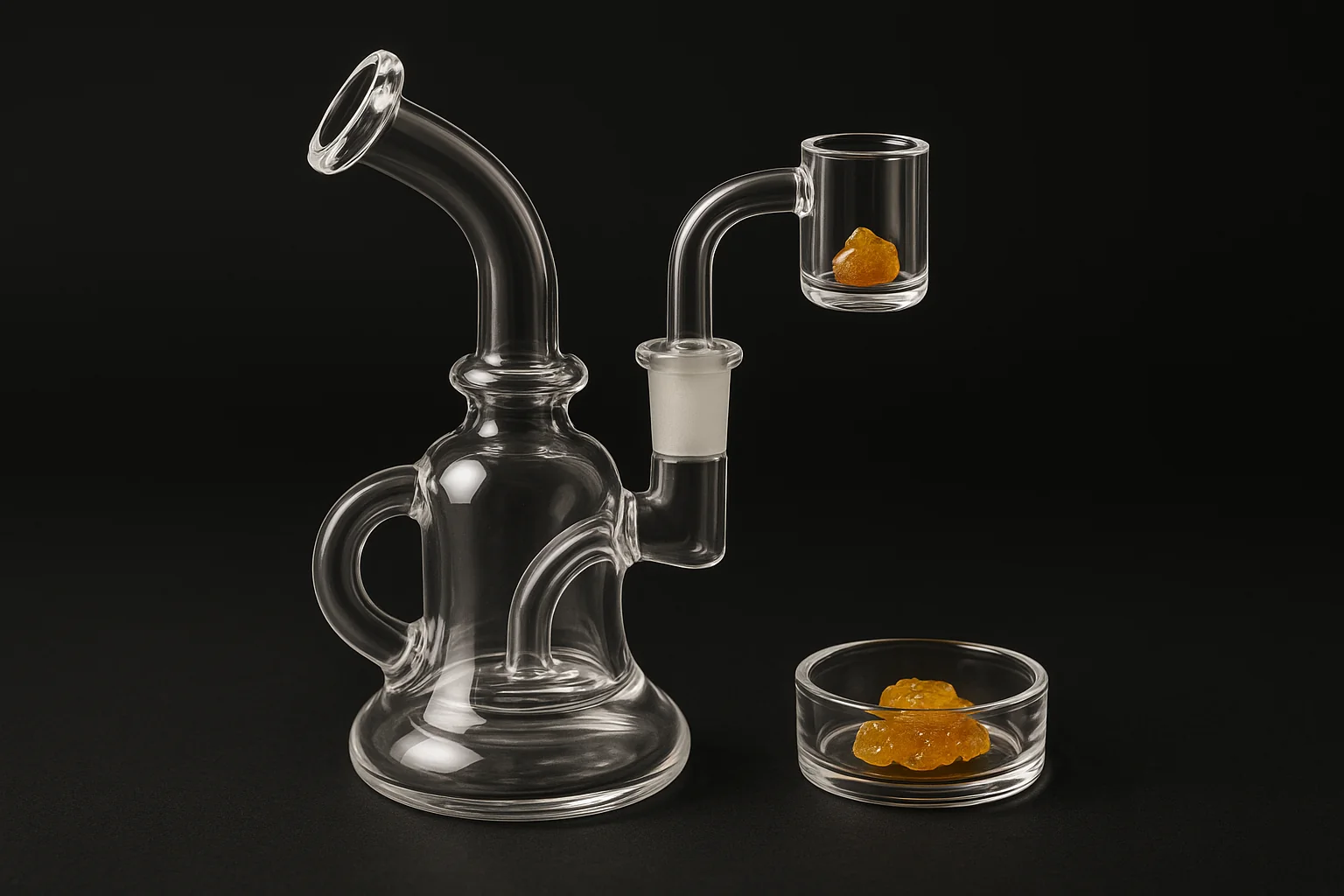
The set consists of a glass base with a water chamber (dab rig), a removable bowl made of quartz, titanium, or ceramic (nail or banger), a heat source, and a tool for applying the portion. The material is concentrate, not flower. The store u Bucha does not carry any of these elements.
The heat source can be a gas torch or an electric controller called an e-nail. The difference is practical: the torch does not show the temperature, and with this method, it is the temperature that determines the composition of the vapor. Meehan-Atrash et al. describe that a minority of users heat lower to preserve flavor, while the majority heat higher to ensure nothing is wasted. E-nail users report a preferred value of around 710 degrees Fahrenheit, or 378 degrees Celsius, with a reported range of 340-482 degrees.
The attachment for the banger is called a carb cap. This same work explains its function differently than most guides: the carb cap lowers the pressure above the surface of the bowl during inhalation, allowing vaporization to occur below the expected boiling temperature of THC, which the authors cite from the literature as around 417 degrees Celsius.
Concentrates vary in consistency and method of production. Shatter, wax, budder, and crumble are produced from butane extraction. Live resin is made from material frozen immediately after harvest, and rosin is made from pressing under pressure, without a solvent. Rosin is not the only method without a solvent: dry sifting and water-ice hash also avoid chemicals.
How does dabbing differ from vaporizing flower?
Dabbing works with concentrate and on a surface heated to several hundred degrees, while vaporization of flower works with whole buds and at a temperature around 200 degrees. The difference in concentration has been measured: in the legal market of Washington state, extracts had an average of 68.7 percent THC compared to 20.6 percent in flower, which is more than three times higher.
| Feature | Dabbing | Vaporization of flower |
|---|---|---|
| Material | concentrate: shatter, wax, rosin, live resin | dried cannabis flowers |
| Measured THC concentration | 68.7% on average (Smart 2017) | 20.6% on average (Smart 2017) |
| Working temperature | 340-482°C reported by e-nail users (Meehan-Atrash 2017) | 210°C set in the study of five devices (Lanz 2016) |
| Heat source | gas torch or e-nail | electric heater with regulation |
| Mobility | low, glass equipment | high, pocket devices |
| In the store u Bucha | none | 5 models, 374-499 PLN (as of August 16, 2026) |
The temperature on the vaporization side is measured, not reported. Lanz and colleagues studied five devices, setting all electrically powered ones to 210 degrees Celsius. The total THC recovery in the vapor ranged from 54.6 to 82.7 percent depending on the model, decarboxylation exceeded 97 percent for THC, and traces of combustion in the form of ash in the chamber and visible smoke were found only in one gas-powered device (PLOS One, 2016). We elaborate on this method in the guide Vaporization: what and how.
What happens to the vapor at different temperatures?
The higher the temperature, the more degradation products. Meehan-Atrash et al. measured the concentration of metacrolein per dab: 185 ppb at a median of 526 degrees Celsius, 157 ppb at 455 degrees, 131 ppb at 403 degrees, and below the detection threshold at 322 degrees. Benzene was not detected outside the highest tested range.
This presents a different picture than what circulates in guides. There is no threshold in this work \”above 340 degrees\” nor a statement that the concentrate burns instead of vaporizing. However, there is a series of measurements showing the relationship and one point at which metacrolein disappears from the result.
The source of these compounds is terpenes, not the cannabinoid itself. The 2017 work focuses on myrcene and other terpenes present in extracts. In the highest tested range, around 550 degrees at the start, limonene produced 261 nanograms of metacrolein per milligram of terpene, linalool 103, and myrcene 81. The 2019 work adds that adding terpenes to pure THC raised the level of gas products (ACS Omega, 2019).
Hence the conclusion that guides miss: the boiling point of THC is not a threshold at which anything starts to vaporize. The tables of \”boiling points\” of cannabinoids, which explain the choice of temperature, describe a different phenomenon than what happens on the bowl. We elaborate on the choice of temperature for flower in the text about choosing vaporization temperature.
Is dabbing safer than smoking?
Partially. In a quantitative risk analysis, Meehan-Atrash et al. found that aerosol gas products had significantly lower values with dabbing and vaporization than with smoking cannabis. The authors themselves advise reading this result cautiously, pointing to the variability of usage patterns and the higher concentration of THC in the aerosol.
The list of compounds detected on the dabbing side is specific: metacrolein, benzene, and methyl vinyl ketone with vaporizers using cartridges and with dabbing. Both pure THC and THC mixed with terpenes produced elevated levels of isoprene. These are not amounts known from cigarette smoke, but neither is it vapor composed solely of cannabinoids and terpenes.
In comparison, Lanz et al. write on the vaporization of flower that vaporization without pyrolysis avoids tar, carbon monoxide, and other combustion products, and decarboxylation of cannabinoid acids occurs around 200 degrees Celsius. Their measurement also showed the limit of this advantage: a gas-powered device, in which temperatures could not be controlled, burned the material despite having the same name on the box.
We leave the conclusion cautious: the advantage concerns one family of compounds and was measured in a laboratory, not in a user session heating with a torch by eye.
Is dabbing legal in Poland?
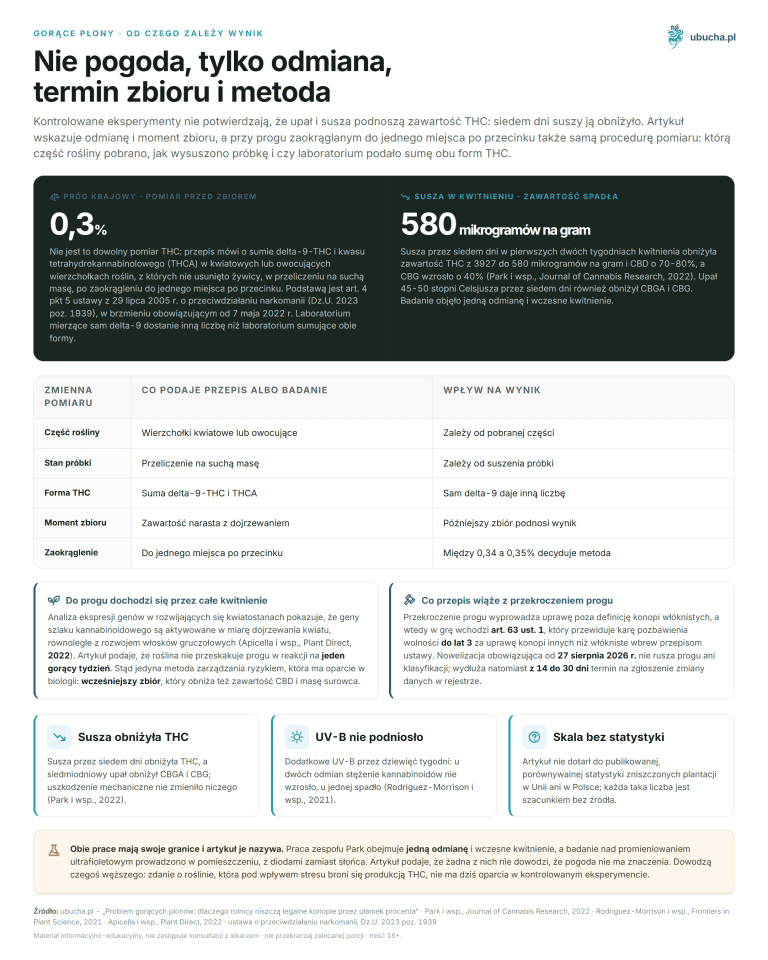
The equipment itself is not banned in Poland, but the material this method concerns is practically illegal. The Act on Counteracting Drug Addiction recognizes as industrial hemp only those plants in which the sum of delta-9-THC and THCA does not exceed 0.3 percent of dry mass. Extracts with an average content of nearly 69 percent are very far from this threshold.
The threshold arises from Article 4 point 5 of the Act of July 29, 2005 on Counteracting Drug Addiction, in the consolidated text Journal of Laws 2023 item 1939, as amended by the Act of March 24, 2022 (Journal of Laws 2022 item 763), in force since May 7, 2022. It is calculated from the plant, specifically from the flowering or fruiting tops from which the resin has not been removed, and rounded to one decimal place. This is not a parameter of the finished product, so there is no such thing as a legal concentrate with a content of 0.3 percent.
Plant material above this threshold is referred to by the law as cannabis other than industrial hemp (Article 4 point 37), and possession of it is a crime under Article 62 of the same law. This also applies to extracts from such material.
There is also a difference that guides do not make. Laboratory certificates usually state the position \”total THC\”, in which THCA is converted using a factor of 0.877. The law sums delta-9-THC and THCA without a factor, so for the same sample, the statutory number comes out higher than that from the certificate.
Frequently asked questions
What is dabbing?
Dabbing is a method of inhaling cannabis concentrates. A portion the size of a grain is placed on a heated bowl made of quartz, titanium, or ceramic, and the resulting vapor is inhaled through a glass base with a water chamber. The name comes from the English word “dab”, meaning a small amount, and describes the size of the portion.
How does dabbing differ from vaporizing flower?
By material and temperature. Dabbing works with an extract with an average THC content of 68.7 percent, while vaporization of flower works with buds with an average of 20.6 percent (Smart et al., Addiction 2017). The study of five vaporizers was conducted at 210 degrees Celsius, while e-nail users report a range of 340-482 degrees.
What is a safe temperature for dabbing?
There is no study indicating a safe value. There is a measurement: metacrolein was not detected at a median of 322 degrees Celsius, and at 403 degrees it was 131 ppb per dab (Meehan-Atrash et al., ACS Omega 2017). Benzene appeared only in the highest tested range.
Is dabbing safer than smoking?
Partially and only in one dimension. The aerosol gas products were significantly lower with dabbing than with smoking cannabis, but the authors advise reading this result cautiously due to the variability of usage patterns and the higher concentration of THC in the aerosol (Meehan-Atrash et al., ACS Omega 2019).
Does the store u Bucha sell dabbing equipment?
No. The offer does not include dab rigs, bangers, e-nails, or concentrates, as the material this method concerns is a controlled substance in Poland. Vaporizers for flower are available: five models priced at 374-499 PLN, as of August 16, 2026.
If you are looking for an inhalation device that is legal to buy in Poland, check the vaporizers category.
This article is for informational and educational purposes only and does not constitute legal advice. The legal status described in the article is valid as of the publication date: regulations regarding cannabis may change. Before making a decision, consult a lawyer or current legal acts.
Author: Michał Waluk · Published: 2026-08-09 · Updated: 2026-08-16