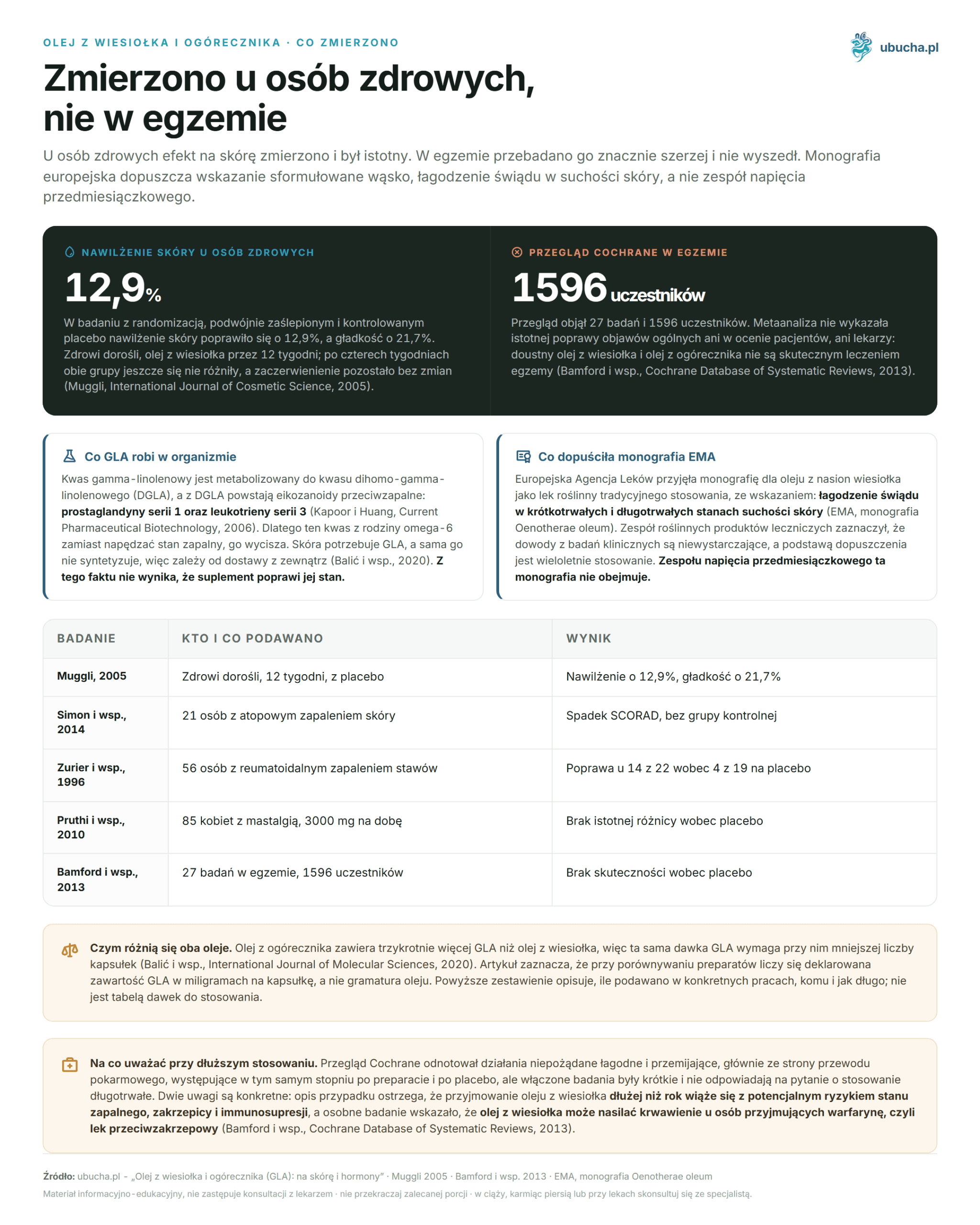

Evening Primrose and Borage Oil (GLA): for Skin and Hormones (Table)
What GLA does to healthy skin, what it does not do in eczema, what doses were used in studies, and what the EMA monograph for evening primrose oil really allows.
Gamma-linolenic acid, or GLA, is that rare omega-6 which instead of driving inflammation, calms it down. The body produces it from linoleic acid with the help of delta-6-desaturase, and in its finished form, it is found in the diet in very small amounts: trace amounts in leafy green vegetables and nuts, and, in infants, in breast milk (Kapoor and Huang, Current Pharmaceutical Biotechnology, 2006). Hence the popularity of evening primrose oil and borage oil. This article separates what has emerged in studies from what is repeated about these oils: the effect in healthy individuals turned out to be different from the effect in skin disease, and the European monograph states something different than most descriptions provide.
KEY INFORMATION
• In a randomized, placebo-controlled study in healthy individuals, 12 weeks of evening primrose oil supplementation improved skin hydration by 12.9%, and smoothness by 21.7% (Muggli, International Journal of Cosmetic Science, 2005).
• A Cochrane review covering 27 studies and 1596 participants states that oral evening primrose oil and borage oil are not effective treatments for eczema (Bamford et al., Cochrane Database of Systematic Reviews, 2013).
• The EMA monograph allows evening primrose oil as a traditional herbal medicine for relieving itching in dry skin, not in premenstrual syndrome.
• Borage oil contains three times more GLA than evening primrose oil (Balić et al., International Journal of Molecular Sciences, 2020).
• In a study on rheumatoid arthritis, 2.8 g of GLA was administered daily, which is a multiple of the doses found in supplements (Zurier et al., Arthritis and Rheumatism, 1996).
What does GLA do in the body?
It converts into something else, and only that something works. GLA is metabolized to dihomo-gamma-linolenic acid (DGLA), and DGLA undergoes oxidation by cyclooxygenases and lipoxygenases. Anti-inflammatory eicosanoids are formed from it: prostaglandins of series 1 and leukotrienes of series 3 (Kapoor and Huang, Current Pharmaceutical Biotechnology, 2006).
This explains the paradox from which most misunderstandings around this ingredient begin. The omega-6 family is commonly described as pro-inflammatory in contrast to anti-inflammatory omega-3, but GLA is an exception in this family precisely because of what it converts into. The authors of the review also indicate that GLA and its metabolites influence the expression of genes important for immune functions and apoptosis.
The skin itself has a special status here: it needs GLA and cannot synthesize it, so it depends on external supply (Balić et al., International Journal of Molecular Sciences, 2020). However, this fact does not automatically imply that supplementation will improve its condition, and this difference is the subject of the next section.
Does GLA supplementation improve skin condition?
The answer depends on whose skin we have in mind, and this distinction is lost in most descriptions. In healthy individuals, the effect was measured and was significant. In individuals with eczema, it was studied much more broadly and did not emerge.
Muggli conducted a randomized, double-blind, placebo-controlled study on healthy adults who took evening primrose oil for 12 weeks. After four weeks, there was no difference between the two groups. Only after twelve weeks did a difference appear in all measured parameters except for redness: hydration improved by 12.9%, trans-epidermal water loss by 7.7%, elasticity by 4.7%, firmness by 16.7%, resistance to mechanical fatigue by 14.2%, and smoothness by 21.7% (Muggli, International Journal of Cosmetic Science, 2005).
In eczema, the picture is reversed. The Cochrane review included 27 studies and 1596 participants, of which 19 studies concerned evening primrose oil and 8 borage oil. The meta-analysis did not show a significant improvement in overall symptoms either in patient or physician assessments. The authors’ conclusion is unequivocal: oral borage oil and evening primrose oil are not effective treatments for eczema, and the confidence intervals are narrow enough that further studies in this indication are difficult to justify (Bamford et al., Cochrane Database of Systematic Reviews, 2013). What dermatology says today about other ingredients used in atopic dermatitis is discussed separately in the entry about CBD in AD.
What has the EMA actually allowed?
Not what most descriptions of this raw material state. The European Medicines Agency accepted the monograph for evening primrose oil as a traditional herbal medicine for traditional use, with the indication formulated narrowly: relief of itching in short-term and long-term dry skin conditions (EMA, monograph Oenotherae oleum).
The herbal medicinal products team noted that the evidence from clinical studies is insufficient, and the basis for approval is long-term use, not effectiveness demonstrated in trials. The category of traditional use means exactly this: the preparation can be sold for a given indication because it has been used for decades and is safe in that use. This is not the same as approval based on established medical use, which requires evidence of effectiveness from studies, and this difference is not visible from the packaging of the preparation itself.
The premenstrual syndrome is not covered by this monograph. Attributing European approval of evening primrose oil to PMS is therefore a mistake worth recognizing, as many product descriptions repeat it. The effectiveness in this indication is addressed in a separate section below and looks different than such approval would suggest.
How does borage oil differ from evening primrose oil?
First of all, by the concentration of the active substance. Borage oil contains three times more GLA than evening primrose oil, so the same dose of GLA requires fewer capsules (Balić et al., International Journal of Molecular Sciences, 2020). The practical conclusion is this: when comparing two preparations, look at the declared GLA content in milligrams, not the weight of the oil.
As for effectiveness, the Cochrane review studied both oils separately, and in eczema, neither performed better than placebo. Beyond this indication, the data are uneven. A review of omega-6 in skin diseases cites an analysis of twelve clinical studies on borage oil, whose results were highly variable, with a cautious conclusion that in milder forms of atopic dermatitis, the preparation can be helpful as a supplement, but not as a standalone treatment.
The authors of this review go further and formulate a general caveat that is worth remembering with every supplement in this group. Population and individual differences in the metabolism of polyunsaturated fatty acids are so large that it is not possible today to recommend a single supplementation strategy suitable for everyone.
What doses have been used in clinical studies?
The following table describes how much GLA or oil was administered in specific studies, to whom, and for how long. This is not a dosing table for use: some of these studies concern diseases where treatment is determined by a doctor, not the supplement label.
| Study | Who and how many people | What was administered and for how long | Result |
|---|---|---|---|
| Muggli, 2005 | Healthy adults, placebo study | Evening primrose oil, 3 capsules of 500 mg twice daily, 12 weeks | Improvement in all skin parameters except for redness |
| Simon et al., 2014 | 21 people with atopic dermatitis, open study | Evening primrose oil, 4-6 g per day, 12 weeks | Increase in GLA in plasma and decrease in SCORAD index, without a control group |
| Zurier et al., 1996 | 56 people with active rheumatoid arthritis | GLA as a free fatty acid, 2.8 g per day, 6 months | Improvement in 14 out of 22 people compared to 4 out of 19 in the placebo group |
| Pruthi et al., 2010 | 85 women with cyclic mastalgia, 41 completed | Evening primrose oil, 3000 mg per day, 6 months | No significant difference compared to placebo in direct comparison |
| Bamford et al., 2013 | Review of 27 studies, 1596 participants | Evening primrose oil or borage oil in eczema | No effectiveness compared to placebo |
Two entries from this table deserve comment. Simon’s study was open, meaning without a control group and without blinding, and the authors call it pilot: it shows that the increase in GLA in plasma goes hand in hand with a decrease in disease severity, but does not determine whether the preparation caused it (Simon et al., Advances in Therapy, 2014). Zurier and colleagues administered 2.8 g of GLA per day and noted in the summary that in practice, GLA is taken in doses many times lower than those used in their study. They also added that the preparation is not approved in the United States for any indication and should not be considered a treatment for any disease (Zurier et al., Arthritis and Rheumatism, 1996).
Does GLA help with PMS and breast pain?
Data do not confirm this, although the result is sometimes presented as positive. Pruthi and colleagues conducted a randomized, double-blind, placebo-controlled study at two American academic centers. They included 85 women with cyclic breast pain, assigned to four arms for six months. 41 of them completed the study.
Here begins a difference that is easy to overlook. The analysis comparing the state before and after showed improvement in the arm with evening primrose oil, but direct comparison with the placebo group did not show a significant difference. The authors formulated the conclusion conditionally, stating that such doses taken for six months may reduce the severity of cyclic mastalgia (Pruthi et al., Alternative Medicine Review, 2010).
A systematic review of breast pain management is more definitive in its assessment: it states that gamma-linolenic acid and evening primrose oil, although sometimes recommended, are not effective (Kataria et al., Indian Journal of Surgery, 2014). More broadly about supplementation during the perimenopausal period is discussed in the entry about supplements for women over forty.
What to watch out for with prolonged use?
The Cochrane review noted mild and transient adverse effects, mainly related to the gastrointestinal tract, occurring to the same extent with the preparation and with placebo. However, the authors noted that the included studies were short and do not answer the question about long-term use.
Two notes from the same review are specific. A case report warns that taking evening primrose oil for more than a year is associated with a potential risk of inflammation, thrombosis, and immunosuppression. A separate study indicated that evening primrose oil may increase bleeding in individuals taking warfarin, a blood-thinning medication (Bamford et al., Cochrane Database of Systematic Reviews, 2013).
Additionally, there is the issue of the stability of the raw material itself. GLA is a polyunsaturated fatty acid, so it oxidizes under the influence of oxygen, and the process is accelerated by heat and light. When purchasing, the declared GLA content in milligrams per capsule matters, not the weight of the oil. Similar selection principles apply to other oils pressed from seeds, as discussed in the entry about black seed oil.
Frequently Asked Questions
What is GLA?
It is gamma-linolenic acid, a fatty acid from the omega-6 family. The body produces it from linoleic acid with the help of delta-6-desaturase, and in its finished form, it is found in the diet in trace amounts. In the body, it is converted into DGLA, from which anti-inflammatory eicosanoids are formed: prostaglandins of series 1 and leukotrienes of series 3.
Does evening primrose oil improve skin appearance?
In healthy individuals, such an effect has been measured. In a randomized, placebo-controlled study, twelve weeks of supplementation improved hydration by 12.9%, firmness by 16.7%, and smoothness by 21.7%, while redness remained unchanged. After four weeks, there was no difference yet, so the effect required full observation time.
Does evening primrose oil treat eczema?
No. A Cochrane review included 27 studies and 1596 participants and found that oral evening primrose oil and borage oil are not effective treatments for eczema. Improvement was similar to that of placebo, and the authors deemed further studies in this indication difficult to justify.
What does the EMA monograph for evening primrose oil cover?
Relief of itching in short-term and long-term dry skin conditions, in the category of traditional herbal medicine. The basis is long-term safe use, not effectiveness demonstrated in clinical trials. Premenstrual syndrome is not covered by this monograph, contrary to many product descriptions.
What is the difference between borage and evening primrose?
The concentration of the active substance: borage oil contains three times more GLA than evening primrose oil, so the same amount of GLA requires fewer capsules. When comparing preparations, the declared GLA content in milligrams per capsule matters, not the weight of the oil itself.
Does GLA reduce breast pain before menstruation?
Data do not confirm this. In a placebo study involving 85 women, direct comparison with the placebo group did not show a significant difference, and a systematic review of breast pain management states that gamma-linolenic acid and evening primrose oil, although sometimes recommended, are not effective.
This article is for informational and educational purposes only and does not constitute medical advice. Before starting supplementation, consult your doctor, especially if you are taking medications regularly, are pregnant or breastfeeding, or have a chronic illness.
Author: Michał Waluk · Published: 2026-07-31 · Updated: 2026-08-11