
PEA (palmitoylethanolamide): endocannabinoid-like compound for pain (table)
PEA (palmitoylethanolamide) in chronic pain: how many people were studied, what two meta-analyses from Pain Physician say, and what is unknown about the micronized form.
Palmitoylethanolamide (PEA) is a lipid that the body produces in tissue affected by inflammation or damage. It has been available in supplements for several years, usually with the promise of pain relief without the gastrointestinal side effects of anti-inflammatory drugs. The evidence base exists and is larger than that for a typical supplement, but narrower than product descriptions suggest. It consists of two meta-analyses published in Pain Physician, several clinical trials, and one large registration study in sciatica. However, some of these are open-label studies without a comparison group, and one of the meta-analyses was co-authored by employees of the manufacturer. This article separates what has been measured in humans from what has been measured in cell cultures and rodents, and shows where the evidence breaks off and what to ask before purchasing.
KEY INFORMATION
• PEA is an endogenous N-acylethanolamine; it primarily acts through the nuclear receptor PPAR-alpha, not through CB1 and CB2 receptors.
• Two meta-analyses in Pain Physician evaluated PEA in chronic pain: a pool of 12 studies (Paladini, Pain Physician, 2016) and 10 studies involving 786 people taking PEA versus 512 in control groups (Artukoglu, Pain Physician, 2017).
• The largest single trial is a registration study in low back pain with sciatica: 636 patients, three weeks, arms of 300 and 600 mg per day versus placebo (Cruccu, CNS Neurol Disord Drug Targets, 2019).
• The superiority of the micronized form over the regular one has not been demonstrated: a review in the British Journal of Clinical Pharmacology states that there are no studies directly comparing both forms (Gabrielsson, Br J Clin Pharmacol, 2016).
• The 2016 meta-analysis was co-authored by employees of the manufacturer of micronized PEA, which the reader should be aware of when assessing its significance.
What is PEA and why is it sometimes called an endocannabinoid-like compound?
PEA belongs to the family of N-acylethanolamines (NAE), the same as anandamide, the first known endocannabinoid. The relationship is chemical, not functional: PEA does not significantly bind to CB1 or CB2 receptors. The term “endocannabinoid-like” refers to the structure of the molecule and the common degrading enzymes, not to a common receptor.
The main described molecular target of PEA is the nuclear receptor PPAR-alpha. A receptor review dedicated to both of these lipids mentions alongside it the TRPV1 channel and membrane receptors GPR119 and GPR55, noting that the affinity for individual proteins varies and is not well measured everywhere (Im, Int J Mol Sci, 2021). At the tissue level, the described mechanism is the inhibition of mast cell degranulation and the silencing of glial activation.
It is worth noting the limit of this description. The cellular mechanism comes from cultures and animal models, not from measurements in patients. A study describing an enzyme inhibitor that breaks down PEA showed the abolition of pain hypersensitivity in mice and rats after topical application, and the effect disappeared in animals lacking PPAR-alpha (Sasso, Pain, 2013). This is a strong indication for the pathway, but not proof that a capsule works the same way in humans.
Does PEA actually reduce pain?
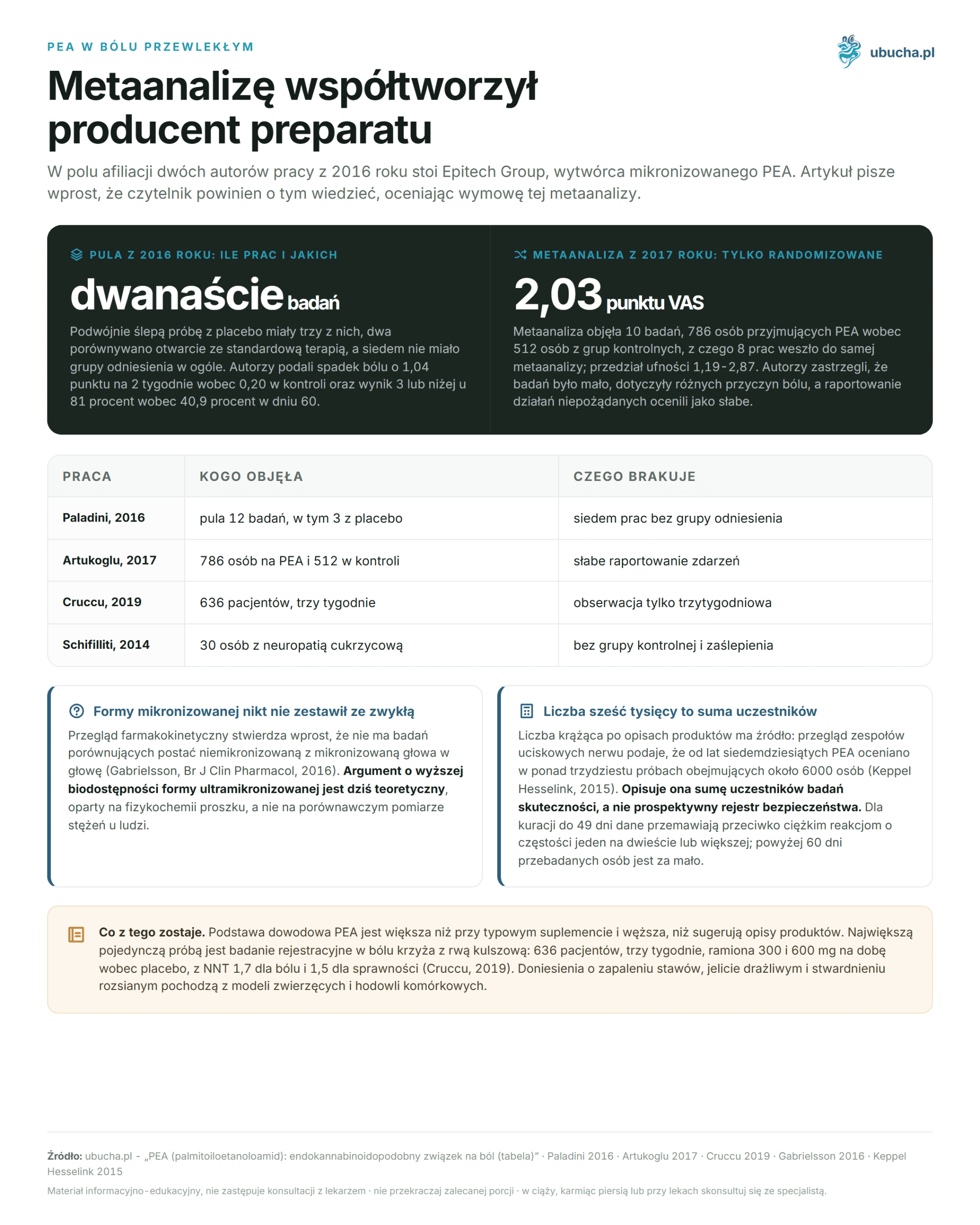
The answer is: in studies on chronic pain, PEA performs better than control, but the quality of these studies is uneven, and the two meta-analyses counted different things. The pool from 2016 included twelve studies, but only three of them had a double-blind placebo-controlled design; two were openly compared to standard therapy, and seven had no reference group at all.
| Study | Who was included | What was compared | Result reported by authors |
|---|---|---|---|
| Paladini, Pain Physician, 2016 | pool of 12 studies, including 3 with placebo | micronized and ultramicronized PEA versus control | pain reduction of 1.04 points over 2 weeks versus 0.20 in control; on day 60, pain score of 3 or lower in 81% versus 40.9% |
| Artukoglu, Pain Physician, 2017 | 10 studies, 786 people on PEA and 512 in control | only randomized trials, 8 of them in the meta-analysis | difference of 2.03 points on the VAS scale, confidence interval 1.19-2.87 |
| Cruccu, CNS Neurol Disord Drug Targets, 2019 | 636 patients with low back pain and sciatica | 300 and 600 mg per day versus placebo, 3 weeks | NNT 1.7 for pain and 1.5 for function; effect increased with the likelihood of neuropathic component |
| Schifilliti, Pain Res Treat, 2014 | 30 people with diabetic neuropathy | 300 mg twice daily, assessment after 30 and 60 days | significant reduction in pain severity on three symptom scales, without a control group |
A difference of 2.03 points on the VAS scale is a significant and clinically noticeable result, but the authors themselves qualified it with a caveat: there were few studies, they concerned different causes of pain, had different designs, and the reporting of adverse events was rated as poor. The 2016 meta-analysis was co-authored by employees of Epitech Group, the manufacturer of micronized PEA, which is evident in the affiliations of two authors.
Does the micronized form absorb better than the regular one?
This is unknown, as no one has directly compared them. This is a finding that most diverges from what labels promise. A pharmacokinetic review in British Journal of Clinical Pharmacology analyzed the available literature and stated outright that there are no studies comparing the non-micronized form with the micronized one head-to-head, therefore evidence for the superiority of either currently does not exist (Gabrielsson, Br J Clin Pharmacol, 2016).
This does not mean that particle size reduction is insignificant. It means that the argument for higher bioavailability of the ultramicronized form is currently a theoretical argument based on the physicochemistry of the powder, not on comparative measurements of concentrations in humans. The same review notes that published trials lacked basic information about the spread of results and measurements at intermediate points, making any comparison of forms between studies difficult.
A practical conclusion for the reader is cautious. If a manufacturer claims that their product is effective at a lower substance content because it is ultramicronized, this is a marketing claim, not a reading from a comparative study. It is worth asking about this and requesting a reference where both forms were compared.
In what indications has PEA been studied in humans?
The best-documented area is low back pain with a radicular component. A registration study from 2010 included 636 patients in a multicenter design, with a double-blind trial and three arms, lasting three weeks. A re-analysis of this data showed that the higher the likelihood of neuropathic pain in a patient, the better the treatment effect, although this correlation did not pertain to improvement in function (Cruccu, CNS Neurol Disord Drug Targets, 2019). The distinction between nociceptive and neuropathic pain is discussed more broadly in the post about two types of pain and different responses to cannabinoids.
In diabetic neuropathy, an open-label study was published involving 30 patients who were given 300 mg twice daily, with assessments after 30 and 60 days. Improvement in three symptom scales was statistically significant, but the design lacked a control group or blinding, so the placebo effect remains indistinguishable from the effect of the preparation (Schifilliti, Pain Res Treat, 2014).
In pelvic pain due to endometriosis, a randomized placebo-controlled trial was conducted on 61 women after laparoscopic surgery. The patients received not just PEA, but a combination with transpolidatin, and the result was better than placebo. However, the same study notes that celecoxib reduced pelvic pain more strongly than the tested combination (Cobellis, Eur J Obstet Gynecol Reprod Biol, 2011). Reports on arthritis, irritable bowel syndrome, and multiple sclerosis come from animal models and cell cultures, so they should not be read as indications.
How does PEA differ from CBD?
They differ in origin and receptor target, and primarily in the type of evidence available. PEA is produced in human cells and primarily acts through the nuclear receptor PPAR-alpha. CBD comes from the plant and has been described over the years as an inhibitor of the FAAH enzyme, which breaks down anandamide. This description now requires correction: a study in Journal of Biological Chemistry showed that CBD does not inhibit human FAAH, but only the rodent enzyme, and proposed a different mechanism for increasing anandamide in humans, namely competition for intracellular transport proteins from the FABP family (Elmes, J Biol Chem, 2015).
The second difference concerns how far the safety assessment extends. For CBD, there is a current official opinion: the EFSA panel derived a provisional safe dose of 0.0275 mg per kilogram of body weight per day, or about 2 mg daily for a person weighing 70 kg, and noted that safety cannot be established in individuals under 25 years of age, in pregnant and breastfeeding women, and in those taking medications (EFSA, EFSA Journal, 2026). For PEA, there is no analogous document.
The third difference is the area of clinical evidence. PEA has been primarily studied in chronic pain; CBD has the strongest data in drug-resistant epilepsy. Comparisons of both compounds in the same patient have not been conducted in any published randomized trial, so claims of synergy remain hypothetical. More broadly about this family of lipids, we write in the post about the expanded endocannabinoid system.
What is known about the safety of PEA?
The authors of the 2016 meta-analysis noted that in none of the studies included were serious adverse events related to PEA recorded. However, the observation period is short, and this caveat is more important than the mere absence of a signal. The 2016 review states that for treatments lasting up to 49 days, data argue against the occurrence of serious reactions at a frequency of one in two hundred or greater. For treatments longer than 60 days, the number of studied individuals is too small to exclude a frequency of one in a hundred (Gabrielsson, Br J Clin Pharmacol, 2016).
The number that circulates in product descriptions is “six thousand patients without serious events.” It has its source: a review of nerve compression syndromes states that since the 1970s, PEA has been evaluated in over thirty clinical trials involving a total of about 6000 people, and in nerve compression syndromes alone, eight studies have been published on 1366 patients (Keppel Hesselink, J Pain Res, 2015). However, this number describes the sum of participants in efficacy studies, not a prospective safety registry, and should not be read as evidence of long-term safety.
Little is known about drug interactions with PEA, and the absence of reports is not the same as proven absence of interactions. If pain is chronic and treated, the decision to add a preparation should be made with the attending physician, especially when taking painkillers or anticonvulsants simultaneously. Separately, about what is known about cannabis in the same indication, we write in the post about trigeminal neuralgia.
Frequently Asked Questions
Does PEA work for neuropathic pain?
In studies on chronic pain, PEA performs better than control. A meta-analysis involving 10 randomized trials, 786 people on PEA and 512 in control groups, showed a difference of 2.03 points on the VAS scale with a confidence interval from 1.19 to 2.87 (Artukoglu, Pain Physician, 2017).
How many people were studied in total in PEA trials?
A review of nerve compression syndromes states that since the 1970s, the compound has been evaluated in over thirty clinical trials involving about 6000 people. The largest single trial is a registration study in sciatica with 636 patients, lasting three weeks.
Is the ultramicronized form better than the regular one?
This has not been demonstrated. A pharmacokinetic review states that there are no studies directly comparing the non-micronized form with the micronized one, so the superiority of either remains unproven (Gabrielsson, Br J Clin Pharmacol, 2016). The argument for higher bioavailability is currently theoretical.
How does PEA differ from CBD?
PEA is produced by the body and primarily acts through the nuclear receptor PPAR-alpha. CBD comes from the plant, does not inhibit the human enzyme FAAH, and raises anandamide levels through a different pathway, by competing for FABP transport proteins (Elmes, J Biol Chem, 2015).
Does PEA have known side effects?
For treatments lasting up to 49 days, data argue against severe reactions occurring at a frequency of one in two hundred or greater. Beyond 60 days, the number of studied individuals is too small to exclude a frequency of one in a hundred. Little is known about drug interactions, so it is advisable to discuss the decision with a doctor.
This article is for informational and educational purposes only and does not constitute medical advice. Before starting supplementation, consult with a doctor, especially if you are taking medications regularly, are pregnant or breastfeeding, or have a chronic illness.
Author: Michał Waluk · Published: 2026-07-15 · Updated: 2026-08-16