
Endocannabinoidome: PEA, OEA and related compounds beyond anandamide and 2-AG
Endocannabinoidome is an extended network of signaling lipids. Where did this name come from, what do PEA, OEA, DHEA, and SEA do, and what has been measured in humans and what in animals.
The endocannabinoid system in a textbook summary consists of two molecules and two receptors: anandamide, 2-AG, and CB1 and CB2. This picture turned out to be too narrow. In the same tissues, several related lipids, chemically almost identical to anandamide, coexist continuously, which do not fit CB1 and CB2, yet have their own receptor targets and actions. Researchers coined the term “endocannabinoidome” for this extended network. This article describes its best-known members, namely PEA, OEA, DHEA, and SEA, and indicates for each claim what it was measured in: in vitro, in rodents, or in humans. It also clarifies two things that are most often repeated in popular descriptions of this family: who invented the name itself and in which direction the least known member of the family acts.
KEY INFORMATION
• Endocannabinoidome is an extended network of signaling lipids encompassing N-acylethanolamines (PEA, OEA, DHEA, SEA) alongside anandamide and 2-AG.
• The term comes from the team of Vincenzo Di Marzo, not from Raphael Mechoulam; it appeared in the title of a scientific paper in 2011, in a study on mice fed a high-fat diet (Piscitelli, Nutrition and Metabolism, 2011).
• PEA is the only family member with meta-analyses in humans: 10 randomized trials, 786 people on PEA versus 512 in control (Artukoglu, Pain Physician, 2017).
• The satiety signal of OEA has been measured in rats and mice as well as in intestinal cell lines, not in humans (Gaetani, J Neurosci, 2010).
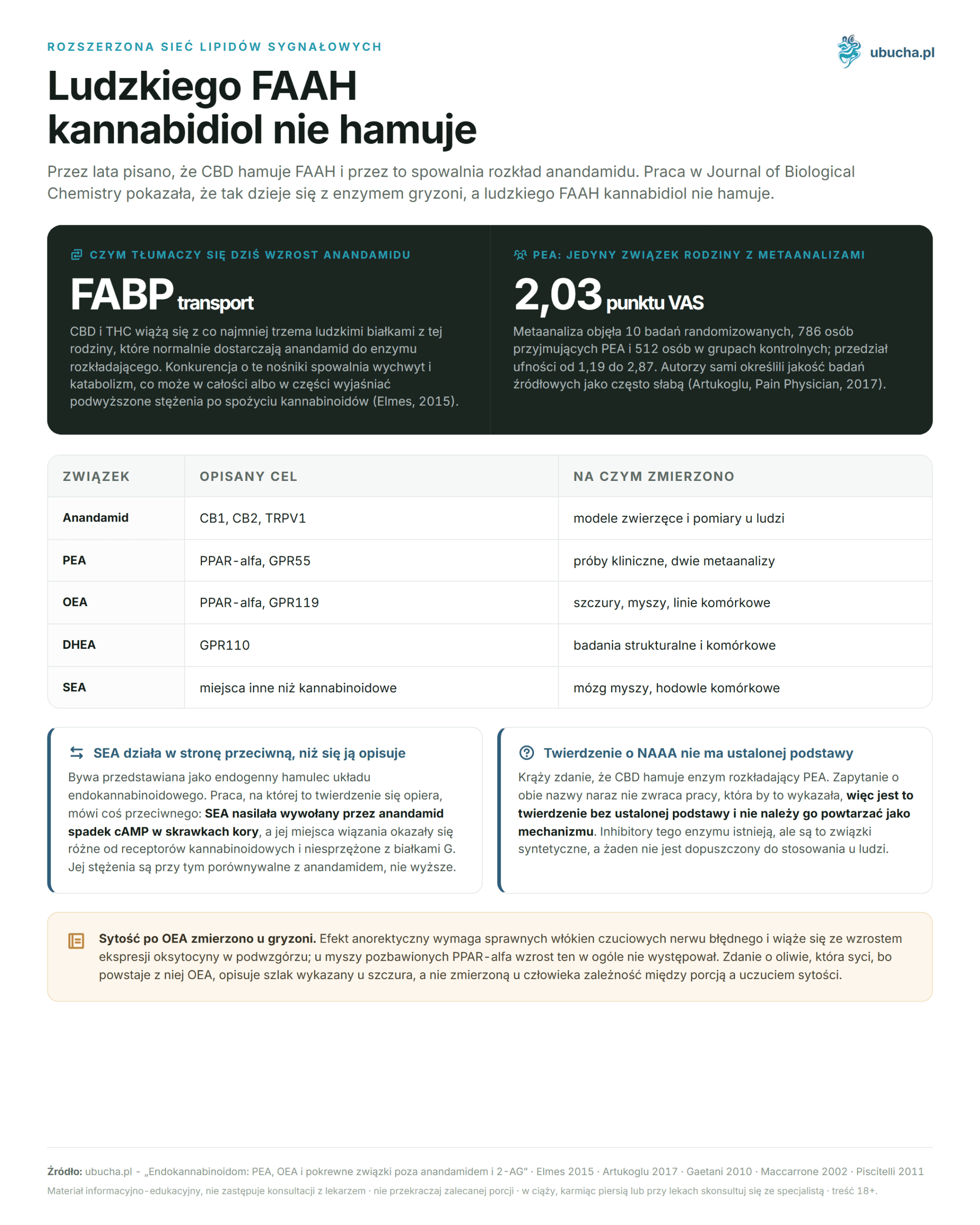
• CBD does not inhibit the human FAAH enzyme, only its counterpart in rodents; the increase in anandamide in humans is now explained by competition for FABP transport proteins (Elmes, J Biol Chem, 2015).
What are N-acylethanolamines and where do they come from?
N-acylethanolamines (NAE) are lipids composed of an ethanolamine moiety linked to a fatty acid. The fatty acid that sits in the molecule determines its action. Anandamide has an arachidonic moiety and therefore binds to CB1 and CB2 receptors; PEA has a palmitic moiety, OEA an oleic one, and SEA a stearic one, and none of these three has significant affinity for cannabinoid receptors.
They are not stored. They are produced from membrane phospholipids when the cell needs them, that is, under stress, inflammation, or neuronal stimulation. The synthesis pathway leads through N-acyl-phosphatidylethanolamine, which is cleaved by phospholipase D to free NAE. The same on-demand production mechanism applies to anandamide, described separately in the entry about the endocannabinoid responsible for the feeling of bliss.
Degradation is handled by two enzymes: FAAH, common to the entire family, and NAAA, which preferentially degrades PEA and OEA in macrophages. A common enzyme means a common fate: a molecule that occupies FAAH slows the degradation of the others. This is where part of the described interactions between these lipids comes from, referred to as the entourage effect, in the original sense assigned to this term in a paper on glycerol esters enhancing the activity of 2-AG (Ben-Shabat, Eur J Pharmacol, 1998).
Who introduced the concept of endocannabinoidome?
The name comes from the team of Vincenzo Di Marzo in Naples, not from Raphael Mechoulam, to whom it is sometimes attributed. The earliest work with this word in the title is a 2011 study on the effect of krill oil on the lipid signaling profile in the tissues of mice fed a high-fat diet; Di Marzo is listed as the last author (Piscitelli, Nutrition and Metabolism, 2011).
It is worth clarifying this detail, as attributing the term to Mechoulam circulates in popular science texts along with the date “around 2012.” Mechoulam has other, earlier contributions in this field: his team isolated anandamide from the pig brain in 1992, and three years later 2-AG from the dog intestine. The second of these compounds is described in the entry about the most abundant endocannabinoid.
What does the concept practically encompass? Besides anandamide and 2-AG, it also includes the family of NAE, nuclear receptors from the PPAR group, channels from the TRP family, and membrane receptors that for years remained without a known ligand, including GPR55 and GPR119. A receptor review dedicated to OEA and PEA lists these targets together and notes that the affinity for individual proteins is often poorly measured or not measured at all (Im, Int J Mol Sci, 2021).
What is known about PEA from human studies?
PEA is the only member of this family for which there are meta-analyses of clinical trials. They favor the compound, but with reservations that supplement descriptions remain silent about. A 2017 meta-analysis included 10 randomized studies, 786 people taking PEA and 512 people in control groups, and the difference in the VAS pain scale was 2.03 points with a confidence interval from 1.19 to 2.87. The authors themselves rated the quality of the source studies as often poor.
| Compound | Fatty acid | Described target | Measured action |
|---|---|---|---|
| Anandamide (AEA) | arachidonic | CB1, CB2, TRPV1 | binding in synaptosomal membranes, animal models, plasma measurements in humans |
| PEA | palmitic | PPAR-alpha, GPR55 | clinical trials in chronic pain, two meta-analyses |
| OEA | oleic | PPAR-alpha, GPR119 | rats and mice, intestinal cell lines |
| DHEA (synaptamide) | docosahexaenoic | GPR110 (ADGRF1) | structural and cellular studies |
| SEA | stearic | binding sites other than cannabinoid receptors | mouse brain, cell cultures |
An older meta-analysis from 2016 summed up twelve studies, but only three of them had a double-blind and placebo-controlled design, and seven had no reference group at all. It was co-authored by employees of the micronized PEA producer. Separately, we write about the PPAR-alpha mechanism and mast cells in the entry about the endogenous relative of CBD.
How does OEA suppress appetite and what was it measured on?
OEA is produced in the enterocytes of the small intestine during fat absorption and suppresses food intake by engaging the nuclear receptor PPAR-alpha. The further course of the signal has been described in an animal model: the anorectic effect of systemically administered OEA requires intact sensory fibers of the vagus nerve, and in the brain, it is associated with an increase in oxytocin expression in the paraventricular and supraoptic nuclei of the hypothalamus. Blocking oxytocin receptors in the brain abolished the action of OEA, and in mice lacking PPAR-alpha, the increase in expression did not occur at all (Gaetani, J Neurosci, 2010).
The second branch of the mechanism leads through the GPR119 receptor on L cells of the intestine and through the release of the incretin GLP-1. This has been demonstrated in mouse, human, and rat cell lines as well as in anesthetized rats: OEA administered directly to the ileum raised the levels of active GLP-1 in normoglycemic animals by one and a half times, and insulin levels by almost four times, with the latter effect occurring only under hyperglycemia. Intravenous administration had no effect at all (Lauffer, Diabetes, 2009).
These are measurements on rodents and in cultures, not in humans, and the difference is practically significant. The statement “olive oil satiates because it produces OEA” describes a pathway demonstrated in rats, not a measured relationship between a portion of oil and the feeling of satiety in humans. The direction is credible, but the magnitude of the effect in humans remains unknown.
Does CBD raise levels of PEA and OEA?
The observation of increased endocannabinoids after CBD is real, but the explanation that circulates in cannabis texts is outdated. For years, it has been written that CBD inhibits FAAH and thus slows the breakdown of anandamide and related NAE. A paper in the Journal of Biological Chemistry showed that this happens with the rodent enzyme, while human FAAH is not inhibited by CBD, so the inhibition of this enzyme cannot explain the increase in anandamide observed in humans (Elmes, J Biol Chem, 2015).
The mechanism proposed instead concerns intracellular transport. CBD and THC bind to at least three human proteins from the FABP family, which normally deliver anandamide to the degrading enzyme. Competition for these carriers slows the uptake and catabolism of anandamide, which may fully or partially explain the elevated levels observed after cannabinoid consumption. The measurement concerned anandamide; this work did not measure the effect of CBD on the levels of PEA and OEA themselves in humans.
Separately, there is a claim that CBD inhibits NAAA, the enzyme that degrades PEA. A query for both names at once does not return a paper in Europe PMC that would demonstrate this, so it is a claim without established basis and should not be repeated as a mechanism. NAAA inhibitors exist, but they are synthetic compounds, as discussed below.
What is known about DHEA and SEA?
DHEA, also known as synaptamide, is a derivative of docosahexaenoic acid from the omega-3 family. Its described target is the adhesive receptor GPR110, also known as ADGRF1; structural studies have shown which fragment of the receptor the molecule binds to and how it activates it (Huang, Communications Biology, 2020). The data come from cell systems, so translating them into the effects of omega-3 supplementation in humans is premature.
SEA is sometimes described as an endogenous brake on the endocannabinoid system, which would reduce the affinity of anandamide for CB1. The paper on which this claim is based states the opposite. In the brains of mice, SEA occurs in amounts comparable to anandamide, has its own binding sites, but these are different from cannabinoid receptors and are not coupled to G proteins. SEA, however, enhanced the anandamide-induced decrease in cAMP in slices of the cortex, which the authors interpret as an entourage effect, that is, enhancing rather than inhibiting (Maccarrone, Mol Cell Neurosci, 2002).
The practical conclusion from the entire family is one: degrading enzymes are now a more interesting target than the lipids themselves. An NAAA inhibitor called ARN077 abolished thermal and mechanical hypersensitivity in mice and rats after topical application, and the effect disappeared after blocking PPAR-alpha and did not occur in animals lacking this receptor (Sasso, Pain, 2013). No such compound is approved for use in humans.
Frequently Asked Questions
What is endocannabinoidome?
It is an extended network of signaling lipids encompassing, besides anandamide and 2-AG, the entire family of N-acylethanolamines, nuclear receptors from the PPAR group, TRP channels, and membrane receptors GPR55 and GPR119. The term comes from the team of Vincenzo Di Marzo and appeared in the title of a paper in 2011.
Does PEA have clinical evidence?
Yes, as the only compound from this family. A meta-analysis of 10 randomized trials involving 786 people on PEA and 512 people in control groups showed a difference of 2.03 points on the VAS scale, with a confidence interval from 1.19 to 2.87 (Artukoglu, Pain Physician, 2017).
Does OEA suppress appetite in humans?
This has not been measured. The satiety pathway has been described in rats and mice as well as in intestinal cell lines: OEA acts through PPAR-alpha, requires an intact vagus nerve, and is associated with an increase in oxytocin in the hypothalamus. The magnitude of the effect in humans remains unknown.
Does CBD inhibit the FAAH enzyme?
Not in humans. CBD inhibits FAAH in rodents, but not in humans, so the increase in anandamide observed in humans after CBD is explained differently today: by competition for intracellular transport proteins from the FABP family (Elmes, J Biol Chem, 2015).
Does SEA dampen the action of anandamide?
Data indicate the opposite direction. In the brains of mice, SEA enhanced the anandamide-induced decrease in cAMP, and its binding sites turned out to be different from cannabinoid receptors and uncoupled from G proteins. SEA concentrations are comparable to anandamide, not higher.
This article is for informational and educational purposes only and does not constitute medical advice. Before starting supplementation, consult your doctor, especially if you are taking medications regularly, are pregnant or breastfeeding, or have chronic illnesses.
Author: Michał Waluk · Published: 2026-08-09 · Updated: 2026-08-16