
CBD and Trigeminal Neuralgia: Does it Alleviate Pain (FAQ)
Trigeminal neuralgia has first-line treatment with confirmed effectiveness. We check how many studies on CBD exist for this disease and what the risks are.
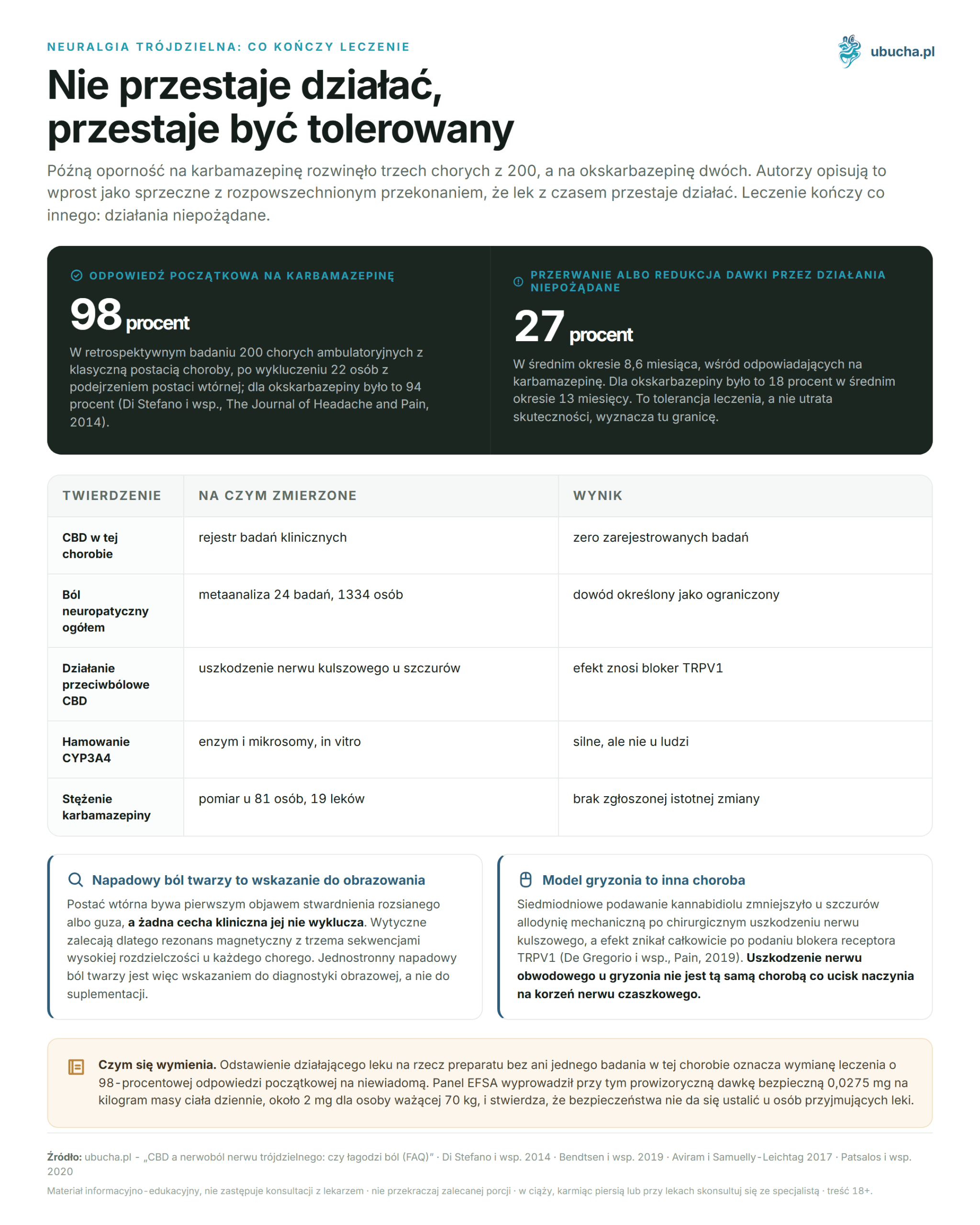
Trigeminal neuralgia is a paroxysmal, unilateral facial pain that patients describe as an electric shock. A query about cannabidiol and this condition in the ClinicalTrials.gov clinical trial registry returns zero registered studies (as of August 16, 2026). This is the first thing to tell someone looking for information about the oil: there is no study we can refer to. There is, however, first-line treatment with documented effectiveness and a drug interaction that is better to know about sooner rather than later. Delaying diagnosis in this disease can be costly, as paroxysmal facial pain can be the first symptom of multiple sclerosis or a tumor. Below we show what has been measured, on whom it has been measured, and where the limits of what can be said about this substance lie.
KEY INFORMATION
• A query about cannabidiol and trigeminal neuralgia in the ClinicalTrials.gov registry returns zero registered studies (as of August 16, 2026).
• Carbamazepine and oxcarbazepine are first-line drugs according to the guidelines of the European Academy of Neurology (Bendtsen et al., European Journal of Neurology, 2019).
• In a cohort of 200 patients, an initial response was achieved by 98 percent of those treated with carbamazepine (Di Stefano et al., 2014).
• Strong inhibition of CYP3A4 has been shown in vitro, and in six studies involving humans, cannabidiol did not change the activity of this enzyme (Patsalos et al., 2020).
• The provisional safe dose according to EFSA is 0.0275 mg per kilogram of body weight per day, or about 2 mg for a person weighing 70 kg.
What is trigeminal neuralgia and how common is it?
It is a paroxysmal pain in the area innervated by the trigeminal nerve, usually on one side of the face, lasting from seconds to two minutes and triggered by touch, tooth brushing, or a gust of cold air. In the classic course, pain completely subsides between attacks. An epidemiological study from Rochester, Minnesota, covering the years 1945-1984, reported a crude incidence rate of 4.3 per 100,000 people per year, with 5.9 in women and 3.4 in men after age standardization (Katusic et al., Annals of Neurology, 1990).
The current classification divides the disease into three forms: classic, caused by vascular compression of the nerve root with visible morphological changes; secondary, caused by another neurological disease; and idiopathic with an unknown cause (Cruccu et al., Neurology, 2016). The secondary form can be the first symptom of multiple sclerosis or a tumor, and no clinical feature excludes it. Guidelines therefore recommend performing magnetic resonance imaging with three high-resolution sequences in every patient. Unilateral paroxysmal facial pain is thus an indication for imaging diagnostics, not for supplementation.
How many studies on cannabidiol in trigeminal neuralgia actually exist?
Zero registered. We checked this in the ClinicalTrials.gov clinical trial registry on August 16, 2026: a query linking cannabidiol to trigeminal neuralgia returns an empty list. For neuropathic pain itself, the registry shows 28 entries, but they concern diabetic neuropathy, carpal tunnel syndrome, central pain in multiple sclerosis, and pain in HIV infection. Trigeminal neuralgia is not among them.
All available evidence therefore pertains to neuropathic pain as a broader category and is weaker than it is usually presented. A systematic review with meta-analysis included 43 randomized studies and 2437 patients, of which 24 studies and 1334 patients entered the meta-analysis itself. The authors defined the evidence as limited, and the effect size for chronic pain was -0.61 with a confidence interval from -0.78 to -0.43. They note that most included studies did not show an effect, and the clinical significance of the result remains uncertain (Aviram and Samuelly-Leichtag, Pain Physician, 2017). This work pertains to cannabis-based drugs, most of which also contain THC, not just cannabidiol. We discuss this group of evidence more broadly in our post about treating neuropathic pain with cannabis.
On what was the analgesic effect of cannabidiol measured?
On rats. This distinction determines how strongly one can formulate a conclusion, so we state it directly. The best-described experiment used a model of sciatic nerve injury in rats maintained for 24 days. Seven days of cannabidiol administration reduced mechanical allodynia, lowered anxiety behaviors, and restored normal serotonergic neuron activity in the dorsal raphe nucleus.
More important than the result itself is how the authors established the mechanism. The analgesic effect was completely abolished by the administration of capsazepine, a TRPV1 receptor blocker, and only partially by the administration of a 5-HT1A receptor antagonist. The anxiolytic effect behaved conversely: it was abolished only by the 5-HT1A antagonist. The authors conclude that the analgesic action of cannabidiol in this model mainly runs through TRPV1, while the anxiolytic action runs through 5-HT1A (De Gregorio et al., Pain, 2019). None of these measurements have been repeated in humans with trigeminal neuralgia, and the model of surgical peripheral nerve injury in rodents is not the same disease as vascular compression of the cranial nerve root. We discuss why the type of pain alters the response to cannabinoids separately in our comparison of nociceptive and neuropathic pain.
How effective is first-line treatment in this disease?
Effective in the vast majority of patients, at least initially. The guidelines of the European Academy of Neurology recommend carbamazepine or oxcarbazepine as first-line drugs for long-term treatment, and in cases of insufficient pain control or poor treatment tolerance, they recommend proposing surgery to the patient, with microvascular decompression being the first surgical choice in the classic form (Bendtsen et al., European Journal of Neurology, 2019).
A retrospective study of 200 outpatients with the classic form of the disease, after excluding 22 individuals suspected of having the secondary form, provides hard numbers. An initial response was achieved by 98 percent of those treated with carbamazepine and 94 percent of those treated with oxcarbazepine. Late resistance developed in only three patients on carbamazepine and two on oxcarbazepine, which the authors describe as directly contradicting the widespread belief that the drug stops working over time. The real problem turned out to be tolerance: in an average period of 8.6 months, 27 percent of those responding to carbamazepine experienced adverse effects that forced them to discontinue treatment or reduce the dose below the effective level, while for oxcarbazepine it was 18 percent in an average period of 13 months (Di Stefano et al., The Journal of Headache and Pain, 2014). Discontinuing an effective drug in favor of a product with no studies in this disease means exchanging treatment with a 98 percent initial response for an unknown.
Does cannabidiol interact with medications used in this disease?
The answer depends on whether one is asking about in vitro or in humans, and these two findings are often confused in texts about cannabis. In vitro, cannabidiol competitively inhibits human CYP3 enzymes: on recombinant CYP3A4, the half-maximal inhibitory concentration was 11.7 micromolar, and on CYP3A5, it was 1.65 micromolar (Yamaori et al., Life Sciences, 2011). This is a measurement on the enzyme and on human liver microsomes, not on patients.
In humans, the picture is different. A review of six interaction studies involving healthy volunteers and patients with epilepsy found that cannabidiol did not change the activity of CYP3A4, and induction of this enzyme only led to a slight reduction in exposure to cannabidiol. The only interaction deemed potentially clinically significant was the combination with clobazam (Patsalos et al., Epilepsia, 2020). In an open-label safety study involving 39 adults and 42 children, concentrations of 19 antiepileptic drugs were measured with increasing doses of cannabidiol; significant changes were reported for clobazam, N-desmethylclobazam, topiramate, and rufinamide, and in adults additionally for zonisamide and eslicarbazepine (Gaston et al., Epilepsia, 2017). Carbamazepine and lamotrigine were not among the drugs for which this study reported significant changes in concentration.
| Claim | Measured on | Source |
|---|---|---|
| Cannabidiol strongly inhibits CYP3A4 and CYP3A5 | Recombinant enzyme and human liver microsomes, in vitro | Yamaori 2011 |
| Cannabidiol does not change CYP3A4 activity | Six studies involving humans | Patsalos 2020 |
| CYP3A4 inducer reduces exposure to cannabidiol | Studies involving humans, effect deemed small | Patsalos 2020 |
| Change in carbamazepine concentration under the influence of cannabidiol | Not reported among significant changes in 81 individuals | Gaston 2017 |
What can cannabidiol realistically offer a person with trigeminal neuralgia?
As of now, it is not a treatment for this disease, and there is no study that would allow us to write otherwise. A conversation with the treating neurologist makes sense, as the doctor knows the set of medications being taken and the tolerance of the current treatment. Tell them everything you are taking outside of prescriptions.
The safety ceiling is worth knowing regardless of the indication. The EFSA panel derived a provisional safe dose of 0.0275 mg per kilogram of body weight per day, or about 2 mg for a person weighing 70 kg, with an uncertainty factor of 400. This value applies only to supplements with a purity of cannabidiol of at least 98 percent and without nanoparticles. The panel also states that safety cannot be established in individuals under 25 years of age, in pregnant and breastfeeding women, and in individuals taking medications, and studies involving humans indicate a potential for liver damage, especially when used concurrently with other medications (EFSA, EFSA Journal, 2026). A person being treated for trigeminal neuralgia belongs to the last of these groups. This is not a dosing recommendation, but a boundary above which the risk assessment body does not confirm safety. A similar discrepancy between mechanism and clinical evidence is described in our article on cannabidiol and migraine.
Frequently Asked Questions
Is there a clinical study of cannabidiol in trigeminal neuralgia?
No. A query linking cannabidiol to trigeminal neuralgia in the ClinicalTrials.gov clinical trial registry returned zero results as of August 16, 2026. All claims about the action of this substance in this disease are therefore a transfer from other neuropathic pain diagnoses or from animal models.
Can cannabidiol replace carbamazepine?
No. The guidelines of the European Academy of Neurology indicate carbamazepine and oxcarbazepine as first-line drugs, and in a cohort of 200 patients, an initial response was achieved by 98 percent of those treated with carbamazepine (Di Stefano et al., 2014). Discontinuing an antiepileptic drug on your own is dangerous.
Does cannabidiol increase the concentration of carbamazepine in the blood?
This has not been demonstrated in humans. In a study involving 81 people and 19 antiepileptic drugs, carbamazepine was not among the drugs for which a significant change in concentration was reported (Gaston et al., Epilepsia, 2017). Strong inhibition of CYP3A4 by cannabidiol has only been described in vitro.
On what animals was the analgesic effect of cannabidiol tested?
The best-described model is surgical injury to the sciatic nerve in rats. Seven days of cannabidiol administration reduced mechanical allodynia, and the effect was abolished by the TRPV1 receptor blocker (De Gregorio et al., Pain, 2019). Peripheral nerve injury in rodents is not the same disease as trigeminal neuralgia in humans.
In which neuropathic pain is the evidence strongest?
In pain studied in randomized trials with cannabis-based drugs, mainly in diabetic neuropathy and central pain in multiple sclerosis. A meta-analysis of 24 studies and 1334 patients defines this evidence as limited and notes that most included trials did not show an effect (Aviram and Samuelly-Leichtag, 2017).
What is the safety ceiling for cannabidiol in supplements?
The EFSA panel derived a provisional safe dose of 0.0275 mg per kilogram of body weight per day, about 2 mg for a person weighing 70 kg. Safety cannot be established in individuals taking medications, pregnant, breastfeeding, and under 25 years of age (EFSA, 2026).
This article is for informational and educational purposes only and does not constitute medical advice. Before starting to use cannabis or CBD for therapeutic purposes, consult your doctor, especially if you are taking other medications, are pregnant, or breastfeeding.
Author: Michał Waluk · Published: 2026-08-09 · Updated: 2026-08-16