
Passiflora (passionflower) for sleep and anxiety: how to use (FAQ)
Passiflora for sleep and anxiety without promises. What the HMPC monograph allows, what the study of passionflower tea showed, and why chrysin ended up here by mistake.
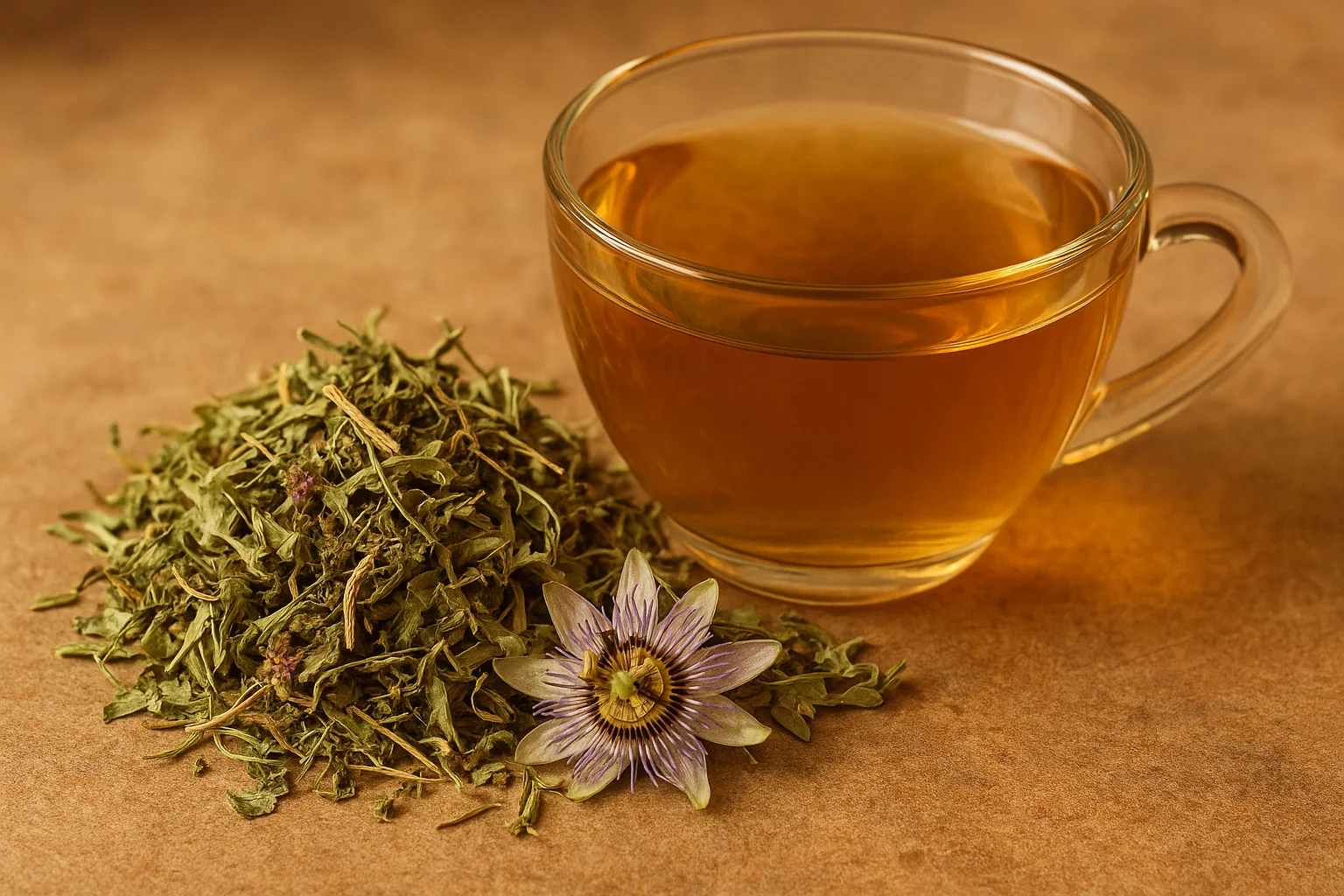
Passiflora incarnata, known in Polish as męczennica cielista, has the status of a traditional herbal product in the European Union. This means precisely that the Committee on Herbal Medicinal Products has recognized a sufficiently long history of use, not that efficacy has been demonstrated in studies. The difference is greater than it appears, and this is where this text begins. Below you will find what the monograph says about passionflower as read from the source, as well as what was actually measured in the only clinical study of tea from this herb. You will also see which statements from the previous version of this entry failed to find support in any document and why they disappeared along with their references. The order is simple: first the regulatory document, then the studies.
KEY INFORMATION
• The HMPC monograph recognizes only traditional use for passionflower, and the column for documented use is empty (EMA/HMPC/669740/2013).
• The indication states: mild symptoms of psychological tension and support for sleep. Anxiety as a separate indication is not mentioned in the monograph.
• The monograph recommends contacting a doctor if symptoms persist for more than two weeks and advises against use in children under 12 years and during pregnancy and breastfeeding.
• In the section on interactions, the monograph states: no reported interactions. It warns, however, that the product may impair the ability to drive.
• The only study of passionflower tea involved 41 individuals and yielded a significant result for one of the six measured sleep characteristics.
What does the EMA monograph say about passionflower, and what is missing from it?
The HMPC monograph for passionflower herb bears the signature EMA/HMPC/669740/2013 and dates from March 25, 2014. Each entry has two columns: documented use and traditional use. For passionflower, the first column is empty in every point, so registration is based solely on long-term use, not on proven efficacy.
The indication is recorded in one sentence: traditional herbal medicinal product for alleviating mild symptoms of psychological tension and for supporting sleep. Anxiety disorders are not on this list, although the title of this article suggests them. The duration of use is limited: if symptoms persist for more than two weeks, the monograph instructs to consult a doctor or pharmacist. A previous version of this entry mentioned two to four weeks, which doubled the source record.
The age group includes adolescents and adults, including the elderly. The monograph does not recommend use in children under 12 due to a lack of data, and this wording is stronger than a referral to a doctor. The same wording applies to pregnancy and breastfeeding: safety has not been established, so use is not recommended. No studies on reproductive toxicity, genotoxicity, or carcinogenicity have been conducted. The section on interactions with medications contains two words: no reported. The section on adverse effects: unknown. A separate note warns that the product may impair the ability to drive.
Which ingredient is responsible for the effect and where did chrysin come from?
So far, this article has based the mechanism on chrysin. Checking the source yields a clear result: in the EMA assessment report for passionflower herb, which is over sixty thousand characters long, the word chrysin does not appear even once. The European Pharmacopoeia requires a minimum of 1.5 percent total flavonoids calculated as vitexin for this raw material, and the report lists the main components as C-glycosides of apigenin and luteolin: isovitexin, isoorientin, schaftoside, isoschaftoside, vicenin-2, and swertisin. Chrysin is a marker of another species of this genus, not of passionflower. The substitution of species while retaining the generic name is invisible to technical control.
With the GABA system, the situation is similar, only more subtly. A previous version attributed the modulation of GABA-A receptors to the 2014 monograph. The monograph does not contain pharmacodynamics at all: point 5.1 refers to Directive 2001/83/EC and states that a description is not required. Data on GABA lie in the assessment report and come from cell models: a dry extract 5-7:1 showed affinity for GABA-A and GABA-B receptors and inhibited GABA reuptake at concentrations in the hundreds of micrograms per milliliter. This is a measurement in vitro, not an effect in humans.
The previous paragraph on alkaloids mentioned harmine and harmaline, which the assessment report does not recognize at all. It mentions harman, harmol, and harmalol, and immediately adds that they are undetectable in most commercial raw materials.
What did the study of passionflower tea really show?
The study by Ngan and Conduit from 2011 is the only clinical study of passionflower tea that has been found, and after correction, it carries the strongest statement of this text. It involved 41 individuals aged 18-35, healthy, with mild fluctuations in sleep quality, not insomnia. The design was double-blind, with placebo and alternating order of both teas, separated by a one-week break. Each period lasted seven days.
Of the six sleep measures analyzed in the diary, one showed a significantly better result for passionflower: subjective sleep quality. The authors write about short-term subjective benefit in healthy adults and about a low dose. Polysomnography was performed on ten participants to validate the diaries. The statement about the polysomnography result was removed: the work is paid, and the summary of this value is not provided.
| Study | Who and how many | Preparation and time | What came out |
|---|---|---|---|
| Ngan and Conduit 2011, Phytotherapy Research | 41 healthy individuals aged 18-35, with 10 additionally undergoing polysomnography | Passionflower herb tea vs placebo, 7 days each, alternating design | Of six measures from the diary, one significant: subjective sleep quality |
| Akhondzadeh et al. 2001, Journal of Clinical Pharmacy and Therapeutics | 36 patients with generalized anxiety disorder, no placebo arm | Passionflower extract vs oxazepam, 4 weeks | Hamilton anxiety scale result the same in both groups; oxazepam acted faster but more often worsened work performance |
Does passionflower match oxazepam in treating anxiety?
The comparison with oxazepam circulated in this article as a conclusion from a meta-analysis supposedly published in Phytomedicine in 2013. Such a meta-analysis could not be found, and the identifier associated with it leads to a paper on video materials for patients after dermatological procedures. The content comes from one study: Akhondzadeh et al. 2001, Journal of Clinical Pharmacy and Therapeutics.
This study exists, but it has a different rank than it was attributed. The authors call it a pilot study. It involved 36 outpatients with generalized anxiety disorder, with eighteen individuals in each group, over four weeks. There was no placebo arm: the extract was directly compared with oxazepam. The result on the Hamilton anxiety scale turned out to be the same in both groups, oxazepam acted faster, but at the same time was more often associated with worsened work performance.
The overall rank is set by the systematic review summarized in the EMA assessment report: two studies involving 198 participants were included in the Cochrane review on passionflower for anxiety, and the author stated that there were too few to draw any conclusions. This is a fair summary of the state of knowledge, narrower than the statement about promising results that was here earlier. If you are considering combining herbs with prescription medications, a guide to herb-drug interactions will be helpful.
Do mixtures with valerian and hops have stronger evidence?
Here, the previous version of the article made a mistake that is repeated throughout popular literature. The statement about the mixture of valerian, hops, and passionflower was supported by a work by Donath from 2000, described as an article in Pharmacology Biochemistry and Behavior. The number given with this description leads to a paper on interferon in HPV infection. The work by Donath exists, was published in Pharmacopsychiatry in 2000, and studies the extract of valerian alone in sixteen patients. After a single dose, there was no effect, sleep efficiency improved after two weeks also after placebo, and the difference compared to placebo concerned slow-wave sleep, not falling asleep.
The opposite of this mistake is equally common. The EMA assessment report for hop cones states directly that no clinical study of hops alone in anxiety or insomnia has been conducted to date. There are at least seven controlled studies with placebo or comparative drug for the established combination of valerian and hops. It is therefore not the mixtures that are less well-studied than individual herbs, but the other way around. A caveat remains in force: the results of trials on combined preparations do not transfer to individual raw materials and primarily serve to assess safety. More about the composition of such preparations can be found in the entry about herbal blends for sleep.
When is herb not enough and why go to the doctor?
The monograph closes this issue with a term of two weeks, and that is the limit at which it is worth stopping experimentation. Insomnia lasting more than three months, sleep disturbed by a somatic disease, or sleep problems accompanying depression are situations where herbs are not the right tool. Insomnia can be a symptom, not a disease, so seeking a stronger raw material usually delays diagnosis rather than helping. It is worth remembering this, as the two-week term from the monograph is shorter than the duration of most self-experiments.
European guidelines on insomnia, updated in 2023 in the Journal of Sleep Research, indicate cognitive-behavioral therapy as the first-line treatment for chronic insomnia in adults of all ages, with the highest level of recommendation. The same guidelines, with the same level, do not recommend herbal preparations for the treatment of insomnia. This statement in the article about the herb must be placed at the forefront. Passionflower may be an addition for transitional difficulties, but it is not a treatment for insomnia. Also, remember point 4.7 of the monograph: the product may impair the ability to drive. Other over-the-counter approaches are described in the entry about natural ways to sleep without pills.
Frequently asked questions
Does passiflora really help with sleep?
The only clinical study of passionflower tea involved 41 healthy individuals and lasted a week. Of the six sleep measures from the diary, one showed a significantly better result: subjective sleep quality. The HMPC monograph allows for the indication of sleep support based on long-term use, not proven efficacy.
Does the EMA monograph mention anxiety among the indications?
No. The indication states: alleviation of mild symptoms of psychological tension and support for sleep. The Cochrane review on passionflower for anxiety, summarized in the EMA assessment report, included two studies with 198 participants, and the author concluded that no conclusions could be drawn.
Does passiflora interact with medications?
Point 4.5 of the monograph states: no reported interactions. This does not mean there are none, only that none have been reported or studied. A previous version of this entry mentioned warfarin and sleeping pills without a source, and those sentences were removed.
Can passiflora be used during pregnancy and in children?
The monograph advises against both. Safety during pregnancy and breastfeeding has not been established, so use is not recommended. For children under 12, the wording is the same and stems from a lack of data, not proven harm.
Is passiflora addictive?
The monograph does not address this topic: adverse effects are described as unknown, and no cases of overdose have been reported. The comparison with benzodiazepines, which was mentioned earlier, had no basis in any document and was removed.
What is the difference between an infusion and an extract in capsules?
The monograph lists both forms separately because the flavonoid content in the infusion depends on the raw material and preparation method, while the extract is standardized to vitexin. The study by Ngan and Conduit was conducted on tea, so it directly refers to the infusion.
The store at Bucha does not have passionflower in any form. In the herbs category, however, valerian and hop cones are available (catalog status as of August 8, 2026).
This article is for informational and educational purposes and does not constitute medical advice. Before starting supplementation, consult a doctor, especially if you are taking medications regularly, are pregnant or breastfeeding, or have a chronic illness.
Author: Michał Waluk · Published: 2026-08-09 · Updated: 2026-08-16