
Herbal Blends for Sleep: What Makes a Good Herbal Blend and How to Use It
Which herbal combinations for sleep have clinical studies behind them, in what form to use them, and when herbs are not enough. A guide based on sources.
Store-bought sleep blends combine several herbs at once, and the descriptions on the packaging promise that the ingredients enhance each other. This sounds reasonable, as insomnia rarely has a single cause: it can involve anxiety, muscle tension, a disrupted circadian rhythm, or simply a bad evening habit. The question, however, is whether anyone has verified this, and the answer is more interesting than the slogan about synergy. There is a study in which a blend performed better than placebo, while its single ingredient in the same amount did not. This article shows which combinations have clinical trials behind them, how to read their results without exaggeration, and when herbs stop being sufficient.
KEY INFORMATION
• In the study by Koetter et al. (Phytotherapy Research, 2007), a fixed blend of valerian with hops significantly shortened the time to fall asleep compared to placebo, while valerian alone did not.
• The results pertain to specific standardized extracts, not any tea made from these herbs.
• Look for effects after weeks, not days.
• Consult a doctor about the composition if using sedatives and with thyroid diseases.
Does a blend of herbs work better than a single herb?
There is direct evidence for one combination, but not for the others. The study by Koetter et al. (Phytotherapy Research, 2007) was designed specifically to resolve this question and compared the blend not only with placebo but also with its own main ingredient.
Participants were patients with non-organic insomnia, whose time to fall asleep before the study was at least half an hour. For four weeks, they received placebo, the valerian extract alone, or a fixed blend of valerian with hops, in which the amount of valerian was exactly the same as in the single herb arm. Sleep was measured with a recording device in the patient’s home, not just through a questionnaire. The blend significantly shortened the time to fall asleep compared to placebo, while valerian alone did not achieve this advantage. The addition of hops made a difference.
The second study of the same blend, by Morin et al. (Sleep, 2005), involved 184 adults with mild insomnia in nine sleep medicine centers and yielded more modest results. Improvement in subjective sleep parameters occurred with both the blend and diphenhydramine, but few comparisons with placebo achieved statistical significance, and polysomnography did not show differences. After 28 days, the group with the blend had significantly better results in the quality of life scale. The authors summarize the effect as moderate.
Both trials concern the same specific preparation with a fixed composition, and one of the researchers is a co-author of both papers. This does not invalidate the results, but it means that these are not two independent confirmations, but two perspectives from a partially shared background. It is worth remembering this when reading claims about the valerian and hops blend as the best-studied.
From the comparison of both studies, a cautious conclusion emerges. The valerian and hops blend works, but weakly, and its advantage over a single herb is real yet small. This is not a basis for the claim that every combination of herbs beats any single herb.
Which herbal combinations have studies behind them?
Very few. The table below collects studies in which herbs used in sleep blends were tested in humans against placebo. Pay attention to the column with what was measured: some studies concern mood rather than sleep, and transferring their results to sleep onset would be an abuse.
| Study | Who and for how long | What was measured | Result |
|---|---|---|---|
| Koetter 2007, valerian with hops | patients with insomnia, 4 weeks | time to fall asleep, home recording | blend better than placebo, valerian alone not |
| Morin 2005, valerian with hops | 184 adults, 28 days | diary and polysomnography | moderate effect, no differences in sleep recording |
| Langade 2019, ashwagandha | 60 patients, 10 weeks | actigraphy, PSQI, anxiety scale | shorter sleep onset and better sleep quality |
| Kyrou 2017, hops alone | 36 young adults, 4 weeks | mood scale, morning cortisol | improved mood, cortisol unchanged |
Langade et al. (Cureus, 2019) administered a root extract of ashwagandha at a dose of 300 mg twice daily or placebo to 60 patients with insomnia for ten weeks. The time to fall asleep after this period averaged 29 minutes compared to 33.9 minutes in the placebo group, with statistical significance. Sleep efficiency and perceived quality also improved. The study was conducted at a single center and on a small group, so treat it as an indication, not a definitive conclusion.
It is also worth noting hops. Kyrou et al. (Hormones, 2017) administered it to 36 young adults in an alternating design with placebo and noted improvements in mood, anxiety, and tension. Sleep parameters were not assessed in this study: body mass and composition, mood scale, and morning cortisol, which did not change, were measured. This is an important distinction, as hops are often advertised with results that pertain to daytime well-being. More about hops can be found in our post about hops cones for sleep and anxiety.
In what form should you use an herbal blend for sleep?
All studies in the table above tested standardized extracts in capsules or tablets, not infusions. This is the first thing that must be stated honestly: the results describe a specific preparation with known active substance content, not a spoonful of dried herbs poured with boiling water.
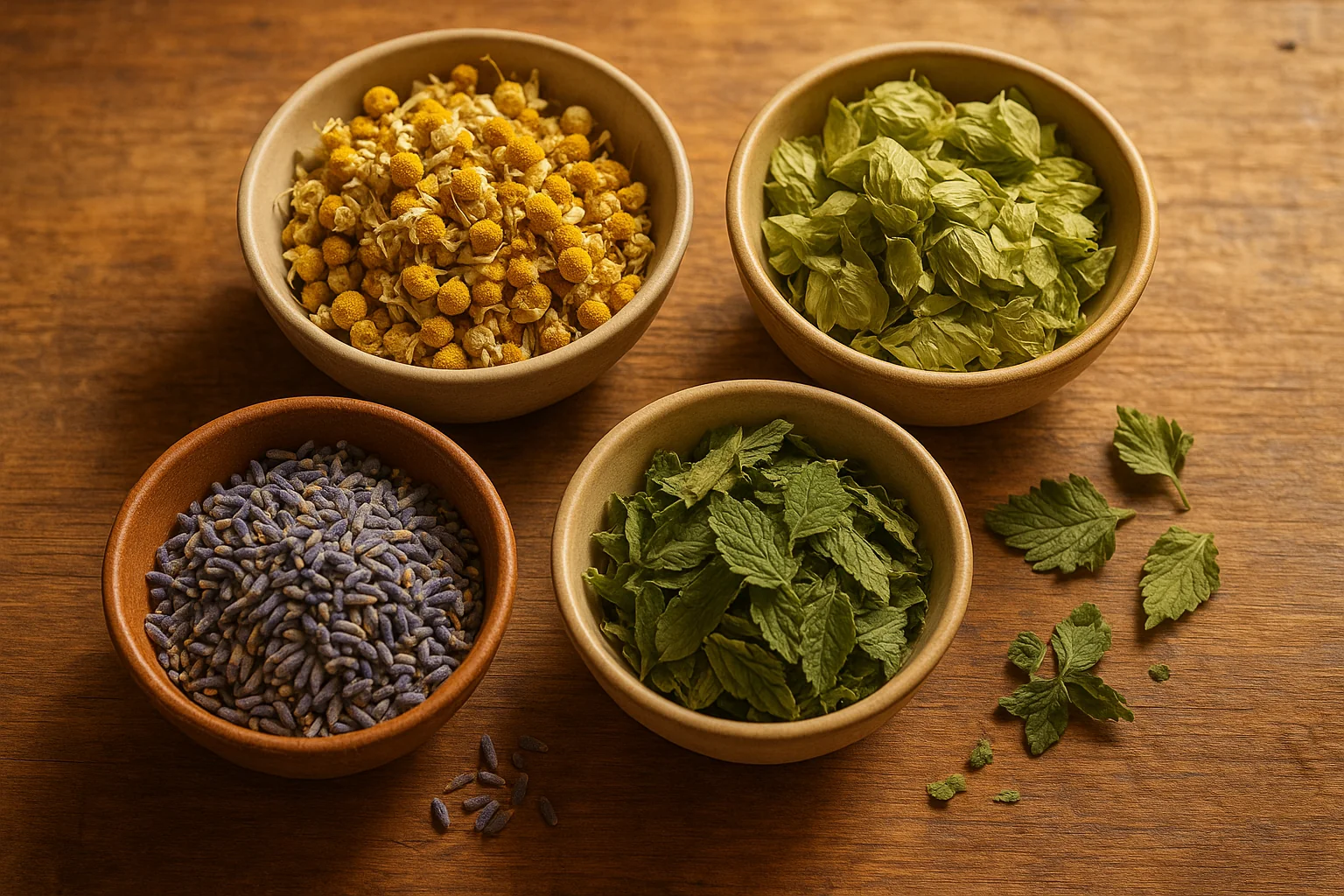
Tea has other advantages that capsules do not provide. Preparing an infusion takes a few minutes and is a signal that the day is ending; a warm drink promotes relaxation, and you can smell the aroma of hops and lavender even before the first sip. The downside is the unpredictable content of active substances, which depends on the quality of the raw material, grinding, and brewing time.
Capsules with standardized extract are the only form where you know how much of each substance you are taking, and the only one comparable to what was administered in studies. The label should indicate the standardization, meaning the content of a specific compound, not just the mass of the raw material. Tinctures are usually absorbed faster than capsules, which must first dissolve, and they are easier to measure in drops, but they contain alcohol, which excludes them for drivers and people with liver diseases. We discuss the differences between these two forms in more detail in our article on ashwagandha in drops and capsules.
A reasonable compromise looks like this: if you want to check if a particular herb helps you, start with a standardized form, because only then does the result mean anything. If you care about the evening ritual and pleasure, tea does it better, and its effect largely depends on regularity.
How to compose your own sleep blend?
Start with one leading herb and add at most two complementary ones. The leading role is usually played by valerian or hops, as they have studies behind them regarding sleep onset. Choose complementary herbs based on taste and aroma, as they determine whether you will reach for the infusion daily.
Keep the proportions simple: the leading herb dominates the blend, and the other two share the rest equally. There is no need to measure it to the gram, as the infusion does not provide a repeatable dose anyway. Use significantly less lavender than the scent of the dried herb suggests, as too much makes the infusion bitter and soapy.
Pour hops cones with water slightly cooler than boiling and do not overbrew, as bitterness increases with each minute and can dominate the whole. Lemon balm and chamomile tolerate higher temperatures without problems. Brewing covered for several minutes is a reasonable starting point for a blend where hops do not constitute the majority.
We noticed, while organizing descriptions of ready-made sleep blends, that the most common mistake is not choosing the wrong herb but transferring results from one form to another. Studies tested standardized extracts in tablets, while the tea producer cites them on the packaging of dried herbs, where the content of active substances is unknown and variable. When comparing products, check not only if the composition contains a studied herb but also if the cited study pertained to the same form. This distinction filters out most promises from labels.
When is an herbal blend not enough?
Herbs make sense for mild difficulties in falling asleep without a clear medical cause. They will not help where insomnia is a symptom of something else, and trying to treat it independently delays the diagnosis of the actual problem.
Such situations include untreated depression and anxiety disorders, chronic pain waking you at night, sleep apnea, restless legs syndrome, and hormonal disorders, including hyperthyroidism. A separate category is shift work, where the problem is not relaxation but a disrupted circadian rhythm, and a sedative herb does not shift the biological clock.
A warning sign is the duration and impact on the day. If sleep problems persist for more than three months or affect functioning during the day, make an appointment with a doctor instead of looking for a stronger blend. In chronic insomnia, cognitive-behavioral therapy for insomnia, abbreviated CBT-I, is considered the first-line treatment. Herbs can then at most accompany the treatment, not replace it.
The caution about interactions applies to each of the plants described here. Sedative herbs amplify their effects with sleeping pills, anxiolytics, and alcohol, and tinctures themselves contain alcohol. Consult a doctor about the presence of ashwagandha in the composition if you have thyroid diseases. If you take any medications regularly, show the blend’s label to your pharmacist before you start using it regularly.
How to check if the blend works?
Keep a sleep diary for two weeks before introducing the blend and four weeks after. Record the time you go to bed, estimated time to fall asleep, number of awakenings, and morning rest assessment. This is the home equivalent of the tools used in the cited studies.
Your own memory is a poor witness here. People regularly rate a night as poorly slept despite a correct record and vice versa, which is why sleep studies rely on diaries, questionnaires, or actigraphy, not on a one-time impression. A note made in the morning, before the first coffee, is more reliable than a memory from a week ago.
Give the blend time. In the Langade study, the difference in sleep onset time became significant only after ten weeks, although measurements were also taken halfway through this period. An assessment after three days tells you nothing beyond how those three nights happened to look. A month of regular use is a reasonable minimum before considering the preparation ineffective.
Also, look at what the diary will not show directly. Daytime sleepiness, headaches, or difficulty waking up in the morning are signals that the preparation is working too strongly or too long, and a reason to take a break. Improvement in sleep that costs you alertness the next day is not an improvement.
Frequently Asked Questions
Does an herbal blend work better than a single herb?
This has been shown for one combination. In the 2007 study by Koetter, a fixed blend of valerian with hops significantly shortened the time to fall asleep compared to placebo, while valerian alone in the same amount did not achieve an advantage over placebo. No one has conducted such comparisons for the other sets.
Which herbs for sleep have the strongest research?
Valerian with hops as a fixed blend, tested in two placebo trials, and ashwagandha, studied in 60 patients over ten weeks (Langade et al., 2019). Lemon balm, lavender, and passionflower appear in compositions more often than would be suggested by the number of studies on their effects on sleep onset.
Tea, capsules, or drops for sleep?
Studies tested standardized extracts in capsules and tablets, so only this form is comparable to their results. Tea, however, provides an evening ritual and the pleasure of drinking, which promotes regularity. Tinctures are usually absorbed faster than capsules, but they contain alcohol and are not suitable for drivers.
How long does it take for an herbal blend to start working?
Count in weeks, not days. In the Langade study, the difference in sleep onset time reached statistical significance only after ten weeks of use, while the Koetter study lasted four weeks. An assessment after a few nights does not distinguish the effect of the preparation from the usual variability of sleep from night to night.
Are herbal blends for sleep safe with medications?
Not always. Sedative herbs can amplify their effects with sleeping pills, anxiolytics, and alcohol, and tinctures themselves contain alcohol. Ashwagandha requires caution with thyroid diseases. If you take medications regularly, show the blend’s composition to your doctor or pharmacist before starting to use it.
Can children drink herbal teas for sleep?
Chamomile and linden are considered safe for older children in dilution, while valerian, hops, and passionflower are not routinely used in children, and ashwagandha has only been studied in adults. Before giving any herbal preparation for sleep to a child, consult the composition with a pediatrician.
Ready-made herbal compositions for brewing, including blends designed for the evening, can be found in the teas category.
This article is for informational and educational purposes and does not constitute medical advice. Before starting supplementation, consult a doctor, especially if you take medications regularly, are pregnant or breastfeeding, or have chronic illnesses.
Author: Michał Waluk · Published: 2026-05-22 · Updated: 2026-08-16