
Over 32,000 Publications on Cannabis in 10 Years
How many publications on cannabis have been produced in the last decade, what this number includes, how many are randomized studies, and how to read these reports.
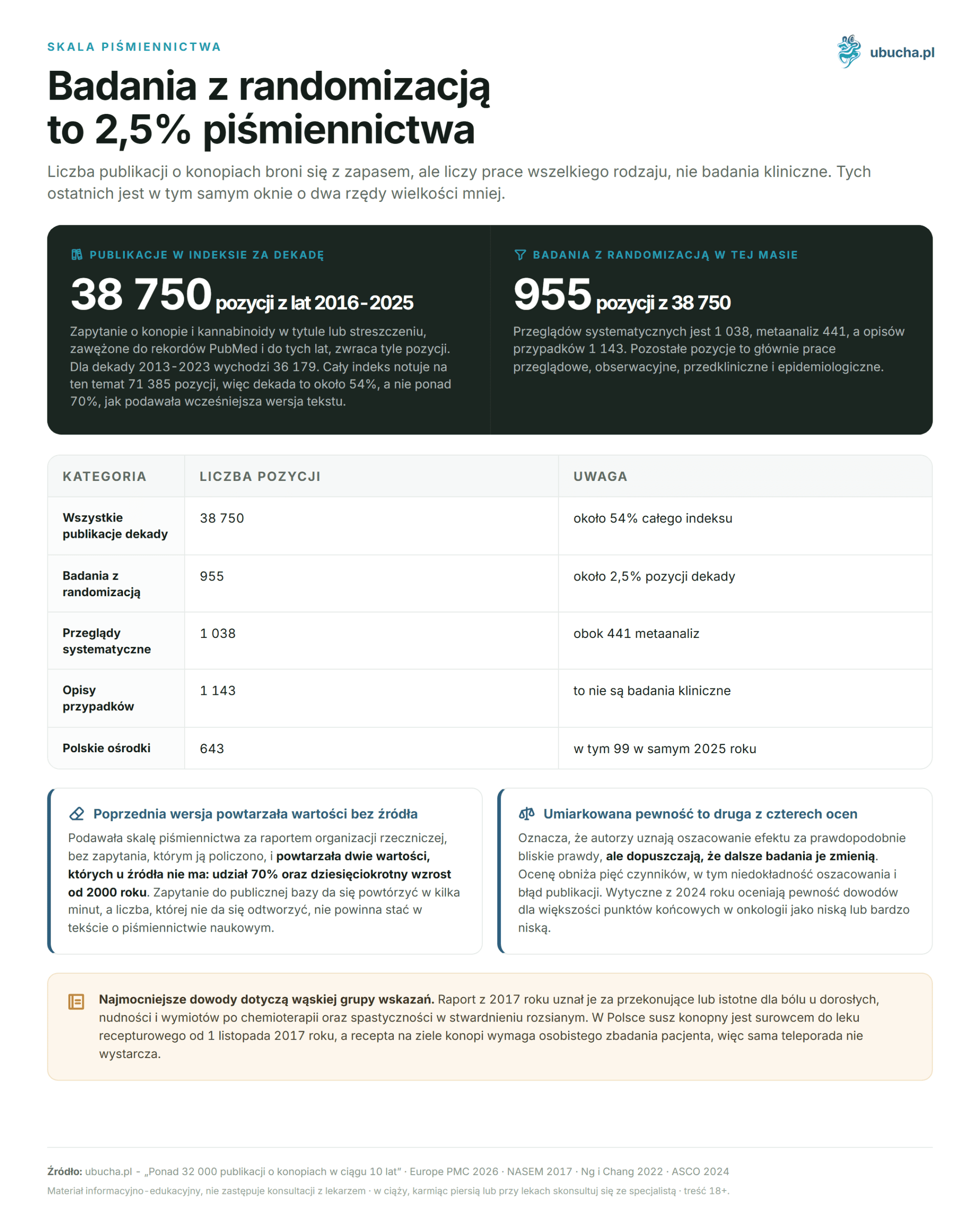
The number in the title can be verified, and we checked it at the source. A query for cannabis and cannabinoids in the title or abstract, limited to PubMed records in Europe PMC and to the years 2016-2025, returns 38,750 entries (as of August 16, 2026). For the decade 2013-2023, referenced by an earlier version of this text, it is 36,179. The number “over 32,000” therefore holds with margin, but it counts publications of all kinds, not clinical studies. The latter are two orders of magnitude fewer in the same window. Below we show where this number comes from, what exactly it includes, the share of randomized studies, and what the strongest works say about effectiveness and safety.
KEY INFORMATION
• In 2016-2025, a query for cannabis and cannabinoids returns 38,750 PubMed-indexed publications in Europe PMC, and for 2013-2023 36,179 (as of August 16, 2026).
• The decade 2016-2025 accounts for about 54% of all entries this index records on the topic since inception (71,385 entries), not over 70% as an earlier version stated.
• Randomized studies are 955 out of 38,750, about 2.5% of the decade’s literature.
• The strongest evidence, according to the 2017 NASEM report summarized by Abrams in “European Journal of Internal Medicine,” concerns adult pain, chemotherapy-induced nausea, and spasticity in multiple sclerosis.
• ASCO 2024 guidelines discourage cannabis as anticancer treatment outside clinical trials and rate evidence certainty for most endpoints as low or very low.
• In Poland, cannabis flower has been a raw material for magistral preparations since November 1, 2017, and a prescription for cannabis herb requires a personal patient examination.
Where does the number 32,000 come from and what exactly does it count?
The number comes from counting records in a literature database, not a clinical trial registry. A query for the words cannabis, cannabinoid, cannabinoids, marijuana, or cannabidiol in the title or abstract, limited to PubMed records in Europe PMC and to 2016-2025, returns 38,750 entries. For 2013-2023, it is 36,179 (as of August 16, 2026).
The result depends on the query, which is the first caveat. The word cannabis alone in title or abstract yields only 19,084 entries for 2013-2023, nearly half as many. Each such number is only as valid as the query used, so we provide it explicitly.
The second caveat concerns content. This number includes review articles, cell line and animal model studies, epidemiological analyses of recreational use, agronomy, and forensic toxicology works. A publication on cannabis is not the same as a study on medical cannabis, and the title of this text blurs that difference.
The third concerns pace. In 2000, the same index recorded 599 entries, in 2023 4,278, and in 2025 4,769. This is about a sevenfold increase in a quarter century, not tenfold as an earlier version stated. The threshold of four thousand publications per year was exceeded in 2021 and remains so.
We also correct one sentence here. The decade 2013-2023 is not over 70% of all cannabis literature but about half: 36,179 entries versus 71,385 total in the index since inception.
Why has cannabis research increased in the last decade?
There is no direct measurement of causes, but some pieces can be identified by dates of works that triggered it. The chronology of molecular discoveries, registration of the first cannabinoid drug, and legal changes in various countries overlap in the same timeframe.
The foundation was chemistry and receptor biology. Delta-9-THC was isolated and described by Gaoni and Mechoulam (Journal of the American Chemical Society, 1964). The cannabinoid receptor was characterized in rat brain (Devane et al., Molecular Pharmacology, 1988), the second receptor described as peripheral (Munro et al., Nature, 1993), and two endogenous ligands, anandamide and 2-AG, by Devane’s team (Science, 1992) and Sugiura’s team (Biochemical and Biophysical Research Communications, 1995). This set enabled hypothesis-driven studies rather than mere observation.
The second impulse was drug-resistant epilepsy. A randomized cannabidiol trial in Dravet syndrome (Devinsky et al., New England Journal of Medicine, 2017) preceded the first cannabinoid drug registration in this indication: European Medicines Agency approved Epidyolex on September 19, 2019, for patients from age two with Lennox-Gastaut or Dravet syndrome.
The third was legal change. In Poland, the act allowing cannabis flower as raw material for magistral preparations came into force on November 1, 2017. We do not provide numbers on other causes, including public funding size, as no measurement was found. The topic has its own peer-reviewed journals, including “Journal of Cannabis Research” and “Cannabis and Cannabinoid Research.”
What exactly do these publications cover?
The largest clusters of clinical works concern chronic pain, drug-resistant epilepsy, spasticity in multiple sclerosis, chemotherapy-induced nausea, and mental disorders. The hierarchy of these areas is ordered by the 2017 NASEM report, which found evidence convincing or substantial for adult pain, chemotherapy-induced nausea, and spasticity in multiple sclerosis, and limited for epilepsy (Abrams, European Journal of Internal Medicine, 2018).
| Area | What the cited work shows | Source |
|---|---|---|
| Chronic pain | 32 randomized studies, 5,174 adults; small improvement in pain relief, moderate certainty of evidence | Wang et al. (BMJ, 2021) |
| Drug-resistant epilepsy (Dravet syndrome) | 120 participants, 14 weeks; median seizures dropped from 12.4 to 5.9 per month versus 14.9 to 14.1 on placebo | Devinsky et al. (New England Journal of Medicine, 2017) |
| Spasticity in multiple sclerosis | 572 enrolled, 241 randomized after initial selection of responders; superiority over placebo, P=0.0002 | Novotna et al. (European Journal of Neurology, 2011) |
| Chemotherapy-induced nausea and vomiting | 147 participants; complete response in 24% versus 8% on placebo, difference 16 percentage points (95% CI 4-28) | Grimison et al. (Journal of Clinical Oncology, 2024) |
| Mental disorders | 83 studies, including 40 randomized with 3,067 participants; anxiety symptom improvement with very low certainty of evidence | Black et al. (Lancet Psychiatry, 2019) |
Pain is best studied. Wang et al.’s meta-analysis (BMJ, 2021) included 32 randomized studies and 5,174 adults; authors report a small improvement with moderate certainty, but significantly more dizziness, somnolence, and nausea. We discuss management in this indication in the guide on neuropathic pain treatment with cannabis.
In oncology, the picture is more cautious than an earlier version stated. The American Society of Clinical Oncology guidelines (Braun et al., Journal of Clinical Oncology, 2024) are based on 13 systematic reviews and five primary studies, rating evidence certainty for most endpoints as low or very low. The panel discourages cannabis as anticancer treatment outside clinical trials and allows it as an adjunct for refractory chemotherapy-induced nausea. We discuss this document in the post on new oncology guidelines.
What is the methodological quality of this wave of publications?
Randomized studies are about one-fortieth of the decade’s literature. The same query limited to “randomized controlled trial” publication type returns 955 entries out of 38,750 in 2016-2025, i.e., 2.5%. There are 1,038 systematic reviews, 441 meta-analyses, and 1,143 case reports (as of August 16, 2026).
- Meta-analyses: 441 entries in the decade.
- Systematic reviews: 1,038 entries.
- Randomized studies: 955 entries.
- Case reports and series: 1,143 entries.
- The rest, the vast majority, are narrative reviews, observational, preclinical, laboratory studies, and epidemiological analyses. The index does not assign them the above labels.
The number of randomized studies alone does not determine certainty. The system measuring it in cited reviews is GRADE, often misdescribed, so it is worth knowing its shape. GRADE has four certainty levels, from high to very low. It assigns them to the entire body of evidence, not a single study. Randomized studies start at high, observational at low. Five factors lower the level: risk of bias, inconsistency, indirectness, imprecision, and publication bias (Balshem et al., Journal of Clinical Epidemiology, 2011).
A separate problem is product heterogeneity. Under cannabis are products with very different THC and CBD ratios, administered orally, inhaled, or topically. In the “BMJ” meta-analysis, 30 of 32 studies involved oral administration, two topical; none inhaled, so the conclusion does not apply to vaporization or smoking. Comparing results between such products is practically comparing different drugs.
Publication bias remains a problem: positive-result studies are easier to publish than negative ones. Protocol registration before study start is now standard to limit this, and cited reviews provide their registration numbers.
How is cannabis research geographically distributed?
The most precise available measurement comes from Ng and Chang’s bibliometric analysis (Journal of Cannabis Research, 2022). They searched Scopus and counted 29,802 articles and reviews from 1829-2021, by 65,109 authors in 5,474 journals. The most publications were from the United States (12,420), followed by the United Kingdom (2,236) and Canada (2,062).
Poland’s and Israel’s positions can be measured in the same index used here. A query limited to Israeli affiliation returns 948 entries in 2016-2025, Polish 643, Canadian 3,816. Poland’s result is growing: 82 entries in 2024 and 99 in 2025. The previous statement of “several dozen to over a hundred works annually” overstated the upper bound and lacked a source.
Affiliation search is a rough tool: it assigns a work to a country if any author listed an address there, so international collaboration counts for multiple countries. The order of magnitude is reliable; exact values less so.
Israel’s position stems from history, not population. The work of Gaoni and Mechoulam from 1964, marking modern cannabinoid chemistry, originated in Jerusalem, as did much classical pharmacological output. We collect these threads separately in the post on Israel as a pioneer of medical marijuana.
The number of works does not indicate their type. The country ranking includes articles and reviews together, so a country with a large lab output ranks equally with one conducting patient trials. The distribution of decisive studies is likely narrower than publication distribution, but no such measurement was found.
For Polish readers, the practical conclusion is that almost all evidence for discussed indications comes from studies abroad, in different populations and healthcare systems. This alone is a caveat when transferring conclusions directly to Polish practice, called indirectness in GRADE language.
What do data say about medical cannabis safety?
The most cited safety review (Wang T et al., CMAJ, 2008, a different team than the pain meta-analysis above) covered 31 studies over 40 years: 23 randomized and 8 observational. Serious adverse events were not significantly more frequent than controls (RR 1.04, 95% CI 0.78-1.39), but mild events were significantly more frequent (RR 1.86, 95% CI 1.57-2.21).
This work circulates in popular summaries without two caveats the authors stated. Median exposure in randomized studies was two weeks; the longest lasted twelve months. Authors conclude that long-term risk is poorly characterized and long exposure studies are needed. The statement about a favorable safety profile thus applies to short supervised use, not chronic use.
Clearly increased risk concerns several groups:
- Adolescents and young adults, where regular use during adolescence is linked to worse cognitive and mental outcomes in adulthood (Hall, Addiction, 2015).
- Pregnant and breastfeeding women.
- Persons with current or past psychosis.
- High-risk cardiology patients.
- Persons taking multiple drugs simultaneously, due to shared metabolic pathways.
Psychosis risk was measured most precisely in a multicenter study by Di Forti et al. (Lancet Psychiatry, 2019), including 901 first-episode psychosis patients and 1,237 controls in 11 centers. Daily cannabis use was associated with odds ratio 3.2 (95% CI 2.2-4.1) versus never users, and daily use of high-potency strains with OR 4.8 (95% CI 2.5-6.3). This case-control study reports association; authors assume causality when calculating population attributable fraction.
Regarding addiction: in the US NESARC cohort analysis, cumulative probability of transition from use to dependence was 8.9% among 7,389 ever users (Lopez-Quintero et al., Drug and Alcohol Dependence, 2011). Hall gives a similar order of magnitude as about one in ten regular users. The previously cited 17% for adolescent starters, referenced to NIDA, was not confirmed in any study and was removed. More on high-risk groups is in the text on side effects of cannabis abuse.
Which research directions are growing fastest today?
Research activity growth can be measured, but effectiveness does not follow. In 2016-2025 cannabidiol appears 6,035 times in title or abstract, cannabigerol 411 times, cannabinol 393 times, and tetrahydrocannabivarin 152 times. Cannabinoids other than CBD and THC thus form a growing segment but still an order of magnitude smaller.
These numbers show how many works were produced, not what they found. For cannabigerol, cannabinol, and tetrahydrocannabivarin, much of the output is lab and animal studies, not human clinical trials, so translating results to humans is premature.
It is worth noting what is missing. Cannabidiol alone has over six thousand entries in the decade, while randomized studies for the entire cannabis field number 955 in the same window, spread over all indications. A new cannabinoid entering scientific circulation thus starts with lab work and gains clinical trials only after years. The three compounds above are at this earlier stage, and no publication count changes that.
Separately, we correct what this text previously said about the entourage effect hypothesis, that full plant extracts act differently than isolated cannabinoids. The phrase “entourage effect” appears 70 times in title or abstract in the decade, and data do not support this hypothesis. Finlay et al. (Frontiers in Pharmacology, 2020) tested five terpenes present in cannabis, alone and in mixtures, and found no binding or functional activity on CB1 and CB2 receptors, except possibly weak beta-caryophyllene interaction with CB2. This is a receptor experiment, not a human study, so it does not close the matter; it shows the simplest mechanism explanation is lacking.
We do not make predictions here about which directions will enter clinical practice. Prediction is not measurement, and available literature reports what has been studied, not what will happen.
How to read scientific cannabis reports without overinterpretation?
Critical reading boils down to several sequential questions, each verifiable in public databases. Press headlines usually get ahead of evidence and simplify one study’s result to a general conclusion, so it is worth returning to the original work.
- Check study type. A meta-analysis of well-conducted randomized studies ranks higher than a single study, which ranks higher than a case report, regardless of journal prestige.
- Check sample size, but do not seek a magic threshold. There is no participant number below which a study is worthless or above which it is reliable; power for the assumed effect and confidence interval width matter. The scale is visible in Black’s review (Lancet Psychiatry, 2019): for depression, 23 randomized studies and 2,551 participants; for Tourette’s syndrome, two studies and 36 people; for PTSD, one study and ten people.
- Check the product and administration route. A conclusion about oral extract does not transfer to vaporization or other THC:CBD ratios.
- Check funding. Devinsky’s cannabidiol study in Dravet syndrome (New England Journal of Medicine, 2017) was funded by the product manufacturer, GW Pharmaceuticals, disclosed in the paper. This does not invalidate the result but is part of the picture.
- Check how authors rate evidence certainty, not just statistical significance. Black found anxiety symptom improvement significant but with very low GRADE certainty. These are two different pieces of information.
- Check if the work exists and has not been withdrawn. ClinicalTrials.gov, Cochrane Library, and Europe PMC allow finding protocols, full texts, and withdrawal notices.
Add one more question: what does the work say about harms, not just benefits. Black’s review found pharmaceutical THC increased adverse events (odds ratio 1.99, 95% CI 1.20-3.29) and withdrawals due to these events (2.78, 95% CI 1.59-4.86). Press summaries usually report only the first half of such results.
It is also worth distinguishing one person’s report, even convincing, from a large-group study result. A single good experience does not prove therapy effectiveness, just as a single adverse event does not prove its danger.
What does this wave of research mean for Polish patients?
For patients in Poland, what matters most is what can be prescribed and under what conditions. Cannabis flower is a pharmaceutical raw material for magistral preparations under Article 33a of the Act on Counteracting Drug Addiction (consolidated text Journal of Laws 2023 item 1939); the provision was introduced by the July 7, 2017 amendment (Journal of Laws 2017 item 1458), effective November 1, 2017. The raw material’s market authorization is granted by the Office for Registration of Medicinal Products for five years.
One sentence in this text was previously written directly contrary to the regulation. Teleconsultation is insufficient: Annex 2 of the prescription regulation (Journal of Laws 2025 item 1678) lists cannabis herb other than fiber hemp, and paragraph 7 section 2a point 2 requires a personal patient examination for these items. Exceptions are narrow. The sentence about telemedicine removing geographic barriers was removed because it directed readers to a prescription a doctor should not issue under the law.
A separate category is cannabis products available without prescription. Fiber hemp is defined by law as plants where the sum of delta-9-THC and tetrahydrocannabinolic acid in flowering or fruiting tops, from which resin has not been removed, does not exceed 0.3% dry weight rounded to one decimal place (Article 4 point 5 of the same act, as amended by the March 24, 2022 act, Journal of Laws 2022 item 763). The threshold counts the sum of both compounds, not just delta-9-THC, and applies to the plant, not the final product.
Such products have no approved medical indications and do not replace magistral preparations. The EFSA panel in a 2026 opinion (EFSA Journal, 2026) states that cannabidiol safety cannot be established for persons under 25, pregnant and breastfeeding women, and those taking medications. These largely overlap with clinical literature high-risk groups.
What does this wave of publications still not resolve?
The cited works end with a surprisingly similar conclusion: long, large, and directly clinical question studies are lacking. This is not our prediction but the authors’ own statements.
The safety review authors (CMAJ, 2008) wrote that long-term cannabinoid risk is poorly characterized and long exposure studies are needed. Black et al. (Lancet Psychiatry, 2019) stated evidence is still insufficient to formulate regulatory guidelines for cannabinoid use in mental disorders and high-quality studies directly testing this effect are needed. The ASCO panel (Journal of Clinical Oncology, 2024) wrote that oncology patients’ access to cannabis has outpaced science justifying it.
This is visible in the simplest comparison. In 2016-2025, case reports (1,143) outnumber randomized studies (955), which are spread over many indications, product forms, and administration routes. With such dispersion, a single indication rarely has more than a few adequately powered trials. In Black’s review, PTSD had one randomized study with ten participants, though twelve works were included for that indication.
Where expectation begins, we call it expectation. One can expect that with 955 randomized studies in one decade, future meta-analyses will narrow conclusions to specific products and administration routes rather than cannabis generally. One can also expect the gap between publication count and decisive studies will persist until clinical trial conditions change. Neither statement is a measurement or a data-supported prediction.
For the literature itself, this shifts the question from how many works are produced to how good they are. A publication increase of several percent annually does not change the picture if decisive studies remain a few percent.
Frequently Asked Questions
How many publications on cannabis have really been produced in the last decade?
A query for cannabis and cannabinoids in the title or abstract, limited to PubMed records in Europe PMC and to 2016-2025, returns 38,750 entries, and for 2013-2023 36,179 (as of August 16, 2026). The number “over 32,000” is therefore true, even underestimated.
Does this number mean that the effectiveness of cannabis is proven?
No. The number of publications is not the same as the strength of evidence. In the same window, randomized studies account for 955 entries, about 2.5% of the database. Effectiveness is well documented for several indications, while evidence in other areas remains moderate or weak.
How many of these publications are randomized studies?
In 2016-2025, the index assigns the randomized study label to 955 entries out of 38,750. There are 1,038 systematic reviews, 441 meta-analyses, and 1,143 case reports. The remaining entries are mainly review articles, observational, preclinical, and epidemiological studies.
Which indications have the strongest evidence?
The 2017 NASEM report (European Journal of Internal Medicine, 2018) considered the evidence convincing or substantial for adult pain, chemotherapy-induced nausea and vomiting, and spasticity in multiple sclerosis. For epilepsy, it was then assessed as limited; this changed only with cannabidiol studies published since 2017.
Where do most cannabis studies come from?
The bibliometric analysis by Ng and Chang (Journal of Cannabis Research, 2022), based on Scopus, lists the United States (12,420 publications), the United Kingdom (2,236), and Canada (2,062). Polish centers have 643 entries in PubMed for 2016-2025, including 99 in 2025 alone.
Is it legal to use medical cannabis in Poland?
Yes, since November 1, 2017. Cannabis flower is a raw material for magistral preparations under Article 33a of the Act on Counteracting Drug Addiction. A prescription is always required, and for cannabis herb, regulations require a personal examination by a doctor, so teleconsultation alone is insufficient.
Does a large number of studies mean cannabis is safe for everyone?
No. A safety review (CMAJ, 2008) found no difference in serious adverse events but an excess of mild events, with a median exposure of two weeks. Long-term risk remains poorly studied, and clear high-risk groups exist.
What does “moderate certainty of evidence” mean?
It is the second of four ratings in the GRADE system (Journal of Clinical Epidemiology, 2011), after high. It means authors consider the effect estimate probably close to the truth but allow that further research may change it. Five factors lower the rating, including imprecision and publication bias.
Summary: what to remember from this guide?
The number in the title holds and is even cautious: in 2016-2025, the index records 38,750 publications on cannabis and cannabinoids, and in 2013-2023 36,179. This is not over 70% of all literature but about half, as the entire index records 71,385 entries on the topic. These are not clinical studies but publications of all kinds.
The structure of this mass is uneven. Randomized studies are about 2.5% of the decade’s entries, and product heterogeneity complicates comparing results between centers. Evidence is strongest for adult pain, chemotherapy-induced nausea, and spasticity in multiple sclerosis, with drug-resistant epilepsy added after studies published since 2017. In oncology, evidence certainty outside symptomatic treatment remains low.
Short supervised use safety is better documented than long-term, and clear high-risk groups remain the same: youth, pregnant and breastfeeding women, persons with psychosis history, cardiology patients, and polypharmacy patients. Every decision in these populations requires medical consultation.
For Polish patients, the legal status matters more than publication count: cannabis flower has been a magistral raw material since November 2017, prescriptions for cannabis herb require personal examination, and non-prescription cannabis products have no approved medical indications.
This text itself exemplifies what it describes. The previous version cited literature scale from an advocacy report without the query used and repeated two values not found at the source: 70% share and tenfold increase since 2000. A public database query can be repeated in minutes, and an irreproducible number should not appear in scientific literature.
Non-prescription cannabis products, e.g., in the cannabis flower section, have the status of industrial goods or food in Polish law and do not replace prescription drugs.
This article is informational and educational and does not constitute medical advice. Before starting cannabis or CBD for therapeutic purposes, consult a doctor, especially if you take other medications, are pregnant, or breastfeeding.
Author: Michał Waluk · Published: 2026-05-04 · Updated: 2026-08-16