
CBD and Addiction and Intoxication: What Research Says
Does CBD cause addiction or intoxication? Results from Babalonis 2017, Schoedel 2018, and Devinsky 2017 studies, drug test risk, and EFSA 2026 safety assessment.
At therapeutic doses, studies do not show abuse potential for cannabidiol. A signal appears only at single doses of 1500 and 4500 mg, and even then it is weaker than for 2 mg alprazolam. The question “does CBD cause addiction” has been recurring in the Polish internet for years, with answers circulating alongside unchecked numbers. This text starts from something else: what can be read in specific studies with their methodology, participant numbers, and results, including inconvenient findings. You will see two experimental abuse potential studies, clinical epilepsy trial data, epidemiological data on tetrahydrocannabinol itself, and the latest European safety assessment of cannabidiol. You will also see which popular claims we removed from this article because their sources could not be verified, and why. This arrangement has one advantage: it allows separating the question of addiction, which studies answer quite consistently, from questions about long-term safety and product quality, for which answers are not reassuring.
KEY INFORMATION
- In Babalonis 2017, oral cannabidiol at doses of 200, 400, and 800 mg showed no signal of abuse potential in 31 frequent marijuana users; results were at placebo level across all measured scales.
- In Schoedel 2018, the therapeutic dose of 750 mg did not differ from placebo, while 1500 and 4500 mg doses showed results significantly higher than placebo, though mean differences were less than 10 points on the scale compared to over 18 points for alprazolam and dronabinol.
- Tetrahydrocannabinol is a different substance with different risk: the cumulative probability of transitioning from use to addiction was 8.9% for cannabis versus 67.5% for nicotine (Lopez-Quintero 2011).
- Full-spectrum products with trace THC could yield positive urine test results; pure cannabidiol practically does not (Spindle 2020).
- Cannabidiol safety cannot be established in people under 25 years old, pregnant and breastfeeding women, and those taking medications (EFSA 2026).
The short answer regarding diagnostic criteria: there is no basis to talk about addiction. DSM-5 requires at least two of eleven criteria within a year, including craving, loss of control, tolerance, and withdrawal syndrome. For cannabidiol alone, neither withdrawal syndrome nor tolerance development has been described. A full breakdown of all criteria is further in the text, and below is a summary of two studies on which this answer is based.
| Element | Babalonis 2017 | Schoedel 2018 |
|---|---|---|
| Cannabidiol doses | 0, 200, 400, and 800 mg orally | 750, 1500, and 4500 mg single dose |
| Number of participants | 31 | 43 in treatment phase, 35 in analysis |
| Population | healthy, frequent marijuana users | recreational users of multiple substances |
| Comparator | smoked marijuana with 0.01% and 5.3-5.8% THC | alprazolam 2 mg and dronabinol 10 and 30 mg |
| Result vs placebo | cannabidiol did not differ from placebo | signal only at 1500 and 4500 mg |
| Result vs comparator | active marijuana produced abuse-related effects, cannabidiol did not | weaker than alprazolam and dronabinol |
How does CBD differ from THC at the receptor level?
The difference boils down to how the two molecules treat the cannabinoid CB1 receptor. Tetrahydrocannabinol is a partial agonist of CB1 and CB2 receptors, and the responses it triggers depend on receptor expression levels and signal transduction efficiency. Cannabidiol behaves oppositely: in cells and tissues expressing these receptors, it shows unexpectedly high efficacy as an antagonist of their agonists (British Journal of Pharmacology, Pertwee 2008).
The mechanism was described in more detail a few years later. In cells expressing CB1 receptor, cannabidiol reduced the efficacy and potency of two agonists, 2-arachidonoylglycerol and tetrahydrocannabinol, on phospholipase C beta 3 and ERK1/2 dependent pathways. It also limited arrestin 2 recruitment to the receptor, preventing its internalization. The authors defined cannabidiol as a non-competitive negative allosteric modulator of the CB1 receptor (British Journal of Pharmacology, Laprairie 2015).
It should be remembered that this was work on cell models, not humans. The authors themselves write that allosteric modulation along with CB1-independent actions may explain observed cannabidiol effects in the body. This is a more cautious formulation than the popular slogan that “CBD blocks THC action.”
The practical conclusion is clear. A substance that does not activate the CB1 receptor but weakens the signal of its agonists has no tool to induce intoxication via the same mechanism as tetrahydrocannabinol. We describe the pharmacological difference between cannabinoids and their acidic forms more broadly in the post about hemp distillate and isolate.
How often does THC use lead to addiction?
Epidemiological data, not pharmacology, are needed here. An analysis of data from the US NESARC population study included people who had ever used nicotine (15,918), alcohol (28,907), cannabis (7,389), or cocaine (2,259). The cumulative probability of transitioning from use to addiction was 67.5% for nicotine, 22.7% for alcohol, 20.9% for cocaine, and 8.9% for cannabis (Drug and Alcohol Dependence, Lopez-Quintero 2011).
The same study provides something often lost in popular summaries: half of cannabis addiction cases appeared about five years after first use, while for nicotine it was about 27 years, and for alcohol about 13 years. Thus, transition to cannabis addiction occurred faster than for nicotine and alcohol, despite lower final probability.
These data concern cannabis as a drug, i.e., material with predominance of tetrahydrocannabinol, not pure cannabidiol. This material has changed over time. An analysis of 38,681 confiscated samples in the US showed an increase in average THC content from about 4% in 1995 to about 12% in 2014, with a simultaneous decrease in CBD content (Biological Psychiatry, ElSohly 2016).
Conclusions from recreational cannabis studies do not automatically transfer to cannabidiol products, and this works both ways. We discuss the impact of THC-predominant cannabis more broadly in the post on marijuana’s impact on mental health.
How is abuse potential measured?
Without this question, the two most important studies on this topic are read by intuition. Abuse potential assessment in humans is a separate, formalized procedure, not just observing whether someone uses a substance again. The reason for conducting it for cannabidiol was legal status: the substance was listed in Schedule I of the US Controlled Substances Act, yet well-controlled data on its abuse potential were lacking (Drug and Alcohol Dependence, Babalonis 2017).
The design of such a study is similar each time. Participants in a crossover, double-blind design receive the test substance, placebo, and at least one positive control drug with known abuse potential; Schoedel 2018 also used a double-masked drug form. If the positive control does not differ from placebo, the study is invalid due to lack of sensitivity.
The primary endpoint is the maximum effect on a visual analog scale of drug liking. Alongside, general liking, willingness to take the substance again, positive and negative effects, and similarity to known substances are measured. Cognitive and psychomotor functions are separately assessed; Schoedel 2018 used divided attention, Hopkins verbal learning, and symbol substitution tests.
The method has clear limits. It measures a single dose in volunteers selected to be sensitive to psychoactive effects, not the course of months-long use in the general population. It answers “does this substance produce an abuse signal under laboratory conditions,” not “what happens after a year of daily use.”
What did Babalonis 2017 show?
This was the first controlled study of pure cannabidiol abuse potential in humans. It included 31 healthy, frequent marijuana users. Participants received oral cannabidiol at doses of 0, 200, 400, and 800 mg, alone and combined with smoked marijuana containing 0.01% or 5.3-5.8% THC. Each participant underwent one dose combination during eight weekly outpatient sessions (Drug and Alcohol Dependence, Babalonis 2017).
The result was unequivocal both ways. Active marijuana repeatedly produced subjective abuse-related effects, including intoxication, with significance below 0.05. Cannabidiol behaved like placebo on all measures, with significance above 0.05. The authors concluded that cannabidiol at tested doses showed no abuse potential signals.
It is worth correcting a version circulating on Polish sites. Babalonis did not include eight people, did not use 750, 1500, and 4500 mg doses, nor compare cannabidiol with alprazolam and dronabinol. Those elements belong to another, later study described in the next section. Confusing the designs of the two studies is one of the most common errors on this topic.
The limitation of this work is equally important. It was a secondary analysis of data collected for a cannabidiol-marijuana interaction study on 31 people, concerning doses up to 800 mg. What happens at much higher doses is addressed only by the next study.
What did Schoedel 2018 show and not show?
This study was designed to assess the abuse potential of purified oral cannabidiol solution, as phase 3 pediatric epilepsy trials reported central nervous system adverse events. Single doses of 750, 1500, and 4500 mg cannabidiol were compared with 2 mg alprazolam, 10 and 30 mg dronabinol, and placebo in recreational polysubstance users (Epilepsy and Behavior, Schoedel 2018).
Of 95 qualified for treatment phase, 43 entered, and 35 were included in pharmacodynamic analysis. Alprazolam and dronabinol produced significantly higher maximum drug liking scores than placebo, confirming methodological validity. For 750 mg cannabidiol, difference from placebo was not statistically significant.
Here begins the part often missing in popular summaries. For 1500 and 4500 mg doses, results differed significantly from placebo (p = 0.04 and 0.002). However, mean differences were less than 10 points on the visual analog scale, while positive controls exceeded 18 points. The authors concluded precisely: the therapeutic 750 mg dose showed low abuse potential, while high and supratherapeutic doses produced detectable subjective effects, significantly weaker than alprazolam and dronabinol.
The study also assessed cognitive functions using divided attention, Hopkins verbal learning, and symbol substitution tests. Unlike alprazolam, cannabidiol showed no noticeable impact on these measures. Most adverse events were mild or moderate; no serious events or deaths were reported.
What is known from clinical trials of Epidiolex?
The most cited study involved children and young adults with Dravet syndrome. 120 participants with refractory epilepsy were randomized to oral cannabidiol solution at 20 mg/kg/day or placebo as add-on to standard antiepileptic treatment. Treatment lasted 14 weeks after a 4-week baseline (New England Journal of Medicine, Devinsky 2017).
The median monthly seizure frequency dropped from 12.4 to 5.9 in the cannabidiol group versus 14.9 to 14.1 in placebo. At least 50% seizure reduction was achieved by 43% versus 27% on placebo, but this difference was not statistically significant (p = 0.08). Seizure-free rates were 5% versus 0%, also not significant.
More important for this article is the safety part, which is not purely optimistic. Diarrhea, vomiting, fatigue, fever, drowsiness, and abnormal liver tests were more frequent than placebo. More participants withdrew from the cannabidiol group. The authors summarized that cannabidiol reduced seizures more than placebo but was associated with more adverse events.
This study did not cover tens of thousands of patient-years or observations longer than a year, although such statements circulate on Polish sites with its citation. It included 120 people for 14 weeks. Long-term exposure claims were removed because they do not come from this work.
How much cannabidiol actually reaches the bloodstream?
This question underlies the entire dose discussion, and the answer is surprisingly sparse. A systematic review of cannabidiol pharmacokinetics in humans searched 792 publications and found 24 reporting human pharmacokinetic parameters. This is little for a widely used substance (Frontiers in Pharmacology, Millar 2018).
Absolute bioavailability was measured only for inhalation and was 31%. No study measured it for other administration routes, despite availability of intravenous formulations needed for such measurement. All tables circulating online comparing oral, sublingual, and inhaled bioavailability are thus based on unmeasured assumptions.
What does the review reliably report? Half-life ranges from 1.4 to 10.9 hours after oral mucosa spray, 2 to 5 days after chronic oral administration, 24 hours after intravenous, and 31 hours after smoking. Maximum concentration is reached between 0 and 4 hours, faster after inhalation than oral, and area under the curve and maximum concentration increase with dose.
One practical observation: maximum concentration increases after a meal and in fatty formulations. The same milligram number on a label thus gives different exposure fasting and fed. The authors conclude data are lacking, available data are inconsistent, and solid data for different product forms are needed.
Does cannabidiol interact with medications?
This is a real clinical problem unrelated to addiction. A review of clinical and animal data states that cannabidiol’s effects on liver enzymes and drug transporters require further study, as it is often used as add-on therapy (Cannabis and Cannabinoid Research, Iffland 2017).
The same review confirms a favorable adverse effect profile of cannabidiol compared to drugs used in epilepsy and psychotic disorders. Fatigue, diarrhea, and appetite and weight changes were most reported. The authors note some toxicological parameters remain unstudied, including cannabidiol’s impact on hormones.
Clinical trial data confirm this. In the Dravet syndrome trial, abnormal liver tests were more frequent in the cannabidiol group than placebo, with treatment as add-on to standard antiepileptic therapy (Devinsky 2017). This is not an effect of the substance alone, isolated from other treatments.
The European assessment states most sharply: human studies indicated hepatotoxic potential of cannabidiol, especially with concomitant medications, and for this reason safety cannot be established in people taking drugs (EFSA 2026). The statement “cannabidiol is not addictive,” even within its scope, does not answer whether it can be safely combined with one’s pharmacotherapy.
Does CBD meet DSM-5 addiction criteria?
DSM-5 defines substance use disorder by meeting at least two of eleven criteria within twelve months. These include loss of control over amount, compulsive seeking, tolerance increase, withdrawal symptoms, and neglect of duties (American Psychiatric Association, DSM-5).
The abuse potential studies described above measure only one aspect: subjective liking and willingness to take again. This is standard methodology for drug evaluation but does not replace long-term observation. Available data come from single doses in adult volunteers and a several-week clinical trial in children.
What do we not know? There are no studies tracking individuals using cannabidiol at consumer doses over years against the eleven DSM-5 criteria. A review of clinical and animal data states a lack of studies with larger participant numbers and longer chronic administration (Cannabis and Cannabinoid Research, Iffland 2017).
There is also a difference easily overlooked in casual conversation. Habitual evening ritual and loss of control over amount are two different phenomena, and diagnostic criteria require the latter. Regular use of anything, from coffee to supplements, does not meet disorder definition unless compulsion and harm appear. This distinction is not an alibi: it means the addiction question must be asked precisely, not that the answer is predetermined.
The honest answer is: available studies detected no abuse potential signal at therapeutic doses, and at supratherapeutic doses detected subjective effects weaker than benzodiazepines. This is not proof that long-term use does not lead to any dependence pattern, as such a study simply does not exist.
How does tolerance differ from addiction?
These are two separate phenomena that may coexist but are not identical. Tolerance is a decrease in response to repeated dose, requiring increase for the same effect. Addiction is a pattern of compulsive use despite harm, described in diagnostic criteria. The first is pharmacological, the second clinical-behavioral.
Classical receptor tolerance involves desensitization or internalization after chronic stimulation. For cannabidiol, a mechanism acting oppositely was described: it limits arrestin 2 recruitment to CB1 receptor and prevents internalization (Laprairie 2015). This is an observation from cell models, not clinical observation.
The popular internet phenomenon of “reverse tolerance,” i.e., alleged dose decrease after weeks of use, has no confirmation in peer-reviewed literature accessible during this text’s preparation. In a previous version, it was cited with a reference leading to unrelated work. We leave the phenomenon as user reports without supporting source.
Similarly for withdrawal syndrome. Lack of withdrawal reports is not the same as studied absence of such symptoms. In the Dravet trial, no withdrawal syndrome was reported, but the study lasted 14 weeks and was not designed to detect it (Devinsky 2017).
Can full-spectrum oil intoxicate or cause positive test?
These two questions have different answers, and mixing them causes much misunderstanding. The answer to the second was measured. In a study with six healthy adults, oral and vaporized cannabidiol at 100 mg, vaporized cannabis with CBD predominance (100 mg CBD and 3.7 mg delta-9-THC), and placebo were compared, with urine samples collected for five days post-dose (Journal of Analytical Toxicology, Spindle 2020).
After pure cannabidiol, only 1 of 218 samples tested positive at 20 ng/ml screening threshold, and none exceeded 15 ng/ml confirmatory threshold. After inhaling CBD-predominant cannabis, nine samples were positive at 20 ng/ml, two at 50 ng/ml, and four confirmed by LC-MS-MS above 15 ng/ml. Authors conclude acute pure cannabidiol administration does not yield positive results under current guidelines, but products containing delta-9-THC can.
This work does not answer the intoxication question. Metabolite detectability in urine and psychoactive effect are different: analytical threshold is often much lower than dose causing any sensation. A specific THC milligram threshold previously stated here was removed due to lack of accessible source.
For people subject to workplace or sports testing, the practical conclusion is one: delta-9-THC content in the product, not the cannabidiol declaration on the label, determines results. We develop this topic in a separate post on CBD and drug tests at work, driving, and sports.
Why does this topic cause so much controversy?
A large part of the confusion is explained by the gap between laboratory-tested substances and what consumers buy. Pharmacological studies use purified substances with known concentration. The market supplies products whose composition often differs from declared, and this is not a supposition but a measurement result.
In an analysis of fourteen commercial cannabidiol oils from European countries, nine samples had concentrations significantly deviating from declared, and five were within reasonable limits. Authors pointed to lack of uniform EU regulation of cannabidiol oil products as the cause, stating this leaves consumers without quality guarantees (Molecules, Pavlovic 2018).
The effect on intoxication discussion is direct. If a product declaring no tetrahydrocannabinol actually contains it, the user may experience effects they did not expect and attribute them to cannabidiol. Scientists study one substance, consumers describe effects of another mixture.
A similar label audit was done earlier on the US market (JAMA, Bonn-Miller 2017). In a previous version, specific percentages of mislabeled products were assigned. Since this publication lacks an abstract or open full text, numbers could not be verified at source and were removed. The fact that such an audit exists remains.
What do people using CBD report in practice?
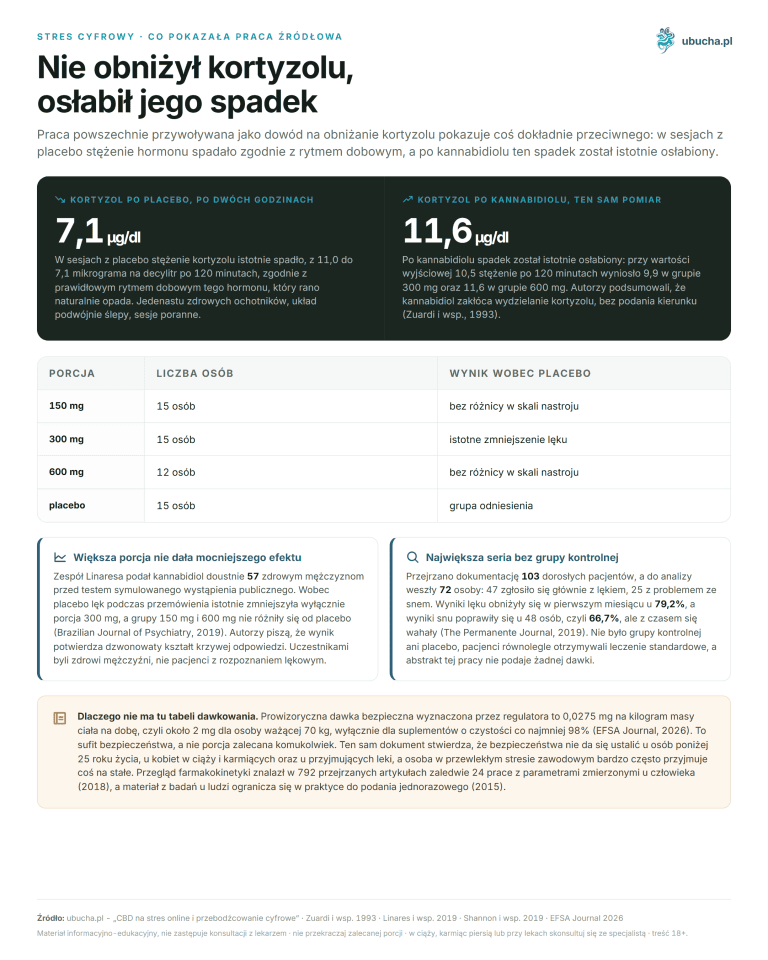
The most cited patient experience description is a retrospective case series from a psychiatric clinic. Documentation of 103 adults was reviewed; the final sample included 72 people mainly seeking help for anxiety (47) or poor sleep (25). Results were assessed with validated tools before and after cannabidiol administration (The Permanente Journal, Shannon 2019).
Anxiety scores decreased in the first month in 57 patients (79.2%) and remained lower throughout observation. Sleep scores improved in the first month in 48 patients (66.7%) but fluctuated over time. Cannabidiol was well tolerated except in three patients.
Authors cautiously conclude cannabidiol may benefit anxiety disorders and controlled clinical trials are needed. This is a case series without control group, so it does not separate substance effect from doctor contact or natural symptom course.
A broader review confirms this limitation. Preclinical data strongly support cannabidiol’s anxiolytic action, but human evidence is limited to single doses, and clinical population studies are few (Neurotherapeutics, Blessing 2015). The calming sensation described by users fits this picture but is not equivalent to proven therapeutic effect.
What does the latest European safety assessment say?
It is clearly more cautious than most texts circulating in the Polish internet. The EFSA panel on nutrition and novel foods updated in 2026 its position on cannabidiol safety as novel food, reviewing animal and human studies published up to June 2024 (EFSA Journal, 2026).
The panel derived a provisional safe dose of 0.0275 mg per kg body weight per day, about 2 mg per day for a 70 kg person, applying an uncertainty factor of 400. This is a safety ceiling, not a recommendation or dosing guideline. It applies only to supplements with at least 98% cannabidiol purity, no nanoparticles, safe production process, and excluded genotoxicity.
Gaps noted in the 2022 position remain. Animal studies showed consistent liver toxicity; human studies indicated hepatotoxic potential, especially with concomitant medications. Cannabidiol crosses the placenta and accumulates systemically; prenatal exposure showed sex-dependent long-term neurodevelopmental effects. Changes in thyroid hormone levels and adrenal histopathology were noted; immunotoxicity was not studied.
Cannabidiol safety cannot be established in people under 25 years old, pregnant and breastfeeding women, and those taking medications simultaneously (EFSA 2026). This sentence concerns a large part of people interested in this article’s topic and cannot be reconciled with the claim that cannabidiol is safe for everyone.
Why do we not cite the WHO 2018 report here?
Because it could not be verified at source, and an article based on a document the author did not access is only as strong as its weakest link. The address cited by the Polish cannabis text corpus for the critical cannabidiol review prepared for the Expert Committee on Drug Dependence no longer returns that document. The same dead link was found in dozens of articles on this blog and is being removed.
One specific sentence traveled with that link: that cannabidiol is well tolerated at doses up to 1500 mg per day. This statement functioned as safety information and often as encouragement to increase dose. Compared to the provisional safe dose derived by EFSA, about 2 mg per day for a 70 kg person, this is a discrepancy of hundreds of times.
This does not mean that document does not exist or said the opposite. It means we could not read it, so we do not build claims on it. The 1500 mg number appears validly elsewhere in this text: as one of the doses tested in Schoedel 2018, where it differed significantly from placebo. This is an experiment description, not a reader guideline.
The same principle applied to several other sentences. Sales data from a store presented as statistics, expert names whose participation could not be confirmed, and adverse event percentages attributed to an unread document were removed. More on the addiction question itself is in the post does CBD cause addiction.
What does this mean for the reader?
First, cannabidiol and tetrahydrocannabinol are not the same conversation. The first acts on CB1 receptor as a negative allosteric modulator in cell models; the second as a partial agonist responsible for psychoactive effect. Data on addiction transition, i.e., 8.9% cumulative probability, concern cannabis as a drug, not cannabidiol preparations.
Second, two experimental abuse potential studies gave consistent but not identical results. At doses up to 800 mg, cannabidiol behaved like placebo on all measures. At 1500 and 4500 mg, subjective effects were detectable but much weaker than alprazolam and dronabinol. The claim that cannabidiol “does not differ from placebo at any dose” simplifies the second study.
Third, practical risk lies elsewhere than usually sought. Real problems are delta-9-THC detectability in urine after full-spectrum products, label-content discrepancies, and drug interactions. None are addiction, but each can cost the reader more than the hypothesis asked about.
Fourth, lack of addiction proof is not proof of safety for all. Cannabidiol safety cannot be established in people under 25, pregnant and breastfeeding women, and those taking medications. If you belong to these groups, dose discussion is with a doctor, not an article.
Frequently Asked Questions
Does CBD cause addiction?
Available studies have not detected a signal of abuse potential at doses up to 800 mg, where cannabidiol behaved like a placebo in 31 frequent marijuana users (Babalonis 2017). However, there are no long-term studies tracking individuals using cannabidiol against DSM-5 criteria.
Can CBD cause intoxication?
Cannabidiol does not activate the CB1 receptor like tetrahydrocannabinol but acts as a non-competitive negative allosteric modulator of this receptor in cell models (Laprairie 2015). In tissues expressing CB1 and CB2 receptors, it behaves as an antagonist of their agonists (Pertwee 2008).
Is a 1500 mg dose of CBD safe?
This statement circulates without a verifiable source. In the Schoedel 2018 study, a 1500 mg dose showed a result significantly different from placebo on the drug liking scale. The EFSA panel derived a provisional safe dose of about 2 mg per day for a 70 kg person (EFSA 2026).
Will CBD affect drug test results?
After pure cannabidiol, only 1 out of 218 urine samples tested positive in screening and none exceeded the confirmatory threshold. After vaporizing cannabis with a CBD predominance containing 3.7 mg delta-9-THC, nine samples were positive and four confirmed (Spindle 2020).
Can tolerance to CBD develop?
There is a lack of studies that have checked this. In cell models, cannabidiol limits CB1 receptor internalization, acting opposite to substances that cause classical receptor tolerance (Laprairie 2015). The popular phenomenon of “reverse tolerance” has no confirmation in peer-reviewed literature.
What did the Epidiolex study in children show?
In a trial involving 120 individuals with Dravet syndrome, the median monthly seizure frequency dropped from 12.4 to 5.9 compared to a drop from 14.9 to 14.1 on placebo, at a dose of 20 mg/kg/day for 14 weeks. Diarrhea, vomiting, drowsiness, and abnormal liver tests were more frequent (Devinsky 2017).
Why do CBD products produce such varied effects?
Because the composition is often different from what is declared. In an analysis of fourteen commercial cannabidiol oils from the European market, nine samples had concentrations significantly deviating from the declaration, and the authors pointed to the lack of uniform regulation as the cause (Pavlovic 2018).
Who should not use cannabidiol?
The EFSA panel stated that cannabidiol safety cannot be established in people under 25 years old, pregnant and breastfeeding women, and those taking medications simultaneously. In these groups, the decision to use it should be made with a doctor, not independently (EFSA 2026).
This article is for informational and educational purposes and does not constitute medical advice. Before starting cannabis or CBD for therapeutic purposes, consult a doctor, especially if you take other medications, are pregnant, or breastfeeding.
Author: Michał Waluk · Published: 2026-05-11 · Updated: 2026-08-24