
CBD for Stress and Digital Overstimulation Online 2026
Screen overstimulation, stress axis, and cannabidiol: we check what source studies confirm, what is myth, and why we do not provide doses in milligrams.
A 7 a.m. notification, three messengers by noon, and one more message in the evening that could have waited until tomorrow. A growing group of people working at screens seek cannabidiol as a way to step off this treadmill. This text examines how justified that is. We reviewed all citations from the previous article version and removed every number not confirmed by the source work, and one claim turned out reversed: the study commonly cited as evidence for lowering cortisol shows the exact opposite. Below you will find what remains after this verification, along with an explanation of why there is no dosing table or day-by-day implementation plan. There are fewer numbers than promised by the first version, but each comes from a work that can be opened and read in full.
KEY INFORMATION
- In a 1993 study, cannabidiol did not lower cortisol but weakened its natural morning drop, so the concentration remained higher than after placebo (Brazilian Journal of Medical and Biological Research, 1993).
- In a randomized study of 57 healthy men, anxiety during public speaking was reduced only by the 300 mg dose; 150 mg and 600 mg did not differ from placebo (Brazilian Journal of Psychiatry, 2019).
- The most frequently cited clinical series included 72 adults, with anxiety scores dropping in 79.2% of them in the first month. Its abstract does not specify any dose (The Permanente Journal, 2019).
- The provisional safe dose set by the regulator is 0.0275 mg per kilogram of body weight per day, about 2 mg for a 70 kg person (EFSA Journal, 2026).
- Cannabidiol safety cannot be established for people under 25 years old, pregnant or breastfeeding women, and those taking medications.
What is digital overstimulation?
A colloquial term for a state in which the nervous system receives more stimuli than it can process, with screens and notifications as the source. It is not a disease or medical diagnosis, just a description of everyday experience.
It is worth saying upfront what you will not find in this text. The previous version of this article gave several striking percentages: how many adults experience physical symptoms of technological stress, how many notifications a remote worker receives daily, what percentage meets criteria for adjustment disorder. None of these numbers could be confirmed in the cited documents, and some references pointed to journal homepages instead of specific studies. We removed them all.
What remains is a description anyone will recognize without statistics: tense shoulders, scattered attention, difficulty falling asleep despite tiredness, irritability after work hours, feeling that the mind keeps working on a task even when the laptop is closed. This is reason enough to look for something. The question is whether cannabidiol can be that something, and this question can be answered much more cautiously than most product descriptions do. We will start with physiology, which can be described without any marketing, and only then check where cannabidiol fits in that physiology.
What does chronic stress do to the body?
It activates the hypothalamic-pituitary-adrenal axis, or HPA axis, and with prolonged exposure prevents it from returning to baseline. A textbook description of the stress response physiology walks through this pathway step by step (StatPearls, updated 2024).
The hypothalamus releases corticotropin-releasing hormone (CRH), which acts on two receptors: CRH-R1 and CRH-R2. The signal reaches the pituitary, which releases adrenocorticotropic hormone (ACTH), stimulating the adrenal cortex to secrete cortisol. Cortisol then does exactly what it is meant to: releases catecholamines, inhibits insulin, and makes energy stores available. For half an hour, this is a beneficial reaction.
The problem is the duration of exposure, not the reaction itself. The same description notes that exposure to chronic stressors leads to maladaptive responses, including depression, anxiety, cognitive impairment, and heart disease. This is why pharmacological support is considered, but also its limit: an intervention that does not reduce the number of stimuli acts on the effect, not the cause. Separately, we compiled a review of stress and cortisol supplements, where we posed the same question about other ingredients. Before proceeding, it is worth remembering one distinction. Cortisol is not a harmful hormone to be eliminated but a hormone with a clear circadian rhythm, high in the morning and ideally falling in the evening. The problem is flattening of this rhythm, not the hormone’s presence, and this difference will be important when evaluating the only study measuring cortisol after cannabidiol.
Is digital stress different from any other stress?
Physiologically, no. The stress axis does not recognize whether the signal came from a messenger or a car breakdown and triggers the same cascade of CRH, ACTH, and cortisol (StatPearls, updated 2024).
The difference lies elsewhere: in frequency and that the signal arrives when it cannot be responded to with action. The textbook description emphasizes that the stress response is adaptive when short and harmful when chronic. A 10 p.m. notification mobilizes the body for effort that cannot be discharged, and this happens a dozen times a day.
We must honestly say we found no study measuring cortisol separately in people exposed to screen overload compared to controls. Percentages circulating in industry materials led to journal homepages, not specific studies. Thus, conclusions about digital stress today rely on general chronic stress physiology, not separate evidence. This difference matters when someone sells a product described as specifically for screen overstimulation.
Does cannabidiol lower cortisol?
No, and the study most often cited to support this shows the opposite. It is the 1993 work by Zuardi et al., worth describing in detail because its results are often reversed in industry summaries.
Eleven healthy volunteers received placebo or oral cannabidiol in a double-blind design: 300 mg for seven people or 600 mg for four. Sessions were in the morning, with blood drawn from 35 minutes before to 180 minutes after administration. Prolactin and growth hormone levels did not change after placebo or cannabidiol (Brazilian Journal of Medical and Biological Research, 1993).
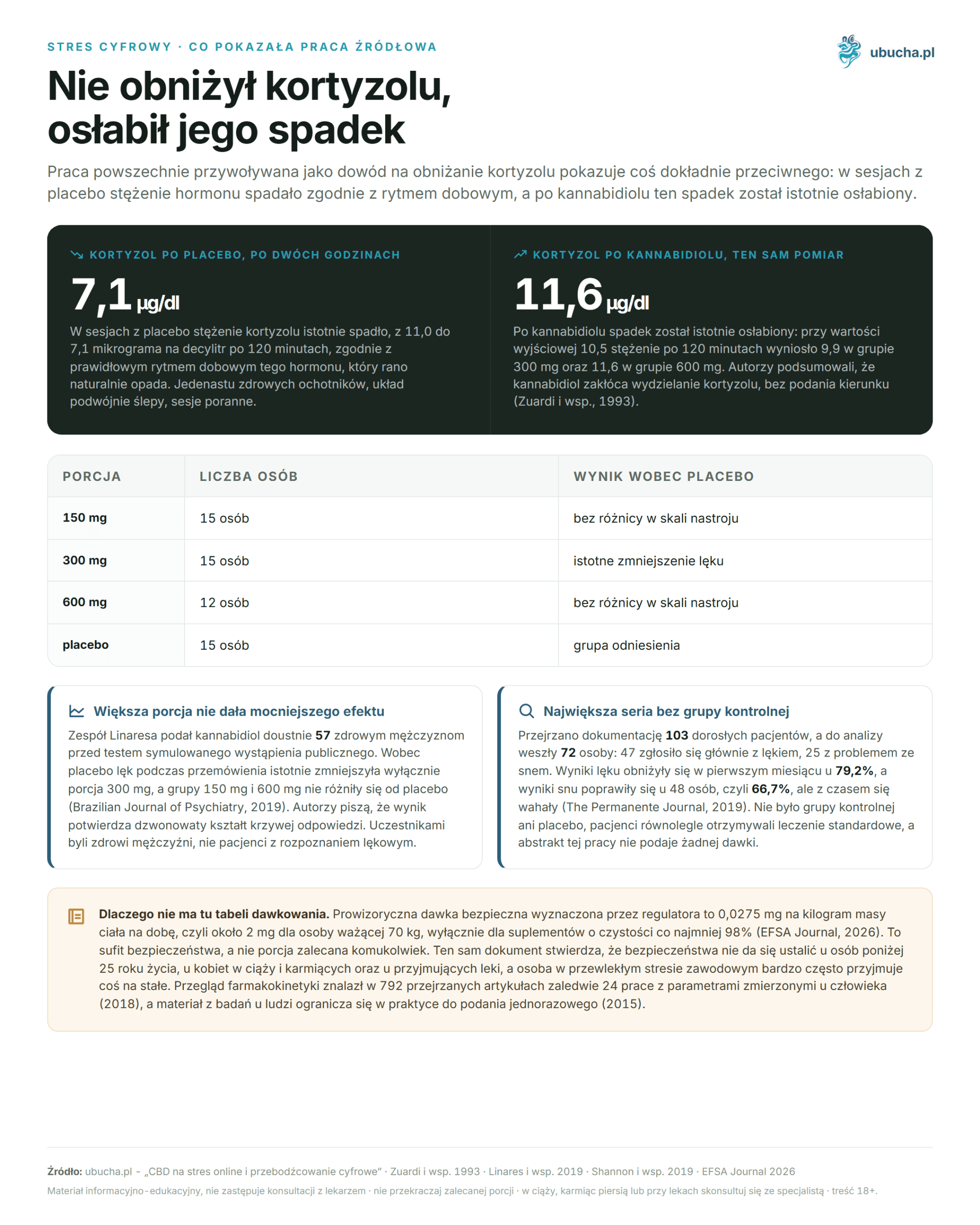
Cortisol behaved differently. In placebo sessions, its concentration significantly dropped from 11.0 to 7.1 micrograms per deciliter after 120 minutes, consistent with the normal circadian rhythm. After cannabidiol, this drop was significantly weakened: starting at 10.5, levels after 120 minutes were 9.9 in the 300 mg group and 11.6 in the 600 mg group. The authors concluded cannabidiol disrupts cortisol secretion and noted sedative effects on self-assessment scales. The claim that cannabidiol lowers cortisol, repeated in product descriptions, is thus a direct reversal of this study’s result.
Where this reversal comes from is only guesswork. The authors’ conclusion mentions disruption without specifying direction, and from such a statement it is a short step to adding a commercially convenient direction. It is also worth noting what this study did not measure: no stress stimulus, no chronically tense subjects, and no chronic administration beyond a single dose. Eleven volunteers, morning session, three hours observation. Inferring about evening cortisol in a person tired from screen time goes far beyond the study’s scope.
How does cannabidiol affect anxiety?
Via several pathways, best described is the serotonin 5-HT1A receptor. A 2012 review indicates that acute anxiolytic and antidepressant-like effects mainly rely on facilitation of signaling through this receptor.
This occurs in brain areas responsible for defensive reactions: the dorsal periaqueductal gray matter, the bed nucleus of the stria terminalis, and the medial prefrontal cortex. Other effects may depend on enhanced anandamide signaling, and activation of TRPV1 channels helps explain the bell-shaped dose-response curve observed with this compound (Philosophical Transactions of the Royal Society B, 2012).
The review authors emphasize a point lost in simplifications: the mechanism is not one but depends on which response is measured. They also list many pathways not yet studied, from adenosine reuptake inhibition to PPAR-gamma receptor action. The practical consequence is that product descriptions reducing all effects to one receptor oversimplify to the point of falsehood. More important for the reader is that these effects concern defensive reactions, i.e., what happens after a stimulus, not the number of stimuli.
Has this been confirmed in human studies?
Yes, but narrowly and with single dosing. The most cited is the 2011 study by Bergamaschi et al. on patients with generalized social anxiety disorder who had never been treated for it before.
Twenty-four patients were randomly assigned to two groups: twelve received 600 mg cannabidiol, twelve placebo, 90 minutes before a simulated public speaking test. Separately, twelve healthy volunteers underwent the same test without any compound. Mood visual analog scales, negative self-statements scale, blood pressure, heart rate, and skin conductance were measured (Neuropsychopharmacology, 2011).
Compared to placebo, cannabidiol significantly reduced anxiety, cognitive impairment, and discomfort during speech. Negative self-thoughts, which increased in the placebo group during the test, almost disappeared in the active group, and in most measured dimensions the active group did not differ from healthy volunteers. However, the study did not include brain imaging, although claims about neuroimaging changes are sometimes appended to it. We removed those claims and the paragraph based on them.
Does a higher dose produce a stronger effect?
No, and this is one of the better-documented surprises in this topic. Linares et al. in 2019 administered oral cannabidiol to 57 healthy men before a simulated public speaking test in a double-blind design.
Participants were assigned to four groups: 150 mg (15 people), 300 mg (15 people), 600 mg (12 people), and placebo (15 people). Only the 300 mg dose significantly reduced anxiety compared to placebo. The 150 mg and 600 mg groups did not differ from placebo on mood scales (Brazilian Journal of Psychiatry, 2019). The authors note this confirms the bell-shaped dose-response curve known from animal studies and call for rigorous determination of optimal doses.
Two points require attention because they circulate distorted. First, the study did not include a 900 mg dose, though that number is sometimes attributed to it. Second, participants were healthy men, not patients with anxiety disorders. The conclusion for someone seeking help with work stress remains: since the response does not increase with dose, adding more drops after a failed attempt is not supported by this study.
What did the largest clinical series show?
Improvement in anxiety in four out of five patients, but in a design that does not allow cause-effect conclusions. This is a retrospective case series by Shannon et al. from 2019, conducted in a psychiatric clinic.
Monthly records of 103 adult patients were reviewed; 72 were included in analysis: 47 primarily with anxiety, 25 with sleep problems. Anxiety scores decreased in 57 patients (79.2%) in the first month and remained lowered throughout observation. Sleep improved in 48 patients (66.7%) but fluctuated over time. The product was well tolerated except in three patients (The Permanente Journal, 2019).
Limitations are serious and acknowledged by authors. No control or placebo group, patients received standard treatment concurrently, and the paper ends with a call for controlled trials. Also worth noting is that the abstract does not specify any dose. The milligram ranges attributed to it in many guides do not come from its abstract, and we do not have access to the full text to repeat them.
Why don’t we provide a dose in milligrams?
Because there is no number that can be honestly given to a person we do not know. Providing a dose would be a recommendation, and recommendations require safety data that simply do not exist for internet readers.
The European regulator updated its stance on cannabidiol as a novel food in 2026. Using the benchmark dose method with an uncertainty factor of 400, it derived a provisional safe dose of 0.0275 mg per kilogram body weight per day, about 2 mg per day for a 70 kg person. This applies only to supplements with cannabidiol purity of at least 98%, without nanoparticles (EFSA Journal, 2026). This is a safety ceiling, not a recommended dose for anyone.
The same document states safety cannot be established for people under 25, pregnant or breastfeeding women, and those taking medications. Note who the last category describes. A person under chronic work stress often takes something regularly: an antidepressant, a blood pressure pill, a thyroid medication. Exactly for them, the regulator cannot set a safe amount, which is why instead of a dosing table there is a referral to a doctor or pharmacist.
What is the endocannabinoid system?
An internal regulatory system including cannabinoid receptors, their natural lipid ligands, and enzymes breaking down these ligands. A comprehensive review describes it as a pharmacotherapy target in a growing number of diseases (Pharmacological Reviews, 2006).
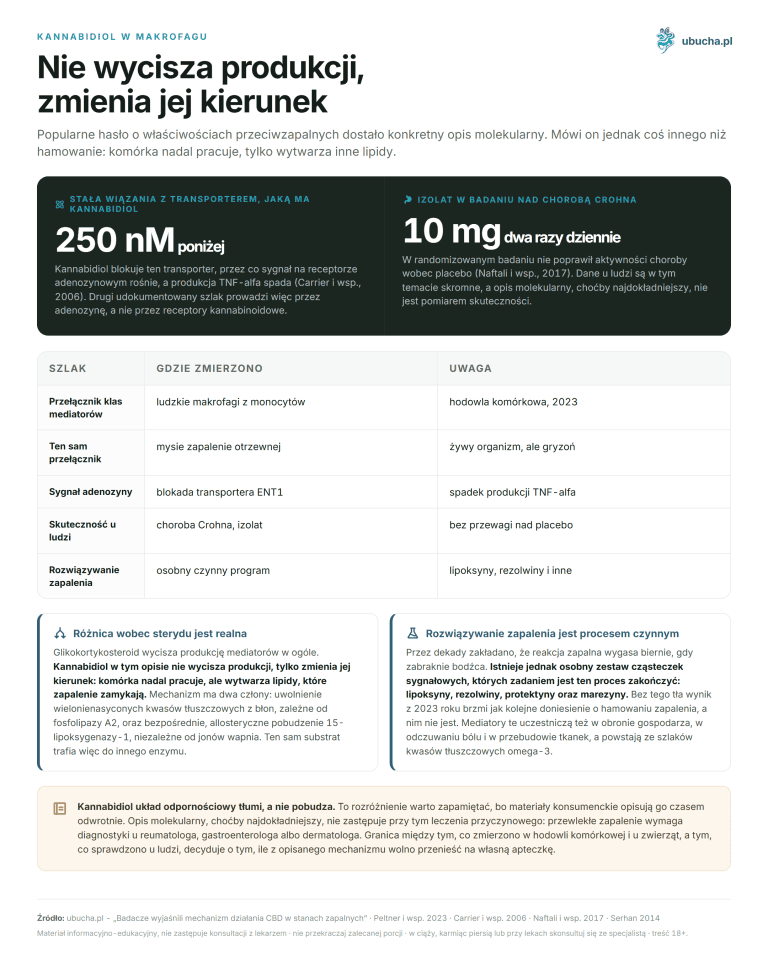
The list of conditions is long and includes mood and anxiety disorders, Parkinson’s and Huntington’s diseases, neuropathic pain, multiple sclerosis, hypertension, glaucoma, and metabolic syndrome. The authors note that psychoactive properties of CB1 receptor agonists hindered cannabinoid drug development, but indirect approaches blocking endocannabinoid breakdown or transport may bypass this.
For this article’s topic, the conclusion is less promising than typical marketing claims about restoring balance. The endocannabinoid system is a promising drug target, not a system you can boost with a bottle of supplement. The review discusses modulators in preclinical and clinical trials, not daily use of food supplements by healthy people. Keep this difference in mind when reading product descriptions. The review is from 2006, and its authors predicted that growing preclinical and clinical research would yield new treatments. Twenty years later, most of these promises remain unfulfilled.
How soon can effects be assessed?
Not before a week at the earliest, and a reliable answer is simply lacking. A systematic review of human pharmacokinetics found only 24 of 792 articles with human parameters measured (Frontiers in Pharmacology, 2018).
These studies show maximum concentration appears between zero and four hours after intake, faster after inhalation than oral, and increases after meals and in fat-based formulations. Half-life after chronic oral dosing is two to five days, meaning daily intake accumulates before steady state. The authors conclude data are insufficient and inconsistent.
A second limitation is even more serious. A review of evidence in anxiety disorders states human data mostly concern single dosing, with few chronic administration trials (Neurotherapeutics, 2015). In other words, we know something about cannabidiol’s effect on one public speaking event but very little about six weeks of daily use. Any implementation plan spanning weeks goes beyond current evidence.
What are side effects and interactions?
Most commonly reported are fatigue, diarrhea, and changes in appetite and weight. These are listed in a safety review covering clinical trials mostly in epilepsy and psychotic disorders, where doses are much higher than in supplements (Cannabis and Cannabinoid Research, 2017).
More serious are interactions. A pharmacokinetic and pharmacodynamic review notes cannabinoids are metabolized in the liver, so enzyme and transporter inhibition or induction can alter other drug levels. Clobazam metabolism inhibition is a documented example. Co-administration with central nervous system depressants adds effects, and combining with sympathomimetics carries cardiac risks (British Journal of Clinical Pharmacology, 2018).
Regulator signals add to this. Animal studies showed consistent liver toxicity, and human data indicate hepatotoxic potential, especially with concurrent medications. Gastrointestinal symptoms occur at higher doses, and neurological and psychiatric safety data are insufficient for assessment (EFSA Journal, 2026). If you take anything regularly, consulting a doctor or pharmacist is a condition, not a polite suggestion.
Does cannabidiol affect alertness at work?
It may cause sedation, and this effect was noted in the study often cited as evidence for stress reduction. In the 1993 cortisol study, participants reported sedative effects on self-assessment scales (Brazilian Journal of Medical and Biological Research, 1993).
This is confirmed by the most common side effects list in the safety review, with fatigue first (Cannabis and Cannabinoid Research, 2017). There is also a pharmacological warning: co-administration with other central nervous system depressants adds effects, and older people are more vulnerable (British Journal of Clinical Pharmacology, 2018). Someone taking cannabidiol during work should know this before driving or performing attention-demanding tasks.
The picture is not straightforward, as the opposite effect was measured under strong stress. In the social anxiety study, the cannabidiol group had less cognitive impairment during speech than placebo (Neuropsychopharmacology, 2011). This is not a contradiction but two different situations: under strong arousal, tension reduction helps perform; on a calm workday, the same reduction may cause drowsiness. The only practical advice is: first time not on a day you drive or operate machinery.
What won’t cannabidiol do?
It will not change the number of stimuli, which are the cause of the problem described. All discussed studies concern the body’s reaction to a stimulus, never its removal.
It will not repay sleep debt, replace conversations about work time boundaries, or cure anxiety or depression. Recall how narrow the evidence is: human data mostly concern single dosing, and clinical population trials are few (Neurotherapeutics, 2015). One public speaking event study does not imply anything certain about six months of work in a high-pressure team.
There is one more thing to know when planning your evening. The 1993 cortisol study noted sedative effects on self-assessment scales and simultaneously weakening of the morning cortisol drop (Brazilian Journal of Medical and Biological Research, 1993). These two effects do not form a simple story about calming the stress axis, and no one has combined them into a coherent model. It is more honest to say cannabidiol’s hormonal effects remain unclear than to add a convenient interpretation.
What to change about evening screen use?
Start with the light source, as there is a human experiment with hormonal measurement. Researchers compared reading on a light-emitting device versus a printed book in the hours before sleep.
Participants reading from a backlit screen took longer to fall asleep, were less sleepy in the evening, secreted less melatonin, had a delayed circadian clock, and were less rested the next morning than when reading paper (PNAS, 2015). The authors note that in a representative survey of 1508 American adults, 90% reported using some electronics at least several nights a week within an hour before bedtime.
This intervention has no cost or side effects, and its effect was shown under controlled conditions, unlike any digital stress supplement. Also important is the hour after which work email is not checked and notifications are turned off for the night. If evening calm is what you seek, also see the article on cannabidiol for sleep without melatonin. Order matters, as a supplement added to a lit evening works against something that could be turned off.
What has not been studied at all?
Surprisingly much, and it is worth knowing before spending money. Gaps are noted by review authors themselves, in summaries that disappear first from commercial abstracts.
The pharmacokinetic review found human parameters in only 24 of 792 articles and concludes data are insufficient and inconsistent (Frontiers in Pharmacology, 2018). The anxiety disorder evidence review states human data mostly concern single dosing (Neurotherapeutics, 2015). The safety review lists among gaps hormonal effects, which no one has studied, and the need for larger, longer trials (Cannabis and Cannabinoid Research, 2017).
The regulator is most blunt. In its 2026 assessment, the panel noted many new studies have methodological limitations: nonstandard protocols, short duration, and participants taking medications. It also pointed out immunotoxicity was not studied at all, despite cannabidiol interacting with immune pathways, and neurological and psychiatric safety data are too scarce for assessment (EFSA Journal, 2026). This does not mean the product is harmful. It means we do not know what we usually expect to know about something taken daily for many months.
When is a specialist needed?
When symptoms stop being a reaction to a difficult period and become a persistent state. No percentage from a report defines the boundary, only the picture you see in yourself over months.
Signals warranting an appointment with a psychologist, psychotherapist, or psychiatrist are well known clinically: anxiety persisting continuously for many months despite lifestyle changes, waking after a few hours of sleep with strong anxiety, panic attacks with palpitations and shortness of breath, loss of ability to enjoy formerly pleasurable things, resignation thoughts, social withdrawal. None of these is a reason to increase supplement dose.
Physiological bases explain why not to delay. Chronic stress axis activation leads to maladaptive responses including depression, anxiety, and cognitive impairment (StatPearls, updated 2024). The longer it lasts, the more recovery is needed. If you seek other support paths, we separately described adaptogens and their effects on the nervous system, with the same caveat: they complement, not treat. Another reason not to postpone is that self-administered supplements can mask symptom worsening for months, making a visit seem unnecessary while doing nothing about the cause. Time lost then is the only resource that cannot be regained.
Which claims did not withstand verification?
Five, all among the most repeated in stress product descriptions. We list them below with what the source study actually says.
| Claim from commercial materials | What the source study says |
|---|---|
| cannabidiol lowers cortisol | weakens its natural morning drop, so concentration remains higher than placebo (Zuardi 1993) |
| the stronger the stress, the higher the dose | effect shown only for 300 mg; 150 mg and 600 mg did not differ from placebo (Linares 2019) |
| 2019 clinical series establishes dose range | its abstract does not specify any dose (Shannon 2019) |
| safe up to 1500 mg per day | provisional safety ceiling about 2 mg per day for 70 kg person (EFSA 2026) |
| sublingual bioavailability is several percent | measured only after smoking in humans, where it was 31% (Millar 2018) |
They share one thing: none of these statements can be found in the cited study. For readers, this is a tip worth more than any number above. If a product description cites a study result, check if the link leads to a specific paper, not a journal homepage or press release. This one step catches most distortions we removed from this text.
Frequently Asked Questions
What is digital overstimulation?
A colloquial term for a state in which the nervous system receives more stimuli from screens and notifications than it can process. It is not a medical diagnosis. Typical symptoms include neck and shoulder tension, scattered attention, difficulty falling asleep despite tiredness, and irritability after work hours.
Does cannabidiol lower cortisol?
No. The study often cited to support this shows the opposite. After cannabidiol, the natural morning drop in cortisol was significantly weakened, meaning the concentration remained higher than after placebo (Brazilian Journal of Medical and Biological Research, 1993). The authors concluded the substance disrupts secretion of this hormone.
What is a safe starting dose?
We do not provide such a number. The European regulator has only derived a provisional safety ceiling of about 2 mg per day for a 70 kg person and noted that safety cannot be established for people taking medications (EFSA Journal, 2026).
Does a higher dose have a stronger effect?
No. In a randomized study of 57 healthy men, anxiety during public speaking was reduced only by the 300 mg dose; 150 mg and 600 mg did not differ from placebo (Brazilian Journal of Psychiatry, 2019). The dose-response curve is bell-shaped, not a simple increase.
How soon is the effect seen?
Maximum concentration appears between zero and four hours after intake (Frontiers in Pharmacology, 2018), but very little is known about effects with daily use, as human studies mostly concern single doses (Neurotherapeutics, 2015).
Can cannabidiol replace digital hygiene?
No. The effects described in studies concern the body’s reaction to a stimulus, not the number of stimuli. Evening cessation of backlit screen use has a proven effect on falling asleep and melatonin secretion (PNAS, 2015), and nothing replaces that.
Can cannabidiol be combined with medications?
Not without consultation. It is metabolized in the liver and can alter concentrations of other drugs, with clobazam as a documented example, and it adds to the effects of substances that depress the central nervous system (British Journal of Clinical Pharmacology, 2018).
Can it be used daily for months?
Unknown, as such studies are scarce. Few chronic administration trials have been conducted (Neurotherapeutics, 2015), and larger, longer trials are lacking (Cannabis and Cannabinoid Research, 2017). The regulator also points to signals of liver toxicity.
What does this mean for someone working at a screen?
That cannabidiol is a tool of uncertain strength with well-described limitations, not an answer to information overload. The strongest data concern single dosing before a stressful event (Neuropsychopharmacology, 2011), not daily use by a chronically tense person.
Along the way, two claims on which the previous guide version relied fell apart. Cannabidiol does not lower cortisol as product materials claim, because the source study shows weakening of its natural drop. There is no established daily dose for a healthy person, and the only number set by the regulator is a very low safety ceiling.
The practical order of actions is thus opposite to most advertising. First, the hour after which notifications stop and an evening without backlit screens, as this is the only intervention in the set confirmed by experiment. Then a conversation with a doctor or pharmacist, especially if you take anything regularly. Only then, if after that conversation you still want to try, choose a product from the oil category, fully aware how thin the evidence base is.
This article is for informational and educational purposes and does not constitute medical advice. Before starting cannabis or CBD for therapeutic purposes, consult a doctor, especially if you take other medications, are pregnant, or breastfeeding.
Author: Michał Waluk · Published: 2026-05-11 · Updated: 2026-08-10