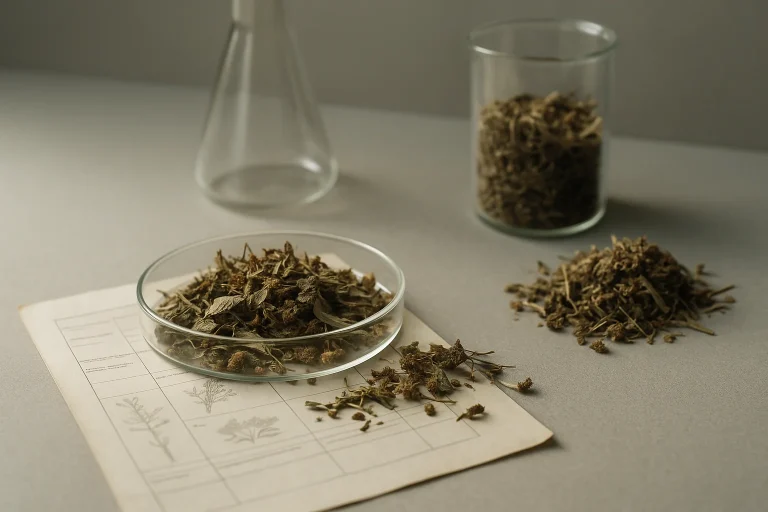

Smoking Hemp Flower Before Training - Impact on Athletic Performance and Workout Satisfaction
Does hemp flower before training improve performance? Review of 15 studies, cardiovascular risk, coordination impact, WADA rules, and Polish legal status.
Smoking hemp flower before training changes how effort is perceived, not how performance measures. This conclusion comes from a review of fifteen experimental studies and the only study where runners completed the same distance once after cannabis and once without. This text breaks down the topic into verifiable parts: THC pharmacology during exercise, heart and lung load, runner’s euphoria mechanism, coordination impact, differences between THC and cannabidiol, anti-doping rules, and Polish legal status. Every number was checked at the source and is accompanied by the population measured. Several claims previously included had to be removed because the cited studies say otherwise.
KEY INFORMATION
• A review of 15 studies on THC and exercise found no improvement in aerobic capacity (Kennedy 2017).
• In two studies from this review, cannabis caused angina at lower loads in all participants.
• In the runners’ study, perceived exertion did not differ between running after cannabis and running without; emotions differed.
• A meta-analysis of 24 studies links cannabis use with increased risk of acute coronary syndrome and stroke.
• In Poland, possession of cannabis other than fiber hemp is a crime under Article 62 of the Anti-Narcotics Act.
What happens in the body after smoking flower before training?
After inhalation, THC reaches the blood within seconds and binds cannabinoid CB1 receptors located in the brain, vessels, and heart muscle. The result is increased heart rate, peripheral vasodilation, and altered perception of signals from the working body. The athlete enters training with the full pharmacological effect of the psychoactive substance, not just residues. This is practically important because the typical interval between smoking and warm-up is about fifteen minutes, exactly the time needed for peak effect to coincide with session start.
The scale of this cardiovascular impact is well recognized. The American Heart Association dedicated a scientific statement to it, noting that cardiovascular therapeutic benefits are few, while some concerning health effects of cannabis involve the heart and vessels, mediated by the administration method (Page 2020, Circulation).
The second mechanism concerns perception. CB1 receptors are densely located in the prefrontal cortex, limbic system, and cerebellum - areas responsible for pain assessment, time perception, and motivation. Activation shifts the emotional perception of effort without changing muscle power output.
The third element is the smoke itself. A systematic review of 34 publications showed that short-term exposure to cannabis smoke dilates bronchi, increasing forced expiratory volume in one second by about 0.15-0.25 liters, but all fourteen studies on long-term use noted increased respiratory symptoms including cough, sputum, and wheezing (Tetrault 2007, Archives of Internal Medicine). Acute airway dilation is thus not a performance benefit but a side effect with a negative long-term balance.
Do cannabis improve sports performance?
No. A systematic review collecting all studies combining THC with formal exercise protocols found fifteen and none showed improved aerobic capacity. The author noted adverse effects: in two studies cannabis caused angina at lower loads in all participants, and muscle strength likely decreased. Some participants did not complete protocols due to adverse reactions after cannabis (Kennedy 2017, Journal of Science and Medicine in Sport).
A newer review in “Sports Medicine” reaches the same conclusion by a different route. Studies on the whole plant and THC alone usually show no effect or a harmful effect on strength and aerobic effort, and rigorous studies sufficient to resolve the issue simply do not exist. The authors add that cannabis’s ability to disrupt cardiovascular homeostasis requires separate mechanistic studies (Burr 2021).
The claim that marijuana is a doping agent has no support in sports literature. Athletes who use flower before training do so for non-performance reasons, or at least describe it that way: for relaxation, pleasure, reducing pre-start tension, or to endure the monotony of long effort.
One observation from Kennedy’s review is important for any athlete subject to anti-doping control. Aerobic exercise itself raises blood THC concentration minimally, below one nanogram per milliliter. The popular claim that intense training can “flush out” or suddenly release THC from fat tissue causing a positive test is not supported by these data.
What did the Colorado runners’ study really show?
A team from the University of Colorado conducted the only study where the same people ran the same distance once after cannabis and once without, in natural conditions, freely choosing products from the legal market. There were 49 participants aged 21-49, average distance 3.88 miles (Gibson and Bryan 2024, Cannabis and Cannabinoid Research).
Results contradict popular stories about this study. Running after cannabis was on average 31 seconds per mile slower, but the difference did not reach statistical significance (p = 0.12). Participants reported less negative affect, more positive affect, more calm, more pleasure, and stronger runner’s euphoria symptoms, and lower pain after running with cannabis.
The most misrepresented result concerns perceived exertion. In this study it did not differ between runs (p = 0.33). The claim that cannabis makes running physiologically “harder” does not come from this work. Nor does the division into sessions after cannabidiol-dominant and THC-dominant strains: product form, cannabinoid content, and perceived “high” intensity were largely unrelated to training outcome in this study.
An earlier version of this article described the study as involving 42 runners published in “Sports Medicine”, with three treadmill sessions and a 0.8-point increase in Borg scale exertion. None of these elements matches the study we read. The authors cautiously conclude: acute cannabis use may be associated with a more pleasant exercise experience in regular users, and long-term benefits and harms require further research.
How many athletes combine cannabis with training?
The percentage is high but concerns a narrower group than usually cited. An online survey included 605 adult cannabis users living in states with full legal access, not runners in general. Among them, 81.7 percent declared combining cannabis with physical activity, more often men and younger people (YorkWilliams 2019, Frontiers in Public Health).
The 81.7 percent figure thus indicates how many cannabis users combine it with movement, not how many experience longer exercise tolerance thanks to it. This distinction disappears in most summaries of this study, including the previous version of this article, changing the result’s meaning.
Other findings from this survey: those combining cannabis with movement reported more minutes of aerobic and anaerobic exercise weekly than other users, even after adjusting for age and sex. Most respondents felt that using cannabis shortly before or after training increased exercise pleasure and improved recovery, and about half indicated increased motivation to exercise.
These are declarative data from a single cross-section in a population by definition favorable to cannabis. They say nothing about measured performance and nothing about causality direction: physically active people may simply use cannabis more often. The authors call their work a clarifying step, not a decisive one. They also note the context enabling this survey: legalization increased both the number of adults starting use and the potency of available products, so results from the legal market do not directly transfer to other countries or earlier decades.
What is the cardiovascular risk of exercise under THC?
Physical effort itself stimulates the sympathetic system and increases myocardial oxygen demand. Adding THC-induced heart rate acceleration sums the load, which in a person with coronary disease may exceed coronary reserve. The strongest single evidence comes from exercise studies: in two works cannabis caused angina at lower loads in all participants (Kennedy 2017).
Population risk scale is described by a meta-analysis published in “Heart”. It included 24 pharmacoepidemiological studies: seventeen cross-sectional, six cohort, and one case-control. Estimated relative risk was 1.29 for acute coronary syndrome, 1.20 for stroke, and 2.10 for cardiovascular death (Storck 2025).
Three caveats apply. First, these are observational data, so they indicate association, not causation. Second, no significant association was found for the composite endpoint combining infarction and stroke. Third, none of these studies measured risk during exercise itself, only in daily life of users.
The practical conclusion is clear. For a healthy person in their twenties, single session risk remains low. For someone over forty, with hypertension or undiagnosed coronary disease, the first intense training after smoking a joint is a situation where two independent heart stressors coincide. The American Heart Association places cannabis among substances whose cardiovascular profile requires physician attention (Page 2020). The authors emphasize that understanding cannabis safety was limited for decades by its illegality, so lack of data on events is not evidence that events do not occur.
Why is “runner’s euphoria” an endocannabinoid effect?
Because an experiment blocking cannabinoid receptors in mice showed that anxiolytic and analgesic components depend on cannabinoid receptors. Animals with inactive CB1 receptors on forebrain GABAergic neurons lost the anxiolytic effect after running, and animals with blocked peripheral CB1 and CB2 receptors lost the analgesic effect. Blocking cannabinoid or opioid receptors did not affect sedation (Fuss 2015, PNAS).
This work contains a sentence often omitted in popular summaries that changes the conclusion scope: euphoria cannot be studied in a mouse model. The authors demonstrated the endocannabinoid basis of two components - anxiety reduction and pain reduction - but not the feeling of euphoria itself. A previous version of this article incorrectly stated “loss of euphoric effect” in mice, which the study does not say.
In humans, the starting point is an older study on trained students running on a treadmill or cycling for 50 minutes at 70-80 percent max heart rate. The authors presented the first evidence that moderate intensity exercise activates the endocannabinoid system and proposed it as a mechanism for post-exercise analgesia (Sparling 2003, Neuroreport).
Since THC and endocannabinoids bind the same receptor, the question arises whether smoking before running enhances or diminishes the runner’s effect. No decisive data exist, and it is fair to say so. The hypothesis that exogenous THC saturates CB1 receptors and weakens response to endogenous endocannabinoids fits pharmacology but has not been measured in humans, so remains a hypothesis. The endocannabinoid topic is developed in a separate text on runner’s euphoria and the endocannabinoid system.
How does THC affect coordination and reaction time?
Impairment is measured and greatest immediately after inhalation. In a study of 70 regular cannabis users in Colorado, peak psychomotor impairment occurred right after use, and after one hour results returned to baseline. The same pattern was replicated in a smaller sample of 39 people in Washington state. The effect involved reaction time in divided attention tasks and balance maintenance (Karoly 2022, Cannabis and Cannabinoid Research).
A second data set comes from driving studies, which measure the same functions precisely. A meta-analysis of 57 experimental studies with 1725 participants showed that cannabis alone impairs lane control, with impairment magnitude comparable to low blood alcohol levels. Combining cannabis with alcohol worsens results more than either substance alone (Simmons 2022, Addiction).
For sports, this translates to one boundary. Disciplines requiring precise movement, quick situation assessment, and balance - climbing, skiing, combat sports, and team games - are affected. Coordination impairment does not mean worse results but higher risk of falls, collisions, or injuries to self and training partners.
The previously stated “20-40 percent increase in reaction time” under a 2021 citation has no support in any found studies. We replaced it with data from two reviews describing effect direction and duration but not reducing it to a single percentage.
Tolerance is a separate issue. The Colorado study involved regular cannabis users, a group in which some subjective and cognitive effects weaken over time. Even so, psychomotor impairment occurred. The belief that experienced users “know how it affects them” and thus maintain full function is not supported by these data.
Who is most harmed by smoking before training?
Four groups emerge clearly at risk from the discussed studies: people with diagnosed or suspected cardiovascular disease, people with anxiety disorders, athletes in technical disciplines, and people on chronic medications. Also, situations with no data exist, such as pregnancy and breastfeeding.
In the cardiology group, the decisive result is from exercise studies where cannabis lowered angina threshold in all participants of two works. Hypertension, coronary disease, cardiomyopathy, arrhythmias, and post-infarction states are situations where combining smoked cannabis with intense exercise has no benefit justification.
In the anxiety group, the problem is THC’s bidirectional action. The same substance that calms at low doses causes anxiety, depersonalization, and panic attacks at higher doses, with an individual and day-to-day variable threshold. Training under THC may end in panic instead of runner’s euphoria, and physical effort further raises heart rate, which anxiety interprets as a threat signal.
Medications stand apart. Cannabinoids are metabolized by cytochrome P450 and may alter concentrations of concurrently taken drugs. The EFSA panel stated in 2026 that cannabidiol safety cannot be established in people under 25, pregnant or breastfeeding women, and those on medications (EFSA 2026). This assessment concerns substances milder than THC, so caution should be greater, not less, with smoked flower.
The least obvious group is beginners. Exercise is a new stimulus for them, and introducing a substance altering perception of heart rate, breathing, and fatigue deprives them of learning their own response to load. The ability to recognize the “this is too much” signal builds during initial sessions.
How does CBD differ from THC in the training context?
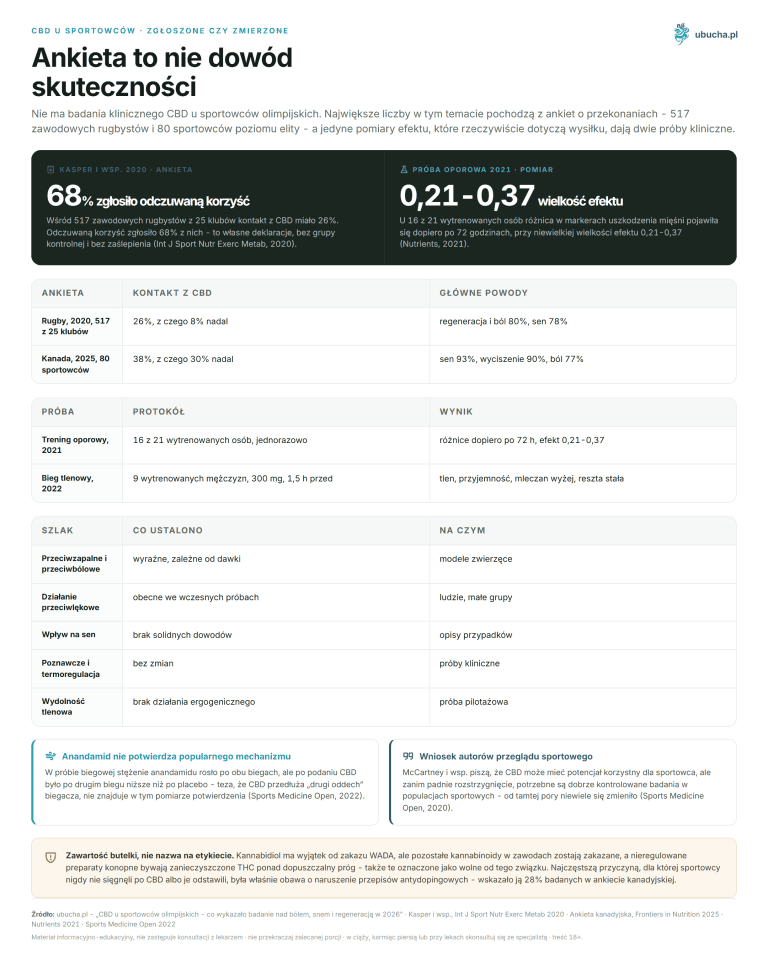
It differs in everything relevant to sport: it does not cause psychoactive effects, does not increase heart rate comparably to THC, and is not banned by the World Anti-Doping Agency. A narrative review in “Sports Medicine - Open” collected evidence potentially relevant to athletes and cautiously concludes: direct studies on cannabidiol and sports performance are lacking (McCartney 2020).
What the review actually states: strong anti-inflammatory, neuroprotective, and analgesic effects are described in animal models. Early clinical studies suggest anxiolytic effects in stressful situations and in people with anxiety disorders. Regarding sleep, authors note case reports of improvement but lack strong evidence. Cognitive functions and thermoregulation remain unchanged. Effects on appetite, metabolism, cardiovascular system, and infection susceptibility require further research, with all conclusions qualified as based on animal models and studies in non-athletes.
Evidence for anxiolytic effect comes from a double-blind study in 24 untreated patients with social phobia. A single 600 mg cannabidiol dose given 1.5 hours before simulated public speaking reduced anxiety and discomfort to levels observed in healthy controls (Bergamaschi 2011, Neuropsychopharmacology). This describes a specific research protocol, not a reader dosage recommendation.
Recovery data are preliminary. A randomized pilot study with 40 training individuals after experimentally induced delayed onset muscle soreness tested a compound preparation containing among others 35 mg cannabidiol and 50 mg cannabigerol. It reduced disruption of daily activities due to soreness but had no effect on objective recovery markers, sleep quality, or mood (Peters 2023). More data are collected in the post on CBD for athletes and post-workout pain.
What do WADA rules say about cannabis in sport?
The World Anti-Doping Agency bans all natural and synthetic cannabinoids except cannabidiol. THC remains banned only in competition and only above 150 nanograms per milliliter in urine; out of competition it is not tested (WADA prohibited list). Cannabidiol was removed from the list with the 2018 edition.
The logic is twofold. In competition, fairness is protected, so psychoactive substances affecting coordination and judgment are banned. Out of competition, the goal is health protection, and evidence of THC harm to athletes was not strong enough to justify a year-round ban.
The threshold level has practical meaning. 150 nanograms per milliliter is set to avoid penalizing athletes for use distant from competition. For daily cannabis users, the situation differs because metabolites accumulate in fat tissue and are excreted over weeks, producing very different test results with identical behavior.
A separate trap is full-spectrum products. Oils labeled cannabidiol may contain trace THC not declared on the label, which with regular use can cause a positive test. Licensed athletes are safer with isolates or broad-spectrum THC-free products. We track regulation changes in the post on CBD in sport and WADA and POLADA regulations.
Amateur athletes not belonging to federations under anti-doping systems are formally not subject to these rules. However, this does not mean freedom, as national law applies regardless of sports status and governs legality of possession in Poland.
What is the legal status of smoking hemp flower in Poland?
Flower with THC content above the statutory threshold is cannabis other than fiber hemp, and possession is a crime punishable by up to 3 years imprisonment (Article 62 paragraph 1 of the Anti-Narcotics Act, consolidated text Journal of Laws 2023 item 1939). The sports context does not change this and does not exclude liability.
The threshold is calculated differently than most online texts state. The law refers to the sum of delta-9-THC and tetrahydrocannabinolic acid, rounded to one decimal place, and applies to flowering or fruiting tops of the plant, not the finished product. Fiber hemp is defined as plants with this sum not exceeding 0.3 percent dry weight; cannabis other than fiber hemp exceeds this. The basis is Articles 4 point 5 and 4 point 37 of the same act, as amended by the March 24, 2022 amendment (Journal of Laws 2022 item 763).
The law allows for case dismissal for small amounts intended for personal use in minor cases (Article 62a). However, this is a prosecutor’s or court’s decision, not a possessor’s right, and does not cover possession of significant amounts.
Medical marijuana is a separate path. Cannabis other than fiber hemp may be a pharmaceutical raw material for compounding prescription drugs in pharmacies under Article 33a of the act, after obtaining permission from the Office for Registration of Medicinal Products. This provision was introduced by the July 7, 2017 act, effective November 1, 2017 (Journal of Laws 2017 item 1458). A prescription is not a permit for independent processing or arbitrary use, and cannabidiol is not listed among controlled substances.
What are the consequences of training and driving after cannabis?
Training itself is not punishable, but the trip to training is. The basis for testing for substances acting like alcohol is Article 129j of the Road Traffic Act, not the alcohol test regulation, which is often confused. Driving under the influence of an intoxicant is a crime under Article 178a paragraph 1 of the Penal Code, punishable by up to 3 years imprisonment.
The often repeated “1 nanogram THC blood threshold” is a misunderstanding. This value comes from a regulation describing testing methodology and means the limit of detection, i.e., the concentration below which the lab cannot confirm substance presence. It is not a criminal responsibility threshold, and the regulation does not specify a saliva threshold.
Two bases differ in consequences. Driving while impaired by an intoxicant is a misdemeanor under Article 87 paragraph 1 of the Code of Misdemeanors, while driving under the influence is a crime under Article 178a paragraph 1 of the Penal Code. Courts impose driving bans in both cases, and in crimes also a financial penalty of no less than 5000 PLN.
For athletes, there is also a sports dimension. A positive anti-doping test in competition triggers disciplinary proceedings regardless of whether the substance was used to improve performance. Legal and sports consequences run in parallel from two independent systems.
How to reduce risk if someone still uses cannabinoids?
This section aims not to encourage but to reduce harm for those who have decided. The first rule follows directly from data: cannabidiol does not cause psychoactive effects, does not impair cognitive functions or thermoregulation, and is not banned in sport, so in training context it is a far less risky choice than smoked THC-dominant flower.
The second rule concerns form. Vaporization produces plasma THC concentrations similar to smoking but lower carbon monoxide in exhaled air, as shown in a study with eighteen participants comparing a vaporizer to marijuana cigarettes (Abrams 2007). Vaporization does not remove THC’s psychoactive effects. Differences between devices are described in the vaporizer guide.
The third rule concerns timing. Since peak psychomotor impairment occurs immediately after inhalation and returns to baseline after one hour, training started fifteen minutes after smoking coincides with the greatest coordination impairment. A one-hour interval changes the situation but does not remove cardiovascular load.
The fourth rule concerns dose and is hardest to apply because no safe dose has been established. The EFSA panel derived a provisional safe dose for cannabidiol alone of 0.0275 mg per kilogram body weight per day, about 2 mg daily for a 70 kg person, only for supplements with at least 98 percent purity. No equivalent assessment exists for THC. The fifth rule is simple: with chronic illness, medications, or age over forty, consult a doctor before first use.
What follows from this?
The balance is asymmetric. Benefits are subjective data: more pleasant running, less negative affect, less post-exercise pain, stronger runner’s euphoria. Costs are hard data: no performance improvement in fifteen studies, lowered angina threshold in two, coordination impairment immediately after inhalation, increased respiratory symptoms with long-term use, and elevated cardiovascular event risk in a meta-analysis of 24 studies.
For someone training for results, the conclusion is clear and needs no interpretation: cannabis is not a performance enhancer. For someone training for well-being, the matter is more open, but even there a natural run lasting over half an hour activates the same receptor system without heart, legal, or sports costs.
Cannabidiol is a separate category and should be treated as such. It is non-psychoactive, not subject to anti-doping bans, and has preliminary data on anxiety and functional post-exercise pain dimensions. However, there is not a single study showing performance improvement after its administration.
Finally, this article changed itself. Five claims previously included had no support in cited studies, and one citation led to a mouse vascular study. If you see a precise number without author and year in texts about supplements or cannabis, treat it as a signal to check the source.
We leave open a question posed by the runners’ study authors. Since acute cannabis use is associated with a more pleasant exercise experience, could it be a bridge to regular activity for someone avoiding movement? No one knows today, as it would require long-term studies, which are just emerging.
Frequently Asked Questions
Does smoking cannabis before training improve sports performance?
No. A systematic review covered 15 studies combining THC with formal exercise protocols and none found improved aerobic capacity. Muscle strength likely decreased, and in two studies cannabis caused angina at lower loads in all participants.
Does cannabis make running feel harder?
In the only study that measured this, perceived exertion did not differ between running after cannabis and running without it. Emotions differed: less negative affect, more pleasure and calm, and lower pain levels after running. Pace was 31 seconds per mile slower, but not statistically significant.
Is CBD banned by WADA?
No. The World Anti-Doping Agency bans all natural and synthetic cannabinoids except cannabidiol, removed from the list with the 2018 edition. However, caution is advised with full-spectrum oils that may contain trace THC not declared on the label.
Is runner’s euphoria due to endorphins or endocannabinoids?
A mouse study showed that anxiolytic and analgesic components depend on cannabinoid receptors. Sedation did not depend on cannabinoid or opioid receptors. The authors did not study euphoria itself because it cannot be measured in a mouse model.
What is the cardiovascular risk of smoking a joint before training?
A meta-analysis of 24 observational studies reports a relative risk of 1.29 for acute coronary syndrome, 1.20 for stroke, and 2.10 for cardiovascular death among cannabis users. In exercise studies, cannabis lowered the angina threshold in all participants of two studies.
How long does coordination impairment last after smoking?
The peak psychomotor impairment occurs immediately after inhalation, and after one hour results return to baseline. This was measured in 70 people in Colorado and replicated in 39 people in Washington state. The effect included reaction time with divided attention and balance maintenance.
Does CBD help with post-workout recovery?
Data are preliminary. In a randomized pilot study with 40 training individuals, a compound preparation reduced disruption of daily activities due to muscle soreness but did not affect objective recovery markers, sleep quality, or mood. Direct studies on cannabidiol’s effect on sports performance are lacking.
Is vaporization safer than smoking flower?
In one respect, yes. In a study with eighteen participants, vaporization produced similar plasma THC concentrations with lower carbon monoxide levels in exhaled air. Vaporization does not remove THC’s psychoactive effects on coordination and heart rate, so it changes less for an athlete than commonly believed.
Oral preparations mentioned in this text can be found in the oils category at u Bucha store.
This article is for informational and educational purposes and does not constitute medical advice. Consult a doctor before starting cannabis or CBD for therapeutic purposes, especially if you take other medications, are pregnant, or breastfeeding.
Author: Michał Waluk · Published: 2026-05-04 · Updated: 2026-08-10