
THCA: what it is, how it works and how it differs from THC
THCA is the acidic form of THC from the raw cannabis plant. How does it differ from THC, what happens to it when heated, and why does Polish law mention it by name.
On the label of the dried product, you see “THCA 18%” instead of “THC 18%” and this is not a printing error. The raw cannabis plant produces almost no THC. It produces its acidic form, THCA, which only loses its carboxyl group and becomes a psychoactive compound under the influence of heat. This difference has two consequences: it changes what you feel and it changes how the plant material qualifies under Polish law. The second of these has generated the most misunderstandings, with the repeated claim about the gray area at the forefront. Meanwhile, the law mentions the acidic form directly, and in three places at once, so the matter is simpler than popular descriptions suggest. Below, I separate chemistry from law, and with each claim, I provide the work or regulation that supports it.
KEY INFORMATION
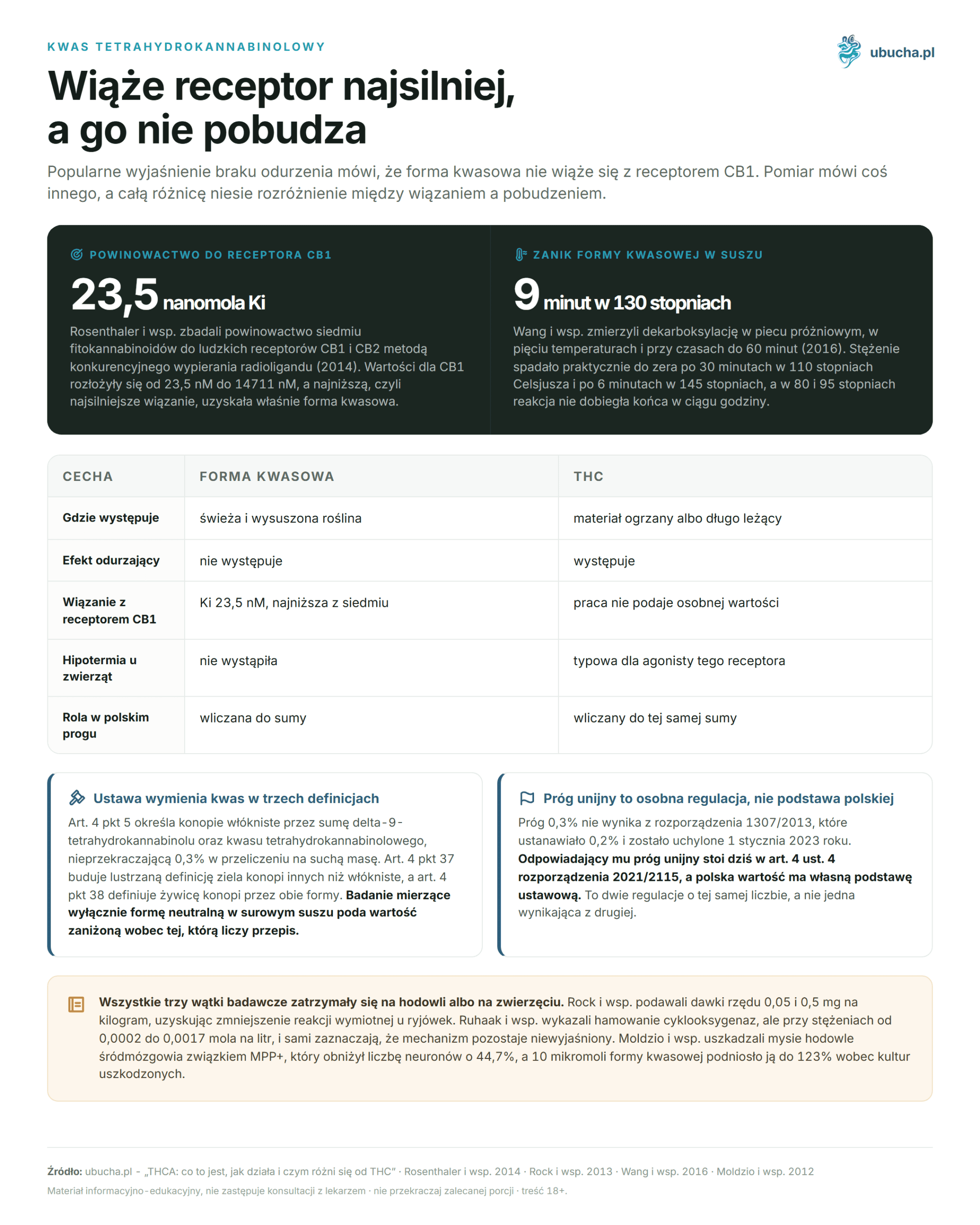
• In the binding test, THCA showed the strongest affinity for the CB1 receptor among the seven studied phytocannabinoids, with a Ki of 23.5 nM (Rosenthaler et al., Neurotoxicology and Teratology 2014).
• Despite this, in animals, THCA did not produce effects typical of a CB1 agonist, such as hypothermia or decreased motor activity.
• At 110 degrees Celsius, THCA disappears from the dried product after about 30 minutes, and at 130 degrees after 9 minutes.
• Polish law mentions tetrahydrocannabinolic acid by name in three definitions of the Act on Counteracting Drug Addiction.
What is THCA and how is it produced in the cannabis plant?
THCA, or tetrahydrocannabinolic acid, is the dominant cannabinoid in fresh, unheated cannabis plants. The living plant does not synthesize THC directly. It first builds cannabigerolic acid, and from it, with the help of synthase, the acidic form of THC is produced. Only heat converts it into the compound associated with intoxication.
Biosynthesis occurs in trichomes, which are secretory glands covering the inflorescence and stipules. There, the acidic form accumulates throughout the growth period and remains there after the plant is cut and dried. That is why raw dried material contains almost exclusively THCA, not THC, and that is why producers indicate this first value on the label.
The acidic form is chemically more stable than the neutral form and degrades more slowly at room temperature, which explains why the plant stores it. The same pattern applies to other acidic forms of cannabinoids: CBDA converts to CBD, and CBGA to CBG, through the same reaction and within the same temperature range.
The discrepancy in reporting arises precisely from this. A laboratory can report the raw content, i.e., THCA in the material as it came for testing, or the total content after conversion to THC. The two numbers for the same sample differ by several percent because the molecule loses the mass of the carboxyl group during decarboxylation. Without information on which value was provided, the percentage on the label of hemp dried product says less than it seems.
How does THCA differ from THC?
By one carboxyl group and all the resulting consequences. The chemical difference is slight, but the difference in effect on the body is fundamental: the acidic form does not produce intoxication. The table below summarizes what can be said about both forms without delving into speculation.
| Feature | THCA | THC |
|---|---|---|
| Name | Tetrahydrocannabinolic acid | Delta-9-tetrahydrocannabinol |
| Where it occurs | Fresh and dried plant | Heated material or long-stored |
| Intoxicating effect | None | Yes |
| Affinity for CB1 in binding test | Ki 23.5 nM, the lowest value among seven studied phytocannabinoids (Rosenthaler 2014) | This same work does not provide a separate Ki value for CB1 |
| How it is produced | Biosynthesis in the trichomes of the living plant | Decarboxylation of THCA under the influence of heat |
| Role in Polish legal definition of threshold | Included in the sum together with THC | Included in the sum together with THCA |
The most commonly repeated explanation for the lack of intoxication is that THCA does not bind to the CB1 receptor. Measurement tells a different story. Rosenthaler and colleagues examined the affinity of seven phytocannabinoids for human CB1 and CB2 receptors using a competitive radioligand displacement method. The Ki values for CB1 ranged from 23.5 nM to 14711 nM, with the lowest, indicating the strongest binding, being THCA.
However, binding is not the same as receptor activation. Rock and colleagues tested two behaviors in animals considered signatures of a CB1 agonist, body temperature reduction and decreased motor activity, and THCA did not produce either (Rock et al., British Journal of Pharmacology 2013). The authors of the affinity study concluded that the observed cellular effects cannot be explained solely by binding to the receptor.
What happens to THCA during heating?
It loses its carboxyl group and becomes THC. The reaction is called decarboxylation, follows first-order kinetics, and its rate increases sharply with temperature. Wang and colleagues measured it for extracts from Cannabis sativa in a vacuum oven, at five temperatures and for times up to 60 minutes.
The results are specific. The concentration of THCA dropped to almost zero after 30 minutes at 110 degrees Celsius, after 9 minutes at 130 degrees, and after 6 minutes at 145 degrees. At 80 and 95 degrees, the reaction did not complete within an hour (Wang et al., Cannabis and Cannabinoid Research 2016). The activation energy was found to be 88 kJ/mol.
It is also worth noting the purity of this transformation. After 40 minutes at 110 degrees, the only detected degradation product was delta-9-THC, and the relative loss of the sum of molar concentrations was 7.94%. For CBDA and CBGA, the picture was less clear, as some reagents or products decreased without explanation, and the rate constants for the acidic form of THC turned out to be twice as high as for the other two.
The practical conclusion concerns storage and targeted decarboxylation. The lowest temperature studied was 80 degrees, and even there the reaction did not complete within an hour, so this work does not provide information on the rate of transformation under storage conditions. However, it is known in which direction heat acts, and that is enough for a practical tip: cool, dark, and airtight storage preserves the acidic form, and juice from raw leaves or frozen fresh plants retains it almost entirely.
Does Polish law recognize THCA?
It does, and it does so by name, in three separate definitions. The claim that the law only controls THC, while its acidic precursor remains in the gray area, contradicts the content of the regulation. It is enough to read the definitions from Article 4 of the Act on Counteracting Drug Addiction.
Article 4 point 5 defines industrial hemp as Cannabis sativa L. plants in which the sum of the content of delta-9-tetrahydrocannabinol and tetrahydrocannabinolic acid in flowering or fruiting tops, from which resin has not been removed, does not exceed 0.3% when calculated on a dry mass basis, with the sum being rounded to one decimal place. Article 4 point 37 builds a mirror definition of cannabis other than industrial hemp, above the same sum. Article 4 point 38 defines cannabis resin as products containing delta-9-THC or delta-9-tetrahydrocannabinolic acid.
The consequence is practical, not academic. Whether a given plant material is legal industrial hemp is determined by the sum of both forms, not just delta-9-THC. A study measuring only the neutral form in raw dried material will provide a value significantly underestimated compared to what the regulation counts, because in unheated material, the acidic form predominates. The basis: consolidated text of the Journal of Laws 2023 item 1939, as amended by the Act of March 24, 2022 (Journal of Laws 2022 item 763), in force since May 7, 2022.
It is also worth correcting the second repeated statement. The threshold of 0.3% does not result from Regulation (EU) 1307/2013, which established 0.2% and was repealed on January 1, 2023. The corresponding EU threshold is now in Article 4 paragraph 4 of Regulation (EU) 2021/2115, and the Polish value has its own statutory basis. These are two regulations with the same number, not one resulting from the other.
What have previous studies on THCA shown?
Three threads have peer-reviewed publications, all on animal or cell models. None have reached the stage of clinical trials in humans, so each statement below describes an experiment, not an application.
The first thread concerns nausea and vomiting. Rock and colleagues administered doses of 0.05 and 0.5 mg per kilogram of body weight to animals, observing a reduction in the vomiting response in Suncus murinus and a conditioned grimace in rats. The effect was blocked by a CB1 receptor antagonist, but not by a serotonin receptor antagonist, indicating the involvement of the cannabinoid pathway. THCA, not THC, was detected in the animals’ plasma.
The second thread concerns inflammation. Ruhaak and colleagues examined six cannabinoids isolated from Cannabis sativa, including the acidic form of THC, for their ability to inhibit cyclooxygenases COX-1 and COX-2 (Ruhaak et al., Biological and Pharmaceutical Bulletin 2011). Inhibition occurred, but at concentrations from 0.0002 to 0.0017 moles per liter, and the authors themselves note that the mechanism of the anti-inflammatory action of cannabinoids remains unexplained.
The third thread concerns dopaminergic neurons. Moldzio and colleagues damaged mouse midbrain cultures with the compound MPP+, which reduced the number of neurons by 44.7%. Simultaneous administration of THCA at a concentration of 10 micromoles raised the number of cells to 123% compared to damaged cultures (Moldzio et al., Phytomedicine 2012). This is a cell culture, not an organism, and the result cannot be transferred to humans.
Frequently Asked Questions
Is THCA psychoactive?
Not in its unheated form. In animals, it did not cause hypothermia or decreased motor activity, which are two effects typical for a CB1 receptor agonist. The popular explanation that it does not bind to this receptor is, however, inaccurate: in a radioligand displacement test, it showed an affinity Ki of 23.5 nM.
Does Polish law regulate THCA?
Yes. Tetrahydrocannabinolic acid is mentioned by name in three definitions of the Act on Counteracting Drug Addiction: in Article 4 points 5, 37, and 38. Whether the plant material is industrial hemp is determined by the sum of delta-9-THC and THCA, so the claim about the gray area is not supported by the regulation.
At what temperature does THCA convert to THC?
The reaction occurs over a wide range, and time matters. In Wang’s study, the concentration of THCA dropped to almost zero after 30 minutes at 110 degrees Celsius, after 9 minutes at 130 degrees, and after 6 minutes at 145 degrees. At 80 and 95 degrees, decarboxylation did not complete within an hour.
How to preserve THCA in its unchanged form?
Keep the plant material in an airtight container, in a cool and dark place, without heating. Juice from raw leaves and frozen fresh plants retain the acidic form almost entirely. The lowest temperature studied by Wang was 80 degrees Celsius, so this work does not resolve the rate of transformation under home storage conditions.
Does THCA have proven therapeutic effects?
No. Available studies concern cell cultures and animal models, and none have reached the stage of clinical trials in humans. Inhibition of cyclooxygenases was shown at concentrations from 0.0002 to 0.0017 moles per liter, and the authors of this work state directly that the mechanism of the anti-inflammatory action of cannabinoids remains unexplained.
Legal hemp dried product, i.e., material with a sum of delta-9-THC and THCA below the statutory threshold, can be found in the dried product category.
This article is for informational and educational purposes only and does not constitute legal advice. The legal status described in the article is valid as of the date of publication: regulations regarding cannabis may change. Before making a decision, consult a lawyer or current legal acts.
Author: Michał Waluk · Published: 2026-08-09 · Updated: 2026-08-11