Adaptogens for Women - Ashwagandha, Rhodiola, Maca 2026

Adaptogens for women: doses of ashwagandha, rhodiola, and maca, what studies really confirm, what is still unknown, and a complete list of contraindications.
Ashwagandha, rhodiola, and maca are three plants that women most often reach for when seeking support for stress, fatigue, and menopausal symptoms. Each works differently and has a different level of evidence. Ashwagandha reduced cortisol levels by 27.9% compared to 7.9% in the placebo group in a randomized study of 64 individuals (Indian Journal of Psychological Medicine, 2012). Rhodiola reduced fatigue after 28 days in individuals with burnout syndrome, while maca has the weakest research backing of the three, although it is marketed as a women’s plant most eagerly. This guide provides doses, timing for intake during the cycle, and contraindications, with particular attention to pregnancy and breastfeeding. For each claim, we state clearly whether there is clinical research behind it or if it is based only on tradition and manufacturer materials.
KEY INFORMATION
• Ashwagandha has the strongest evidence: 300-600 mg of standardized extract daily reduces cortisol and stress scale scores (Chandrasekhar 2012, Indian J Psychol Med).
• Rhodiola works the fastest: 576 mg of SHR-5 extract daily reduced fatigue after 28 days in individuals with burnout syndrome (Olsson 2009, Planta Medica).
• Maca has the weakest backing: a systematic review included four studies and deemed the evidence too limited to draw conclusions (Shin 2010, BMC Complement Altern Med).
• None of these herbs are used during pregnancy or breastfeeding, and there are no studies on rhodiola and maca in these groups at all.
• The full effect on the stress axis requires 8-12 weeks; an assessment after two weeks has no basis.
What are adaptogens and how do they work in women?
Adaptogens are plants that are said to increase the non-specific resistance of the body to stress. The concept was introduced by Soviet pharmacologists Brekhman and Dardymov in a 1969 paper in the Annual Review of Pharmacology (Annual Review of Pharmacology, 1969). A common denominator in modern descriptions is the effect on the hypothalamic-pituitary-adrenal axis.
A review by Panossian and Wikman from 2010 gathered data on the molecular mechanisms behind this effect. The authors link the protective action of adaptogens to the regulation of the HPA axis and to mediators of the stress response, including heat shock proteins from the HSP70 family, JNK1 kinase, the transcription factor DAF-16, cortisol, and nitric oxide (Pharmaceuticals, 2010). Most of this data comes from animal studies and neuronal cell cultures, not from clinical trials.
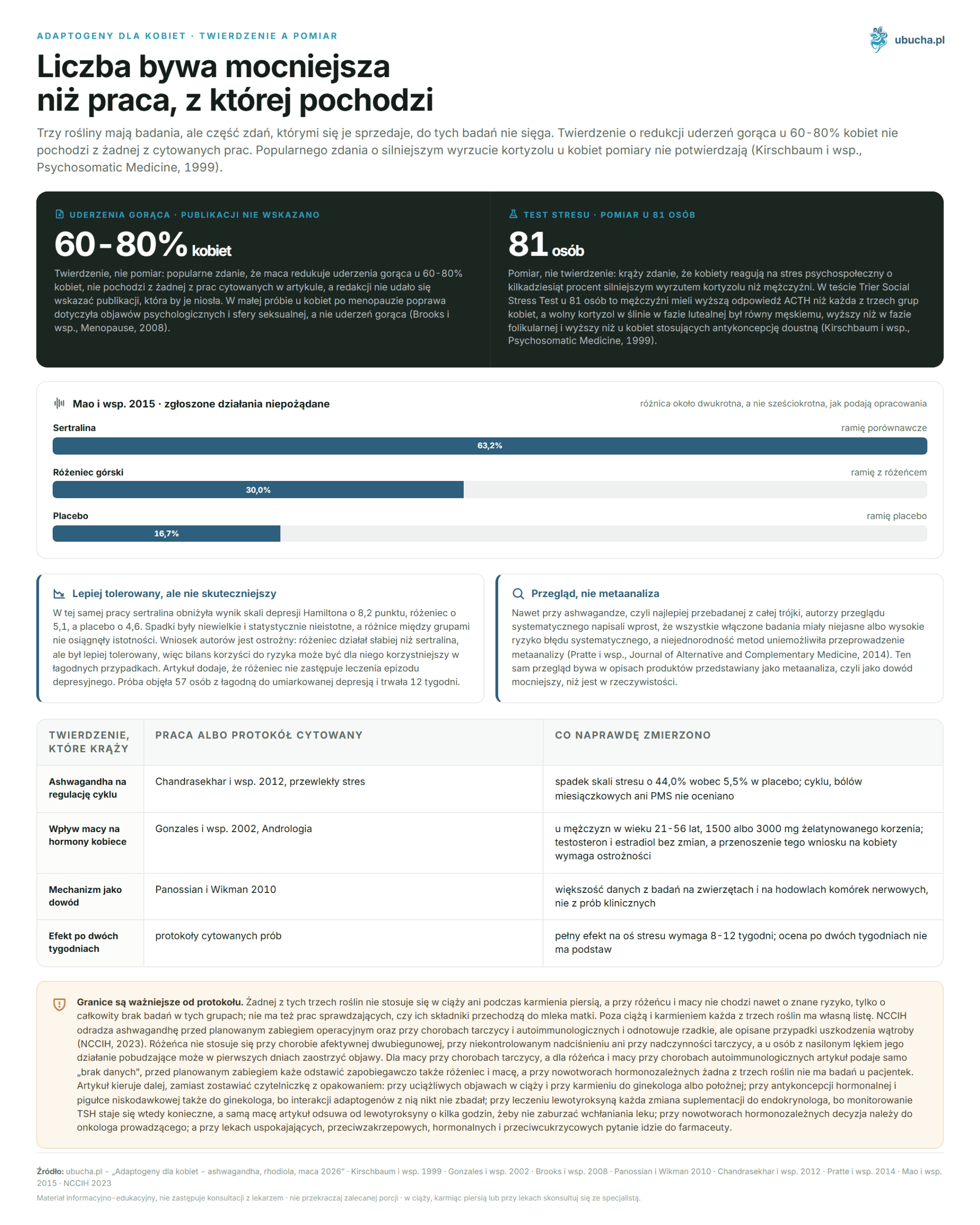
There is a claim that women respond to psychosocial stress with a cortisol spike that is several dozen percent stronger than men. Measurements do not confirm this. In a study by Kirschbaum et al. from 1999, in which 81 individuals underwent the Trier Social Stress Test, men had a higher ACTH response than any of the three groups of women, and free cortisol in saliva followed the sequence: luteal phase equal to men, above the follicular phase, and above women using oral contraception (Psychosomatic Medicine, 1999).
The practical conclusion is different from what the popular version suggests. It is not that the female body produces more cortisol, but that its response changes depending on the phase of the cycle and the use of hormonal contraception. Therefore, the same dose of adaptogen may produce different feelings in different weeks of the cycle, and assessing effectiveness makes sense only after a full two or three cycles. The mechanism of the stress axis is discussed more broadly in the text about how adaptogens affect the HPA axis.
What does ashwagandha provide for women according to research?
Ashwagandha has the strongest backing of the three. Chandrasekhar et al. studied 64 individuals with chronic stress: for 60 days, they took 300 mg of root extract twice daily. Serum cortisol dropped by 27.9% compared to 7.9% in the placebo group, and the Perceived Stress Scale score decreased by 44.0% compared to 5.5% (Indian Journal of Psychological Medicine, 2012).
This same work describes the raw material in more detail than most studies in this field. It was the KSM-66 extract from Ixoreal Biomed, standardized to no less than 5% withanolides measured by HPLC. The standardization values provided by other manufacturers, for example, no less than 10% withanolide glycosides for Sensoril, come from commercial specifications and measure something different, so they cannot be directly compared to these 5%.
The second area is sleep. A meta-analysis by Cheah et al. from 2021 included five randomized studies and 400 participants, and the overall effect on sleep was -0.59 in standardized mean difference, with a confidence interval from -0.75 to -0.42 (PLoS One, 2021). The authors call it small but significant, noting that it was more pronounced in individuals with diagnosed insomnia, at a dose of 600 mg daily and after at least eight weeks.
The third area is the thyroid. In a study by Sharma et al. from 2018, 50 individuals aged 18-50 with subclinical hypothyroidism took 600 mg of extract daily for eight weeks, and TSH, T3, and T4 values significantly improved compared to placebo (Journal of Alternative and Complementary Medicine, 2018). This can be beneficial in hypothyroidism, but in hyperthyroidism, the same effect is a problem.
What studies have not shown, but is often attributed to them: none of the above evaluated the menstrual cycle, menstrual pain, or the severity of PMS. The claim that ashwagandha regulates the cycle has no support in clinical trials today and should be treated as such.
When does rhodiola help, and when does it harm?
Rhodiola rosea, or golden root, works the fastest of the three, and the best-documented indication is fatigue. Olsson et al. administered 576 mg of SHR-5 extract daily for 28 days to 60 individuals with fatigue syndrome. Compared to placebo, improvements were noted in the Pines burnout scale and several attention indicators in the Conners computer test, and the cortisol response to awakening differed between groups (Planta Medica, 2009).
In terms of mood, the picture is much weaker. Mao et al. in 2015 compared rhodiola with sertraline and placebo in 57 individuals with mild to moderate depression over 12 weeks. The decreases in depression scale scores were small and statistically insignificant, and the differences between groups did not reach significance. Sertraline reduced the Hamilton scale score by 8.2 points, rhodiola by 5.1, and placebo by 4.6 (Phytomedicine, 2015).
This same work is the source of a frequently misquoted number. Adverse effects were reported by 63.2% of those on sertraline, 30.0% on rhodiola, and 16.7% on placebo. This is a difference of about twofold compared to the drug, not sixfold, as some reports state. The authors’ conclusion is cautious: rhodiola worked weaker than sertraline but was better tolerated, so the benefit-risk balance may be more favorable for it in mild cases.
Rhodiola does not replace treatment for a depressive episode. It is not used in bipolar disorder, uncontrolled hypertension, or hyperthyroidism, and in individuals with heightened anxiety, its stimulating effect may exacerbate symptoms in the first days. The dose should be taken in the morning or before noon, no later than 2 PM, as later doses disrupt sleep. Details on dosing are discussed in a separate text about the properties of golden root.
Does maca change hormonal balance?
In available studies, it did not change it. Gonzales et al. administered 1500 or 3000 mg of gelatinized maca root for 12 weeks and noted an improvement in perceived sexual desire from the eighth week, with no differences in testosterone and estradiol levels compared to placebo (Andrologia, 2002). However, this study was conducted in men aged 21-56, so transferring its conclusions to women requires caution.
Data for women comes from one small trial. Brooks et al. included 14 postmenopausal women who took 3.5 g of powdered maca in an alternating regimen with placebo for six weeks. Estradiol, FSH, LH, and sex hormone-binding globulin levels did not change, while the Greene scale showed improvements in psychological symptoms, namely anxiety and low mood, as well as sexual dysfunction indicators (Menopause, 2008).
It is worth noting what is missing in this result. The improvement concerned psychological symptoms and the sexual sphere, not hot flashes. The popular claim that maca reduces hot flashes in 60-80% of women does not come from any of these studies, and we have not been able to identify a publication that carries it.
The entirety of the evidence is summarized by a systematic review by Shin et al. from 2010. It included four randomized studies and found limited evidence of maca’s effectiveness in sexual function disorders, with the authors stating directly that the number of trials, total sample size, and their methodological quality are too small to draw firm conclusions (BMC Complementary and Alternative Medicine, 2010). Thus, maca is the least well-documented position of the three, even though it is most often sold as a “women’s” plant.
Which adaptogen to choose for which symptom?
The choice is based on the dominant symptom and how strong the evidence is for that indication. For stress and sleep, the first choice is ashwagandha, as only it has meta-analyses. For fatigue and decreased drive, rhodiola is more sensible, as it works faster. Maca remains an option for reduced libido and perimenopausal symptoms, with the awareness that it has the least data behind it.
| Feature | Ashwagandha | Rhodiola | Maca |
|---|---|---|---|
| Latin name | Withania somnifera | Rhodiola rosea | Lepidium meyenii |
| Best-documented indication | Stress, cortisol, sleep | Fatigue and attention in burnout | Sexual drive, psychological symptoms after menopause |
| Dose from studies | 300-600 mg extract | 576 mg SHR-5 extract | 1500-3500 mg powdered root |
| Time of intake | Flexible, with a meal containing fat | In the morning, no later than 2 PM | In the morning and at noon |
| Time to effect in studies | 8 weeks and more | 28 days | 6-12 weeks |
| Strength of evidence | Meta-analyses of randomized studies | Single randomized studies | Review rated as insufficient |
| Main contraindications | Pregnancy, breastfeeding, thyroid and autoimmune diseases | Pregnancy, breastfeeding, bipolar disorder, uncontrolled hypertension, hyperthyroidism | Pregnancy, breastfeeding, lack of oncological data |
The table also organizes one thing that marketing obscures: the columns are not equivalent. Ashwagandha has evidence from meta-analyses, rhodiola from single trials, and maca from a review that assessed the material as insufficient. So when three plants stand next to each other on the shelf at the same price, it does not mean that the same evidence base stands behind them.
How long should adaptogens be taken?
The horizon is set by the studies themselves. Rhodiola showed a measurable effect after 28 days, ashwagandha after eight weeks and more, and maca in trials lasting from six to twelve weeks. An assessment after seven or fourteen days does not correspond to any of these protocols and usually leads to premature discontinuation.
A reasonable twelve-week scheme is divided into three stages. For the first two weeks, half the target dose is taken to assess gastric tolerance and catch adverse reactions. From the third to the eighth week, the full dose applies. The last four weeks serve to stabilize and assess whether the effect is sufficient to continue.
Introduce one ingredient at a time, with a week or two in between. With three plants introduced on the same day, it is impossible to determine which one is responsible for improvement and which for gastric discomfort. This is the simplest way to know anything certain about your own reaction after three months.
Time must be considered alongside the dose, as one does not work without the other. Salve et al. divided 60 stressed adults into three arms: 125 mg of ashwagandha twice daily, 300 mg twice daily, and placebo, and followed them for eight weeks. The stress scale score and cortisol levels dropped with both doses, but at 600 mg daily at a higher level of significance (Cureus, 2019). Eight weeks on a dose below the studied threshold will not replace eight weeks on the proper dose.
Data on use longer than a few months is practically non-existent. The American NCCIH states about ashwagandha that it may be safe for short-term use, up to about three months, and there is a lack of information to assess longer periods (NCCIH, 2023). Practiced breaks, such as a month after every three months, are a precautionary solution, not a recommendation based on research.
Should adaptogens be combined with CBD?
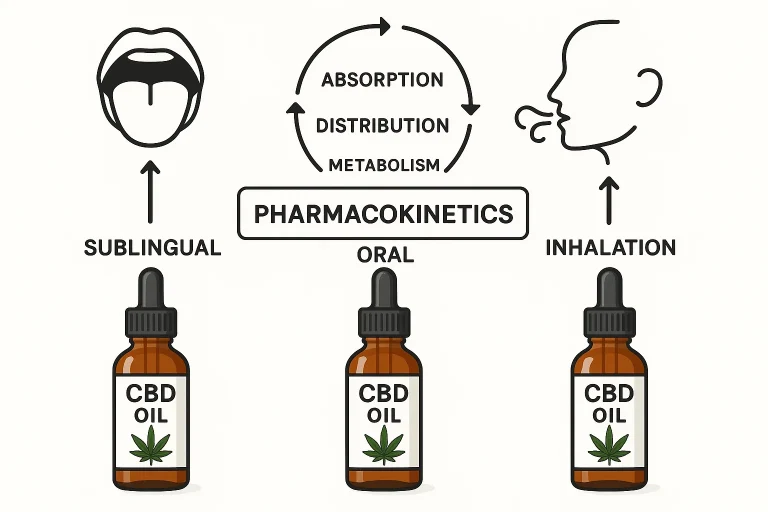
There is no study that has tested such a combination, so the answer is based on the profiles of both groups separately. Adaptogens are described as acting through the HPA axis and mediators of the stress response, while cannabidiol acts through the endocannabinoid system and 5-HT1A receptors. These pathways do not overlap, but the mere lack of overlap is not evidence of synergy.
The most frequently cited work on CBD, sleep, and anxiety is a retrospective case series by Shannon et al. from 2019. They reviewed the records of 72 adult psychiatric patients who received CBD as an adjunct to treatment. In the first month, anxiety scores decreased in 57 individuals, or 79.2%, and remained at a lower level, while sleep scores improved in 48 individuals, or 66.7%, but fluctuated over time (The Permanente Journal, 2019).
Two things must be said loudly about this work. It was not a randomized or placebo-controlled study, but a review of patient charts, so the strength of evidence is correspondingly lower. The authors also did not measure sleep architecture, so the frequent claim that CBD prolongs REM phase or deepens slow-wave sleep does not come from this source.
If you still want to combine one with the other, a sensible arrangement is simple: adaptogen in the morning or with a meal, CBD in the evening at a low dose, and observation for the first 7-10 days for excessive drowsiness. The mechanisms of both groups are compared in detail in the text about the synergy of CBD and adaptogens.
Who should not use adaptogens?
The list is short but firm. NCCIH advises against ashwagandha for individuals before planned surgical procedures and for those with autoimmune diseases and thyroid disorders, indicating possible interactions with thyroid hormonal medications and noting rare but documented cases of liver damage associated with supplements containing this plant (NCCIH, 2023).
In thyroid diseases, the direction of action is known. Ashwagandha changed thyroid parameters in individuals with subclinical hypothyroidism (Sharma 2018), which can be desirable in hypothyroidism, but in hyperthyroidism and Graves’ disease, it acts in the wrong direction. Rhodiola, on the other hand, is advised against in hyperthyroidism due to its stimulating effect. If you are being treated with levothyroxine, report any changes in supplementation to your endocrinologist, as monitoring TSH becomes necessary.
Hormone-dependent cancers require an honest approach. We do not know of studies that have evaluated the safety of these three plants in oncological patients, either during treatment or in remission. This means that it cannot be said whether they are safe or harmful. In such a lack of data, the decision is made with the treating oncologist, not based on the description on the package.
| Situation | Ashwagandha | Rhodiola | Maca |
|---|---|---|---|
| Pregnancy | Avoid (NCCIH) | No safety data | No safety data |
| Breastfeeding | Do not use (NCCIH) | No safety data | No safety data |
| Thyroid diseases | Not recommended without supervision (NCCIH) | Advised against in hyperthyroidism | No data |
| Autoimmune diseases | Not recommended without supervision (NCCIH) | No data | No data |
| Hormone-dependent cancers | No studies in patients | No studies in patients | No studies in patients |
| Planned surgical procedure | Not recommended (NCCIH) | Discontinue preventively | Discontinue preventively |
Interactions with medications are poorly studied beyond what NCCIH provides for ashwagandha. If you are taking sedatives, anticoagulants, hormonal, or antidiabetic medications, ask your pharmacist before adding any of these plants. The answer “data is lacking” is common here and in itself constitutes a reason for caution.
Are adaptogens safe during pregnancy and breastfeeding?
No, and for two of the three plants, it is even impossible to say how great the risk is. NCCIH states unequivocally for ashwagandha: it should be avoided during pregnancy and not used while breastfeeding (NCCIH, 2023). This recommendation is based on a lack of safety data, not on proven harm.
For rhodiola and maca, the situation is even more empty. We do not know of studies evaluating their use in pregnant or breastfeeding women. We also do not know of studies measuring whether salidroside, rosavins, or maca components pass into breast milk and in what amounts. This is not a signal that they do not pass. It means exactly that no one has checked it.
The argument for traditional use of maca in the Andes appears in many reports and does not replace data. Traditional use indicates that the plant was eaten, not that its impact on pregnancy, birth weight, or infant development has been studied. A supplement in the form of a concentrated extract is, after all, a different exposure than root in the diet.
The practical recommendation is therefore simple: during pregnancy and breastfeeding, discontinue all three. If the symptoms you wanted to address are bothersome, this is precisely the moment to talk to your gynecologist or midwife, as in these groups, the risk of an untested substance is significantly higher than the benefit, which no one has measured.
What mistakes most often ruin the effect?
The most common are four, and all involve deviating from the research protocol: too short a time, unmarked raw material, wrong timing of intake, and lack of any evaluation. None of these say anything about the plants themselves, only about how they are used.
Time is the number one problem. Discontinuing ashwagandha after two weeks means interrupting treatment before any measurements were made in studies. Rhodiola is an exception here, as its effect on fatigue was noted after 28 days, but even that is a month, not a week.
- A cheap powder without specified standardization does not allow you to estimate how much active substance you are taking, and the label “1000 mg” on the front usually describes the mass of the raw material, not the content of withanolides.
- Rhodiola taken in the evening disrupts sleep; the last dose should be taken no later than 2 PM.
- Ashwagandha without a meal containing fat is absorbed poorly, as withanolides are lipophilic, and on an empty stomach, it often causes nausea.
- Separate maca from levothyroxine by a few hours, just like any mineral preparation, to avoid interfering with the absorption of the medication.
- Without a simple symptom diary after eight weeks, it is impossible to distinguish improvement from the natural variability of well-being.
Evaluation is the most overlooked, and it costs the least. A weekly note with four ratings on a scale from one to ten: sleep, stress level, energy, and libido, plus a note on the regularity of the cycle is enough. After three months, you have data on which the decision to continue is no longer a guess.
Summary: Practical Adaptogen Strategy
The three plants are not equal in terms of evidence, and they should be selected accordingly. Ashwagandha is the first choice for stress and sleep problems, at a dose of 300-600 mg of standardized extract daily, with a real assessment horizon after eight weeks. Rhodiola is an option for fatigue and burnout, 200-576 mg in the morning, with the effect visible at the earliest, after a month.
Maca remains at the end of this order, and not due to safety, but due to data. The systematic review included four studies and assessed the material as too modest to draw firm conclusions. The only trial conducted in women included fourteen participants. If you reach for maca, do so with the awareness that you are buying a premise, not evidence.
Boundaries are more important than the protocol. None of these plants are used during pregnancy or breastfeeding, and with rhodiola and maca, it is not even about known risks, but about the complete lack of studies in these groups. In cases of thyroid diseases, autoimmune diseases, and hormone-dependent cancers, the decision lies with the treating physician, as there is simply no data on which anyone else could rely.
Finally, a note about reading sources, as it is more useful in this category of products than anywhere else. Even with ashwagandha, the best-studied of the three, the authors of the systematic review by Pratte et al. stated directly that all included studies had unclear or high risk of systematic error, and the heterogeneity of methods prevented a meta-analysis from being conducted (Journal of Alternative and Complementary Medicine, 2014). This same review is sometimes presented in product descriptions as a meta-analysis, i.e., as evidence stronger than it is in reality. Before you believe the number on the label, check which study it comes from and what that study actually measured.
Frequently Asked Questions
Are adaptogens safe for every woman?
No. NCCIH advises against ashwagandha during pregnancy, breastfeeding, in cases of thyroid and autoimmune diseases, and before surgical procedures (NCCIH, 2023). There is a lack of studies on rhodiola and maca in these groups, which is also a reason for caution.
Can ashwagandha be taken during menstruation?
We do not know of any study that evaluated the use of ashwagandha in specific phases of the cycle, so there is no basis for either prohibition or promise of alleviating menstrual pain. The Chandrasekhar 2012 study measured cortisol and stress scales, not menstrual symptoms, and is often cited for this thesis without basis.
When should rhodiola be taken to avoid disrupting sleep?
In the morning or before noon, no later than 2 PM. An evening dose may cause insomnia due to its stimulating effect. In the Olsson 2009 study, 576 mg of SHR-5 extract was used daily for 28 days (Planta Medica, 2009).
Does maca affect hormones?
In available studies, it did not affect them. In 14 postmenopausal women taking 3.5 g daily for six weeks, levels of estradiol, FSH, LH, and sex hormone-binding globulin remained unchanged (Brooks, Menopause, 2008). However, the sample was very small.
Can ashwagandha, rhodiola, and maca be combined?
We do not know of any study that has tested this combination, so there is no evidence for or against synergy. If you decide to take all three ingredients, introduce them one at a time with a week or two in between, otherwise you will not determine which one is responsible for improvement and which for discomfort.
How long do adaptogens take to start working?
Rhodiola showed a measurable effect on fatigue after 28 days (Olsson 2009). Ashwagandha required eight weeks or more, especially for sleep (Cheah, PLoS One, 2021). Maca has been studied in protocols ranging from six to twelve weeks. An assessment after two weeks has no basis.
Are adaptogens safe to use during pregnancy and breastfeeding?
No. Ashwagandha should be avoided during pregnancy and not used while breastfeeding (NCCIH, 2023). There are no studies on rhodiola and maca in these groups, nor are there studies checking whether their components pass into breast milk. Traditional use of maca in the Andes does not replace such data.
Can adaptogens be combined with hormonal contraception?
There is a lack of studies on the interactions of adaptogens with hormonal contraception, so no one can provide a reliable answer today. If you are on a low-dose pill, ask your gynecologist. It is worth remembering that oral contraception itself alters the cortisol response to stress (Psychosomatic Medicine, 1999).
Standardized plant extracts, including ashwagandha and maca, can be found in the plant extracts category in the u Bucha store. Golden root catalog as of August 10, 2026 does not contain it in any form.
This article is for informational and educational purposes and does not replace consultation with a doctor. If you are pregnant, breastfeeding, taking medications, or have chronic conditions, consult the use of supplements or herbs with a specialist.
Author: Michał Waluk · Published: 2026-05-11 · Updated: 2026-08-10