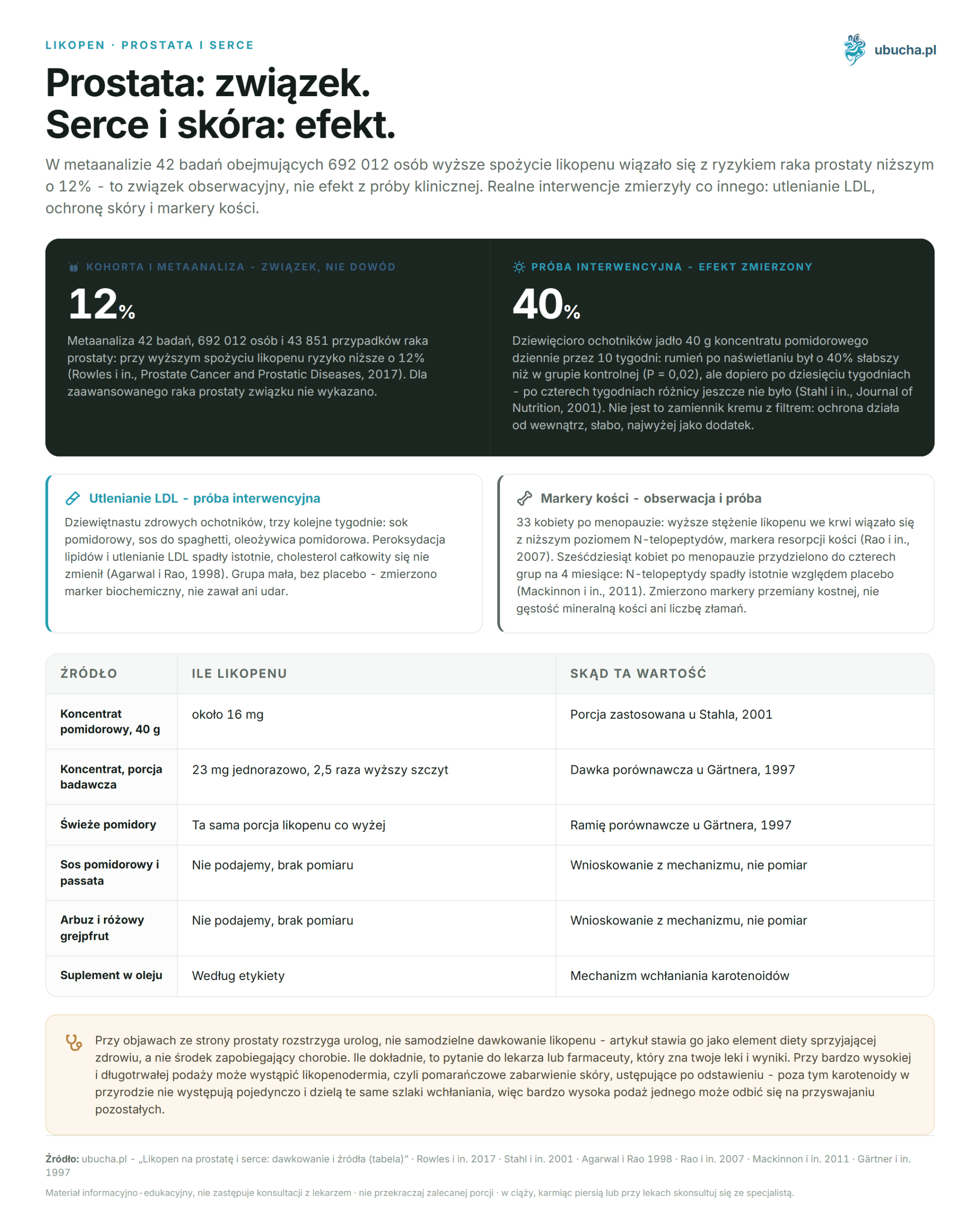

Lycopene for Prostate and Heart: Dosage and Sources (Table)
What has really been shown for lycopene: prostate, LDL oxidation, skin, and bones. We provide numbers from specific studies and show where the evidence ends.
Lycopene is the red pigment found in tomatoes, watermelon, and pink grapefruit. Unlike beta-carotene, it is not a precursor of vitamin A, but it quenches singlet oxygen more efficiently than other carotenoids: the measured rate constant is over twice as high for it as for beta-carotene, 31 versus 14 in the same units (Di Mascio et al., Archives of Biochemistry and Biophysics, 1989). The authors of this work add a caveat: when considering plasma concentrations, the quenching abilities of lycopene, beta-carotene, and tocopherol turn out to be comparable. Interest in it exploded after a large cohort study published in 1995, which linked the consumption of tomato products with a lower risk of prostate cancer. Since then, more data has emerged, and some of it cools the enthusiasm. Below, we break it down: what exactly was measured in studies on the prostate, heart, skin, and bones, how many people were involved, for how long, and where the evidence falls short.
KEY INFORMATION
• In a meta-analysis of 42 studies involving 692,012 people and 43,851 cases of prostate cancer, higher lycopene intake was associated with a 12% lower risk (Rowles et al., Prostate Cancer and Prostatic Diseases, 2017).
• For the same portion, lycopene from tomato concentrate gave 2.5 times higher peak concentration than from fresh tomatoes (Gärtner et al., American Journal of Clinical Nutrition, 1997).
• 40 g of concentrate daily for 10 weeks reduced erythema after irradiation by 40% (Stahl et al., Journal of Nutrition, 2001).
• No association was found for advanced prostate cancer.
Why do cooked tomatoes provide more lycopene than raw ones?
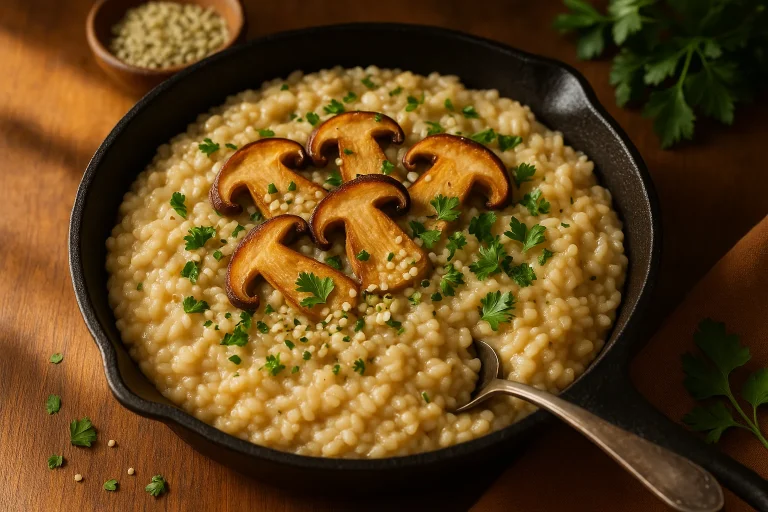
Because heat treatment and fat increase absorption, not content. Lycopene is lipophilic, meaning it dissolves in fats, and in raw tomatoes, it is trapped in cellular structures. Heating breaks down cell walls and releases it from the matrix, and the presence of fat in the meal allows it to pass into micelles, from which the intestine can absorb it.
This has been measured directly. In a pharmacokinetic study, volunteers took 23 mg of lycopene at once, once from fresh tomatoes and once from tomato concentrate, in both cases together with 15 g of corn oil. After the concentrate, the peak concentration of lycopene in the chylomicron fraction was 2.5 times higher, and the area under the curve was 3.8 times higher than after fresh tomatoes (Gärtner et al., American Journal of Clinical Nutrition, 1997). The isomer pattern was the same in both products, so the difference comes from availability, not composition.
A practical conclusion surprises many people: in terms of lycopene, a serving of pasta sauce beats a salad of tomatoes. The same principle applies to supplements. A lycopene preparation suspended in oil behaves differently than a dry powder in a capsule, and taking a capsule with a meal containing fat matters for how much actually gets into the blood.
Which sources of lycopene have confirmed measurements?
Only those that were actually weighed in the cited studies, and there are fewer of them than popular tables suggest. Two reference points come directly from the works described in this article: the portion of concentrate used in the skin study and the comparative portion from the absorption study. For other products, we provide the order instead of apparent accuracy.
| Source | How much lycopene | Absorption | Where this value comes from |
|---|---|---|---|
| Tomato concentrate, 40 g | about 16 mg | High, especially with oil | Portion used in Stahl, 2001 |
| Tomato concentrate, research portion | 23 mg at once | 2.5 times higher peak concentration than from fresh tomatoes | Comparative dose in Gärtner, 1997 |
| Fresh tomatoes | The same portion of lycopene as above | Significantly lower | Comparative arm in Gärtner, 1997 |
| Tomato sauce and passata | Not provided, no measurement in cited works | High, because processed and with fat | Inference from mechanism, not measurement |
| Watermelon and pink grapefruit | Not provided, no measurement in cited works | Moderate, without heat treatment | Inference from mechanism, not measurement |
| Oil-based supplement | According to the label | High when taken with a fatty meal | Mechanism of carotenoid absorption |
We have noticed that tables of lycopene content circulating on the internet provide values accurate to the milligram, without indicating the source of measurement. Meanwhile, the content in tomatoes varies with variety, ripeness, and processing method, so one number for “concentrate” is inherently an approximation. If you need data for a specific product, look for it in food composition tables or on the label, not in articles.
Does lycopene protect against prostate cancer?
Observational data show a moderate association, but do not prove causation and do not include advanced forms. The thread began with the prospective analysis of the Health Professionals Follow-up Study, which observed 47,894 men and recorded 812 new diagnoses from 1986 to 1992. Among the carotenoids studied, only lycopene was associated with a lower risk: the relative risk was 0.79 when comparing the highest quintile of intake with the lowest. Total consumption of tomatoes, sauce, juice, and pizza gave a relative risk of 0.65 when comparing more than ten servings per week with less than one and a half (Giovannucci et al., Journal of the National Cancer Institute, 1995).
A newer compilation is larger and more balanced. A systematic review with a meta-analysis of dose-response relationships included 42 studies, 692,012 participants, and 43,851 cases of prostate cancer. Both dietary lycopene intake and its concentration in the blood were associated with a lower risk: in both cases, the relative risk was 0.88, or 12% less. Each additional 2 mg of lycopene daily corresponded to a 1% reduction in risk (Rowles et al., Prostate Cancer and Prostatic Diseases, 2017).
However, the authors of the same work note something that gets lost in summaries: for prostate cancer in advanced forms, no association was found. This positions lycopene as a dietary element conducive to health, not as a disease-preventing agent. In the case of prostate symptoms, a urologist decides; we discuss plant preparations studied for benign enlargement separately in texts about saw palmetto and nettle for prostate enlargement.
What does lycopene do to LDL cholesterol oxidation?
It reduces it, as measured in a small interventional study using regular food. Oxidation of the LDL fraction is considered an early step in the formation of atherosclerotic plaque, so this is a sensible endpoint for an antioxidant. Nineteen healthy volunteers received lycopene for three consecutive weeks, each time in a different form: first as tomato juice, then as spaghetti sauce, and finally as tomato oleoresin.
The serum concentration of lycopene increased at least twofold. Total cholesterol and LDL and HDL fractions did not change, while lipid peroxidation in serum and LDL oxidation significantly decreased, measured by two independent methods that yielded consistent results (Agarwal and Rao, Lipids, 1998).
Three caveats must be made immediately. The group was small, the study had no placebo arm, and the endpoint was a biochemical marker, not a heart attack or stroke. The result thus indicates that lycopene from food reduces the susceptibility of LDL to oxidation, not that it lowers the risk of a heart attack. For the latter claim, studies with hard endpoints would be needed, which do not exist for lycopene alone.
Does lycopene protect the skin from the sun?
In one well-described study, yes, though on a scale that does not replace sunscreen. Carotenoids accumulate in the skin and quench reactive oxygen species generated by radiation, so the hypothesis is physiologically sensible. It was tested by providing a regular food product instead of a supplement.
Nine volunteers consumed 40 g of tomato concentrate daily for 10 weeks, providing about 16 mg of lycopene, washed down with 10 g of olive oil. The control group, ten people, received only oil. Erythema was induced by irradiating the skin of the back with a solar simulator at the beginning of the study, after the fourth week, and after the tenth week. After ten weeks, erythema in the group eating the concentrate was 40% weaker than in the control group (P = 0.02). After four weeks, there was no difference yet (Stahl et al., Journal of Nutrition, 2001).
This lack of difference in the fourth week is the most interesting here, as it shows that protection builds up over weeks with carotenoid accumulation in the skin. It is not something that can be done right before a trip. And it is not a substitute for sunscreen: the protection works from the inside, weakly, and at best as an additional layer.
What is known about lycopene and bone health?
More than the niche nature of the topic suggests, as there is both observational and interventional research. The starting point is oxidative stress, which increases the activity of osteoclasts, or cells that break down bone tissue. An antioxidant could therefore slow down the loss of bone mass.
First, the observation. In a cross-sectional study, 33 postmenopausal women aged 50 to 60 kept seven-day food diaries and donated blood. Higher serum lycopene concentrations were associated with lower levels of N-telopeptides, a marker of bone resorption, and with less protein oxidation (Rao et al., Osteoporosis International, 2007).
Then, the intervention. Sixty women in the same age group, after a one-month period of lycopene washout from their diet, were assigned to four groups: regular tomato juice, enriched juice, capsules, and placebo, providing 30, 70, 30, and 0 mg of lycopene daily for 4 months, respectively. In the groups receiving lycopene, total antioxidant capacity increased, and lipid peroxidation, protein oxidation, and N-telopeptides decreased, with all three decreases being significantly different from changes in the placebo group (Mackinnon et al., Osteoporosis International, 2011). However, it should be noted what these results are not: the study measured markers of bone metabolism, not bone mineral density or fracture rates. Lycopene is therefore not a treatment for osteoporosis, but a sensible dietary element for women in the risk group.
How to increase lycopene intake from the diet?
In three moves, none of which require a supplement. First, choose processed products instead of fresh tomatoes, as heat treatment releases lycopene from the cellular matrix. Second, eat them with fat, such as olive oil, because without it, absorption is significantly lower. Third, do this regularly: in the skin study, the effect appeared only between the fourth and tenth weeks of daily consumption of concentrate.
A supplement makes sense where the diet is irregular or someone cannot stand tomatoes. In that case, choose the oil-suspended form and take it with a meal containing fat. How much exactly is a question for your doctor or pharmacist, who knows your medications and results. In the studies described above, amounts ranged from about 16 mg to 70 mg daily for periods from several weeks to several months, but these were research protocols, not recommendations for the reader.
It is worth remembering one thing: carotenoids in nature do not occur in isolation and share the same absorption pathways, so a very high intake of one may affect the absorption of the others. This is an argument for obtaining them from food, where the proportions are natural, rather than from a megadose of one component. Similar questions about the selection of preparations are discussed in the text about supplements for men over forty.
Frequently Asked Questions
How much lycopene was used in studies?
In the skin study, it was about 16 mg daily for 10 weeks, in the bone study from 30 to 70 mg daily for 4 months, and in the absorption study 23 mg at once. These are research protocols, not recommendations for you. Decide whether and how much to supplement with your doctor, who knows your medications.
Is lycopene from tomatoes better than from a supplement?
Both sources work if accompanied by fat. For the same portion, tomato concentrate gave 2.5 times higher peak concentration than fresh tomatoes (Gärtner et al., 1997). A supplement in oil taken with a meal behaves similarly to the product, while the dry form without fat performs worse.
Does lycopene protect against prostate cancer?
Observational data link higher intake with a 12% lower risk (Rowles et al., 2017), but this is correlation, not causation. No association has been shown for advanced forms. Lycopene makes sense as a dietary element, not as an oncological prevention replacing check-ups.
Is lycopene safe?
It has a good safety profile and no organ toxicity has been reported. With very high and prolonged intake, lycopenodermia, or orange skin discoloration, may occur, which resolves after discontinuation. Lycopene from food is safe without special restrictions.
When is the best time to take lycopene?
With a meal containing fat, because without it, carotenoid absorption is significantly lower. The time of day does not matter, so lunch or dinner with oil will work equally well. It is better to avoid taking it on an empty stomach.
Preparations with carotenoids and other ingredients discussed in this text can be found in the supplements category.
This article is for informational and educational purposes and does not constitute medical advice. Before starting supplementation, consult your doctor, especially if you are taking medications regularly, are pregnant or breastfeeding, or have a chronic illness.
Author: Michał Waluk · Published: 2026-08-05 · Updated: 2026-08-11