
Supplements for Men Over 40: Testosterone, Energy, and Heart - What Really Works
Zinc and vitamin D raise testosterone only in cases of deficiency. What do studies say about omega-3s, coenzyme Q10, creatine, and the prostate after forty.
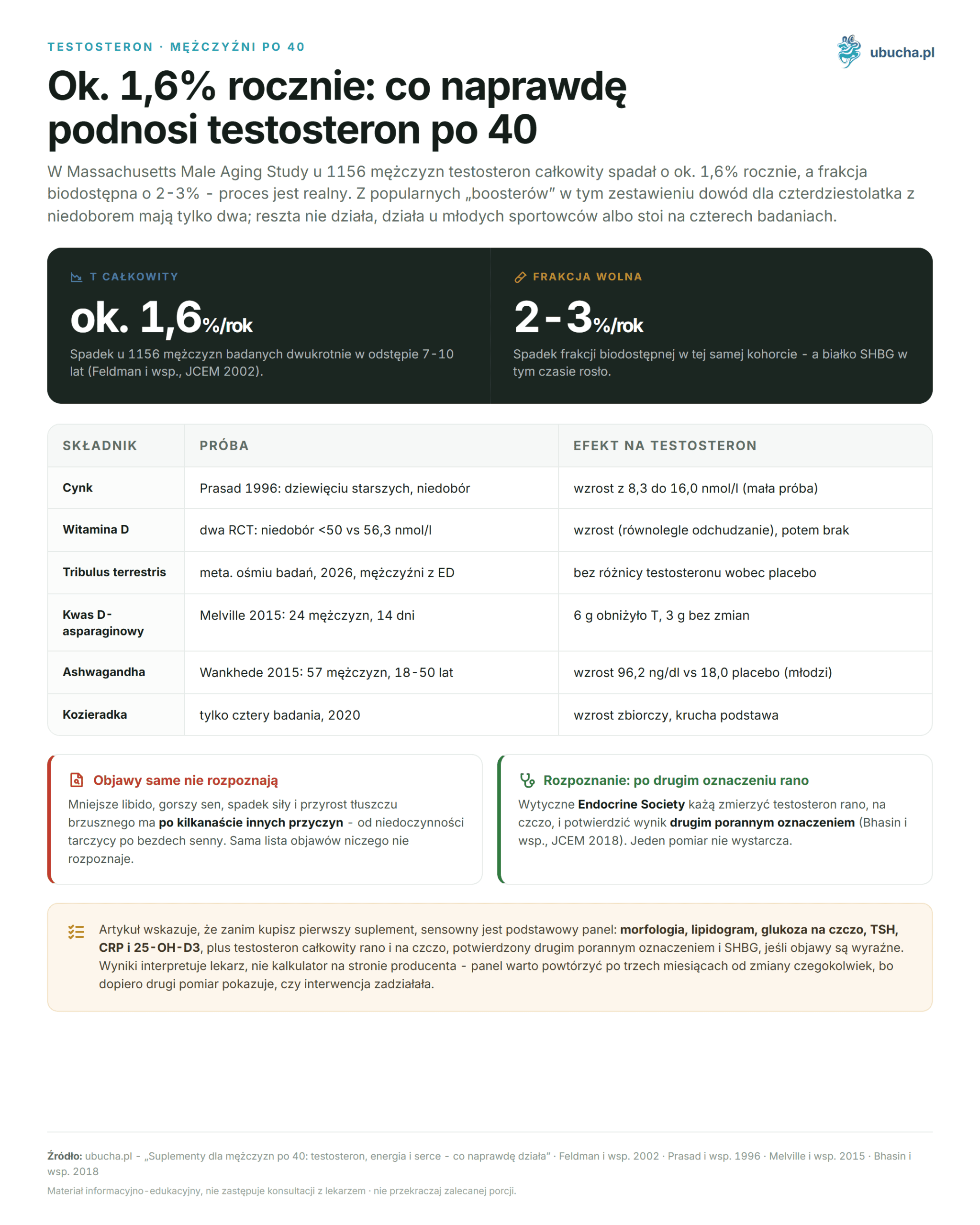
The “testosterone booster” category is one of the best-selling shelves in supplement stores and at the same time one of the least documented. Data from the Massachusetts Male Aging Study show that in middle-aged men, total testosterone decreases by about 1.6% per year, and the bioavailable fraction by 2-3% (Feldman et al., Journal of Clinical Endocrinology and Metabolism, 2002). The process is real. The problem is that most products sold as a response to it lack data to justify their claims. In this text, we separate two things that guides usually do not distinguish: supplementing a deficiency and attempting to raise hormone levels above normal. We also show what studies say about the heart, prostate, and muscles.
KEY INFORMATION
• The Cochrane review included 86 studies and 162,796 people: omega-3s did not change overall mortality or the number of cardiovascular events (Abdelhamid et al., 2020).
• Zinc and vitamin D raise testosterone where there was a deficiency. In men with normal levels, studies do not show an increase.
• Tribulus and D-aspartic acid did not raise testosterone in studies with a control group.
• Low testosterone is diagnosed by a doctor with two morning measurements, not a list of symptoms from the internet.
What happens to a man’s testosterone after forty?
The decline is slow and measurable. In the Massachusetts Male Aging Study, 1156 men were examined twice over a period of 7-10 years. Total testosterone decreased by about 1.6% per year, and the bioavailable fraction by 2-3% (Feldman et al., Journal of Clinical Endocrinology and Metabolism, 2002). At the same time, the concentration of SHBG, a protein that binds the hormone, increased.
SHBG increased in this cohort by about 1.6% per year. This is important because testosterone bound to SHBG is biologically inactive. The total result may look decent, while the available fraction may be low. Therefore, an endocrinologist looks at both parameters, not just one.
The authors also noted something else. Men without chronic diseases, without medications taken regularly, without obesity, and without alcohol abuse had levels of several androgens that were 10-15% higher than the rest of the cohort. However, this does not mean that their hormones were declining more slowly: good health flattened the cross-sectional trend for testosterone and LH, but the rate of decline measured in the same individuals over time did not change. Overall health shifts the baseline level, not the slope of the curve.
The symptoms associated with this process are nonspecific: reduced libido, poorer sleep quality, decreased strength, increased abdominal fat, and lowered mood. Each of these has a dozen other causes, from hypothyroidism to sleep apnea. That is why a mere list of symptoms does not diagnose anything.
When is low testosterone a diagnosis, and when is it just a list of symptoms?
Hypogonadism is diagnosed only when symptoms coexist with consistently low hormone levels. The Endocrine Society guidelines recommend measuring total testosterone in the morning and fasting and confirming the result with a second morning measurement (Bhasin et al., Journal of Clinical Endocrinology and Metabolism, 2018).
One measurement is not enough because the hormone has a circadian rhythm and significant day-to-day variability. When the total result is close to the lower limit of the norm or the patient has a condition affecting SHBG levels, the guidelines require measuring free testosterone using equilibrium dialysis or calculating it with a reliable formula. After confirming a deficiency, the cause is sought, as hypogonadism can be secondary to pituitary disease, hemochromatosis, or medications taken.
The conclusion for the reader is simple. A supplement does not treat hypogonadism. Treatment is testosterone therapy conducted by a doctor, with its own list of contraindications: breast or prostate cancer, elevated PSA, a nodule in the prostate, high hematocrit, untreated severe sleep apnea, planning a child in the near future. None of these conditions will be checked for you by a store.
If you recognize symptoms from the previous section, the order is one: blood test, talk to your doctor, and only then possibly supplement deficiencies. The reverse order costs money and delays diagnosis by months.
Do zinc and vitamin D raise testosterone?
Only in cases of deficiency. In men with normal levels of both substances, studies do not show an increase in testosterone above the physiological range, and the works cited by manufacturers were conducted on individuals with documented deficiencies. This distinction disappears in product descriptions.
The most frequently cited work on zinc is Prasad et al. (Nutrition, 1996). The cross-sectional part included 40 men, the experiment with dietary zinc restriction was conducted on four young men, and supplementation on nine older men with borderline deficiency. In this last group, testosterone increased after 6 months from 8.3 to 16.0 nmol/l. Nine people is too few to promise anything.
With vitamin D, it is similar, but the data are conflicting. Pilz et al. (Hormone and Metabolic Research, 2011) administered 3332 IU daily for a year to 31 overweight men with baseline vitamin D deficiency. Total testosterone increased from 10.7 to 13.4 nmol/l, while in the placebo group, it did not change. All of them participated in a weight loss program, and weight loss itself raises testosterone. Eight years later, Lerchbaum et al. (European Journal of Nutrition, 2019) repeated the idea on 100 men with testosterone below 10.4 nmol/l and vitamin D below 75 nmol/l, administering 20,000 IU weekly for 12 weeks, and found no effect. However, the deficiency was not equally deep in both studies: in Pilz’s study, the baseline vitamin D level was below 50 nmol/l, which is in the deficiency range, while in Lerchbaum’s, the average was 56.3 nmol/l, which is above that threshold.
Zinc as a separate preparation is not available at Bucha, so we are not selling you anything with this section. The combination of vitamin D3 with K2 is described in a separate text about dosing D3 and K2.
What do studies say about ashwagandha, fenugreek, tribulus, and D-aspartic acid?
Two of these four ingredients have neutral or negative results. A meta-analysis of eight studies on Tribulus terrestris in men with erectile dysfunction showed improvement in IIEF scores compared to placebo, but no difference in total testosterone (Suharyani et al., International Journal of Impotence Research, 2026). This is an important distinction because the product is sold as a “testosterone booster,” and the only signal in this work pertains to something else.
D-aspartic acid performs even worse. Willoughby and Leutholtz (Nutrition Research, 2013) administered 3 g daily to strength-training men for 28 days. Total and free testosterone, LH, and estradiol remained unchanged. Melville et al. (Journal of the International Society of Sports Nutrition, 2015) tested 3 g and 6 g in 24 men over 14 days: the 6 g dose lowered total and free testosterone, while 3 g did not change anything.
Ashwagandha has positive but narrow data. In a study by Wankhede et al. (2015), 57 men aged 18-50 trained with weights for 8 weeks, taking 300 mg of extract twice daily. Testosterone increased by 96.2 ng/dl compared to 18.0 ng/dl in the placebo group. These are young men with little training experience, not forty-year-olds with symptoms. Chandrasekhar et al. (Indian Journal of Psychological Medicine, 2012) showed a significant decrease in cortisol after 60 days in 64 individuals with chronic stress.
Fenugreek has a meta-analysis showing a collective increase in total testosterone, but it included only four studies (Mansoori et al., Phytotherapy Research, 2020). Four studies is a fragile basis. The collective analysis counted only the change in blood testosterone levels, so it does not say anything about whether it improved anyone’s well-being, performance, or libido.
Do omega-3s protect a man’s heart after forty?
Not to the extent suggested by packaging. An updated Cochrane review included 86 studies and 162,796 participants and found no effect of long-chain omega-3s on overall mortality (RR 0.97) or cardiovascular events (RR 0.96), with high certainty of evidence (Abdelhamid et al., 2020).
Cardiovascular mortality fared slightly better, RR 0.92, but with moderate certainty of evidence. Stroke and arrhythmia showed no changes. This finding comes from a very large database, so it cannot be invalidated by a single study.
What do omega-3s definitely do? They lower triglycerides. If your lipid profile shows elevated triglycerides, it makes sense to discuss it with your doctor rather than self-selecting a fish oil dose.
In this context, the REDUCE-IT study is often cited (Bhatt et al., New England Journal of Medicine, 2019), in which 4 g of icosapent ethyl daily reduced the risk of the primary endpoint by 25% in 8,179 high-risk patients taking statins. This is not an over-the-counter supplement, but a prescription drug in a purified form of EPA, given to a specific population: with triglycerides from 135 to 499 mg/dl despite treatment. In the same study, the rate of hospitalization due to atrial fibrillation or flutter was higher in the treated group, 3.1% versus 2.1%. The study was funded by the product manufacturer, and the placebo used in the form of mineral oil has been criticized. Transferring this result to capsules bought without a prescription is an abuse.
What is known about coenzyme Q10, vitamin E, and magnesium?
Evidence diverges among these substances. Vitamin E performs the worst. A meta-analysis of 18 studies involving 142,219 healthy individuals found no effect of supplementation on overall mortality in the range of 23-800 IU daily (Curtis et al., Cardiovascular Drugs and Therapy, 2014).
Coenzyme Q10 with statins has two conflicting meta-analyses. Qu et al. (Journal of the American Heart Association, 2018) gathered 12 studies and 575 patients and described alleviation of pain, weakness, and muscle cramps, although without a change in creatine kinase levels. Two years later, Kennedy et al. (Atherosclerosis, 2020) combined 7 studies and 321 patients and found no improvement in symptoms or better endurance in statin therapy; the collective effect was -0.42 with a confidence interval from -1.47 to 0.62, which includes zero. In heart failure, a meta-analysis of 33 studies indicated lower overall mortality, relative risk 0.64, but the authors themselves rated the quality of this data as moderate (Xu et al., BMC Cardiovascular Disorders, 2024). More about this ingredient is discussed in the text about coenzyme Q10 for heart and energy.
Magnesium appears to work best where there is a problem. A meta-analysis of 38 studies and 2,709 participants showed a decrease in systolic blood pressure by 2.81 mm Hg and diastolic by 2.05 mm Hg, but in groups with normal blood pressure, the effect did not reach statistical significance (Argeros et al., Hypertension, 2025). In individuals treated for hypertension, the decrease in systolic blood pressure was 7.68 mm Hg, and in those with hypomagnesemia, 5.97 mm Hg, which is two to three times more than in the entire group. The authors note high heterogeneity of studies and lack of dose dependency. We compare forms of magnesium in a separate article.
Which heart interventions have the strongest data?
Blood pressure, lipid profile, and non-smoking, followed closely by regular exercise. The INTERHEART study included 15,152 patients after a heart attack and 14,820 control individuals in 52 countries. Nine modifiable factors accounted for 90% of the population risk of heart attack in men (Yusuf et al., The Lancet, 2004).
The distribution of these factors is instructive. Lipid disorders measured by the ApoB to ApoA1 ratio accounted for 49.2% of population risk, smoking 35.7%, psychosocial factors 32.5%, abdominal obesity 20.1%, hypertension 17.9%, lack of daily fruits and vegetables 13.7%, lack of regular exercise 12.2%, diabetes 9.9%.
There is no supplement on this list. Not because researchers forgot about them, but because the size of the effect is incomparable. Quitting smoking and bringing blood pressure to target values does more for your heart than any capsule, and by an order of magnitude.
We have noticed in conversations with customers that the order is often reversed: first an order with six preparations, and measuring blood pressure sometime later. This order is costly and ineffective. A blood pressure monitor costs about the same as two packages of omega-3s and measures something that really weighs on risk.
Does creatine make sense after forty?
It does, but as a muscle supplement, not a hormonal one. A meta-analysis of 22 studies involving 721 individuals aged 57-70 showed that creatine combined with resistance training resulted in a 1.37 kg greater increase in lean body mass than training alone (Chilibeck et al., Open Access Journal of Sports Medicine, 2017).
Training was a condition there, not an addition. Protocols included 2-3 sessions per week for 7-52 weeks, and strength increased in bench press and leg press, although the effect size was small: 0.35 and 0.24 in standardized mean difference. Without training, this meta-analysis says nothing.
The position of the International Society of Sports Nutrition summarizes over 500 peer-reviewed works and considers creatine monohydrate safe for long-term use in healthy individuals (Kreider et al., Journal of the International Society of Sports Nutrition, 2017). A slight increase in creatinine in laboratory results is a predictable consequence of storing creatine in muscles and does not indicate kidney damage. In cases of diagnosed kidney disease, the decision is made by a doctor.
We do not have creatine in the store, so instead of an offer, we leave you our separate text on what creatine does and when to take it.
Do saw palmetto and lycopene help with the prostate?
Large placebo-controlled studies have not confirmed either. In the CAMUS study, 369 men over 45 received saw palmetto extract at a dose increased to three times the standard for 72 weeks and did not perform better than placebo on any endpoint (Barry et al., JAMA, 2011).
The Cochrane review confirms this picture. A collective analysis of two high-quality long-term studies involving 582 men found no advantage of Serenoa repens over placebo in reducing symptoms measured by the AUA scale (Tacklind et al., 2012).
Lycopene is mainly studied for prostate cancer, not for lower urinary tract symptoms. A meta-analysis of six randomized studies in men with non-metastatic prostate cancer found no effect of lycopene on PSA levels in the entire group (Sadeghian et al., Nutrition and Cancer, 2021). However, the collective result is not the whole answer: in the subgroup with baseline PSA of at least 6.5 µg/l, the decrease was significant and amounted to 3.74 µg/l. Observational data linking higher lycopene intake with lower risk exist, but observation does not prove causation.
This is the section where it is easiest to harm yourself by delay. Weaker urine flow, waking up at night, feeling of incomplete bladder emptying, and blood in urine are reasons to visit a urologist, not to buy capsules. The same symptoms can be caused by benign prostatic hyperplasia, inflammation, and cancer, and they are distinguished by examination, not supplements.
What tests should I do before buying my first supplement?
The basic panel costs less than a quarter of blind supplementation and tells you what you really lack. A complete blood count, lipid profile, fasting glucose, TSH, CRP, and 25-OH-D3 are enough to distinguish deficiency from a problem requiring treatment.
- Lipid profile shows cholesterol fractions and triglycerides, which is the factor with the largest population share in the INTERHEART study.
- 25-OH-D3 answers the question of whether vitamin D is relevant to you at all. Without this result, you are supplementing blindly.
- Fasting glucose detects disorders that lower testosterone through visceral fat.
- TSH excludes hypothyroidism, which gives almost identical symptoms to presumed low testosterone.
- Total testosterone in the morning and fasting, repeated with a second morning measurement, plus SHBG if symptoms are clear.
Results are interpreted by a doctor, not a calculator on the manufacturer’s website. The reference range for testosterone is wide, and a value at the lower limit of the norm in one man gives symptoms that another does not have at the same number. That is why the guidelines require symptoms and results simultaneously, rather than just a number. Repeat the panel three months after changing anything, as only the second measurement shows whether the intervention worked.
Frequently Asked Questions
Will the supplement raise my testosterone?
If you have a deficiency of zinc or vitamin D, supplementing it may restore hormone levels to normal. If you do not have a deficiency, studies do not show an increase above the physiological range. A meta-analysis of eight studies on Tribulus terrestris showed no difference in total testosterone compared to placebo (Suharyani et al., 2026).
Does zinc raise testosterone?
Only in cases of deficiency. In the study by Prasad et al. (Nutrition, 1996), supplementation was given to nine older men with borderline deficiency, and after 6 months, testosterone increased from 8.3 to 16.0 nmol/l. Nine people is a very small sample, and the study did not include men with normal zinc levels.
When does coenzyme Q10 make sense with statins?
The evidence is conflicting. A meta-analysis of 12 studies and 575 patients described alleviation of muscle symptoms (Qu et al., 2018), but a meta-analysis of 7 studies and 321 patients found no improvement in symptoms or better endurance in statin therapy (Kennedy et al., 2020). Report muscle pain to your doctor instead of stopping the medication on your own.
Is creatine safe after 40?
The position of the International Society of Sports Nutrition summarizes over 500 peer-reviewed works and considers creatine monohydrate safe for long-term use in healthy individuals (Kreider et al., 2017). A slight increase in creatinine in laboratory results is predictable and does not indicate kidney damage. In cases of kidney disease, the decision is made by a doctor.
Do omega-3s reduce the risk of heart attack?
The Cochrane review included 86 studies and 162,796 participants and found no effect of long-chain omega-3s on overall mortality or cardiovascular events, with high certainty of evidence (Abdelhamid et al., 2020). Triglycerides are lowered, so discussing your lipid profile with a doctor makes more sense than buying capsules just in case.
Will saw palmetto help with frequent nighttime urination?
In the CAMUS study, 369 men took saw palmetto extract at a dose increased to three times the standard for 72 weeks and did not perform better than placebo on any endpoint (Barry et al., JAMA, 2011). Symptoms from the lower urinary tract require a visit to a urologist.
What should I do if I suspect I have low testosterone?
Start with a blood test, not shopping. The Endocrine Society guidelines require measuring total testosterone in the morning and fasting and confirming the result with a second morning measurement, and a diagnosis is made only when symptoms coexist (Bhasin et al., 2018). Only then do you talk to your doctor about treatment.
You can find vitamin D3 with K2, magnesium, omega-3s, coenzyme Q10, and ashwagandha in the supplements section of the Bucha store. Zinc or creatine as separate preparations are not available there, so you will have to look elsewhere for them.
This article is for informational and educational purposes and does not constitute medical advice. Before starting supplementation, consult your doctor, especially if you are taking medications regularly, are pregnant or breastfeeding, or have chronic illnesses.
Author: Michał Waluk · Published: 2026-06-22 · Updated: 2026-08-15