
What the Realm of Caring and Johns Hopkins Data Show: Quality of Life and Fewer Medications
The Realm of Caring registry analyzed by Johns Hopkins: quality of life, fewer prescription medications, and less frequent visits to the emergency department. Numbers, method, and limits of conclusions.
Randomized studies are a benchmark in medicine, but they examine narrow groups over a short time. Realm of Caring, an American non-profit organization focused on research and education around cannabis, maintains a patient registry that researchers from Johns Hopkins University School of Medicine use. From this registry came a study comparing 808 medical cannabis users with 468 control group individuals. Users reported better quality of life, fewer prescription medications, and less frequent visits to the emergency department. This article shows what exact numbers were reported, where they come from, and what should not be inferred from them. Several percentages circulating in Polish discussions of this registry do not appear in any of the source papers and have been removed from the text along with the paragraphs that carried them.
KEY INFORMATION
• The Realm of Caring registry study included 1276 people: 808 using medical cannabis and 468 in the control group, with researchers from Johns Hopkins University School of Medicine among the authors (Schlienz et al., Cannabis and Cannabinoid Research 2021).
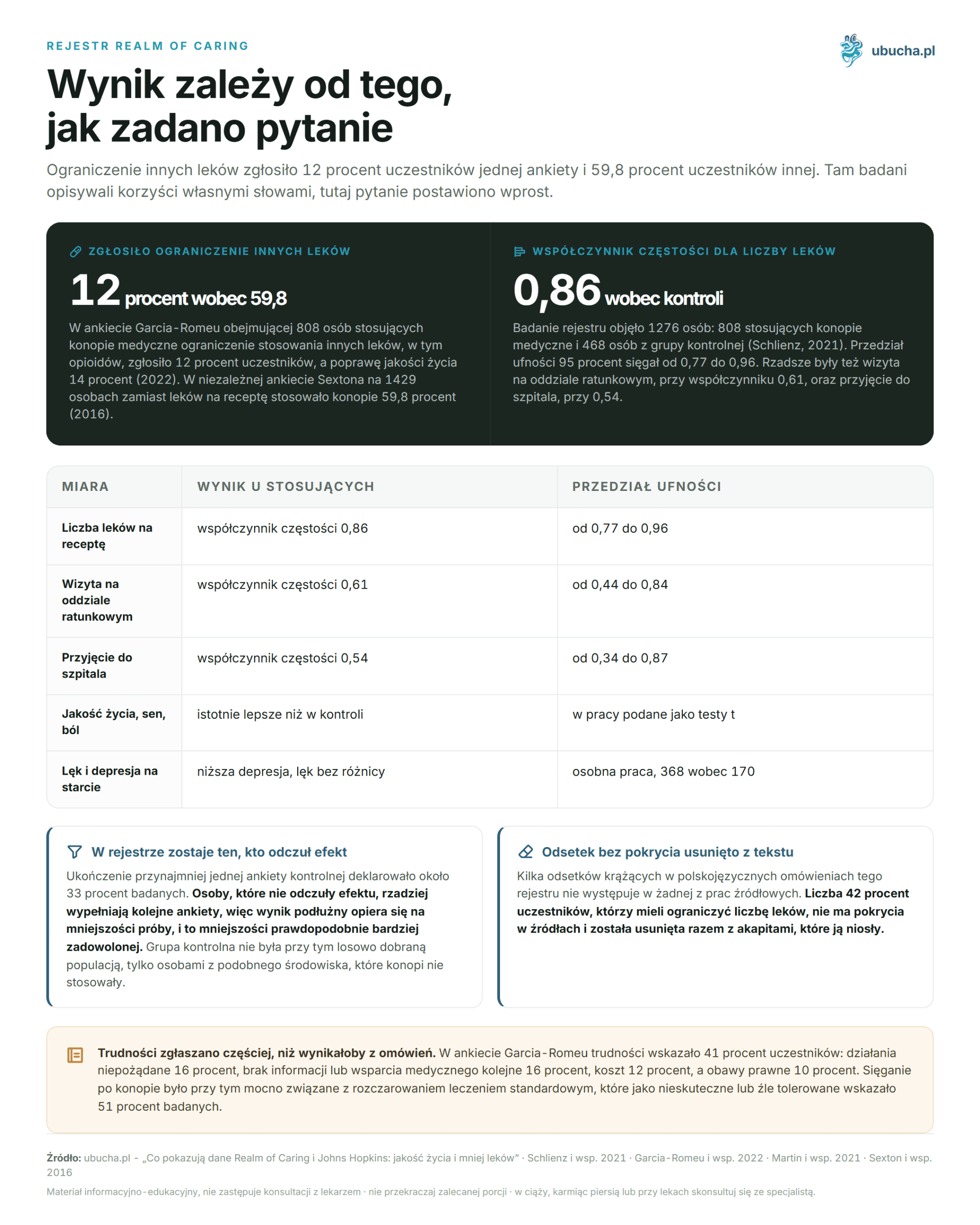
• Users took fewer prescription medications (rate ratio 0.86; 95 percent confidence interval from 0.77 to 0.96) and were less likely to visit the emergency department (0.61; from 0.44 to 0.84) and be hospitalized (0.54; from 0.34 to 0.87).
• In a separate survey from the same population, 12 percent of participants reported reducing other medications, and 14 percent reported an improvement in quality of life (Garcia-Romeu et al., Frontiers in Pharmacology 2022).
• These are observational and self-reported data. Any change in medications should occur only under the supervision of the attending physician.
What is the Realm of Caring registry?
The Realm of Caring Foundation is an American non-profit organization focused on research into the therapeutic use of cannabis and education in this area. This is how the authors of the paper that utilized its registry describe it (Schlienz et al., Cannabis and Cannabinoid Research 2021). Participants were recruited from the patient registry of this foundation and from its social media.
The method of data collection is significant for what can be inferred from it. The study was conducted online from April 2016 to February 2018. Participants filled out a baseline survey and were then invited by email to subsequent ones every three months. About 33 percent of respondents reported completing at least one follow-up survey. The questionnaires included demographic data, healthcare utilization, medications taken, pain, anxiety, depression, sleep, and quality of life.
Both patients with a medical diagnosis and caregivers of such patients registered in the registry. This explains the structure of the sample: 808 people in the cannabis-using group are 524 adult patients and 284 adult caregivers, while 468 people in the control group are 271 patients and 197 caregivers. The control group is therefore not a randomly selected population, but individuals from a similar environment who did not use cannabis. Johns Hopkins also conducts randomized studies on other psychoactive substances, as we discuss in relation to the results of psilocybin research in depression.
What did the comparison of users and the control group show?
Differences favored cannabis users in every domain studied. The authors report significantly better quality of life, higher satisfaction with health status, better sleep in both children and adults, lower average pain severity, and lower severity of anxiety and depression. However, the strongest part of the results concerns measurable behaviors.
Users took fewer prescription medications, and the difference was expressed with a rate ratio of 0.86 with a 95 percent confidence interval from 0.77 to 0.96. They also reported less frequent visits to the emergency department in the last month (0.61; from 0.44 to 0.84) and hospital admissions (0.54; from 0.34 to 0.87). Individuals in the control group who started using cannabis after the baseline survey showed improvement at the next measurement corresponding to the difference between groups observed at the start.
| Measure | Result for cannabis users | 95 percent confidence interval |
|---|---|---|
| Number of prescription medications | rate ratio 0.86 | 0.77 to 0.96 |
| Visit to the emergency department in the last month | rate ratio 0.61 | 0.44 to 0.84 |
| Hospital admission | rate ratio 0.54 | 0.34 to 0.87 |
| Quality of life, health satisfaction, sleep, pain, anxiety, depression | significantly better than in the control group | values reported in the paper as t-tests |
How many people reported reducing medications?
The number is significantly lower than suggested by popular discussions. In the Garcia-Romeu et al. survey, involving 808 medical cannabis users, 12 percent of participants reported reducing the use of other medications, including opioids, and 14 percent reported an improvement in quality of life (Garcia-Romeu et al., Frontiers in Pharmacology 2022).
This same paper provides a fuller picture of reported benefits. Any positive effect was attributed to cannabis by 77 percent of respondents, with specific changes including pain reduction in 28 percent, sleep improvement in 18 percent, reduction of seizure attacks in 18 percent, anxiety reduction in 22 percent, and mood improvement in 11 percent. Products with a predominance of cannabidiol were used by 58 percent of participants, most often for neurological disorders and pain.
The authors also noted problems that discussions rarely mention. Difficulties were reported by 41 percent of respondents: adverse effects in 16 percent, lack of information or medical support in another 16 percent, cost in 12 percent, and legal concerns in 10 percent. Motivations for using cannabis were strongly related to disappointment with standard treatment, which was indicated as ineffective or poorly tolerated by 51 percent of participants.
What do the data say about anxiety and depression?
A separate study from the same research program included 368 medical cannabis users and 170 controls, all with anxiety or depression (Martin et al., Frontiers in Psychiatry 2021). The baseline result was incomplete: cannabis use was associated with lower depression severity, but not anxiety.
The longitudinal part is more interesting. Starting cannabis use during the observation was associated with a significant decrease in both anxiety and depression severity, and this effect was not observed in control group individuals who did not start using cannabis. This setup is closer to causality than a simple comparison of two groups, as the change occurs over time in the same individuals.
However, the authors conclude the paper by stating that placebo-controlled studies are needed to replicate these results and to establish the route of administration, dosage, and composition of the preparation. Without this, it is unclear what exactly was effective. A related issue, described separately by us, is whether cannabis can reduce the number of medications in seniors burdened with polypharmacy.
How do these results compare to independent surveys?
It is worth comparing the registry with a study conducted outside of it. The Sexton et al. survey included 1429 individuals reporting medical cannabis use, recruited through social media and dispensaries in Washington state, thus in a population unrelated to Realm of Caring (Sexton et al., Cannabis and Cannabinoid Research 2016).
The most common reasons for use were pain in 61.2 percent of respondents, anxiety in 58.1 percent, depression in 50.3 percent, headaches and migraines in 35.5 percent, nausea in 27.4 percent, and muscle spasticity in 18.4 percent. Participants reported an average of 86 percent symptom reduction, and 59.8 percent used cannabis instead of prescription medications. This last number is many times higher than the 12 percent from the Garcia-Romeu et al. survey, showing how much the result depends on how the question is asked. There, respondents described benefits in their own words, and the percentage was calculated from how many people mentioned medications on their own; here, the question was asked directly.
The authors of this survey draw a cautious conclusion: many users use cannabis without medical supervision and for conditions for which there is no research justifying such use, explicitly mentioning depression and anxiety. This statement is more important in this context than the percentages themselves.
What should not be inferred from this data?
None of the discussed papers prove that cannabis replaces medications. All rely on participants’ declarations rather than independent measurement, and in all, participants decided for themselves which group they would belong to. The authors of the registry paper state this directly, pointing to the possible influence of beliefs about the health benefits of cannabis present in this population.
Additionally, there is a bias arising from who remains in the registry. Individuals who did not feel an effect are less likely to complete subsequent surveys, and only about one-third of participants reported completing at least one follow-up survey. Thus, the longitudinal result is based on a minority of the sample, likely a more satisfied minority. The same mechanism applies to individually maintained records, so when conducting personal observations, it is worth also noting days without effect, as we discuss in the text about keeping a cannabinoid diary.
A fair summary of this data would therefore read: large observational studies show that some medical cannabis users take fewer prescription medications and use emergency care less frequently, which justifies well-designed randomized studies, but does not prove causality. Discontinuing or reducing the dosage of opioids, benzodiazepines, or psychiatric medications without the supervision of a physician is dangerous regardless of what registries show.
Frequently Asked Questions
What is the Realm of Caring registry?
It is a patient registry maintained by an American non-profit foundation focused on research into the therapeutic use of cannabis and education. Participants fill out surveys online and are invited to subsequent ones every three months. The data is used by academic researchers, including those from Johns Hopkins University School of Medicine.
How many people were included in the registry study and what were the results?
The Schlienz et al. study included 1276 people: 808 using medical cannabis and 468 in the control group. Users took fewer prescription medications, with a rate ratio of 0.86 and a 95 percent confidence interval from 0.77 to 0.96, and were less likely to visit the emergency department and be hospitalized.
Did 42 percent of participants reduce their medication use?
No, that number is not supported by sources and has been removed from this article. In the Garcia-Romeu et al. survey involving 808 people, 12 percent of participants reported reducing the use of other medications, including opioids, and 14 percent reported an improvement in quality of life.
Can observational data replace randomized studies?
No, they cannot. Participants decide on their own to use cannabis, report effects themselves, and tend to stay in the registry longer when they are satisfied. Registries show the scale of the phenomenon and set the direction for further research, but do not determine whether cannabis caused the observed improvement.
Do these studies mean that cannabis replaces medications?
No, they do not. They show a correlation between cannabis use and a lower number of prescription medications taken, based on participants’ declarations. Any change in dosage or discontinuation of medication, especially opioids, benzodiazepines, or psychiatric medications, requires the decision and supervision of the attending physician.
Did cannabis use reduce anxiety and depression?
In the Martin et al. study involving 368 users and 170 controls, starting cannabis use during the observation was associated with a significant decrease in anxiety and depression severity, which was not seen in those who did not start using cannabis. The authors note that placebo-controlled studies are needed.
This article is for informational and educational purposes and does not replace consultation with a physician. If you are pregnant, breastfeeding, taking medications, or have chronic conditions, consult the use of supplements or herbs with a specialist.
Author: Michał Waluk · Published: 2026-08-09 · Updated: 2026-08-11