
Gynostemma (jiaogulan) - longevity tea: how to drink (FAQ)
Gynostemma: answers to frequently asked questions and what studies say. u Bucha.
Gynostemma pentaphyllum - known in China as jiaogulan or xiancao (herb of immortality) - is a plant that only appeared on the scientific research map at the end of the 20th century, when Chinese demographic studies revealed the extraordinary longevity of residents in the Guizhou and Guangxi regions, where jiaogulan is regularly consumed like tea. The plant contains a group of triterpenoid saponins called gypenosides, structurally related to ginsenosides from ginseng - hence the nickname 'cheap ginseng'. A meta-analysis by Li and colleagues published in PLOS ONE showed that gypenoside supplementation significantly reduced fasting glucose levels in individuals with type 2 diabetes in controlled clinical trials (Li et al., PLOS ONE, 2019).
KEY INFORMATION
• Gynostemma contains over 100 gypenosides - triterpenoid saponins similar to ginsenosides from ginseng.
• The meta-analysis (Li et al., 2019) confirms the glycemic regulation effect in individuals with type 2 diabetes.
• Tradycyjne stosowanie: 2-3 szklanki herbaty dziennie w kulturach Azji Wschodniej.
• Steep at 80-90°C (not in boiling water) - leaves withstand 2-3 brews.
• Interactions: blood sugar-lowering medications, statins - consult a doctor before combining.
Co to jest gynostemma - botanika i historia
Gynostemma pentaphyllum is a perennial vine from the Cucurbitaceae family (gourd family), related to cucumbers and melons. It originates from East and Southeast Asia - China, Japan, Korea, Vietnam, Thailand, and India. It grows wild in mountainous regions at elevations of 100-3200 m above sea level. Under cultivation conditions, it grows vigorously and is easy to cultivate, which explains its historical availability to poorer segments of society - hence the nickname 'herb of the poor'.
The first mentions of gynostemma in Chinese medical literature date back to the 15th century when it was described as an 'immortality agent' used in Guizhou. Modern scientific interest in the plant began in the 1970s with Japanese research by Masahiro Nagai, who discovered that gynostemma contains saponins similar to ginsenosides. Since then, hundreds of scientific studies have been published on various biological properties of the plant.
Active composition of gynostemma - gypenosides and other components
The most important group of active ingredients in gynostemma are gypenosides - triterpenoid saponins based on a dammarane skeleton. Over 170 different gypenosides have been identified in the leaves of the plant. Interestingly, four of them (gypenoside III, IV, VIII, and XII) are identical to ginsenosides Rb1, Rb3, Rd, and F2 from ginseng (Panax ginseng) - this is the biological basis for the similar adaptogenic profile of both plants.
In addition to gypenosides, gynostemma contains: polysaccharides (immunomodulation), flavonoids (antioxidation), trace elements (selenium, zinc, iron), and plant sterols. The overall profile of active ingredients is richer and more diverse than, for example, valerian or lemon balm, which may explain the multifaceted observed biological effects.
What do scientific studies say about gynostemma?
Research on gynostemma covers several areas: glycemia, blood lipids, oxidative stress, and adaptogenicity. A meta-analysis by Li et al. (2019) included 8 randomized clinical trials involving 577 individuals with diabetes or prediabetes. Results: gypenoside supplementation (typically 450-800 mg/day for 8-24 weeks) significantly lowered fasting glycemia and HbA1c compared to placebo. The effect was particularly pronounced in individuals with baseline glycemia above 120 mg/dl.
Regarding lipids, the study by Mukherjee et al. (Journal of Ethnopharmacology, 2011) showed that gynostemma extract significantly reduced triglyceride and LDL levels while simultaneously increasing HDL in individuals with dyslipidemia (Journal of Ethnopharmacology, 2011). The effect was comparable to that of low-dose atorvastatin in the control group of the study, although this comparison should be approached with caution due to methodological limitations.
The adaptogenic effect of gynostemma - understood as the ability to modulate the body's response to stress - is more challenging to confirm in classical clinical trials, but is observed in animal models. Gypenoside has shown an impact on the HPA axis (hypothalamic-pituitary-adrenal) in in vitro studies and in rats, which provides a mechanistic justification for its adaptogenic action.
| Action | Scientific evidence | Quality of evidence |
|---|---|---|
| Glycemic regulation (T2D) | Meta-analysis (Li et al., PLOS ONE, 2019) | Umiarkowana-wysoka |
| Blood lipid regulation | Several RCTs (Mukherjee et al., 2011) | Moderate |
| Antioxidant Activity | In vitro and in vivo studies | Preliminary (no large RCTs) |
| Adaptogenic properties (stress) | Animal models, observational data | Low (no RCTs in humans) |
| Immune system support | In vitro studies (polysaccharides) | Low (no RCTs) |
How to brew and drink gynostemma tea
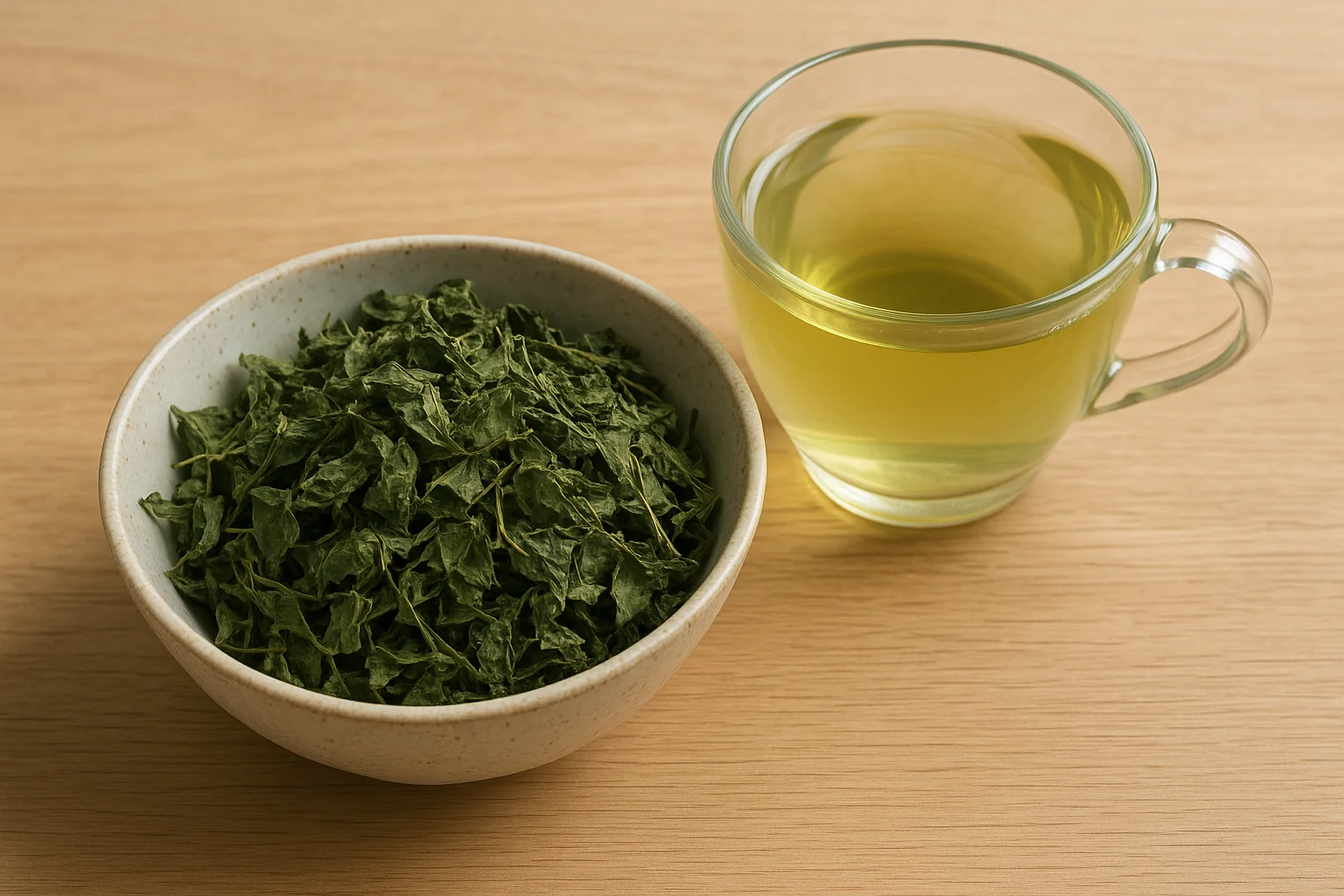
Gynostemma is different from black tea - boiling water (100°C) can destroy the more delicate gypenosides and impart a bitter taste. The optimal brewing temperature is 80-90°C. If you don't have a tea thermometer, boil the water and wait 3-4 minutes before pouring.
Proportions: 1-2 teaspoons (2-4 g) of dried herb for 200-250 ml of water. Cover the container and steep for 3-5 minutes. Longer steeping gives a stronger, more herbal flavor, but it is not necessary to extract the active ingredients. Gynostemma stands out because the same leaves can be steeped multiple times - 2-3 times - making it an economical option for daily drinking.
The taste of gynostemma is mildly sweet and herbal, with a hint of grass or fresh greens. For those accustomed to green tea, the flavor will be familiar and pleasant. It can be combined with honey, lemon, or a piece of ginger. Gynostemma also pairs well with green tea - adding a portion of the herb to a green tea infuser enriches the profile of active ingredients without significantly changing the taste.
Gynostemma vs. ginseng - a comparison
Comparing gynostemma with ginseng is a natural question since both plants contain structurally similar triterpenoid saponins. Asian ginseng (Panax ginseng) has a significantly richer clinical documentation - hundreds of studies, a long history in traditional Chinese and Korean medicine. Gynostemma has a more modest clinical evidence base, but several well-designed studies in specific areas (particularly glycemia).
Practical difference: ginseng is widely available in pharmacies in the form of standardized preparations, is expensive, and is rarely found in herbal tea form (roots take a long time to brew). Gynostemma is a perennial plant, with leaves harvested throughout the growing season; the dried herb is inexpensive and available for regular drinking like tea. For those interested in adaptogenic support for daily functioning without high costs, gynostemma is a logical choice for a daily tea ritual.
Important note: gynostemma should not be considered a substitute for ginseng in specific clinical indications. If a doctor or herbalist has recommended ginseng in a specific dose and form, do not replace it with gynostemma without consultation - despite chemical similarities, the profiles of biological activity are not identical.
Gynostemma and glucose and insulin resistance - what is worth knowing?
The glycemic regulation effect is the best-documented clinical effect of gynostemma. The mechanism may involve several pathways: gypenosides may activate AMPK (AMP-activated protein kinase) - an enzyme known as the "master switch of metabolism," which improves insulin sensitivity in muscle tissue and the liver. The same pathway is activated by metformin - the most common drug for type 2 diabetes.
Important disclaimer: individuals taking glycemic-lowering medications (metformin, sulfonylureas, insulin) should consult their doctor before starting gynostemma. The potential additive effect with medications may lead to hypoglycemia. This is not a reason to give up tea - it is a reason to inform your healthcare provider about supplementation.
Frequently Asked Questions
What is gynostemma (jiaogulan)?
Gynostemma pentaphyllum is a perennial vine from East Asia, known in Chinese as jiaogulan or xiancao (herb of immortality). It contains gypenosides - triterpenoid saponins similar to ginsenosides from ginseng. In traditional Chinese medicine, it is used as an adaptogen and a means to support longevity.
What properties does gynostemma have?
Gynostemma is best studied for glycemic regulation - a meta-analysis (Li et al., PLOS ONE, 2019) confirmed a reduction in fasting glucose in individuals with type 2 diabetes. It also shows effects on blood lipids (cholesterol, triglycerides) and antioxidant properties. Adaptogenic effects have mainly been observed in animal models.
How to brew tea from gynostemma?
Pour 1-2 teaspoons of dried herb into 200-250 ml of water at 80-90°C. Steep for 3-5 minutes under cover. The same leaves can be steeped 2-3 times. Drink 1-3 cups daily. The taste is mildly herbal and slightly sweet.
Is gynostemma safe?
Gynostemma is generally well tolerated as an herbal tea. Possible rare side effects: mild stomach discomfort with initial use or large doses of extract. There is no data on safety during pregnancy and breastfeeding - it should be avoided or consulted with a doctor. It may interact with blood sugar-lowering medications and statins.
What are gypenosides and how do they differ from ginsenosides?
Gypenosides are triterpenoid saponins from gynostemma. Ginsenosides are analogous saponins from ginseng. Both groups have a similar chemical structure - four gypenosides are identical to ginsenosides. This is the biological basis for the similar adaptogenic action profile of both plants. Gynostemma contains over 170 different gypenosides.
How much gynostemma should be consumed daily?
Traditional use is 2-3 cups of tea daily. In clinical studies, standardized extracts are used in doses of 450-800 mg of gypenoside daily. As tea, 1-3 cups is a safe range for healthy adults. Do not exceed large doses of extract without medical consultation in chronic diseases or when taking medications.
This article is for informational and educational purposes and does not replace consultation with a doctor. If you are pregnant, breastfeeding, taking medications, or have chronic conditions, consult the use of supplements or herbs with a specialist.
Author: Michał Waluk · Published: 2026-05-04 · Updated: 2026-05-04