
Lentil Dhal with Hemp Seeds: Indian Classic in Polish
Lentil dhal made from red lentils with hulled hemp seeds. Step-by-step recipe and measured data on the protein content of both ingredients, without marketing shortcuts.
Lentil dhal made from red lentils is a dish that requires minimal ingredients and delivers maximum flavor. Hemp seeds subtly change it: they add fat that smooths the sauce without cream and a nutty flavor that pairs well with the spiciness of cumin and turmeric. Additionally, their protein complements the lentils, creating a pair that compensates for the weaker aspects of both ingredients. The entire dish is ready in half an hour, is vegan, and reheats better the next day than it tasted on the first. To cook it, you need one pot and a few minutes at the stove. Below you will find a step-by-step recipe, measured data on the composition of both ingredients, and an explanation of why the popular shortcut about “complete plant protein” requires clarification.
KEY INFORMATION
• One hundred grams of dry red lentils contain 23.9 g of protein, 10.8 g of fiber, and 7.39 mg of iron (USDA FoodData Central, record 174284).
• One hundred grams of hulled hemp seeds contain 31.6 g of protein, 48.8 g of fat, and 700 mg of magnesium (USDA FoodData Central, record 170148).
• Lentils have more lysine (1.74 g vs 1.28 g), while hemp seeds have over four times more methionine.
• The PDCAAS of hulled hemp seeds is 63-66%, and the first limiting amino acid in them is lysine (House et al., 2010).
Why do hemp seeds go well with lentils?
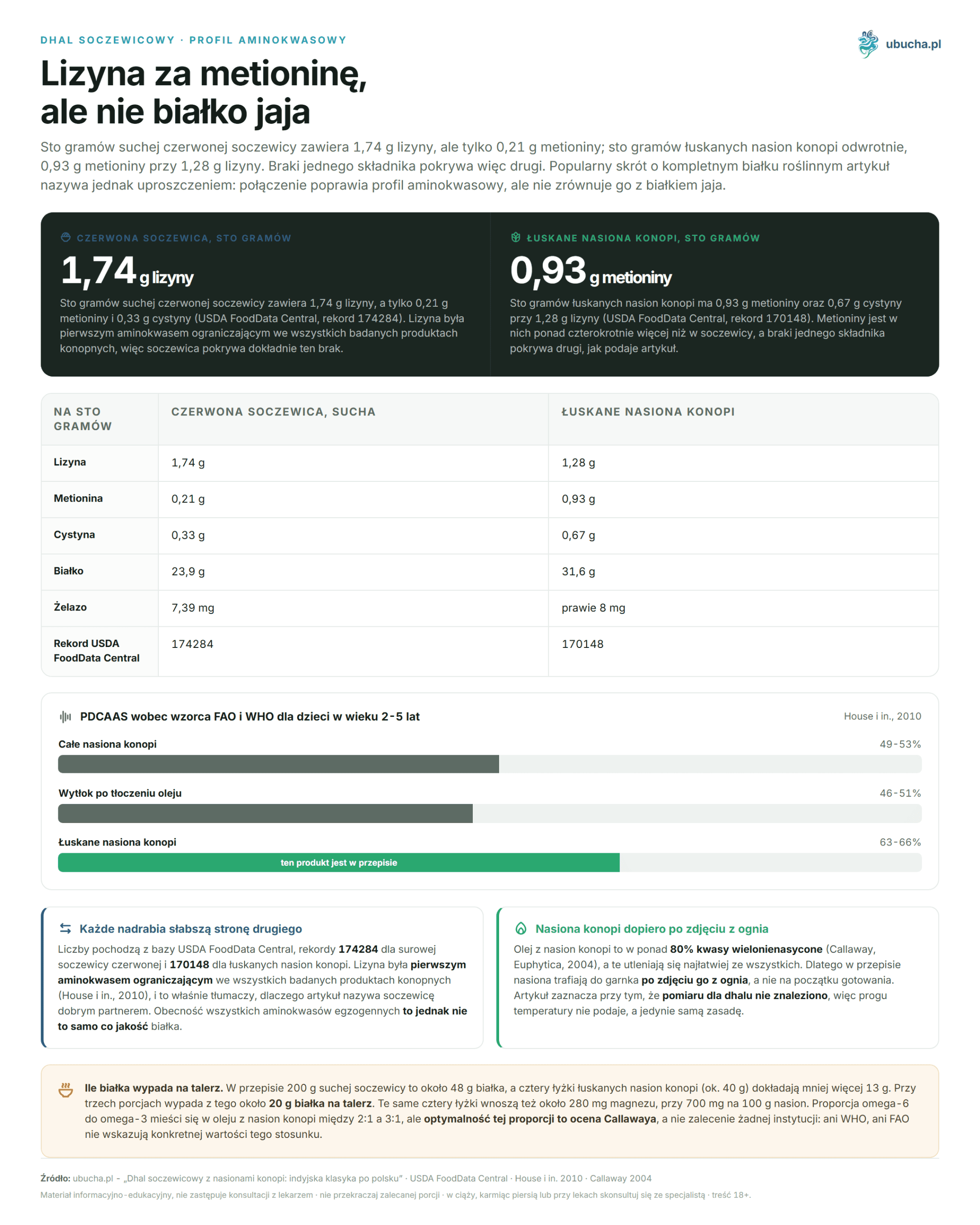
Because each compensates for the weaker side of the other. One hundred grams of dry red lentils contain 1.74 g of lysine but only 0.21 g of methionine and 0.33 g of cysteine. One hundred grams of hulled hemp seeds have 0.93 g of methionine and 0.67 g of cysteine with 1.28 g of lysine. Thus, the deficiency of one ingredient is covered by the other.
The numbers come from the USDA FoodData Central database, records 174284 for raw red lentils and 170148 for hulled hemp seeds. The same pair of records states that there are 23.9 g of protein per 100 g of lentils and 31.6 g per 100 g of seeds. Two hundred grams of dry lentils from the recipe thus provide about 48 g of protein, and four tablespoons of seeds add about 13 g. For three servings, this amounts to about 20 g of protein per plate.
However, the popular shortcut about complete plant protein requires clarification. Callaway (Euphytica, 2004) states that the proteins in hemp seeds contain nutritionally significant amounts of all essential amino acids, but presence is not the same as quality. House et al. (Journal of Agricultural and Food Chemistry, 2010) measured the PDCAAS of thirty commercial samples, and for hulled seeds, it came out to be 63-66% compared to the FAO and WHO amino acid standard for children aged 2-5 years. Lysine was the first limiting amino acid in all tested hemp products, which explains why lentils are a good partner here.
| Hemp Product | Protein | Fat | PDCAAS |
|---|---|---|---|
| Whole seeds | 24.0% | 30.4% | 49-53% |
| Oil press cake | 40.7% | 10.2% | 46-51% |
| Hulled seeds | 35.9% | 46.7% | 63-66% |
The table comes from the measurements by House et al. (2010) and concerns three different products that are often confused under the common name. For dhal, we take hulled seeds, which is the last row.
What do hemp seeds bring to dhal besides protein?
Fat and minerals. Hulled hemp seeds contain 48.8 g of fat per 100 g, and this fat replaces cream or coconut milk in the pot. Additionally, there are 700 mg of magnesium per 100 g, which amounts to about 280 mg in four tablespoons from the recipe, and almost 8 mg of iron for the same 100 g.
The type of fat matters in cooking. Hemp seed oil is over 80% polyunsaturated fatty acids, and the omega-6 to omega-3 ratio is between 2:1 and 3:1 (Callaway, Euphytica, 2004). Callaway calls this ratio optimal for humans, but this is his assessment, not a recommendation from any institution: neither WHO nor FAO specifies a specific value for this ratio. The practical conclusion for the kitchen is simpler: polyunsaturated fatty acids oxidize the easiest, so we add the seeds after removing the pot from the heat, not at the beginning of cooking.
From our experience, dhal with hemp seeds tastes significantly better the next day. Overnight it thickens, the spices stop being individually detectable, and the nutty flavor of the seeds takes a back seat and stops competing with cumin. It is worth cooking a larger portion right away, as reheated dhal is one of the best lunches from the fridge that can be prepared the day before.
What do you need for dhal?
Red lentils, onion with garlic and ginger, a can of tomatoes, and four spices. Hemp seeds are added at the end. The proportions are enough for three or four servings, preparation takes 5 minutes, and cooking another 25.
- 200 g of dry red lentils
- 4 tablespoons of hulled hemp seeds (about 40 g)
- 1 can (400 g) of chopped tomatoes or 2 fresh tomatoes
- 600 ml of water or vegetable broth
- 1 large onion
- 3 cloves of garlic
- 1 teaspoon of grated fresh ginger or half a teaspoon of ground
- 2 tablespoons of coconut oil, ghee, or olive oil
- 1 teaspoon of turmeric
- 1 teaspoon of cumin seeds
- 1 teaspoon of ground coriander
- half a teaspoon of garam masala
- salt, pepper, and lemon or lime juice
- fresh coriander for serving
- basmati rice or naan bread for serving
Red lentils are the only ingredient without a substitute here. Unlike green and brown lentils, they fall apart during cooking, and this breakdown creates the creamy consistency of the dhal. Green lentils will remain whole and give you a soup with grains instead of a smooth sauce. You do not need to have all the spices: dhal still works without garam masala, but it loses the most without cumin.
How to cook dhal step by step?
Flavor is built in layers: first spices in fat, then onion with tomatoes, and finally lentils with water. Hemp seeds are added as the last element, after removing the pot from the heat. The entire procedure takes half an hour and does not require supervision except for stirring every few minutes.
- Heat oil in a deep pan or pot over medium heat. Add cumin seeds and wait 30 seconds until they start to sizzle. Add finely chopped onion and fry for 6-7 minutes until golden, as caramelized onion is the flavor foundation of the entire dish.
- Add garlic with ginger and fry for a minute. Add turmeric, ground coriander, and a pinch of chili and stir for half a minute. Spices in hot fat release their aroma much more strongly than when added later to the liquid.
- Pour in chopped tomatoes and fry for 3-4 minutes until excess water evaporates and the sauce thickens slightly.
- Rinse the lentils under cold water, add them to the pot and cover with water or broth. Bring to a boil, reduce heat, cover halfway, and cook for 18-20 minutes. Stir every few minutes as lentils tend to stick to the bottom. They are ready when they completely fall apart.
- Remove the pot from the heat and only then add the hemp seeds. Season with salt, lemon juice, and garam masala. If the dhal is too thick, add 50-100 ml of water. Serve with basmati rice or naan, sprinkled with fresh coriander.
What dhal variations are worth trying?
Three, and each changes only one element. Tarka enhances the aroma, coconut milk softens the spices, and adding vegetables turns dhal into a more complete one-pot dish. Hemp seeds remain unchanged in each, always added at the end.
Tarka is heated fat with spices poured over the finished dish. Heat a tablespoon of ghee, add a teaspoon of cumin, and two cloves of garlic sliced, fry until golden and pour this over the dhal just before serving. The aroma becomes noticeably stronger as freshly heated spices hit the top rather than sinking into the sauce.
The creamy version is made by replacing 200 ml of water with coconut milk. The dhal then becomes milder and less spicy, which can be a good choice for children. The vegetable version requires adding diced sweet potato along with the lentils or 100 g of spinach in the last two minutes of cooking.
If you are looking for similarly simple dishes with the same seeds, check out the recipes for miso soup with hemp seeds, cauliflower cream with curry, and curry with chickpeas and hemp flour.
Frequently Asked Questions
Why do hemp seeds go well with lentil dhal?
Because they complement the weakest amino acid in lentils. One hundred grams of dry red lentils contain 1.74 g of lysine but only 0.21 g of methionine, while hulled hemp seeds provide 0.93 g of methionine per 100 g (USDA FoodData Central, records 174284 and 170148). The reverse is also true, as lysine is the limiting amino acid in hemp.
When should hemp seeds be added to dhal?
After removing the pot from the heat or at a minimal flame. Hemp seed oil is over 80% polyunsaturated fatty acids (Callaway, 2004), which oxidize the easiest of all. We did not find a measurement for dhal, so we do not provide a temperature threshold, only the principle: add the seeds at the end.
Does red lentil require soaking?
No, it cooks for 18-20 minutes straight from the package, just rinse it under cold water. Unlike green and brown lentils, it falls apart during cooking and creates a creamy consistency on which the whole dish stands. Green lentils will remain whole and give you a soup with grains.
How much protein do the ingredients of this dhal have?
Two hundred grams of dry lentils contain about 48 g of protein, and four tablespoons of hulled hemp seeds add about 13 g. For three servings, this amounts to about 20 g of protein per plate. The basis for the calculation is records 174284 and 170148 from the USDA FoodData Central database.
Is dhal with hemp seeds a complete protein?
This is an oversimplification, although the pair of ingredients is well matched. The PDCAAS of hulled hemp seeds is 63-66% compared to the FAO and WHO standard for children aged 2-5 years (House et al., 2010). The combination with lentils improves the amino acid profile but does not equate it with egg protein.
If you are looking for ready-made food products, check out the food category in the u Bucha store.
This article is for informational and educational purposes and does not replace consultation with a doctor. If you are pregnant, breastfeeding, taking medications, or have chronic conditions, consult the use of supplements or herbs with a specialist.
Author: Michał Waluk · Published: 2026-06-15 · Updated: 2026-08-16