
Glycine for Sleep and Recovery: What Was Measured and What Was Added (Table)
Glycine for sleep and recovery without a dosing table. What did Bannai and Kawai really measure, why the glycine gap is 10 g, and what the FDA did with the GRAS status.
Glycine is the smallest amino acid in the body and one of the few sleep supplements for which measurements can be indicated in humans. The problem is that this measurement pertains to something different than is usually written. This article goes through three studies that underpin the entire popular narrative about glycine and sleep, showing for each who was studied, how many participants were involved, and what endpoint was measured. The table remains, but instead of doses, it shows studies. The reason is simple: none of these studies provide a basis to tell the reader how much to take. You will also see which numbers from the previous version of this entry were reversed from their sources and how they look after checking the documents.
KEY INFORMATION
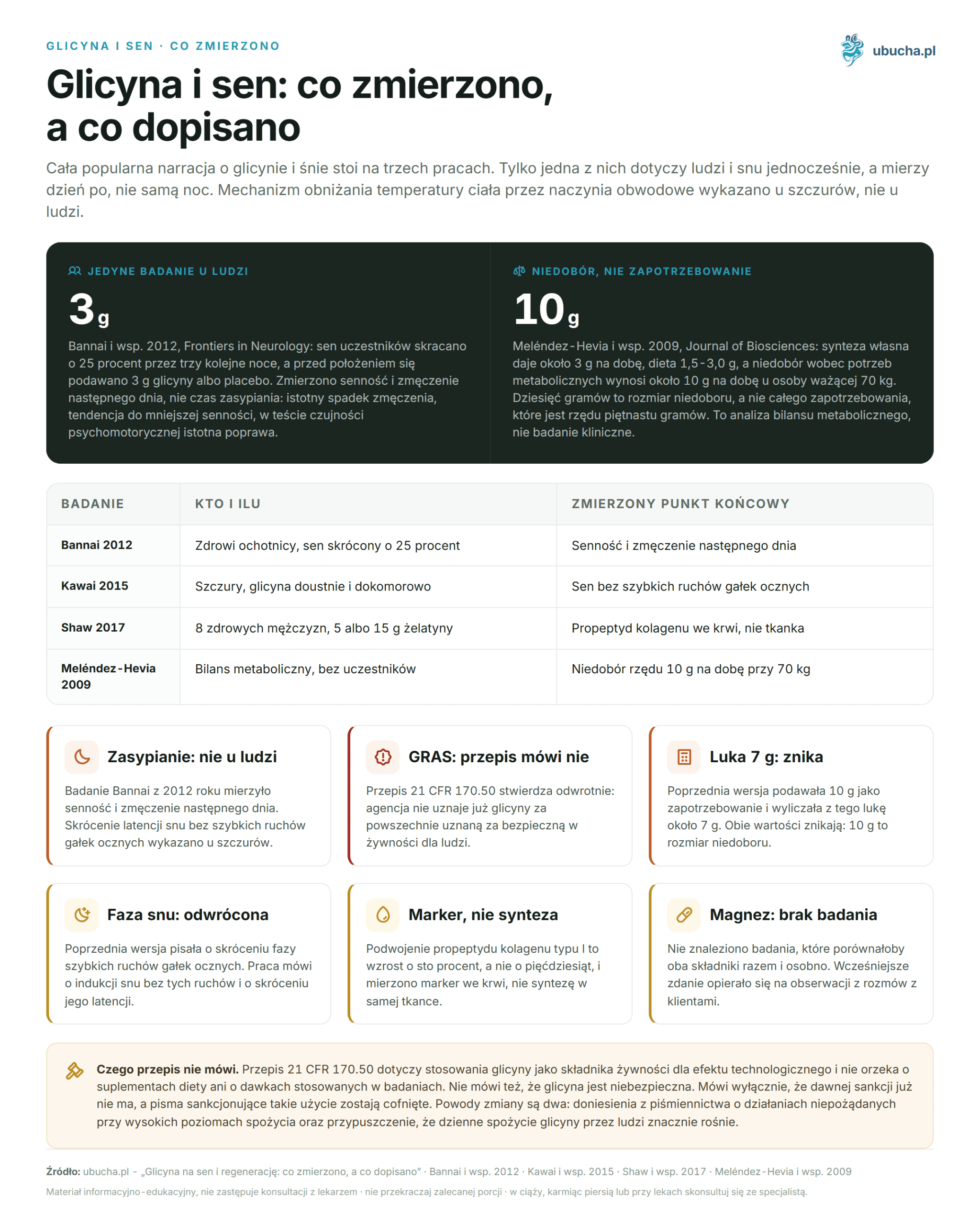
• The analysis by Meléndez-Hevia from 2009 states that endogenous synthesis provides about 3 g of glycine daily, diet provides another 1.5-3.0 g, and the deficiency relative to metabolic needs is about 10 g per day for a person weighing 70 kg.
• The mechanism of lowering body temperature through peripheral vessels has been shown in rats, not in humans.
• The Bannai study from 2012 measured sleepiness and fatigue during the day in individuals with restricted sleep, not sleep onset time.
• The FDA in regulation 21 CFR 170.50 states that it no longer recognizes glycine as a substance generally recognized as safe in food, and retracts previous letters on this matter.
• In the Shaw study, 15 g of gelatin before exercise doubled the concentration of the collagen synthesis marker in the blood of eight men.
How much glycine does the body produce, and how much does it need?
The numbers in this section were previously reversed, and it is worth showing how the switch occurred. The study by Meléndez-Hevia et al. from 2009 in the Journal of Biosciences compares all reported streams of glycine production and consumption in an adult human. The result: synthesis from serine accounts for over 85 percent of endogenous production and provides about 3 g per day, diet supplies from 1.5 to 3.0 g, and all of this together does not cover metabolic needs, including collagen synthesis, by about 10 g per day for a person weighing 70 kg.
Thus, ten grams is the size of the deficiency, not the total requirement. The previous version of this entry stated 10 g as the requirement and calculated the gap at about 7 g from this reversed number. Both values disappear. The true requirement results from the sum: about 3 g from synthesis, up to 3 g from diet, and about 10 g missing, which means around fifteen grams per day.
It is worth knowing what this work is before citing it. It is a metabolic balance analysis based on streams collected from the literature, not a clinical study on humans. The authors themselves conclude that glycine is a semi-essential amino acid and that it is worth taking in supplementation, but this is a conclusion from a model, not from a randomized trial. The identifier that stood with this statement in the previous version actually led to a completely different work: a review of the multiple beneficial actions of glycine from 2017.
How would glycine improve sleep?
The mechanism described in this article is real, but it has only been demonstrated in animals and under a different signature than was provided. The work to which the identifier led here is Kawai et al. 2015, Neuropsychopharmacology, not Bannai and Kawai in Frontiers in Neurology from 2012. The authors state directly that they studied the site of action and the sleep-inducing mechanism of glycine in rats.
What they found: orally administered glycine induced non-rapid eye movement sleep and shortened its latency, while simultaneously lowering deep body temperature. It increased skin blood flow on the plantar surface in a dose-dependent manner, leading to heat loss. This effect was abolished by blocking the NMDA receptor, not by strychnine blocking the glycine receptor, and destruction of the suprachiasmatic nucleus completely abolished the sleep-inducing and thermal effects. The previous version mentioned a shortening of rapid eye movement sleep, which is something else: the work speaks of inducing non-rapid eye movement sleep and shortening its latency.
The statement about modulating the circadian rhythm was removed because it is contradicted by another work cited in the same entry. Bannai et al. checked this directly and found no changes: melatonin levels in plasma did not change either in the dark or light phase, and the levels of expression of the clock genes Bmal1 and Per2 remained unchanged. They observed an increase in two neuropeptides in the suprachiasmatic nucleus and state that they found no change in the clock itself. The value of a temperature drop of 0.5-1 degree was also removed, as it is not present in the available abstract.
What was actually measured in the Bannai study?
The previous version of this entry attributed the shortening of sleep onset time to the work of Bannai et al. published supposedly in Sleep and Biological Rhythms in 2012. A publication with such a description could not be found. However, there is a work by this team from the same year in Frontiers in Neurology, and it is the only study here involving humans, although it concerns a different endpoint.
The setup was as follows: participants’ sleep was shortened by 25 percent compared to usual length for three consecutive nights, and before going to bed, they were given 3 g of glycine or placebo. Sleepiness and fatigue were measured the next day, using a visual analog scale, a questionnaire, and a computer performance test. The result: a significant decrease in fatigue and a trend towards less sleepiness, and a significant improvement in the psychomotor vigilance test.
The difference between this and the statement that stood here earlier is fundamental. The work did not measure sleep latency or sleep quality on the night of administration. It measured how a person functions the day after a night shorter than needed. This is a valuable result and worth describing, but it answers a different question than the title of this article. Evening supplement sets are discussed separately in the entry on the evening supplementation protocol.
It is also worth knowing where the supplement stands in all of this. European guidelines on insomnia, updated in 2023 in the Journal of Sleep Research, recommend cognitive-behavioral therapy as the first-line treatment for chronic insomnia in adults, with the highest level of recommendation. In the summary of these guidelines, which lists separately recommended and discouraged medications, glycine does not appear on either side. This is not a criticism of it, just a description of its place: a substance with one study in humans measuring next-day well-being is not yet the subject of resolution in a document organizing insomnia treatment.
Does the FDA really consider glycine to be GRAS?
No, and this is the most serious single mistake in the previous version of this text, as it was repeated four times: in the box, in the prose, in the questions section, and in the structured data. Regulation 21 CFR 170.50, titled “Glycine (aminoacetic acid) in food intended for human consumption,” begins with the statement that until now the agency has expressed in commercial correspondence the view of glycine being generally recognized as safe for certain technical applications, then says “however” and lists the reasons for changing its mind.
The reasons are twofold: reports from the literature of adverse effects at high levels of consumption and the assumption that daily glycine intake by humans is significantly increasing due to changing applications in food technology. The conclusion of the regulation states that the agency no longer recognizes glycine or its salts as generally recognized as safe in food for humans, and all letters sanctioning such use are retracted. Manufacturers were ordered to reformulate products.
This sentence is worth reading carefully, as it is easy to stretch it the other way. The regulation pertains to the use of glycine as a food ingredient for technological effect and does not rule on dietary supplements or doses used in studies. It also does not say that glycine is unsafe. It only states that the previous sanction is no longer in place. The sentence about doses from 10 to 60 g without observed toxicity was also removed: the address that was supposed to support it returns the application shell itself, so the numbers could not be confirmed with it.
What is known about glycine and connective tissue regeneration?
Glycine occupies every third position in the triple helix of collagen, and hence its participation is around one third of the amino acid residues. This is the starting point for the entire section. The most frequently cited study is the work of Shaw et al. from 2017 in the American Journal of Clinical Nutrition, which in the previous version of this entry was described with three errors at once.
What it actually looked like: eight healthy men, a crossover design with double blinding, a drink with 5 or 15 g of gelatin enriched with vitamin C or placebo. An hour after drinking, participants performed six minutes of jumping rope, not triple jump exercises, which in this description was a translation from nowhere. Those who took 15 g of gelatin an hour before exercise had their type I collagen propeptide concentration in the blood doubled, meaning a 100 percent increase, not fifty. And a blood marker was measured, not synthesis in the tissue itself.
The second correction concerns vitamin C. The statement about it is true and remains, as the hydroxylation of proline and lysine indeed requires it as a cofactor. However, the identifier that stood with it led to a work on the metabolism of flavonoids in the diet, not to a review of the role of vitamin C in skin health, published in Nutrients in 2017. The number was off by two digits and hit the adjacent entry of the same volume. We discuss the building block more broadly in the entry on collagen taken at night or in the morning.
How do these studies look in one summary?
The table below replaces the dosing table that stood here earlier and provided the time of intake and gram weight for six purposes, including diabetes. Such recommendations are not published in this service, and their basis was not the studies mentioned in the article anyway. The summary below shows what can be verified: who conducted the study, how many participants there were, what they were given, and what endpoint was measured. Note that only one of these entries concerns humans and sleep simultaneously, and even it measures the day after, not the night itself.
| Study | Who and how many | What was given | Measured endpoint |
|---|---|---|---|
| Bannai et al. 2012, Frontiers in Neurology | Healthy volunteers with restricted sleep, sleep shortened by 25 percent for three nights | 3 g of glycine or placebo before bedtime | Sleepiness and fatigue the next day; significant decrease in fatigue, trend towards less sleepiness, improvement in vigilance |
| Kawai et al. 2015, Neuropsychopharmacology | Rats | Glycine orally and intracerebroventricularly | Non-rapid eye movement sleep and its latency, deep temperature, skin blood flow; effect abolished by NMDA antagonists |
| Shaw et al. 2017, American Journal of Clinical Nutrition | 8 healthy men, crossover design | 5 or 15 g of gelatin with vitamin C one hour before 6 minutes of jumping rope | Type I collagen propeptide in blood; doubling after 15 g |
| Meléndez-Hevia et al. 2009, Journal of Biosciences | Metabolic balance of an adult, no participants | Analysis of reported streams of production and consumption | Deficiency relative to metabolic needs of about 10 g per day at 70 kg body weight |
Frequently Asked Questions
Does glycine shorten the time it takes to fall asleep in humans?
This was not measured in the study that is usually cited. The 2012 Bannai study concerned daytime sleepiness and fatigue in individuals with restricted sleep. A reduction in sleep latency without rapid eye movement sleep was shown in rats in the 2015 Kawai study.
Does the FDA consider glycine to be GRAS?
No. Regulation 21 CFR 170.50 states that the agency no longer recognizes glycine or its salts as generally recognized as safe in food for humans, and it retracts previous letters sanctioning such use. The regulation pertains to food, not supplements or studies.
What is the glycine gap?
About 10 g per day for a person weighing 70 kg, and this is the size of the deficiency, not the total requirement. Endogenous synthesis provides about 3 g, and diet provides 1.5 to 3.0 g. The number comes from a metabolic balance analysis, not a clinical study.
Does glycine cause next-day drowsiness?
In the Bannai study, the group receiving glycine reported less fatigue, and performed better in the psychomotor vigilance test. The decrease in drowsiness itself was only a trend, without statistical significance. Participants were healthy volunteers after three nights of restricted sleep.
Do glycine and magnesium work better together?
We did not find a study that compared both ingredients together and separately. The previous statement in this article was based on observations from conversations with customers and was removed because observation is not measurement, and the statement suggested a controlled study result.
Who should exercise caution?
Individuals with severe kidney failure and pregnant or breastfeeding women, for whom there is a lack of data from studies on supplemental doses. In both cases, the decision to supplement should be made with a doctor, not based on the article.
The store u Bucha does not have glycine in any form. In the supplements category, however, there are magnesium and collagen preparations mentioned above (catalog status as of August 8, 2026). The forms of magnesium itself are compared in the entry on magnesium for stress and sleep.
This article is for informational and educational purposes and does not constitute medical advice. Before starting supplementation, consult with a doctor, especially if you are taking medications regularly, are pregnant or breastfeeding, or have a chronic illness.
Author: Michał Waluk · Published: 2026-08-09 · Updated: 2026-08-16