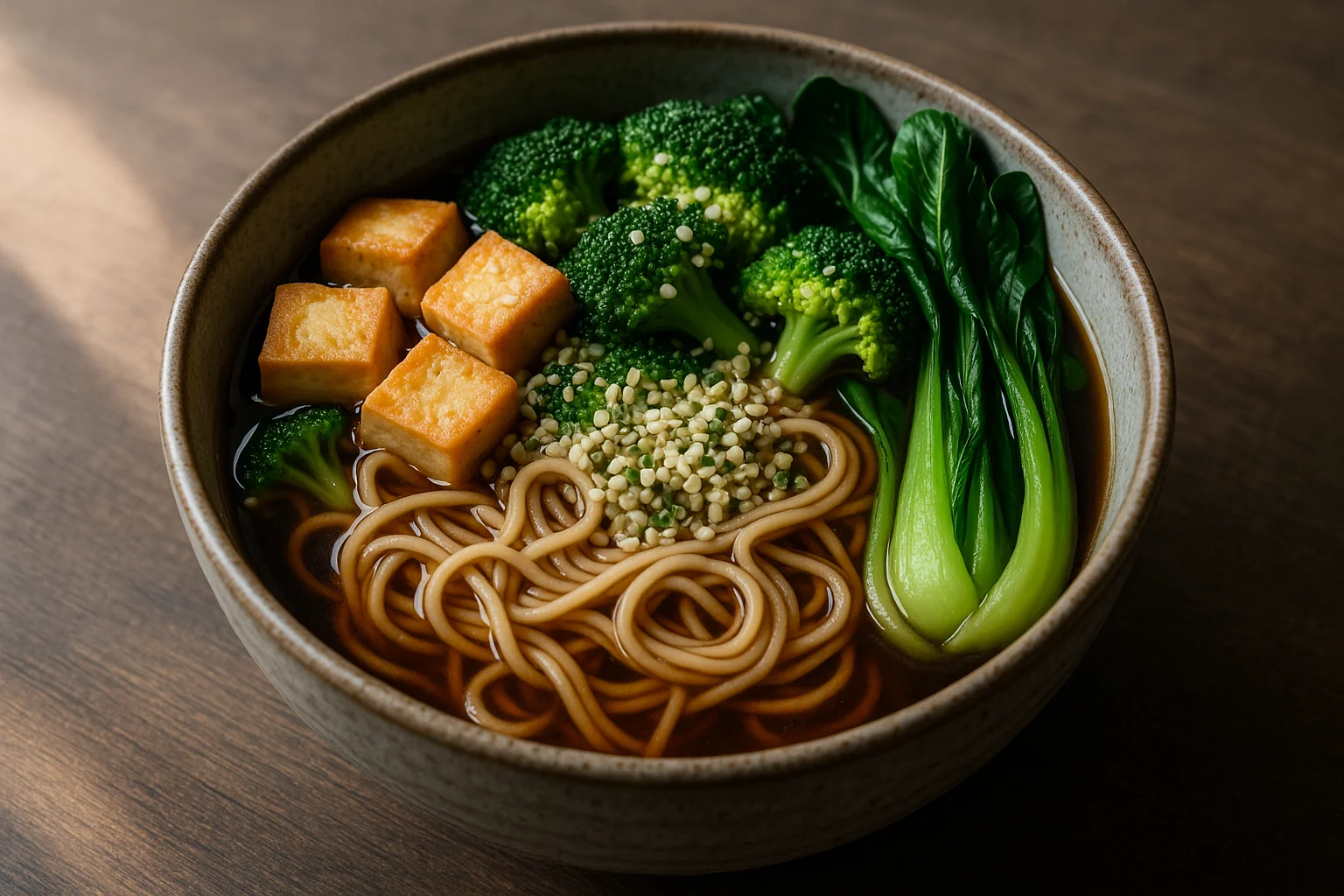

Ramen with hemp seeds and vegetables - vegan broth
Vegan ramen with toasted hemp seeds: miso broth in 25 minutes, noodles cooked separately, seed composition from USDA per 100 g, and a list of label traps.
Vegan ramen does not have to be a pale shadow of tonkotsu. The depth is built here by umami: miso paste, soy sauce, dried shiitake, and dry-burnt onion along with the skin. The problem with such a bowl is different, nutritional. Just noodles with broth are mainly carbohydrates and sodium, so a portion without a proper source of protein stops being filling after an hour. Hulled hemp seeds close this gap most simply, as 100 g provides 31.6 g of protein and 48.8 g of fat, including 38.1 g of polyunsaturated fatty acids (USDA FoodData Central, record 170148). Sprinkled on top, they also provide the crunch that is usually missing in ramen. Below you will find a recipe for two servings with cooking times, the seed composition calculated per 100 g, and a list of traps that can take away the vegan nature of this soup.
KEY INFORMATION
• 100 g of hulled hemp seeds contains 553 kcal, 31.6 g of protein, and 48.8 g of fat (USDA FoodData Central, record 170148).
• It contains 27.4 g of linoleic acid, 8.68 g of alpha-linolenic acid, which is about 3 to 1 (the same USDA record).
• The seeds have all nine essential amino acids, but lysine limits them: PDCAAS for hulled seeds is 63-66% (House et al., 2010).
• The vegan nature of ramen is spoiled by two labels: miso with dashi and noodles with egg in the composition.
What do hemp seeds provide in vegan ramen?
Hemp seeds bring protein and fats to the bowl, which the noodles lack. One hundred grams of hulled seeds contains 553 kcal, 31.6 g of protein, 48.8 g of fat, and 8.67 g of carbohydrates, including 4 g of fiber (USDA FoodData Central, record 170148). A tablespoon weighs about 10 g, so you do the conversion per serving yourself.
| Ingredient | Per 100 g of hulled seeds |
|---|---|
| Energy | 553 kcal |
| Protein | 31.6 g |
| Total fat | 48.8 g |
| Linoleic acid, omega-6 | 27.4 g |
| Alpha-linolenic acid, omega-3 | 8.68 g |
| Gamma-linolenic acid, GLA | 1.34 g |
| Fiber | 4.0 g |
| Magnesium | 700 mg |
| Zinc | 9.9 mg |
The ratio of both acids comes out from this table: 27.4 g to 8.68 g, which is about 3 to 1. It is worth knowing where the number that the internet repeats as a constant feature of hemp comes from. A review paper by Callaway (Euphytica, 2004) provides a typical range for hemp seeds from 2 to 1 up to 3 to 1, not a single value. The USDA record describes a specific batch of seeds, not every one you buy.
Is protein from hemp seeds complete?
It contains all nine essential amino acids, but qualitatively does not match soy. House, Neufeld, and Leson (Journal of Agricultural and Food Chemistry, 2010) examined thirty commercial samples of hemp from Western Canada and measured that the limiting amino acid is lysine in all of them. For hulled seeds, protein digestibility was 83.5-92.1%, and the PDCAAS was 63-66%.
This same work shows why hulled seeds make sense in the bowl. For unhulled seeds, PDCAAS was lower, at 49-53%, and for the cake after pressing, 46-51%. Removing the hull thus increases both digestibility and the overall protein rating. The authors provide the measurement conditions, which cannot be overlooked when reading these numbers: digestibility was measured in a rat test, and the reference point for amino acids was the needs of children aged two to five according to FAO and WHO. This is the standard PDCAAS method, but the number describes protein in that specific setup, not in an adult diet.
The practical conclusion is simple and concerns this specific soup. The lysine gap is closed by tofu, as soy protein is rich in lysine, so the combination of seeds with tofu makes sense not only in terms of flavor. Just ramen with hemp topping, without legumes, will provide less valuable protein than the number 31.6 g per hundred grams suggests. The same applies to the combination of seeds with chickpeas, which we described in the recipe for chickpea and hemp seed patties.
What do you need for two servings?
The list is short, and half of the ingredients are pantry staples. The active time is about 20 minutes, the broth cooks for 25 minutes, and the whole process takes 45 minutes. Besides hemp seeds, you can buy everything at a regular store or an Asian grocery store.
- 160 g ramen noodles, can be soba, udon, or rice noodles
- 4 tablespoons hulled hemp seeds, about 40 g
- 150 g firm tofu
- 2 small bok choy or 150 g baby spinach
- 1 large onion, unpeeled
- 5 cm piece of ginger
- 4 cloves of garlic
- 20 g dried shiitake mushrooms
- 2 tablespoons red or awase miso paste
- 2 tablespoons soy sauce or tamari
- 1 tablespoon tahini
- 1 tablespoon sesame oil, 1 tablespoon canola oil for tofu
- 1.2 l water
- for serving: nori, chives, chili oil
The vegan nature of this bowl is determined by two labels, so check them in the store, not at the pot. Miso paste is sometimes sold in the dashi-iri version, which contains broth from dried bonito tuna; the ingredients of vegan miso paste are soy, rice or barley, salt, and koji. Ramen noodles in the classic recipe contain flour, water, salt, and kansui, but some packets of dried and instant noodles have powdered egg or a packet with meat extract. A third, rarer case is Japanese chili oil with dried shrimp. Nothing else in the recipe comes from animals.
How to cook the broth and assemble the bowls?
The order matters here more than the ingredients themselves. The broth cooks for 25 minutes, and during that time, you prepare the rest, the noodles go in a separate pot, and the miso only goes into the broth taken off the heat. You toast the seeds at the end so they go into the bowl still warm.
- Cut the onion in half, do not peel. Place the cut side on a dry, hot pan and hold for 4 minutes until the surface turns dark brown.
- In a pot, heat sesame oil, add ginger slices and crushed garlic, sauté for 2 minutes over low heat. Add the onion, shiitake, and 1.2 liters of water. Cook covered for 25 minutes on the lowest heat.
- Toast the hemp seeds in a dry pan for 2 minutes over medium heat, stirring constantly. Remove when they start to smell nutty, and transfer to a cold plate.
- Cut the tofu into 2 cm cubes and sauté in a tablespoon of canola oil for 4 minutes, turning the pieces. Cut the bok choy in half lengthwise.
- Cook the noodles in a separate pot in salted water, usually for 3-4 minutes, and drain.
- Remove the broth from the heat, strain through a sieve, and wait a minute. Dissolve the miso and tahini in a ladle of broth, pour back in, and add soy sauce. Dip the bok choy for 2 minutes.
- In a bowl, place the noodles, on top the tofu and bok choy, and pour over the broth. Top with a tablespoon of toasted seeds, nori, chives, and chili oil. Serve immediately.
Our trials show that burnt onion does more for the color of the broth than an additional ten minutes of cooking. The broth without this step comes out straw-colored and looks diluted, although it tastes similar. If you prefer a version without noodles and without tofu, the same miso base stands in a simpler version with us: miso soup with hemp seeds.
What mistakes ruin vegan ramen?
Three mistakes come up most often, and each is reversible. Noodles cooked in the broth release starch, the soup becomes cloudy, and after a few minutes, it becomes sticky. Miso thrown into boiling water loses some aroma and live cultures. Seeds burnt over high heat become bitter, and that cannot be undone.
Toasting should be shortened for this reason. The fat in the seeds consists of 38.1 g of polyunsaturated fatty acids per 100 g, and these oxidize faster than saturated fats, so two minutes over medium heat is more than enough. If you care about maximum omega-3, add raw seeds and skip the pan.
A separate rule applies to hemp oil, as it is often confused with sesame oil. Do not fry vegetables in it and do not pour it into boiling broth. This oil goes into the dish only when it is ready and cooled, a teaspoon per bowl just before serving: heating oxidizes its fatty acids and takes away the grassy flavor for which it is bought. For frying, use canola or sesame oil. The same mechanism applies to tofu, which likes high temperatures, and the seeds are only sprinkled on the plate, as shown in the recipe for tofu in hemp sauce.
Frequently asked questions
Can vegan ramen broth have depth of flavor?
Yes, although it is built differently than in tonkotsu. Three sources of umami work here: glutamates from miso paste and soy sauce, guanylates from dried shiitake mushrooms, and sugars from the dry-burnt onion. Hemp seeds add a nutty flavor, but do not build the flavor of the broth.
Is miso paste and ramen noodles always vegan?
No. Miso in the dashi-iri version contains broth from dried bonito tuna, and some dried and instant ramen noodles contain powdered egg or a packet with meat extract. Check the label: the ingredients of vegan miso paste are soy, rice or barley, salt, and koji.
How much protein does a tablespoon of hemp seeds provide?
Hulled seeds contain 31.6 g of protein per 100 g (USDA FoodData Central, record 170148). A tablespoon weighs about 10 g, so it provides approximately 3.2 g of protein and 55 kcal. Three tablespoons in a bowl is a noticeable addition, but will not replace tofu or legumes.
Is hemp protein complete?
It contains all nine essential amino acids, but is limited by lysine, so the term complete is a simplification here. For hulled seeds, House and colleagues measured PDCAAS at 63-66%, and for unhulled 49-53%. Tofu in this bowl closes the lysine gap.
Do hemp seeds need to be toasted?
No, it is not necessary. Toasting is a flavor decision: 2 minutes over medium heat brings out a nutty note and a slight crunch. The fat in the seeds consists of 38.1 g of polyunsaturated fatty acids per 100 g, which do not tolerate high temperatures well, so for maximum omega-3, use raw seeds.
What can replace ramen noodles?
Buckwheat soba, udon, rice noodles, and glass noodles work well in this broth. Soba brings more protein than wheat noodles, rice noodles are gluten-free, udon provides a thicker texture. Cook each in a separate pot and transfer to the bowl just before pouring the broth.
Hemp teas and herbal blends that match the soup bowl can be found in the hemp food category. The store at Bucha currently does not carry hulled hemp seeds.
This article is for informational and educational purposes and does not replace consultation with a doctor. If you are pregnant, breastfeeding, taking medications, or have chronic conditions, consult the use of supplements or herbs with a specialist.
Author: Michał Waluk · Published: 2026-06-02 · Updated: 2026-08-16