
Probiotic Lactobacillus reuteri for Infant Colic: Dosage and Evidence
Lactobacillus reuteri DSM 17938 and infant colic: what a meta-analysis of 345 infants showed and why the effect is only visible in breastfed children.
Infant colic is one of the most common concerns in the first months of parenthood, and it is also a condition where it is difficult to separate the effect of treatment from the natural resolution of symptoms. Among the proposed solutions, the most data from randomized studies has been gathered for one bacterial strain: Lactobacillus reuteri DSM 17938. A meta-analysis of individual data from four double-blind studies, involving 345 infants, showed a reduction in crying time compared to placebo, but clearly only in the breastfed group (Sung et al., Pediatrics, 2018). This text collects what individual studies have shown: who they included, how long they lasted, and what they did not resolve. It is not a recommendation for a specific child. The decision to administer a probiotic to an infant belongs to the pediatrician.
KEY INFORMATION
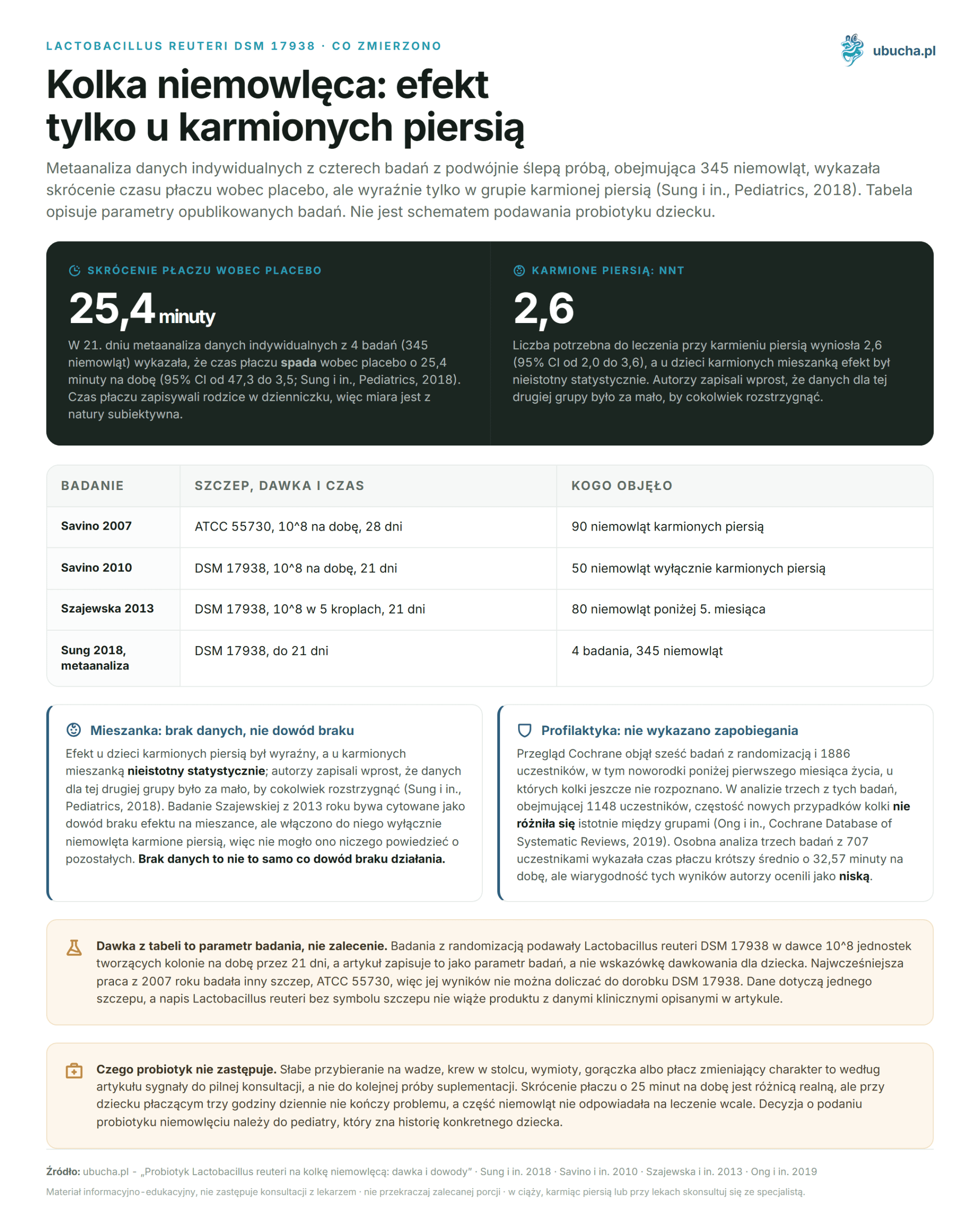
• A meta-analysis of individual data from 4 studies (345 infants) showed a reduction in crying by 25.4 minutes per day compared to placebo on day 21 (Sung et al., Pediatrics, 2018).
• The effect was clear in breastfed children (NNT 2.6), while in formula-fed children it was statistically insignificant; the authors state directly that there was insufficient data for this second group.
• Studies administered strain DSM 17938 at a dose of 10^8 colony-forming units per day for 21 days. This is a study parameter, not a recommendation.
• The Cochrane review on prevention did not show that the probiotic prevented the occurrence of colic.
• Data pertains to one strain; other L. reuteri strains do not have comparable research backing.
What is infant colic and why is it difficult to assess its treatment?
Colic is defined as crying lasting more than three hours a day, for more than three days a week, and for longer than three weeks, in a healthy and well-nourished child. This definition was proposed in 1954 and despite later modifications, it remains a reference point in clinical research (Wessel et al., Pediatrics, 1954).
The scale of the phenomenon depends on the criteria adopted. A review of studies published after the introduction of ROME IV criteria reports the incidence of colic at 10-15% among infants aged 0-6 months (Muhardi et al., Frontiers in Pediatrics, 2021). Older and higher estimates were mainly due to differing definitions and methods of data collection.
Assessing treatment is difficult due to a factor that has nothing to do with the quality of the preparations. Colic resolves spontaneously, usually around the fourth month of life. Any intervention given in the third month thus appears effective, as symptoms would have resolved anyway. Therefore, in this topic, only studies with a placebo group count, not reports of improvement after using anything. Additionally, the causes of colic remain undetermined: the immaturity of the intestinal nervous system, the composition of the microbiota, and sensitivity to cow’s milk proteins are considered, which in itself explains why no single intervention works for all children.
How does Lactobacillus reuteri affect an infant’s intestines?
Lactobacillus reuteri produces reuterin from glycerol, a compound with antibacterial action. It is worth immediately correcting a widespread simplification: reuterin does not selectively spare good bacteria. In a study involving a representative panel of intestinal bacteria, most of them were found to be very sensitive to it, while only lactic acid bacteria and Clostridium clostridioforme were relatively resistant (Cleusix et al., BMC Microbiology, 2007).
This distinction has practical significance. The advantage of the strain over the gut flora lies in the relative resistance of the lactobacilli themselves, not in the fact that reuterin recognizes pathogens. A change in the composition of the flora was indeed measured: in a randomized study, a significant increase in the number of lactic acid bacteria in the stool and a decrease in the content of Escherichia coli and ammonia were noted, and this was only in the group receiving the probiotic (Savino et al., Pediatrics, 2010).
Popular explanations go further and speak of the gut-brain axis, accelerated intestinal motility, or influence on visceral pain receptors. None of the clinical studies described in this text measured this. They measured crying time, the percentage of children with improvement, and the composition of stool flora, while the mechanism linking these three remains a hypothesis.
What protocols were used in studies on colic?
All studies that built this evidence base used the same daily dose and similar duration. They differed in the strain in the earliest work and the group included in the observation. The following summary presents what the authors wrote, without converting it into guidelines for the reader.
| Study | Strain and dosage | Who was included | Duration | Outcome reported by authors |
|---|---|---|---|---|
| Savino 2007 | ATCC 55730, 10^8 per day | 90 breastfed infants | 28 days | On day 28, median crying was 51 vs 145 minutes per day in the comparator group receiving simethicone; improvement in 95% vs 7% |
| Savino 2010 | DSM 17938, 10^8 per day | 50 exclusively breastfed infants | 21 days | On day 21, median crying was 35 vs 90 minutes per day in the placebo group (p = 0.022) |
| Szajewska 2013 | DSM 17938, 10^8 in 5 drops once daily | 80 infants under 5 months, exclusively or predominantly breastfed | 21 days | Improvement in a significantly larger percentage of children; on day 21, relative risk 2.7 (95% CI 1.85-4.1) |
| Sung 2018, meta-analysis of individual data | DSM 17938 | 4 studies, 345 infants | up to 21 days | Reduction in crying by 25.4 minutes per day compared to placebo (95% CI from 47.3 to 3.5); NNT 2.6 in breastfed children |
| The table describes the parameters of published studies. It is not a scheme for administering the probiotic to a child. This is decided by a pediatrician who knows the history of the specific infant. | ||||
Two things in this summary are often confused. The first is the strain: the 2007 study examined ATCC 55730, not DSM 17938, so its results cannot be counted towards the achievements of the latter strain (Savino et al., Pediatrics, 2007). The second is the nature of the endpoint. In all these studies, crying time was recorded by parents in a diary, so the measure is inherently subjective, and the blinding of the preparation administered in drops has its limits. This does not invalidate the results, but explains why the authors of the meta-analysis formulate their conclusion cautiously and limit it to one group of children.
Does L. reuteri work the same for formula-fed children?
No. This is the best-documented limitation of the entire evidence base. In the meta-analysis of individual data, the effect in breastfed children was clear, with a number needed to treat of 2.6 (95% CI from 2.0 to 3.6), while in formula-fed children it was statistically insignificant. The authors stated directly that there was insufficient data for this second group to draw any conclusions (Sung et al., Pediatrics, 2018).
It is also worth clarifying a misunderstanding circulating in Polish-language studies. Szajewska’s 2013 study is sometimes cited as evidence of a lack of effect in children on formula. This was not the case: that study included only infants who were exclusively or predominantly breastfed, so it could not say anything about the others (Szajewska et al., The Journal of Pediatrics, 2013). Lack of data is not the same as evidence of lack of effect.
Why exactly this difference exists is not known for sure. The most frequently repeated hypothesis points to the oligosaccharides in breast milk, which may promote colonization of the gut by the administered strain. This explanation sounds coherent, but in the cited studies, no one tested it, so it remains a guess. The practical conclusion is more modest: if a child is formula-fed, expectations regarding the probiotic should be correspondingly lower, and the conversation with the pediatrician becomes all the more important.
Can the probiotic prevent colic before it appears?
Available data do not indicate that it prevents it. The Cochrane review included six randomized studies and 1886 participants, including newborns under one month of age, in whom colic had not yet been diagnosed. In the analysis of three of these studies, involving 1148 participants, the incidence of new cases of colic did not differ significantly between groups (Ong et al., Cochrane Database of Systematic Reviews, 2019).
However, the picture is not uniform. An analysis of three studies with 707 participants showed a shorter crying time at the end of the observation in groups receiving the probiotic, on average by 32.57 minutes per day, and in the subgroup with L. reuteri by 44.26 minutes. The authors rated all these results as low credibility, with high heterogeneity between studies. Their own summary sounds cautious: there is no clear evidence that probiotics prevent colic more effectively than placebo, although crying time seems shorter with them.
Safety appeared calm in this review. No difference was found in the frequency of serious adverse events between groups, and the reported individual events were evenly distributed. Preventive administration of probiotics to healthy newborns thus has no established benefit, although it has not been linked to clear harm. Before reaching for any preparation for the youngest child, it is worth reviewing the principles of safe supplementation in children.
What do these studies not resolve?
First and foremost, they do not resolve how significant this benefit is in daily life. A reduction in crying by 25 minutes per day is a real difference, but with a child crying for three hours a day, it does not end the problem. The meta-analysis also measured the percentage of children with improvement, and there the difference was greater, yet still some infants did not respond to treatment at all.
They also do not resolve what happens after the administration ends, as observation ended around day 21. They do not answer questions about children born prematurely, about infants taking antibiotics, or those with chronic diseases, as results in such subgroups are not provided. They do not compare strain DSM 17938 with other strains of the species, so transferring results to any preparation labeled Lactobacillus reuteri has no basis.
There is also a limit before which the probiotic does not stand at all. Poor weight gain, blood in stool, vomiting, fever, or crying that changes character are signals for urgent consultation, not for another attempt at supplementation. Separately, it is worth remembering about caregivers: prolonged crying of an infant is exhausting and can be a psychologically burdensome factor in the first months after childbirth, as discussed more broadly in the text about mental health after childbirth.
How to store and administer drops to avoid wasting the dose?
Preparations with live bacterial cultures are sensitive to temperature, and the number of live cells in a dose decreases when storage conditions deviate from those recommended by the manufacturer. These conditions vary between products, so the only reliable instruction is the one on the packaging, not a general principle heard with another preparation.
Several things follow directly from physics and microbiology, regardless of the brand. Drops should not be mixed with hot milk or tea, as high temperatures kill bacteria. Oil suspensions require shaking before use, as cells settle at the bottom, and without this, the first portions from the bottle have a different content than the last. If the child spits out a drop, adding portions by eye spoils the only thing that can be controlled in this scheme, which is repeatability.
When purchasing, the label is decisive. It should provide the full strain designation, not just the species name, and the number of colony-forming units per dose. The label Lactobacillus reuteri without the strain symbol does not indicate whether what was studied in the works described above is inside. Without the strain symbol, nothing connects the product to the clinical data described in this text.
Frequently Asked Questions
What strain and dosage were used in studies on colic?
Randomized studies administered Lactobacillus reuteri DSM 17938 at a dose of 10^8 colony-forming units per day for 21 days (Savino et al., 2010). The earliest work from 2007 studied a different strain, ATCC 55730. These are study parameters, not dosage recommendations for a child.
Will the probiotic work for a formula-fed child?
It is unknown. In a meta-analysis of individual data, the effect was clear in breastfed children, while in formula-fed children it was statistically insignificant, with authors noting that there was insufficient data for this group to draw any conclusions (Sung et al., 2018).
What children were included in these studies?
Therapeutic studies included infants diagnosed with colic, in Szajewska’s work below 5 months of age and breastfed. The review on prevention included newborns under one month without a diagnosis of colic. The studies do not provide results for premature infants and children with chronic diseases.
How long did it take for the studies to note a change?
The difference in the percentage of children with improvement appeared after seven days, and the main endpoints were assessed on day 21 (Szajewska et al., 2013). Observation ended around the third week, so these studies do not speak to longer use.
Were any adverse effects noted in the studies?
No adverse events related to supplementation were reported in therapeutic studies (Savino et al., 2010), and the Cochrane review found no difference in the frequency of serious events between groups. The decision to administer the probiotic to an infant should be made by a pediatrician.
This article is for informational and educational purposes and does not constitute medical advice. Before starting supplementation, consult a doctor, especially if you are taking medications regularly, are pregnant or breastfeeding, or have a chronic illness.
Author: Michał Waluk · Published: 2026-08-05 · Updated: 2026-08-11