
Contraindications and Interactions: Psychedelics, SSRI Medications, and Serotonin Syndrome
Which combinations of psychedelics with medications are documented, and which remain theoretical. Serotonin syndrome, lithium, SSRIs, and MAOIs in light of research.
The question of combining psychedelics with psychiatric medications arises in every discussion about psilocybin research. The answer is often given in a shorthand that distorts the picture: sometimes as “everything poses a risk of serotonin syndrome,” sometimes as “antidepressants suppress effects anyway, so it is safe.” Both shortcuts are false, and one of them can be dangerous. Below, we separate what has been measured in humans from what remains a precautionary assumption: which combinations have documented fatalities, where a placebo study showed something contrary to popular description, and how to recognize a condition requiring immediate help. The text is educational and describes only the context of clinical research and treatment conducted by a physician.
KEY INFORMATION
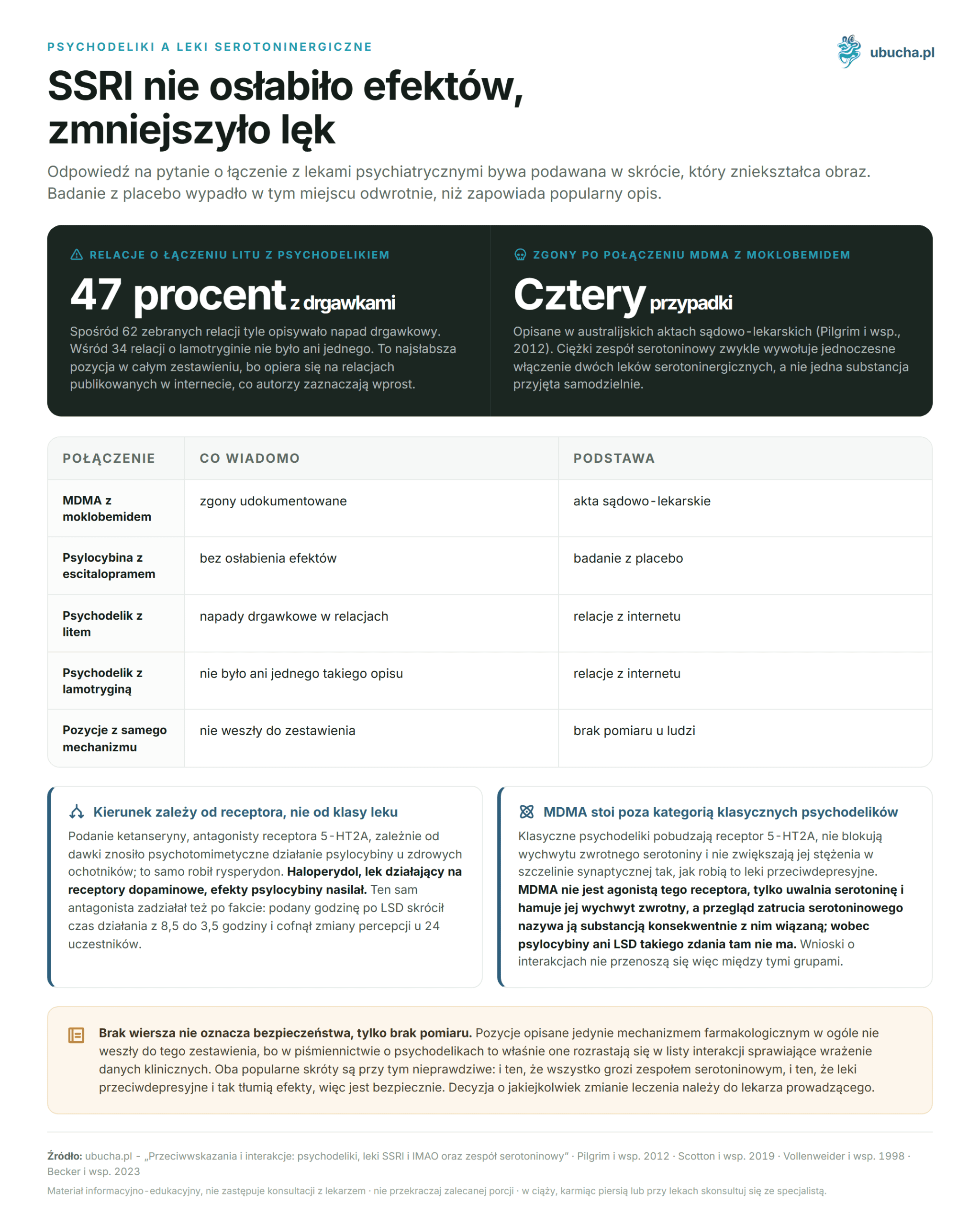
• Four fatalities from serotonin syndrome after combining MDMA with moclobemide were documented in Australian forensic records (Pilgrim et al., Forensic Science International, 2012).
• Severe serotonin syndrome is usually triggered by the simultaneous introduction of two serotonergic drugs, not one substance (Scotton et al., International Journal of Tryptophan Research, 2019).
• In a placebo study, two weeks of escitalopram administration did not weaken the positive effects of psilocybin, but reduced anxiety and side effects.
• Among 62 reports of combining lithium with a psychedelic, 47 percent described a seizure; among 34 reports on lamotrigine, there were no seizures.
How do classic psychedelics affect the serotonin system?
Classic psychedelics, namely psilocybin, LSD, and mescaline, stimulate the serotonin receptor 5-HT2A. They do not block the reuptake of serotonin and do not increase its concentration in the synaptic cleft as antidepressants do. This distinction determines the interaction profile but does not remove these substances from the mechanism of serotonin toxicity.
Evidence that the effect runs through this receptor is direct. Administration of ketanserin, an antagonist of 5-HT2A, depending on the dose, abolished the psychotomimetic effect of psilocybin in healthy volunteers; risperidone did the same. Haloperidol, a drug acting on dopamine receptors, intensified the effects of psilocybin (Vollenweider et al., NeuroReport, 1998). The direction thus depends on which receptor the drug acts on, not whether it is an antipsychotic.
The same antagonist also worked post-factum. In a randomized placebo study involving 24 healthy participants, ketanserin given an hour after LSD shortened the duration of action from 8.5 to 3.5 hours, reversed perceptual changes, and reduced unwanted cardiovascular effects (Becker et al., International Journal of Neuropsychopharmacology, 2023). The authors describe this as a possibility for planned shortening of the session in research conditions.
MDMA stands outside this category. It is not a 5-HT2A agonist; it releases serotonin and inhibits its reuptake. A review of serotonin toxicity consistently associates MDMA with it; there is no such statement in this document regarding psilocybin or LSD. Therefore, conclusions about interactions do not transfer between these two groups.
Which drug combinations with psychedelics are actually documented?
The table below separates two things that are usually placed side by side in guides without distinction: risk confirmed by case reports or measurements in humans and risk derived from the mechanism itself. The decision to change any treatment belongs to the supervising physician, not to the article.
It is worth noting where the boundary of evidence lies in this comparison. The strongest positions are based on forensic records or placebo studies, meaning material where someone counted cases. The weakest is based on reports published on the internet, which the authors explicitly note. Positions described solely by pharmacological mechanism did not enter here at all, as in the literature on psychedelics, they are the ones that grow into lists of interactions that give the impression of clinical data. The absence of a row does not mean safety, only the lack of measurement that could be pointed out.
| Drug or Class | Substance | What is known | Basis |
|---|---|---|---|
| Moclobemide (reversible MAO-A inhibitor) | MDMA | Documented fatalities | Four forensic cases, Australia |
| Irreversible MAO inhibitors | Serotonergic drugs in general | Most severe form of syndrome | Review of serotonin toxicity |
| Lithium | LSD, psilocybin | Seizures | Analysis of 62 internet reports |
| Lamotrigine | LSD, psilocybin | No seizures in the same analysis | 34 reports, zero seizures |
| Escitalopram (SSRI) | Psilocybin | Less anxiety and side effects | Placebo study, crossover design |
| Risperidone, ketanserin | Psilocybin, LSD | Blockade of effects, measured | Studies with antagonist administration |
| Haloperidol | Psilocybin | Intensification of effects, not blockade | Study from 1998 |
| Tramadol, triptans, dextromethorphan | Serotonergic drugs and supplements | Described as a source of toxicity | Review of serotonin toxicity |
What is serotonin syndrome and when should help be called?
Serotonin syndrome is a drug-induced condition that can be life-threatening, caused by excessive serotonergic activity in the central and peripheral nervous systems. It is diagnosed by three groups of symptoms: changes in mental state, neuromuscular hyperactivity with tremors, clonus, and increased reflexes, and autonomic instability with fever and rapid heartbeat (Scotton et al., International Journal of Tryptophan Research, 2019).
The same review states that today’s standard for diagnosis is the Hunter criteria, not the older Sternbach criteria; sensitivity is 84 versus 75 percent, and specificity is 97 versus 96 percent. In severe cases, body temperature usually exceeds 41.1 degrees Celsius. Complications described in this form include seizures, kidney failure, metabolic acidosis, rhabdomyolysis, disseminated intravascular coagulation, respiratory failure, and death.
The time of symptom onset is often reported too narrowly. The classic description states symptoms occur within a day of taking the drug, but a meta-analysis of case reports showed that just over 60 percent of patients present within six hours, and about a quarter later than a day. This last group is practically significant: a good first day is not evidence that nothing will happen.
The practical conclusion is one. Fever, muscle rigidity, and tremors with confusion after taking a serotonergic drug are reasons to call an ambulance, not to observe at home. Treatment is conducted in a hospital setting; benzodiazepines are used in the first line to control agitation and suppress the adrenergic component, and in more severe forms, cyproheptadine, a serotonin receptor antagonist. The original clinical description of the syndrome remains the work of Boyer and Shannon (New England Journal of Medicine, 2005).
Do SSRI medications block the effects of psilocybin?
The popular claim is that SSRI medications negate the effects of psilocybin by desensitizing the 5-HT2A receptors. A study that tested this in humans in a placebo setup showed otherwise. In a crossover design with double-blind conditions, healthy volunteers received psilocybin after two weeks of taking escitalopram or placebo. Escitalopram had no significant impact on the positive mood effects, while clearly reducing discomfort, anxiety, unwanted cardiovascular effects, and other side effects (Becker et al., Clinical Pharmacology and Therapeutics, 2022).
The study also measured things that in popular explanations were supposed to be the mechanism. Escitalopram did not change the pharmacokinetics of psilocin, did not change the expression of the 5-HT2A receptor or serotonin transporter, and did not affect the QTc interval. Desensitization of the receptor was therefore not demonstrated here.
The authors themselves note the limitations of this result. The preparation lasted two weeks, and the study involved healthy individuals, not patients treated psychiatrically for months. Studies with a longer duration of antidepressant treatment are needed. The conclusion for the reader, however, is the opposite of the common belief: one must not assume that an antidepressant acts as a safety switch. One must also not discontinue it independently, as interrupting psychiatric treatment is a separate risk, determined solely by a physician.
Why is lithium a separate case?
The signal regarding lithium is the strongest of all the combinations described here, yet it comes from the weakest methodological material. A team from Johns Hopkins analyzed reports published on three websites. Among 62 descriptions of combining lithium with a classic psychedelic, 47 percent contained a seizure, another 18 percent involved a difficult experience, and 39 percent involved contact with medical assistance. Among 34 reports regarding lamotrigine, there was not a single seizure (Nayak et al., Pharmacopsychiatry, 2021).
The authors formulate the conclusion cautiously and state explicitly that this finding is preliminary and requires further research. The mechanism has not been established, so any explanation provided on the internet as a ready biochemical pathway precedes what has been measured.
It is worth noting where the need for this work arose. Individuals with bipolar disorder are excluded from psychedelic research, so data on their safety do not arise in controlled conditions. At the same time, media reports about the effectiveness of psilocybin in depression reach them just as they do to everyone else. The authors turned to internet reports precisely because there is no better material and there will not be for a long time, and the question is real, as some readers will attempt it anyway. The comparison with lamotrigine, for which no seizures were recorded, also shows that the signal does not concern mood stabilizers as a class, but specifically lithium.
Who do research protocols exclude and why?
Safety guidelines for research with hallucinogens in humans list as a safeguard the exclusion of volunteers with a personal or family history of psychotic disorders and other severe mental disorders (Johnson et al., Journal of Psychopharmacology, 2008). The same document describes what the protection is meant to address: the most common threat is overwhelming anxiety during the action of the substance, less often prolonged psychoses.
Familial exclusion is sometimes misunderstood as excessive caution. The sense is different: it concerns susceptibility, which one may not know about oneself until a stimulus acts. The guidelines also list safeguards that have nothing to do with pharmacology but arise from the same risk measurement. These include trust built before the session, a safe environment, and the presence of two people monitoring throughout the action of the substance.
The authors also emphasize the need for follow-up after the study, as some disorders manifest later. They mention a rare perceptual disorder that persists after hallucinogens and recommend actively asking about it during follow-up visits. In Poland, psilocybin, LSD, and MDMA are listed in group I-P of the list of psychotropic substances, and Article 33, paragraph 2 of the Act on Counteracting Drug Addiction allows the use of substances from this group solely for research purposes. Practical questions about availability are described in the text about ketamine therapy in Poland, as ketamine is subject to different regulations.
Which supplements count as serotonergic drugs?
The list of substances taken that a patient provides before qualification may be incomplete precisely in this area. Over-the-counter preparations are not a separate category for the body. A review of serotonin toxicity lists among sources of risk tramadol, triptans used in migraines, and dextromethorphan present in cough syrups.
Separately, it is worth mentioning 5-HTP, a serotonin precursor sold as a supplement for sleep and mood. It increases serotonin production, meaning it acts in the same direction as drugs that inhibit its reuptake or breakdown, and this is precisely the system that classically leads to serotonin toxicity. We elaborated on this in the post about how 5-HTP works and whether it is safe.
The conclusion is not that every supplement is dangerous. The conclusion is that the assessment belongs to a physician or pharmacist who sees the entire list at once, not to summing individual leaflets. Concealing a preparation before qualification does not protect against anything and deprives researchers of the information needed to assess safety. A completely different class of risk is posed by substances prolonging the QT interval, which we describe in the text about ibogaine and its cardiac toxicity.
Frequently Asked Questions
Is psilocybin and SSRI medication a safe combination?
There is no basis to call them safe, nor to repeat that an antidepressant negates the effects of psilocybin. In a placebo study, two weeks of escitalopram did not diminish the positive effects of psilocybin, but reduced anxiety and side effects. The study involved healthy individuals and a short treatment duration, so it does not answer the question for patients.
Why are MAO inhibitors described as the most dangerous?
Because they block the breakdown of serotonin, thus contributing to any other mechanism that increases its activity. A review of serotonin syndrome indicates the combination of an MAO inhibitor, especially one acting on the MAO-A isoform, with a serotonergic drug as particularly dangerous and leading to the most severe form of the syndrome, sometimes fatal.
What symptoms of serotonin syndrome require immediate help?
Fever, muscle rigidity and tremors, increased reflexes, rapid heartbeat, and confusion after taking a serotonergic drug. In severe cases, the temperature exceeds 41.1 degrees Celsius, and complications include rhabdomyolysis, kidney failure, and disseminated intravascular coagulation. This is a condition requiring an ambulance call, not home observation.
Is lithium and psychedelics a dangerous combination?
The available signal is strong, although it comes from internet reports rather than clinical studies. Among 62 reports of combining lithium with a classic psychedelic, 47 percent involved a seizure, and 39 percent involved contact with medical assistance. Among 34 reports on lamotrigine, no seizures were recorded. The authors call this conclusion preliminary.
Do antipsychotics interrupt the effects of psychedelics?
It depends on which one. Risperidone and ketanserin, acting on the 5-HT2A receptor, diminished the effects of psilocybin depending on the dose, while haloperidol intensified them. In a study with LSD, ketanserin given an hour after the substance shortened the duration of action from 8.5 to 3.5 hours, which the authors describe as a possibility for planned interruption of the session in research conditions.
Are antidepressants discontinued before a research session?
This is a decision made by the supervising physician, individually within the study protocol. Independently discontinuing psychiatric treatment is a separate risk, independent of any interaction. No article can replace the assessment of a psychiatrist who knows the full list of medications taken and the course of the illness.
This article is informational and educational. It describes clinical research in which the substance is administered under the supervision of a physician after participant qualification; using these conditions on one’s own does not replicate them. These substances are controlled in Poland under the Act on Counteracting Drug Addiction. If you have suicidal thoughts, call the free, 24-hour numbers 116 123 or 800 70 2222. In life-threatening situations: 112.
Author: Michał Waluk · Published: 2026-08-09 · Updated: 2026-08-16